2015 AUDI A8 towing
[x] Cancel search: towingPage 213 of 312

.... N .... N
0 J:
'SI: .... \!) 1.1'1
.... 1.1'1 ,....,
Trailer load distribution Be sure the load in the trailer is held securely
in place to prevent it from shifting forward,
backward or sideways.
Never allow a passenger to ride in a trailer
¢ .&. in Driving instructions on page 212.
Engine cooling system
Towing a trailer makes the engine work hard
er . It is important that the cooling system's
performance is up to the additional load .
Make sure that the cooling system has enough
fluid.
Tire pressure
When towing a trailer, inflate the tires of your
vehicle to the cold tire pressure listed under
"Full load" on the label located on the driver's
side B-pillar (visible when the door is open).
Inflate trailer tires to trailer and tire manufac
turers' specifications.
Lights
Check to make sure both vehicle and trailer
lights are working properly.
Safety chains Be sure trailer safety chains are properly con
nected from the trailer to the hitch on the ve
hicle . Leave enough slack in the chains to per
mit turning corners . When you install safety
chains, make sure they will not drag on the
road when you are driving.
The chains should cross under the trailer
tongue to prevent it from dropping in case of
separation from the hitch .
Adjusting the Audi drive select Make sure the vehicle is on a level surface
be
fore
hitching up the trailer and before adjust
ing the tongue weight. The vehicle must be in
auto or comfort driving mode and not raised
¢page 108, ~CD .
Make sure that the vehicle is lowered. In Info
tainment, select:
ICARI function button> low
er control button .
Trailer towing 211
If you must drive under poor road conditions,
you can raise the vehicle
after coupling the
trailer or
after adjusting the tongue weight
¢ page 110.
@ Note
- Changes in temperature or load can af
fect the height of the vehicle.
- Always select auto or comfort mode.
Otherwise, the tongue load specified for
your vehicle will no longer be applicable.
Driving instructions
Driving with a trailer always requires extra
core and consideration.
To obtain the best possible handling of vehicle
and trailer, please note the following:
.,. Do not tow a loaded trailer when your car it
self is not loaded .
.,. Be especially careful when passing other
vehicles.
.,. Observe speed limits.
.,. Do not drive at the maximum permissible
speed .
.,. Always apply brakes early .
.,. Monitor the temperature gauge.
Weight distribution
Towing a loaded trailer with an empty car re
sults in a highly unstable distribution of
weight. If this cannot be avoided, drive at very
low speeds only to avoid the risk of losing
steering control.
A "balanced" rig is easier to operate and con
trol. This means that the tow vehicle should be loaded to the extent possible and permissi
ble, while keeping the trailer as light as possi
ble under the circumstances . Whenever possi
ble , transfer some cargo to the luggage com
partment of the tow vehicle while observing
tongue load requirements and vehicle loading
considerations .
Speed
The higher the speed, the more difficult it be
comes for the driver to control the rig. Do not .,.
•
•
Page 214 of 312

212 Trailertowing
drive at the maximum permissible speed. Re
duce your speed even more if load, weather or
wind condit ions are unfavorable -part icu larly
when going downhill.
Reduce vehicle speed
immedi atel y if the trail
er shows the slightest sign of swaying .
Do not
tr y to stop th e sway ing by acceler ating .
Observe speed limi ts. In some areas, speeds
for vehicles towing trailers are lower than for
regular vehicles .
A lways apply brakes early. When driv ing
downhill, shift into a lower gear to use the en
gine braking effect to slow the vehicle . Use of
the brakes a lone can cause them to overheat
and fail.
Coolant t emperature
The coolant temperature gauge¢ page 10
must be observed carefully. The coolant tem
perat ure can increase if you drive on long in
clines in a low gear at high engine speeds. Re
duce your speed immediate ly if the L EDs in
the top part of the display turn on.
F or more in formation about indicator lights,
referto .¢page
15 .
A WARNING
Anyone not properly restrained in a mov
ing veh icle is at a much greater risk in an
accident . Never let anyone ride in your car
who is not properly wear ing the restra ints
provided by Aud i.
Trailer towing tips
Important to know
Your vehicle hand les different ly when towing
-
a trailer because of the addit ional weight and
d ifferent weight distribution . Safety, perform
ance and economy w ill greatly depend on how
carefully you load your trailer and operate
your ng.
Before you actually tow your trailer, practice
turning, stopp ing and back ing up in an area
away from traffic . Keep practicing until you have become completely familiar with the way
your vehicle-trailer combination behaves and responds .
Backing up is diffi cult and requ ires practice .
Backing up with a trailer gene rally req uires
steering action opposite to that when backing
up your vehicle without a tra iler.
Maintain a greater d ista nce between you r ve
hicle and the one in front of you . You wi ll need
more room to stop. To compensate for the
trailer, you w ill need a larger than normal
turning rad ius.
When passing, remember that you cannot ac
ce lerate as fast as you norma lly would be
ca use of the added load. Make sure yo u have
enough room to pass. After passing, allow
plenty of room for your trailer be fore chang
ing lanes again .
Avoid jerky starts, sharp turns or rapid lane changes.
(D Tips
- Do not tow a trailer during the break-in
period of your vehicle .
- If you tow a trailer, your Audi may re
quire more frequent maintenance due to
the extra load¢
page 290.
Parking on a slope
Do not park on a slope with a trailer. If it can
not b e avoided, do so only after doing th e fol
lowing:
When par king:
.,. App ly the foot brake.
.,. Have someone p lace chocks under both the
vehicle and the tra iler wheels .
.,. With chocks in place, slowly release the
brakes unt il the wheel chocks absorb the
load .
.,. Turn the whee ls towards the curb .
.,. Apply the parking brake .
.,. Select the P se lector lever posit ion.
When re starting after parking:
.,. App ly the foot brake.
Page 215 of 312

,....,
N ,....,
N
0 J:
'SI: ,...., \!) 1.1'1 ,...., 1.1'1 ,....,
~ Start the engine.
~ Se lect the D selector lever position.
~ Re lease the park ing brake and slowly pull
out and away from the wheel chocks .
~ Stop and have someone retrieve the wheel
chocks.
(D Tips
If you move the selector lever of the auto
matic transm ission to P before applying
the parking brake and before blocking the
wheels, you may have to use more force
later to move the lever out of the P posi
tion .
Trailer towing 213
•
•
Page 256 of 312

254 Tires and wheels
A WARNING
Overloading a vehicle can cause loss of ve
hicle control, a crash or other accident, se
rious personal injury, and even death.
- Carrying more weight than your vehicle
was designed to carry will prevent the
vehicle from handling properly and in crease the risk of the loss of vehicle con
trol.
- The brakes on a vehicle that has been
overloaded may not be able to stop the
vehicle within a safe distance.
- Tires on a vehicle that has been overload
ed can fail suddenly, including a blowout
and sudden deflation, causing loss of
control and a crash.
- Always make sure that the total load be
ing transported -including the weight of
a trailer hitch and the tongue weight of a
loaded trailer -does not make the vehi
cle heavier than the vehicle's Gross Vehi
cle Weight Rating.
Determining correct load limit
Use the example below to cal
culate the total weight of the
passengers and luggage or oth
er things that you plan to trans
port so that you can make sure
that your vehicle will not be
overloaded.
Steps for Determining
Correct Load Limit
1. Locate the statement "THE
COMBINED WEIGHT OF OC
CUPANTS AND CARGO
SHOULD NEVER EXCEED XXX
KG OR XXX LBS" on your ve
hicle's placard (tire inflation pressure label)
¢ page 249,
fig. 208.
2.
Determine the combined
weight of the driver and pas
sengers that will be riding in
your vehicle.
3. Subtract the combined weight of the driver and pas
sengers from
"XXX" kilo
grams or
"XXX" pounds
shown on the sticker
c> page 249, fig. 208.
4. The resulting figure equals
the available amount of car
go and luggage load capaci
ty. For example, if the
"XXX"
amount equals 1400 lbs.
and there will be five 150
lbs. passengers in your vehi
cle, the amount of available
cargo and luggage load ca
pacity is 650 lbs. (1400-7 SO
(5
X 150) = 650 lbs.)
5. Determine the combined weight of luggage and cargo
being loaded on the vehicle.
That weight may not safely
exceed the available cargo
and luggage load capacity
calculated in Step 4.
6. If your vehicle will be towing
a trailer, load from your trail
er will be transferred to your .,.
Page 269 of 312

.... N .... N
0 J:
'
"' ....
Vehicle tool kit
Vehicle tool kit and jack
The vehicle tool kit is located in the luggage
compartment under the cargo floor cover.
Fi g. 217 Luggage compartment: cargo floor cover
folded upward
Fig. 218 Trunk lid: Vehicle too l ki t
.. Lift the cargo floor by the plastic handle.
.. Hook the handle into the luggage compart
ment weather strip ¢
fig. 217.
.. Remove the spare wheel to reach the vehicle
tool kit .
.. Remove the foam p iece.
The onboard tool kit includes:
- Hooks to remove the wheel
covers* or wheel
hub covers
- Plastic hook to
remove wheel bolt covers*
- Wheel bolt wrench
- Al ignment p in for changing wheels
- Screwdriver with reversible blade
- Towing loop
- Jack
Before storing the jack, make sure it is wound
back down as far as it will go.
What do I d o now ? 267
A WARNING
Im proper use of the vehicle jack can cause
serious personal injur ies.
- Never use the screw driver hex head to
tighten wheel bolts, since the bolts can
not attain the necessary tighten ing tor
que if you use the hex head, potentially
causing an accident.
- The factory-supplied jack is intended on
ly for yo ur vehicle model. Under no c ir
cumstances should it be used to lift heavy veh icles or other loads; you risk in
ju ring yo urself.
- Never start the engine when the vehicle
is raised, wh ich could cause an acc ident.
- Support the vehicle securely with appro
priate stands if work is to be performed
underneath the vehicle; otherwise, there
is a potentia l risk for injury.
- Never use the jack supplied wit h your
Audi on another vehicle, particularly on a
heavier one. The jack is only s uitable for
use on the vehicle it came with.
(D Tips
-Some of the onboard items listed above
are provided on certain models only or
are optional ext ras .
- Before yo u can raise your vehicle using
the jack, you must activate the jacking
mode
¢page 272 .
Page 271 of 312

.... N .... N
0 J:
-
"' ....
Spare wheel
Applies to vehicles: with spare wheel
The spare wheel is stored in the wheel well
underneath the floor panel in the luggage
compartment.
F ig. 220 Luggag e co mpartm ent : spar e wh eel
Taking out the sp are whee l
• Lift the cargo floor by the plast ic handle
c:::>fig . 220.
• Hook the hand le into the luggage compart
ment weather strip .
• Turn the large screw
c:::> fig. 220 counter
clockwise.
• Takeout the spare tire.
• Always store the vehicle tool kit , the jack*
and the replaced tire in the luggage com
partment
c:::> page 139 .
• Unhook the ca rgo floor before closing the
rear lid.
& WARNING
-
Loose items in the passenger compart
ment can cause serious pe rsonal in jury
during hard braking or in an accident.
- Never store the spare wheel or jack and
tools in the passenger compartment.
@ Tips
Check the inflat ion p ressu re of the spare
tire periodically to keep the tire ready for
use.
What do I d o now ? 269
Changing a wheel
Before changing a wheel
Observe the following precautions for your
own and your passenger's safety when chang
ing a wheel.
• After you experience a t ire failure, pull the
car well away from moving traffic and try to
reach
leve l ground before you stop c:::> ,&.
• All passengers should le av e t he ca r and
move to a safe location (for ins tance, behind
t he guardra il)
c:::> ,& .
• Engage the parki ng br ake to prevent your
vehicle from rolling unintentionally
c:::> ,& .
• Move sele ctor lever to po sit ion P c:::> ,&. .
• If you are towing a trailer, unhitch the trailer
from your ve hicle.
• Take the
jac k and the sp are tire out of the
luggage compartment
c:::> page 267,
c:::> page 268 .
& WARNING
You o r you r passengers could be i njured
while changing a wheel if you do not fo l
low these safety precaut ions:
-I f you have a flat tire, move a safe d is
tance off the road. Turn off the engine,
turn the eme rgency flashers on and use
other warning devices to a lert other mo
torists .
- Make sure that passengers wait in a safe
place away from the vehicle and well
away from the road and traffic.
- To help prevent the vehicle from moving
suddenly and possibly slipping off the
jack, always f ully set the parking brake
and b lock the wheel d iagonally opposite
the wheel be ing changed. When one
front wheel is lifted off the ground, plac ing the Automatic Transmission in "P"
(Par k) will
not prevent the vehicle from
mov ing .
- Before you change a wheel, be sure the
ground is level and firm. If necessary,
use a sturdy board under the jac k.
-
Page 283 of 312

.... N .... N
0 J:
'SI: .... \!) ..,.,
.... ..,., ,....,
Emergency situations
General
This chapter i s intended for trained emer
gency crews and working personnel who have the necessary tools and equipment to
perform these operations.
Starting by pushing or
towing
(D Note
Ve hicles w ith an au tomatic tra nsmission
cannot be started by pus hing o r tow ing.
Starting with jumper
cables
If necessary, the engine can be started by
connecting it to the battery of another vehi
cle.
If the engine shou ld fail to start because of a
discha rged o r wea k battery, the battery can be
connected to the battery o f
another vehicle,
using a
pair of jumper cables to start the en
g ine.
Jumper cables
Use only jumper cables of sufficiently la rge
c ross section to carry the starter c urrent safe
l y. Refer to the man ufacturer's specifications.
Use only jumper cables with
insulated te rm i
na l clamps wh ic h are d istinctly marked:
plus(+) cable i n mos t cases co lore d red
minu s(-) cable
in most cases colored black .
A WARNING
Batterie s contain e lec tricity, ac id, an d gas.
A ny of these can cause ve ry ser io us or fatal
inju ry. Follow the instructions below f or
safe han dling of your veh icle's b attery .
- Alway s shield you r eyes and avoid lean
ing over the bat te ry whenever possib le.
- A dis ch arged battery c an free ze at tem
peratures ju st be low 32 °F ( 0 °C ). Befo re
Emergency situations 281
connecting a jumpe r cab le, you must
thaw the fr ozen battery c omp lete ly, ot h
erwise it could explode.
- Do not allow battery acid to contact eyes
or skin. Fl ush any contacted area with
wate r immediately.
- Improper use of a booster battery to start a vehicle may cause an explosion.
- Vehicle batter ies genera te exp losive gas
es. Keep spar ks, flame and lighted c iga
rettes away from batte ries.
- Do not try to jump start any ve hicle w ith
a low ac id leve l in the battery.
- The vo ltage of the booste r batte ry m ust
a lso have a 12-Vol t rating. T he capacity
(Ah) of the booster battery sho uld not be
lowe r tha n that of the discharged bat
tery . Use of batte rie s of d iffe ren t voltage
or substantially diffe rent "Ah" rat ing
may c au se an exp losion and persona l in
JU ry.
- N ever cha rge a fro zen battery. Gas trap
pe d in the ice may cause a n ex plosion.
- Never cha rge or use a batte ry tha t h as
been fr ozen. T he battery case may have
be weakened.
- Us e of b atter ies of differe nt voltage or
sub stant ia lly diffe ren t ca pa city (Ah) ra t
i ng may c ause an ex plosion an d injury .
Th e capac ity (Ah) of the booster bat tery
should not be lower than that of the dis
charged batte ry .
- Before you chec k any thing in the engine
compa rtment, always read and hee d all
WARNINGS¢
page 22 8.
(D Note
- App lyin g a higher vo ltage booster ba t
t ery w ill cause expens ive damage to se n
sit ive e lectronic com ponents, such as
cont ro l units, relays, rad io, etc.
- The re must be no electrical contact be
tween the vehicles as ot herwise c urrent
co uld a lready start to f low as soon as the
p o sit ive(+) term inals a re connected. ..,. •
•
Page 285 of 312
-When connecting jumper cables, make
sure that they cannot get caught in any
moving parts in the eng ine compart
ment .
- Before you check anything in the engine
compartment, always read and heed all
WARNINGS ¢
page 228.
(D Note
Improper hook-up of jumper cables can r u
in the generator.
- Always connect POSITIVE( +) to POSI
TIVE(+), and NEGATIVE(-) to NEGATIVE
( - ) gro und post of the battery manager
control unit .
- Check that all screw plugs on the battery
cells a re screwed in firmly . If not, tighten
pl ugs p rior to connecting clamp on nega
tive battery term inal.
- Please note that the procedure f or con
nect ing a jump er cable as desc ribed
above appl ies spec ifically to the case of
you r vehi cle be ing jump started. When
you are giv ing a jump star t to an othe r ve
hi cle, do
not connec t the negat ive (-) ca
ble to the negat ive (-) terminal on the
discharged battery @¢
fig. 236. In
stead, securely connect the negative( -)
cable to e ithe r a solid metal component
that is firmly bolted to the engine block
or to the e ng ine block itse lf. If the bat
te ry tha t is being charged does not vent
to the outside, escaping batte ry gas
could igni te and exp lode!
Emergency towing
with commercial tow truck
General hints
Your Audi requires special handling for tow
tng.
The follow ing information is to be used by
commercia l tow tr uck operators who know
h ow to ope rate thei r equipme nt safe ly.
Emergenc y situ ation s 283
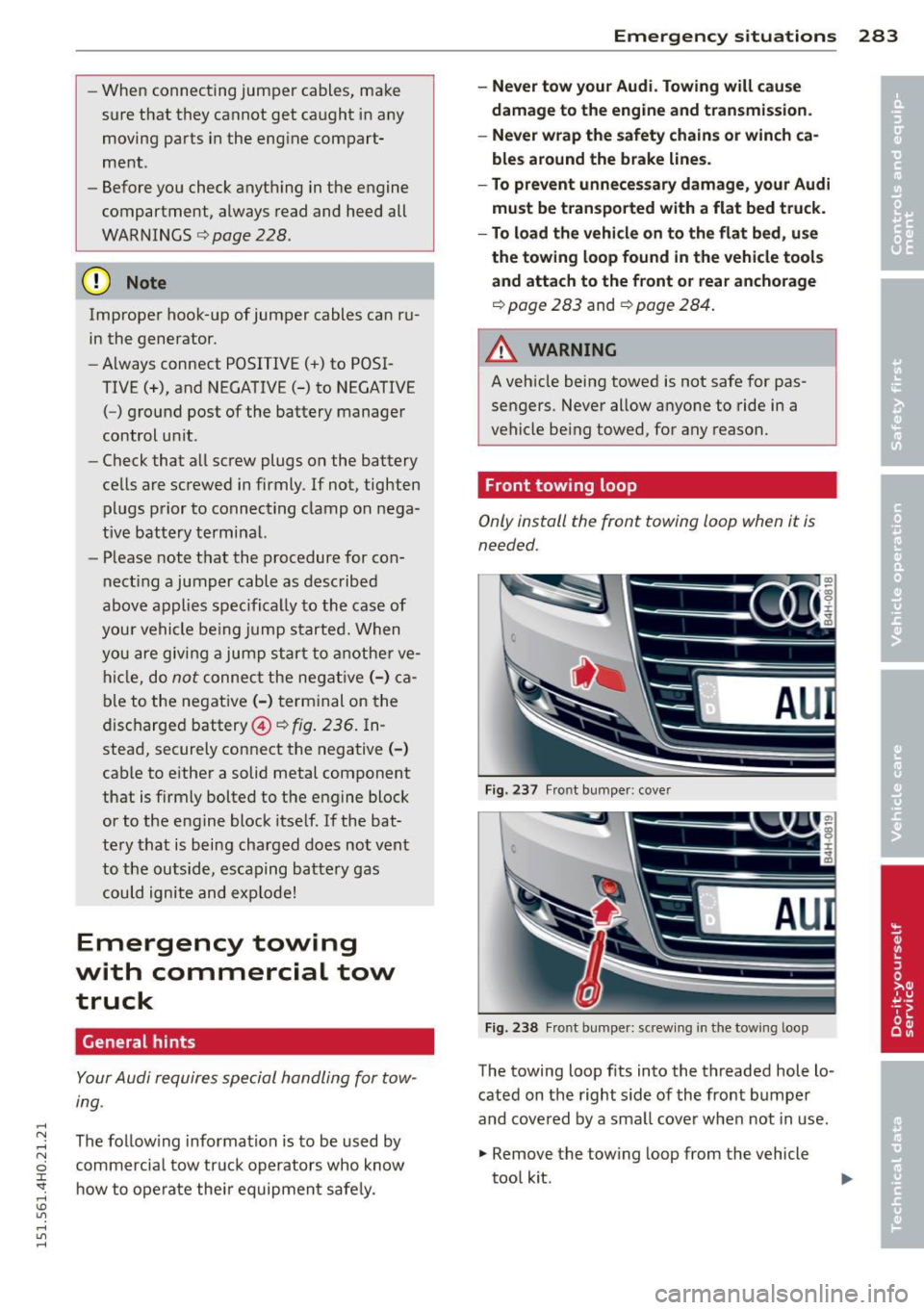
-Ne ver tow your Audi. Towing will cause
damage to the engine and tran smission.
- Never wrap the safety chain s or w inch ca
ble s around the brake lines.
- To prevent unnece ssary damage , your Audi
must be transported with a flat bed tru ck.
- To load the vehicle on to the fl at bed , use
the towing loop found in the vehicle tools
a nd attach to the front or rear anchora ge
¢ page 283 and ¢ page 284 .
_& WARNING
A vehicle being towed is not safe for pas
sengers. Never allow anyo ne to ride in a
vehicle be ing towed, for any reason.
Front towing loop
Only install the front towing loop when it is
needed.
Fig. 237 Fr ont bu mpe r: cove r
Fig. 238 Fr ont bu mpe r: sc rew ing in t he tow ing loop
-
The towing loop f its into the threaded hole lo
cated on the right s ide of the front bumpe r
and cove red by a sma ll cove r when not in use .
.. Remove the tow ing loop from the vehicle
too l kit .