2015 AUDI A4 emergency
[x] Cancel search: emergencyPage 230 of 304

228 Tires an d whee ls
and make of tire and the tread
pattern.
Hidden damage
Damage to tires and rims is of
ten not readily visible. If you
notice unusua l vibration or the
vehicle pulls to one side, this may indicate that one of the
t ires has been damaged . The
tires must be checked immedi
ately by an authorized Audi
dealer or qualified workshop .
Unidirectional tires
A unidirectional tire can be
identified by arrows on the
sidewall, that point in the direc
tion the tire is designed to ro
tate. You must follow the speci
fied direction of rotation. This is
necessary so that these tires
can develop their optimum
characteristics regarding grip,
road noise, wear and hydro
planing resistance. For more in
formation
c:> page 267 .
&_ WAR NIN G
New tires or tires that are
old, worn or damaged cannot provide maximum control
and braking ability. -
New tires tend to be slip
pery and must also be bro
ken-in. To reduce the risk of losing control, a collision
and serious personal inju
ries, drive with special care
for the first 350 miles (560 km).
-Driving with worn or dam
aged tires can lead to loss of
control, sudden tire failure,
including a blowout and
sudden deflation, crashes
and serious personal inju
ries. Have worn or damaged
tires replaced immediately.
- Tires age even if they are
not being used and can fail
suddenly, especially at high
speeds . Tires that are more
than 6 years old can only be
used in an emergency and
then with special care and at low speed.
-Never mount used tires on
your vehicle if you are not sure of their "previous histo
ry." Old used tires may have
been damaged even though
the damage cannot be seen
that can lead to sudden tire
failure and loss of vehic le
control.
...
Page 249 of 304

Incorrect wheel alignment
Incorrect wheel alignment can
cause excessive tire wear, im
pairing the safety of the vehi
cle. If tires show excessive
wear, have the wheel alignment checked by an authorized Audi
dealer or qualified workshop.
All wheel drive
Vehicles with quattro must al
ways have tires of the same size, construction and tread
type. For details see
¢ page 190 .
A WARNING
Sudden tire failure can lead
to loss of control, a crash and
serious personal injury!
-Never drive a vehicle when the tread on any tire is worn
down to the wear indica
tors.
-Worn tires are a safety haz ard, they do not grip well on
wet roads and increase your risk of "hydroplaning" and
loss of control.
- Always keep chemicals that
can cause tire damage, such
as grease, oil, gasoline and brake fluid away from tires.
-
Tires and wheels 24 7
-Tires age even if they are not being used and can fail
suddenly, especially at high
speeds. Tires that are more
than 6 years old can only be
used in an emergency and
then with special care and at lower speeds.
-Never mount used tires on your vehicle if you are not
sure of their "previous histo ry ." Old used tires may have
been damaged even though
the damage cannot be seen
that can lead to sudden tire
failure and loss of vehicle
control.
•
•
'
Page 254 of 304

252 Tires and wheels
Maximum Permissible
Inflation Pressure
This number is the greatest
amount of air pressure that
should ever be put in the tire
under normal driving condi
tions.
.&_ WARNING
-Using incorrect or unmatch ed tires and/ or wheels or improper tire and wheel
combinations can lead to loss of control, collision and
serious personal injury.
-Always use tires, rims and wheel bolts that meet the
specifications of original
factory-installed tires or
other combinations that have been specifically ap
proved by the vehicle manu
facturer.
-Tires age even if they are
not being used and can fail
suddenly, especially at high
speeds. Tires that are more
than 6 years old can only be used in an emergency and
then with special care and
at lower speeds.
-Never mount used tires on your vehicle if you are not sure of their "previous
histo
ry." Old used tires may have
been damaged even though
the damage cannot be seen
that can lead to sudden tire
failure and loss of vehicle
control.
-All four wheels must be fit ted with radial tires of the
same type, size (rolling cir
cumference) and the same
tread pattern. Driving with different tires reduces vehi
cle handling and can lead to
a loss of control.
-If the spare tire is not the
same as the tires that are
mounted on the vehicle -for
example with winter tires -
only use the spare tire for a
short period of time and
drive with extra care. Refit
the normal road wheel as soon as safely possible.
-Never drive faster than the maximum speed for which
the tires on your vehicle are
rated because tires that are
driven faster than their rat
ed speed can fail suddenly.
-Overloading tires cause heat build-up, sudden tire fail
ure, including a blowout
..
Page 264 of 304

262 What do I do now ?
• Always store the vehicle tool kit, the jack *
and the replaced tire in the luggage com
partment ¢
page 132.
Stowing the infl atable spare tir e
• Release the air by unscrew ing the va lve
stem.
• Screw the valve stem back in afterwards.
• Wait a few hours before p lacing the wheel in
the spare wheel well¢.&_ .
• Secure the wheel with the large screw.
• Fold the cargo floor back down.
Aft er usi ng th e inflat able sp are wh eel
The inflatable spare tire can be re-used as
long as it is not damaged and is not worn
down to the tread wear indicators¢&. .
When you let the air out of the inflatable
spare tire, it does not assume its folded shape
again for several hours . Until then, it cannot
be p laced back in the spare wheel well and
stowed securely .
A WARNING
-Never use the spare tire if it is damaged
or if it is worn down to the tread wear in
dicators.
- If the inflatable spare tire is more than 6
years old, use it only in an emergency and w ith extreme caut ion and caref ul
dr iv ing .
- The inflatable spare tire is intended only
for temporary and short-term use.
It
should be replaced as soon as possible
with the norma l wheel and tire.
- T he tire pressure value for the inflatable
spare t ire is located on the drive r's side
8 -pilla r
¢page 234, fig. 190.
-Maximum perm iss ible speed is SO mph
(80 km/h).
- Avoid full-throttle acce le rat ion, heavy
braking, and fast corner ing.
- When the air is let out of the inflatable
spare wheel, it does not ass ume its fold
ed shape for severa l hours. Until t hen, it
cannot be p laced back in the spare wheel
we ll and stowed secu rely . -
Never drive with more than one inflata
ble spare tire.
- For technical reasons, the use of tire
chains on the inflatable spare tire is not
perm itted. If it is necessary to drive with
tire chains, the inflatab le spare wheel
must be mounted on the rear axle in the
event of a f lat in a front tire . The newly
availab le rear whee l must then be instal
led in place of the front whee l with the
f lat t ire. Instal ling the tire chain before
mount ing the wheel and tire is recom
mended .
- L oose items in the passenger compart
ment can cause serious personal injury
during hard braking or in an accident.
Never store the inflatable spare tire or
jack* and too ls in the passenger com
partment.
(D Note
- The inflatable spa re tire has been deve l
oped specifically for this vehicle mode l.
It must not be exchanged or used for
other vehicle models. Sim ilarly, inflata
ble t ires from other vehicle models must
not be used.
- Normal summer or w inter tires must not
be installed on the inflatable t ire rim.
Inflating inflatable
spare tire
Applies to veh icles: w ith inflatable spare t ire
F ig. 199 Lu gg age compart ment: co mpressor
• Remove the cover for the veh icle tools and
remove the compressor. For some vehicle
models, the compressor is located i n a hold-
er under the spare tire . .,.
Page 276 of 304

2 7 4 Emergency situations
Emergency situations
General
This chapter is intended for trained emer
gency crews and working per sonnel who
have the necessary tools and equ ipment to
perform these ope rations.
Starting by pushing or
towing
Q;) Note
Vehicle s with an automati c transmission
cannot be started by pushing or towing .
Starting with jumper
cables
If necessary, the engine can be started by
connecting it to the battery of another vehi
cle.
If the engine should fail to start because of a
discha rged or wea k batte ry, the battery can be
connected to the battery o f
another vehicle,
using a
pair of jumper cables to start the en
g ine .
Jumper cables
Use only jumper cab les of sufficiently
large cross section to carry the starter cur rent
safely. Refer to the manufact urer's spec ifica
ti ons.
Use on ly jumper cables with
insulated te rmi
na l clamps wh ic h are d istinctly mar ked :
plus (+) cable in most c ases co lore d red
minu s (-) cable
in most cases colored black .
A WARNING
Batterie s cont ain e lec tricity, a cid, a nd gas.
A ny o f these c an ca use ve ry ser io us or f atal
in ju ry . F ollow the i nstruc tio ns below for
safe ha ndling of your ve hicle's bat tery.
- Alw ay s sh ield yo ur eye s and a vo id le an
ing over the batte ry w henever p ossib le . -
A discharged battery can freeze at tem
pe rat ures just below 32 °F (0 °C). Before
connecting a jumper cable, you must
thaw the fr ozen battery complete ly , ot h
e rwise it cou ld explode.
- Do not allow batte ry acid to contact eyes
or skin . Fl ush any contacted a rea wi th
wate r im media tely.
- Imp roper use of a booster battery to
s tart a vehicle may cause an explosion.
- Vehicle batter ies generate explosive gas
es . Keep sparks, flame and lighted ciga
rettes away from ba tte ries .
- Do not try to jump start a ny ve hicle w ith
a low ac id leve l in the battery .
- The vo ltage of the booster batte ry m ust
a lso have a 12-Vo lt rat ing . The capacity
(A h) of the booster batte ry should not b e
lowe r than that of the discharged bat
tery . U se o f batt erie s of d iffe ren t voltage
or subs tanti ally diffe ren t "Ah" rat ing
may c ause an exp losion and person al in
ju ry .
- N ever ch arge a fr ozen bat te ry. Gas t rap
ped in the ice may ca use an ex plosion .
- N ever ch arge o r use a batt ery th at has
been fro zen. T he battery case may have
be weakened.
- Us e of batt erie s of di ffere nt vo ltag e or
substan tially differen t ca pa city (Ah) rat
i ng may cause an exp losion and injury.
T he capac ity (Ah) of the booster battery
should not be lower than that of the dis
charged batte ry.
- Before you check anything in the engine
compartment, always read and heed a ll
W ARNI NGS¢
page 212.
(D Note
- App lyi ng a hig her voltage booste r bat
tery wi ll cause expens ive damage to sen
sitive e lectronic components, such as
cont ro l units, relays, rad io, etc.
- There must be no electrical contact be twee n the vehicles as otherwise current
co uld already start to f low as soon as t he
posi tive(+) terminals a re con nected . ..,.
Page 277 of 304

M N
~ co
rl I.O
"' rl
"' rl
@ Tips
The discharged battery must be properly
connected to the vehicle's electrical sys
tem. When jump starting or charg ing the
battery, never connect the negative
ground cable to the battery negat ive post
because the ba ttery manager system must
be ab le to detect the battery's state of
charge. Always connect the negative
g round cab le to the negative ground pos t
of t he battery manager cont ro l unit.
Use of jumper cables
Make sure to connect the jumper coble
clomps in exactly the order described b elow!
Fi g. 21 1 Eng ine co mpar tment: Co nnecto rs fo r jum per
c ab les a nd c har ge r
F ig. 212 Jump start in g w ith t he ba ttery of a not her ve ·
hi cle :@ booster battery, @ disc harged veh icle battery
The procedure described below for connecting
jumper cables is intended to provide a jump
start for your veh icle .
Vehicle with di scharged battery :
~Turnoff lights and accessories , move lever
of automatic transmission to N (Neutral) or P (Park) and set parking brake .
Emergency situ ation s 2 7 5
Connect POSITIVE(+) to POSITIVE(+ )
(red )
~ Remove the cover above the jump start con
nection .
~ Open the cover on the positive pole
¢fig . 211 .
1. Connect one end of the red positive cable
on the
jump sta rt bolt c::;, fig. 212 (D
(Bolts under cove r= "posit ive ") of the ve
hicle to be started @.
2 . Conne ct the othe r end to the pos itive ter -
mina l@ of the booster battery @.
Connect NEGATIVE (-) to NEGATIVE (-)
(black )
3. Co nnect one end o f the b lack neg ative c a
ble to the nega tive te rmi na l@ of the
booster battery @.
4 . Connect the other end to the
jump start
bolt @
(Bolts with hex head = "negative")
of the vehicle to be started @.
Starting the engine
~ Start the engine of the ve hicle with the
booste r battery @. Run the engine at a
moderate speed.
~ Start engine with d ischarged vehicle battery
® in the usual manner .
~ If the engine fails to start: do not keep t he
starter cran king for lo nger than 10 seconds .
Wait for about 30 seco nds and the n try
aga in.
~ W ith engi ne runni ng, remove jumpe r cab les
from both vehicles in the exa ct
reverse o r
der .
~ Close the cover on the positive pole .
T he b attery is vented to the o utside to p reven t
gases from en tering the veh icle in ter ior . Ma ke
s ur e that the j umper clamps a re well connect
e d with their
metal ports in full contact with
the batte ry term inals.
A WARNING
To avoid serious personal injury and dam
age to the vehicle, heed all warnings and
in structions of the jumper cable ma nufac-
turer . If i n dou bt, call for road servic e.
Ill>
Page 278 of 304

2 76 Em ergency sit uat ions
-Jumper cables must be long enough so
that the vehicles do not touch.
- When connecting jumper cables, make
sure that they cannot get caught in any
moving parts in the eng ine compart
ment.
- Do not bend over the batteries - danger of chemical burns!
- The battery ce ll locking screws must be
tightened securely .
- Before you check anything in the engine
compartment, always read and heed all
WARNINGS
9 page 212.
Improper hook-up of jumper cables can ru
in the generator.
- Always connect POSITIVE( +) to POS I
TIVE(+), and NEGATIVE( -) to NEGATIVE
( - ) ground post of the battery manager
control unit.
- Check that a ll screw plugs on the battery
cells are screwed in firmly . If not, tighten
plugs p rior to connecting clamp on nega
tive battery terminal.
- Please note that the procedure for con nect ing a jumper cable as described
above applies spec ifically to the case of
your vehicle being jump started. When
you are giving a jump start to another ve hicle, do
not connect the negat ive( -) ca
ble to the negat ive (-) term inal on the
discharged battery@)
9fig. 212. In
stead, securely connect the negative(- )
cable to e ither a solid metal component
that is firm ly bolted to the engine block
or to the engine block itself. If the bat
tery that is being charged does not vent
to the outside, escaping battery gas
could ignite and explode!
Emergency towing
with commercial tow
truck
General hints
Your Audi requires special handling for tow
ing.
T he following information is to be used by
commercial tow truck operators who know
how to operate their equipment safely.
- Nev er tow your Audi , towing will cau se
damage to the engine and tr an smi ssion .
- Ne ver wrap th e safety chain s or winch ca
ble s around the brak e lines.
- To pre vent unne ce ss ary dam age, your Audi
mus t be tr an sp o rt ed with a flat bed tru ck.
- To load th e vehicle on to th e flat b ed, use
the towing l oop found in t he vehicle to ols
a nd att ach to th e front or rea r a nchor age
c;,page 277 and c;,page 277 .
& WARNING
= -
A vehicle being towed is not safe for pas-
sengers. Never allow anyone to ride in a
vehicle being towed, for any reason.
Page 280 of 304
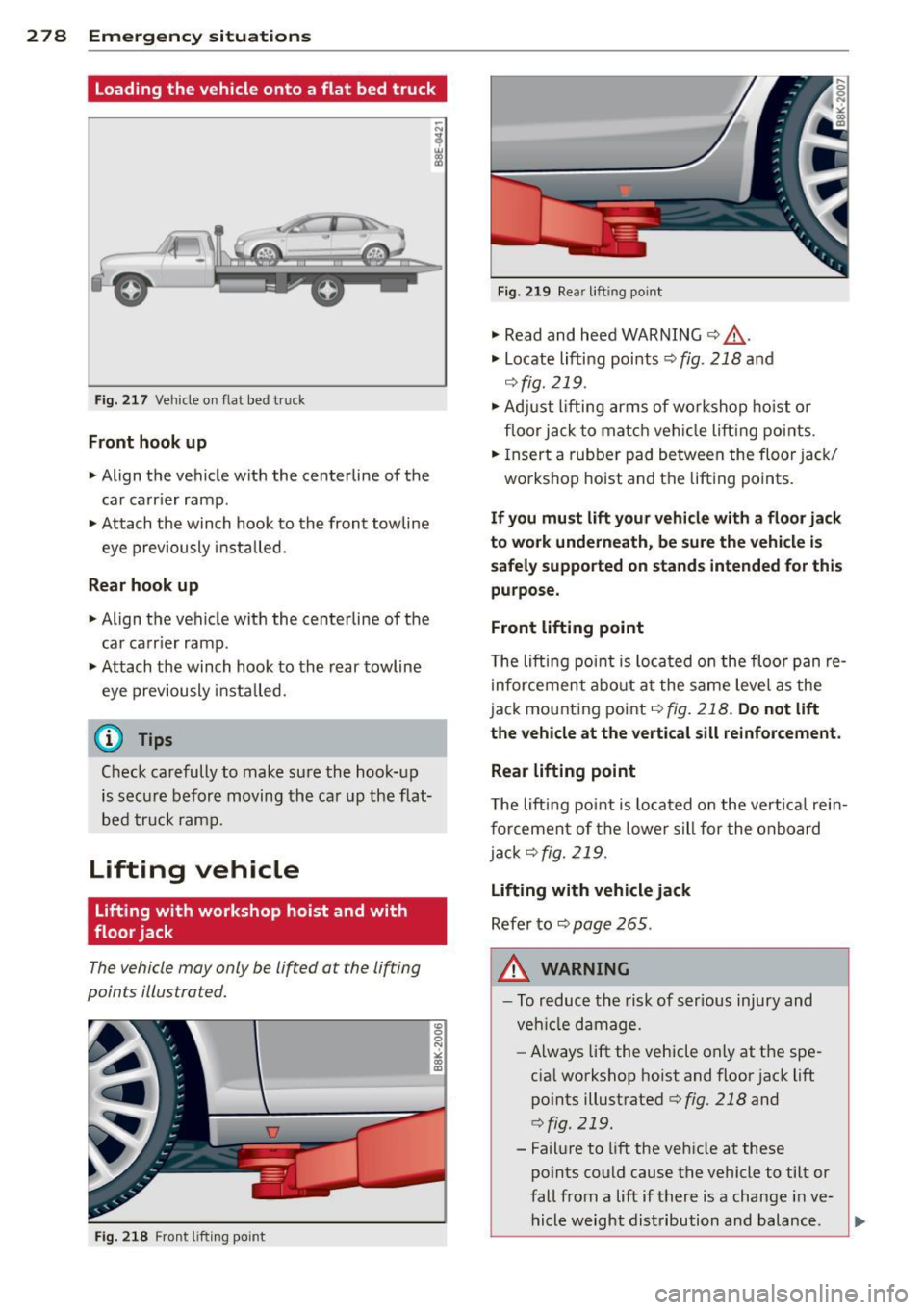
2 78 Emergency situations
loading the vehicle onto a flat bed truck
Fig. 217 Vehicle on flat bed tr uck
Front hook up
• Align the vehicle with the centerline of the
car carr ier ramp .
• Attach the winch hook to the front towline
eye previously insta lled .
Rear hook up
• Align the vehicle with the centerline of the
car carr ier ramp.
• Attach the winch hook to the rear towline
eye previously insta lled.
@ Tips
Check carefully to make sure the hook-up
is secure before moving the car up the flat·
bed truck ramp .
Lifting vehicle
lifting with workshop hoist and with
floor jack
The vehicle may only be li~ed at the lifting
points illustrated.
Fig. 218 Front lift ing po int
:g 0 N
" O> a,
Fig. 219 Rear lifting point
• Read and heed WARNING ¢ &_ .
• Locate lifting points r::!> fig . 218 and
¢ fig. 219 .
• Adjust lifting arms of workshop hoist or
floor jack to match vehicle lifting points .
• Insert a rubber pad between the floor jack/
workshop hoist and the lifting points.
If you must lift your vehicle with a floor jack
to work underneath, be sure the vehicle is
safely supported on stands intended for this
purpose.
Front lifting point
The lifting point is located on the floor pan re
i nforcement about at the same leve l as the
jack mounting point
¢ fig. 218. Do not lift
the vehicle at the vertical sill reinforcement.
Rear lifting point
The lifting point is located on the vert ical rein
forcement of the lower sill for the onboard
jack ¢
fig. 219 .
lifting with vehicle jack
Refer to r:!> page 265 .
A WARNING
= -
-To reduce the risk of ser ious injury and
veh icle damage.
- Always lift the vehicle only at the spe
cial workshop hoist and floor jack lift
points illustrated
¢ fig. 218 and
¢ fig. 219.
- Failure to lift the vehicle at these
points could cause the vehicle to tilt or
fall from a lift if there is a change in ve-
hicle weight distribution and balance.
~