2015 AUDI A3 checking oil
[x] Cancel search: checking oilPage 221 of 288
Brake fluid
Checking brake fluid level
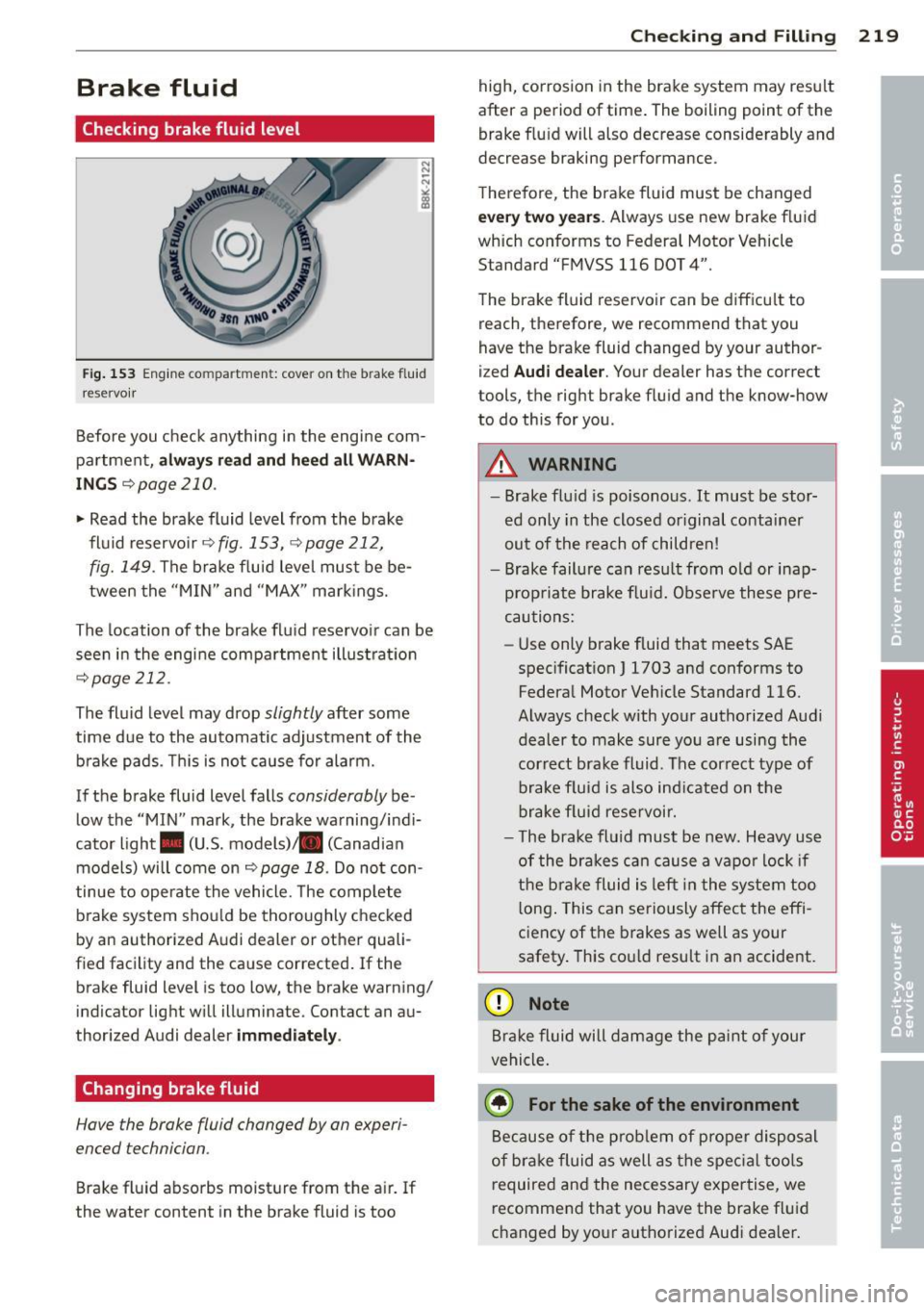
Fig . 153 Engine co mpa rtment: cove r on the b rake f lu id
reservo ir
B efore you check anything in the engi ne com
partment,
alwa ys read and heed all WARN ·
INGS r:=:,page 210 .
~ Read the brak e fluid level from the brake
fluid reservo ir
r:=;, fig . 153, r:=:, page 212,
fig. 149 .
The brake f luid leve l mus t be be
tween the "MIN" and "MAX " ma rkings.
The location of the brake flu id reservo ir can be
seen in the engi ne compa rtment illust ra ti on
¢ page 212 .
The fluid level may drop slightly after some
time due to the automatic adjustment of the b rake pads . Thi s is not cause for alarm.
If the brake fluid level falls
considerably be
low the "MIN" mark, the b rake wa rning/ind i
cato r light . (U .S . models)/ . (Canadian
models) will come on
r:=;, page 18 . Do not con
tinue to operate the vehicle. The comp lete
brake system should be thoroughly checked
by an authorized A udi dealer or other quali
f ied fac ility and the ca use corrected . If the
br ake fluid level is too low, the brake warning/
indica tor light w ill illuminate. Contact an au·
thor ized Audi dealer
immediately .
Changing brake fluid
Have the brake fluid changed by an experi
enced technician .
Brake fluid abso rbs moist ure from the air. If
the water content in the brake fluid is too
Che cking and Fillin g 219
high, co rrosion in the brake system may resu lt
after a period of time . The boiling point of the
brake f lu id will also decrease conside rably and
decrease braking performance.
T herefore, the brake fluid must be changed
eve ry two year s. Always use new brake f luid
which conforms to Federal Motor Veh icle
Standard "FMVSS 116 DOT 4".
The brake fluid reservoi r can be difficu lt to
reach, therefore, we recomm end that you
have the brake fluid changed by your author
i z ed
Audi dealer . Your dealer has the correct
tools, the right brake flu id and the know-how
to do this for you .
A WARNING
-
-Brake flu id is poisonous. It must be stor-
ed only in the closed or iginal containe r
out of the rea ch of children!
- Brake failure can resu lt from o ld or inap
p rop riate brake f lu id. Observe these pre
cautions:
- Use only brake f luid that meets SAE
spec ificat ion
J 1703 and conforms to
Federa l Motor Ve hicle Standard 116.
Always check with your authorized Audi
dealer to make sure yo u are using the
cor rect bra ke fluid. The cor rect type of
brake f luid is also i nd icated on t he
brake f lui d rese rvoir.
- The bra ke flu id must be new. Heavy us e
of the brake s can cause a vapo r lock if
the b ra ke fluid is left i n the system too
l ong . This can se riously affect the effi
ciency of the brakes as we ll as your
safety . This co uld resu lt i n an accident .
(D Note
Brak e fluid will dam age the pa int of your
vehicle .
@ For the sake of the environment
Because of the p rob lem of proper disposal
o f bra ke fluid as well as the spec ial too ls
r equired and the necessary exper tise, we
recommend that yo u have the brake flu id
changed by yo ur authorized Audi dea ler.
Page 244 of 288

24 2 T ire s and wheel s
Where snow chains are mandatory oncer
tain roads, this normally also applies to
veh icles with all-wheel dr ive.
Wheel bolts
Wheel bolts must always be tightened to the
correct torque.
The design o f whee l bolts is matched to the
factory installed rims . If different rims are fit
ted, the correct wheel bolts with the right
length and correctly shaped bolt heads must
be used. This ensures that wheels are fitted
securely and that the brake system functions
correctly .
In certain circumstances, you may not use
wheel bolts from a different vehicle -even if it
is the same model
r=> page 270.
A WARNING
Improperly tightened or maintained wheel
bolts can become loose caus ing loss of
c ont ro l, a co llision and serious persona l in
Jury .
- Always keep the wheel bolts and the
threads in the wheel hubs clea n so the
wheel bolts can turn easily and be prop er ly t igh tened .
- Never grease or oil the wheel bo lts and
the threads in the wheel hubs. They can
become loose while d riving if greased or
oiled, even if tightened to the specified
torque.
- Only use wheel bolts that belong to the
rim being installed.
- Never use different whee ls bolts on your
vehicle.
- Always maintain the co rrect tighten ing
torq ue fo r th e wheel bo lts to reduce the
risk of a wheel loss . If the tightening tor
que of the wheel bo lts is too low, they
can loosen and come out w hen the veh i
cle is moving. If the tighteni ng torque is
too high, the whee l bolts and threads can be damaged and the whee
l can be
come loose.
@ Note
The specified torque for the whee l bolts is
90 ft lb (120 Nm) with a tolerance of± 7,4
ft lb(± 10 Nm) . Torque wheel bolts diago
nally. After changing a whee l, the torque
must be checked as soon as possible with a
torque w rench -preferably by an author
i zed Audi dealer or qualified workshop .
Low aspect ratio tires
Your Audi is factory-eq uipped w it h low aspect
ra tio tires. These tires have been tho roughly
tested and been se lected specifically fo r your
model for their superb perfo rmance, road fee l
and handling under a variety of d riving condi
t ions . Ask your author ized A udi dealer for
more details.
T he low aspect ratio of these tires is ind icated
by a numera l of
55 or less in the tire's s ize
designation. The n umera l represents the ratio
of the tire's sidewall height in relation to its
tread width expressed in percentage. Conven
t iona l tires have a he ight/w idth ratio of 60 or
more .
The performance of low-aspect -ratio tires is
particularly sens iti ve to imp roper inflation
pressure. It is therefore important that low
a spect ratio tires are inflat ed to the specified
pre ssure and that the inflation pressure i s
regularly ch ecked and maintain ed. Tire pre s·
sure s should be checked at lea st once a
m onth and always bef ore a long trip
r=> page 231, Checking tire pressure .
What you can do to avoid tire and rim
damage
Low aspect ratio tires can be d amage d more
easily by impact w ith potholes, curbs, gull ies
or ridges on t he road, particularly if the tire is
u nd eri nflated.
Page 278 of 288

276 Index
E
ECO mode (automatic climate control sys -
tem) . ..... .. ................ ..... .. 67
EDL
refer to Electronic differentia l lock . .. . 185
Efficiency program . . . . . . . . . . . . . . . . . . . 28
Description . ...... .......... ... .. .. 28
Fuel economy messages . . . . . . . . . . . . . 29
Other equipment . . . . . . . . . . . . . . . . . . . 29
Electrical accessories
refer to Socket ............. .. .... .. 56
Electromechanical parking brake
refer to Parking brake ............... 76
Electromechanical steering .. .. .. .. .. . 189
I ndicator lights .......... .. .. .... . 189
Electronic differential lock ... .... .... . 185
Indicator light . . . . . . . . . . . . . . . . . . . . . 22
Electronic immobilizer ....... ... .... .. 36
also refer to Immobilizer . . . . . . . . . . . . 31
E lect ronic interaxle differential lock .... 185
Electronic speed limiter ..... .. .. .. .. . . 30
Electronic stabilization control (ESC)
Indicator light . . . . . . . . . . . . . . . . . . . . . 22
Electronic Stabilization Control (ESC) ... 185
Emergency assistance .......... .... . 246
Emergency flasher .......... ... .... .. 43
Emergency flashers
I ndicator light . . . . . . . . . . . . . . . . . . . . . 25
Emergency operation Emergency braking function .. .. .. .. . . 78
Front passenger's door/rear doors . . . . . 3 7
L uggage compartment lid ........ .. . 246
Panorama sunroof ........ .. .. ...... 41
with conven ience key .... .. .. .. .. .. . . 75
Emergency release Fuel filler door .............. ... ... 209
Selector lever . . . . . . . . . . . . . . . . . . . . . 112
Emergency starting ........ .. .. .. .. . 259
Emergency towing ......... .. .. .. .. . 261
Energy management . . . . . . . . . . . . . . . . 190
Indicator light . . . . . . . . . . . . . . . . . . . . . 20
Engine Coolant .. .. ..................... . 216
Starting with jumper cables .... .... . 259
starting (button) . .. ...... .. .. .. .. . . 73 Starting (driver messages with conven-
ience key) ..... .. ................ .. 75
starting (key) . ... ................ .. 70
stopping (button) ............. ..... 74
stopping (key) ................ ..... 72
Engine compartment
Closing the hood . . . . . . . . . . . . . . . . . . 211
Opening the hood ................ . 211
Overview .. .... .. ... .......... .... 212
Safety precautions ............... .. 210
Engine control (indicator light) . . . . . . . . . 23
Engine coolant .. .. .......... ... .. .. 216
Radiator fan ... .. ... .......... .... 218
Engine oil .. ................... .... 212
adding . .. .. .. .. ... .......... .... 215
Changing . ...... ... ......... ... .. 216
Checking the oil level ... ..... ... .. .. 215
Dipstick... .. .. .. .... .... .... 212, 215
Indicator light .................... . 20
Oil consumpt ion .. ............. .. .. 214
Oil grades ..... .. ............. .... 212
Specification and viscosity ........ ... 212
Use ..... ..... .. .. .............. . 215
Engine speed limitation ( indicator light) . 23
Environment Break -in per iod . .. ... ....... ... .. .. 193
Catalytic converter ....... ...... .. .. 194
Disposing of your vehicle battery ..... 223
Driving at high speeds .......... .... 195
Driving to minimize pollution and noise 195
Fuel economy .... ................ . 195
Letting the vehicle stand and warm up . 196
Proper disposal of drained brake fluid . 219
Proper disposal of drained engine oil .. 216
Unleaded fuel .... ... .......... .... 206
What should I do with an old battery? . 223
EPC (engine control) ................ .. 23
ESC Electronic stabilization control ... .. .. 185
Post-coll is ion brake assist ..... .. .. .. 186
Sport mode ... .. ................ . 187
ESP
refer to ESC ... .. ..... ..... ... .. .. 185
Event Data Recorder (EDR) ............ 185
Exhaust tail pipes cleaning ........... 202
Exterior lighting ... ..... ..... ... .. .. . 42