2015 AUDI A3 CABRIOLET checking oil
[x] Cancel search: checking oilPage 224 of 302

222 Checking and Filling
After you switch the engine off, the auxiliary
fan can continue running for up to 10 minutes
- even with the ignition off. It can even switch
on again later by itself
c:> .&. , if
- the temperature of the engine coolant rises
due to the heat build-up from the engine in
the engine compartment, or
- the engine compartment heats up beca use
the vehicle is parked in intense sunlight.
A WARNING
- To reduce the risk of personal injury
nev
er touch the radiator fan.
- The auxiliary electr ic fan is temperature
contro lled and can switch on sudden ly
even when the engine is not running.
- The auxiliary radiator fan switches on au tomatically when the engine coolant
reaches a certain temperature and will
continue to run until the coolant temper
ature drops.
Brake fluid
Checking brake fluid level
N
N
;;;
" 00 co
Fig . 169 Engine compartment : cove r on the brake flu id
r eservoir
Before you check anything in the engine com
partment,
always read and heed all WARN ·
INGS c:> page 214.
.. Read the brake fluid level from the brake
fluid reservoir
c:> fig.169, c:>poge216 ,
fig. 165.
The brake f luid level must be be
tween the "MIN" and "MAX" markings.
The location of the brake fluid reservoir can be
seen in the engine compartment illustration
c:> page 216 .
The fluid level may drop slightly after some
time due to the automatic adjustment of the
brake pads . This is not cause for a larm.
If the brake f luid level falls
considerably be
low the "MIN" mark, the brake warning/indi
cator light . (U.S. models)
I. (Canad ian
models) will come on
c:> page 18 . Do not con
tinue to operate the vehicle. The complete brake system should be thoroughly checked
by an authorized Audi dealer or other quali
fied facility and the cause corrected. If the
brake fluid level is too low, the brake warning/
indicator ligh t will illuminate. Contact an au
thorized Audi dea ler
immediately.
Changing brake fluid
Have the broke fluid changed by an experi
enced technician.
Brake fluid absorbs moisture from the air. If
the water content in the brake f luid is too
high, corrosion in the brake system may result
after a period of time. The boiling point of the
brake fluid will also decrease considerably and
decrease braking performance.
T he refo re, the brake fluid must be changed
every two years. Always use new brake fluid
wh ich conforms to Federal Motor Vehicle
Standard "FMVSS 116 DOT 4".
T he brake fluid reservoir can be difficult to
reach, therefore, we recommend that you
have the b rake fluid changed by your author
ized
Audi dealer. Your dealer has the correct
tools, the right brake fluid and the know-how
to do this for you .
A WARNING
---Brake flu id is poisonous. It must be stor
ed only in the closed or iginal container
out of the reach of children!
- Brake failure can resu lt from o ld or inap·
propriate brake flu id. Observe these pre·
cautions:
- Us e only brake fluid that meets SAE
specification
J 1703 and conforms to
Federa l Motor Vehicle Standard 116.
Page 259 of 302

M N ,....
> co ,...., \!) 1.1'1 ,...., 1.1'1 ,....,
In certain circumstances, you may not use
wheel bo lts from a different vehicle -
even if it
i s the same mode l
Qpage 284.
A WARNING
Improperly tightened or maintained wheel
bolts can become loose caus ing loss of
control, a collision and ser ious personal in
jury .
- Always keep the wheel bolts and the
threads in the wheel hubs clean so the
wheel bolts can turn easily and be prop
erly t ightened.
- Never grease or oil the wheel bolts and
the threads in the wheel hubs. They can
become loose w hile d riving if greased or
o iled,
even if tightened to the spec ified
torq ue.
- Only use wheel bo lts that belong to the
rim being ins talled.
- Never use different whee ls bolts on your
vehicle .
- Always maintain the correct tightening
torque fo r the wheel bolts to reduce the
risk of a wheel loss. If the tigh teni ng tor
que of the wheel bolts is too low, they
can loosen and come out when the vehi
cle is moving . If the tightening torque is
too high, the whee l bolts and threads
can be damaged and the wheel ca n be
come loose .
(D Note
The specified torque for the wheel bo lts is
90 ft lb (120 Nm) w ith a tolerance of
± 7,4 ft lb(± 10 Nm). Torque whee l bolts
diagonally. After changing a wheel, the
torque must be checked as soon as possi
b le with a torque wrench -prefe rably by an
author ized Audi dealer or qualified wo rk
shop.
Low aspect ratio tires
Your Audi is factory-equipped with low aspect
ratio tires . These tires have been thorough ly
tested and been selected spec ifically for your
model for the ir superb performance, road feel
Tire s an d wheel s 257
and handling under a variety o f driving condi
tions. Ask your authorized A udi dealer for
more details .
T he low aspec t ratio of these tires is ind icate d
by a numera l of
55 or le ss in the tire's size
designation. The numera l represents the ratio
of the t ire's sidewa ll height in relation to its
tread width expressed in percentage.
Conven
tiona l tires have a he ight/w idth rat io of 60 or
more .
The performance of low-a spect-ratio tire s is
particularl y sens it iv e to improper inflation
pressure. It is therefore important that low
a spect ratio tir es are inflated to the specified
pre ssure and that the inflation pr essure i s
regularly checked and ma intain ed . Tire pr es
s ure s should be checked at lea st on ce a
month and alway s bef ore a long trip
~ page 240 , Checking tire pressure .
A Word about Low Aspect Ratio and High
Performance Ti res
Hig h pe rformance tires are des igned for bet
ter performance and handling in warm cli
mates. When driving in cold, snowy or icy
weather, you sho uld equ ip your vehicle w it h
four all-season or winter tires, which
offer
better traction under those condit ions. We
suggest you use the Audi recommended win
te r or a ll-season tires specified for you r Audi.
High performance tires a lso have a lower as
pect ratio that aids performance and han
dling . Driving over rough or damaged road
surfaces, as well as debr is, cu rbs and other
obstacles can cause serious damage to
whee ls, tires, vehicle body, and suspens ion
parts . B e carefu l to avo id road hazards and re
du ce your speed , espec ia lly if your vehicle is
equipped wi th low prof ile tires .
Please a lso remember when making your se
lection that, wh ile these tires deliver respon
s ive handling, t hey m ay ride less comfo rtably
and make more noise than o thers . Finally,
these tires may wear more quickly than other
c h oices.
IJJ>
•
•
•
Page 290 of 302
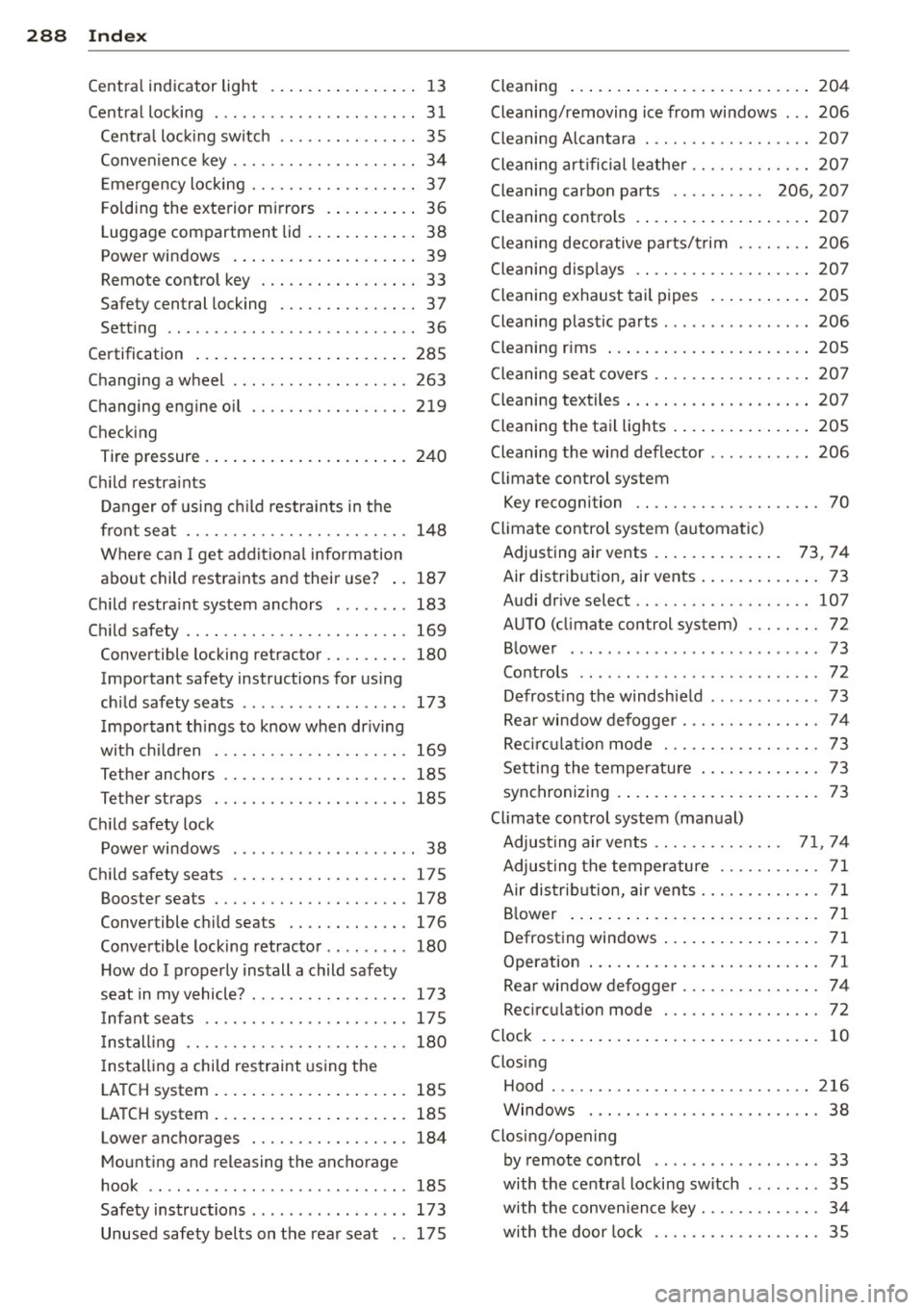
288 Index
Centra l indicator light .... .. .. .. .... . . 1 3
Central locking ............. ... .. .... 3 1
Ce ntr al loc king switch ..... .. .. .... .. 35
Conven ience key . . . . . . . . . . . . . . . . . . . . 34
Emergency locking ........ .. .. .. .. .. 37
Folding the exterior mirrors .. .... .. .. 36
Luggage compartment lid .. .. .. .... . . 38
p . d ower win ows ........... ... .... . . 39
Remote control key ....... .. .. .. .. .. 33
Safety central locking . . . . . . . . . . . . . . . 3 7
Setting .. ................. ...... ..
36
Certification ............. ... .. .... . 285
Changing a wheel ................... 263
Changing engine oil ........ .. .. .. .. . 219
Checking
Tire pressure ..... ......... ... .... .
240
Child restra ints
Danger of us ing c hild restra ints in the
front seat . . . . . . . . . . . . . . . . . . . . . . . .
148
Where can I get addit ional information
about child restraints and their use? ..
187
Ch ild restra int system anchors ... .. ... 183
Child safety .... ............. .. .... . 169
Convertible lo cking retractor .. .. .. ... 180
Important safety instructions for using
ch ild safety seats .............. ....
173
Important things to know when driving
with ch ildren .....................
169
Tether anchors .................... 185
Tether straps . ........... .... .... . 185
Child safety lock
Power wi ndows . . . . . . . . . . . . . . . . . . . .
38
Ch ild safety seats ............ .. .. .. . 175
Booster seats ............ .. .. .... . 178
Convertible child seats .......... .. . 176
Convertible locking retractor . . . . . . . . . 180
H ow do I properly install a child safety
seat in my vehicle? ........ .. .. .. .. .
173
Infant seats ...................... 175
Install ing .. .. ... ..... ..... .. .. .. . 180
Installing a child restraint using the
L ATCH system .... ..... ... .. .. .... .
185
LATCH system .. . ...... ... .. .. .... . 185
Lower anchorages ............ .... . 184
Mount ing and releasing the anchorage
hook .. ... ................... ... .
185
Safety instructions . . . . . . . . . . . . . . . . . 173
Unused safety belts on the rea r seat .. 17 5 Cleaning
Cleaning/removing ice from windows
.. .
Cleaning Alcantara . ... .......... .. . .
204
206
207
Cleaning artificial leather ......... .... 20 7
Cleaning carbon parts . . . . . . . . . . 206, 207
Cleaning contro ls .. ... .. ..... ... .. .. 207
Cleaning decorative parts/trim ........ 206
Cleaning displays .. ............. .... 207
Cleaning exhaust tail pipes .... ... .. .. 205
Cleaning plastic pa rts ............... . 206
Cleaning rims ... .. ... .. ..... ... .. .. 205
Cleaning seat covers ............. .. .. 20 7
Cleaning textiles . .. .......... ....... 207
Cleaning the tail lights . .. ..... ... .. .. 205
Cleaning th e wind deflector ........... 206
Climate control system
Key recogni tion . . . . . . . . . . . . . . . . . . . .
70
Climate control system (automatic)
Adjusting air vents . . . . . . . . . . . . . .
73 , 74
Air distrib ution, air vents ..... ... .. .. . 73
Audi drive select .. ... ...... .... .. .. 107
AUTO (climate control system) ....... . 72
B lower ....... .................... 73
Controls . . . . . . . . . . . . . . . . . . . . . . . . . . 72
Defrost ing the windsh ie ld .......... .. 73
Rea r window defogger .......... .... . 74
Recirc ulat ion mode ............ .... . 73
Setting the temperatu re . . . . . . . . . . . . . 73
synchronizing .... .. ... ..... ... .. .. . 73
Climate control system (manual)
Adjusting air vents ... .......... .
71, 7 4
Adjus ting the temperature ........... 71
Air distrib ution, air vents ...... .... .. . 71
B lowe r ... .... .. .. ... ..... ... .. .. . 71
Defrosting windows ..... .... ... .. .. . 71
Operation . . . . . . . . . . . . . . . . . . . . . . . . . 71
Rear window defogger .......... .. .. . 74
Recirculation mode ............ .... . 72
Clock . ... .. .... .. .. ... ..... ... .. .. . 10
Clos ing
Hood . .... .... .. ............. ....
216
Windows . .. .. .. .... ......... .... . 38
Closing/opening
by remote control . . . . . . . . . . . . . . . . . . 33
with the central locking switch ..... .. .
35
with the conven ience key . . . . . . . . . . . . . 34
with the door lock ........... .... .. . 35
Page 292 of 302

290 Index
E
ECO mode (automatic climate control sys -
tem) . ..... .. ................ ..... ..
72
Efficiency program . . . . . . . . . . . . . . . . . . . 28
Description .............. .... .. .. .. 28
Fu el economy messages . . . . . . . . . . . . . 29
Other equipment . . . . . . . . . . . . . . . . . . . 29
Electrical accessor ies
refer to Socket . . . . . . . . . . . . . . . . . . . . . 64
Electromechanical parking brake
refer to Parking brake ......... .... .. 82
Electromechanical steering ....... ... . 192
Indicator lights ................... 192
Electronic diffe rent ial loc k ... .. .. .. .. . 188
Indicator light . . . . . . . . . . . . . . . . . . . . . 21
Electronic immobilizer ...... .... .... .. 36
also refer to Immobilizer . . . . . . . . . . . . 31
Electronic speed limiter . . . . . . . . . . . . . . . 30
Electronic stabilization control (ESC)
I ndicator light . . . . . . . . . . . . . . . . . . . . .
21
Sport mode ................ ..... . 189
Electronic Stabilization Control (ESC) . . . 188
Emergency assistance ....... ... .... . 261
Emergency flasher . . . . . . . . . . . . . . . . . . . 50
Emergency flashers
Indicator light . . . . . . . . . . . . . . . . . . . . .
25
Emergency operation
Emergency braking function .... .... ..
84
Front passenger's door ...... .. .. .. . . 37
Luggage compartment lid .. .... .... . 261
Power top . . . . . . . . . . . . . . . . . . . . . . . . . 45
·th ' k
w1 convenience ey . . . . . . . . . . . . . . . . 80
Emergency release
Fuel filler door ........... .........
213
Selector lever . . . . . . . . . . . . . . . . . . . . . 117
Emergency starting ......... ... .... . 273
Emergency towing ... .. .... .. .. .. .. . 275
Energy management ....... .. .. .. .. . 193
Indicator light . . . . . . . . . . . . . . . . . . . . . 20
Engine
Coolant
.. .. ................ ..... . 220
Starting with jumper cables . ..... .. . 273
starting (button) ............. .... .. 78
Starting (driver messages with conven-
ience key) .. ........ ..... .. ........
81
start ing (key) . .. ...... .... ... .. .. .. 76
stopping (button) ............. ..... 79
stopping (key) ... ................ .. 78
Engine compartment
Closing the hood .............. .. ..
216
Open ing the hood ................. 215
Overview . ..... .. ................ . 216
Safety precautions ............. .... 214
Engine control (indicator light) ...... .. . 22
Engine coolant .. .. ............. .... 220
Radiator fan ... .. ... .......... .... 221
Engine oil . ..... .. ................ . 217
adding ....... .. ................ . 218
Changing ........................ 219
Checking the oil level ............... 218
Dipstick. .. .. .. .. ............ 216, 218
Indicator light . .. ... ......... ... .. . 20
Oil consumption .. ..... ..... ... .. .. 217
Specification and viscosity ... .. .. .. .. 217
Use ...... .... ................... 218
Engine speed limitation (indicator light) . 23
Environment
Break-in period . . . . . . . . . . . . . . . . . . . .
196
Catalytic converter ............. .. .. 197
Disposing of your vehicle battery . .. .. 226
Driving at high speeds ............ .. 198
Driving to minimize pollution and noise 198
Fuel economy . ... ....... ...... .. .. 198
Letting the vehicle stand and warm up. 199
Proper disposal of drained brake fluid . 222
Proper disposal of drained eng ine oil .. 219
Unleaded fuel .... ................ . 210
What should I do with an o ld battery? . 226
EPC (engine contro l) . . . . . . . . . . . . . . . . . . 22
ESC
Automatic post-collision braking sys-
tem .. ... ... .. .. .. ...... ....... ..
189
Electronic stabilizat ion control . .. .. .. 188
Sport mode . .. .. ... ....... ... .. .. 189
Event Data Recorder (EDR) . . . . . . . . . . . . 194
Exterior lighting . .. ... .......... ..... 49
Exterior m irrors
Adjusting . . . . . . . . . . . . . . . . . . . . . . . . .
55
D. . 1mming .. .. ...... .. ... ... ... ..... 56
folding ... ................... ..... 55
Heating . .. ................... .... . 55