Page 27 of 215

Keys, doors and windows259Warning
Take care when operating the
sliding side door. Risk of injury.
Ensure that nothing becomes
trapped during operation and no-
one is standing within the moving
area.
If the vehicle is parked on a slope,
open sliding doors may move
accidentally on account of their
weight.
Close the sliding doors before
driving off.
Power sliding door
Opening
With vehicle at a standstill and the
parking brake applied, press switch
on instrument panel to open the
power sliding door automatically; the
LED in the switch flashes during
operation.
To stop movement at any time, press
the switch again. Press once more to
continue power sliding door
movement.
Closing
Press switch again; the LED flashes
and a chime sounds during operation.
In the event of opening or closing
difficulties, e.g. due to frost, press and
hold the switch to increase power to
the sliding door.9 Warning
Take care when operating the
power sliding door. Risk of injury,
particularly to children.
Take particular care when the
vehicle is parked on a slope: open
or close the door fully until it
latches into its locking position.
Keep a close watch on the moving door when operating. Ensure thatnothing becomes trapped during
operation and no-one is standing
within the moving area.
Notice
Do not operate power sliding door too often without engine running asthis will discharge the vehicle
battery.
Page 56 of 215
54Seats, restraintsChild restraint installation locationsPermissible options for fitting a child restraint system
Front seats - All variantsWeight and age classSingle seat - front passenger side 1)Bench seat - front passenger sidewithout airbagwith airbagwithout airbagwith airbagcentreoutercentreouterGroup 0: up to 10 kg
or approx. 10 months
Group 0+: up to 13 kg
or approx. 2 years
UU 2)UUU 2)U2)
Group I: 9 to 18 kg
or approx. 8 months to 4 yearsUU 2)UUU2)U 2)Group II: 15 to 25 kg
or approx. 3 to 7 years
Group III: 22 to 36 kg
or approx. 6 to 12 years
UU 2)UUU 2)U2)
1)
If adjustable, ensure seat is in its rearmost position. Make sure vehicle seat belt is as straight as possible between shoulder and upper anchorage point.
2) Ensure the front passenger airbag system is deactivated when installing a child restraint in this position.
Page 57 of 215
Seats, restraints55
Crew cab - rear seatsWeight and age class2nd row seatsOuterCentreGroup 0: up to 10 kg
or approx. 10 months
Group 0+: up to 13 kg
or approx. 2 years
UX
Group I: 9 to 18 kg
or approx. 8 months to 4 yearsUXGroup II: 15 to 25 kg
or approx. 3 to 7 years
Group III: 22 to 36 kg
or approx. 6 to 12 years
UX
Page 58 of 215
56Seats, restraints
Combi - rear seatsWeight and age class2nd row seats3rd row seatsDriver side
outer seat
Centre seat
Passenger side
outer seatGroup 0: up to 10 kg
or approx. 10 months
Group 0+: up to 13 kg
or approx. 2 years
U 3)
,
Group I: 9 to 18 kg
or approx. 8 months to 4 yearsU 4)
,
,
or approx. 3 to 7 years
Group III: 22 to 36 kg
or approx. 6 to 12 years
U 4)UF 4)UF 4)X
3)
Move the front seat as far forward as possible to install a rear facing child seat, then move back the seat in front in accordance with the child seat instructions.
4) Forward facing child seat; position the seatback of the child seat in contact with the seatback of the vehicle seat. Adjust the height of the headrest or
remove it if necessary; do not push the seat in front of the child more than halfway back on its runners and do not recline the seatback more than 25°.
Page 59 of 215
Seats, restraints57
Bus - rear seatsWeight and age classRear seatsGroup 0: up to 10 kg
or approx. 10 months
Group 0+: up to 13 kg
or approx. 2 years
X
Group I: 9 to 18 kg
or approx. 8 months to 4 yearsXGroup II: 15 to 25 kg
or approx. 3 to 7 years
Group III: 22 to 36 kg
or approx. 6 to 12 years
X
U=Suitable for universal category restraint systems for use in this weight and age class, in conjunction with three-point
seat belt.UF=Suitable for universal category forward-facing restraint systems for use in this weight and age class, in conjunction
with three-point seat belt.<=Suitable for ISOFIX child restraint system with mounting brackets and anchorage points, where fitted. When mounting
an ISOFIX child restraint system, only systems that have been approved for the vehicle may be used. Refer to "Permissible options for fitting an ISOFIX child restraint system".X=Seat position not suitable for children in this weight and age class.
Page 60 of 215
58Seats, restraints
Permissible options for fitting an ISOFIX child restraint systemCombiWeight classSize classFixtureFront seats2nd row seats3rd row seatsDriver side
outer seat
Centre seat
Passenger side
outer seatGroup 0: up to 10 kg
or approx. 10 monthsEISO/R1XILXXXGroup 0+: up to 13 kg
or approx. 2 yearsEISO/R1XILXXXDISO/R2XILXXXCISO/R3XILXXXGroup I: 9 to 18 kg
or approx. 8 months to 4 yearsDISO/R2XILXXXCISO/R3XILXXXBISO/F2XIL, IUFIL, IUFXXB1ISO/F2XXIL, IUFIL, IUFXXAISO/F3XIL, IUFIL, IUFXXIL=Suitable for particular ISOFIX restraint systems of the "specific-vehicle", "restricted" or "semi-universal" categories.
The ISOFIX restraint system must be approved for the specific vehicle type.IUF=Suitable for ISOFIX forward-facing child restraint systems of universal category approved for use in this weight class.X=No ISOFIX child restraint system approved in this weight class.
Page 61 of 215
Seats, restraints59
ISOFIX size class and seat deviceA - ISO/F3=Forward-facing child restraint system for children of maximum size in the weight class 9 to 18 kg.B - ISO/F2=Forward-facing child restraint system for smaller children in the weight class 9 to 18 kg.B1 - ISO/F2X=Forward-facing child restraint system for smaller children in the weight class 9 to 18 kg.C - ISO/R3=Rear-facing child restraint system for children of maximum size in the weight class up to 18 kg.D - ISO/R2=Rear-facing child restraint system for smaller children in the weight class up to 18 kg.E - ISO/R1=Rear-facing child restraint system for young children in the weight class up to 13 kg.
Page 65 of 215
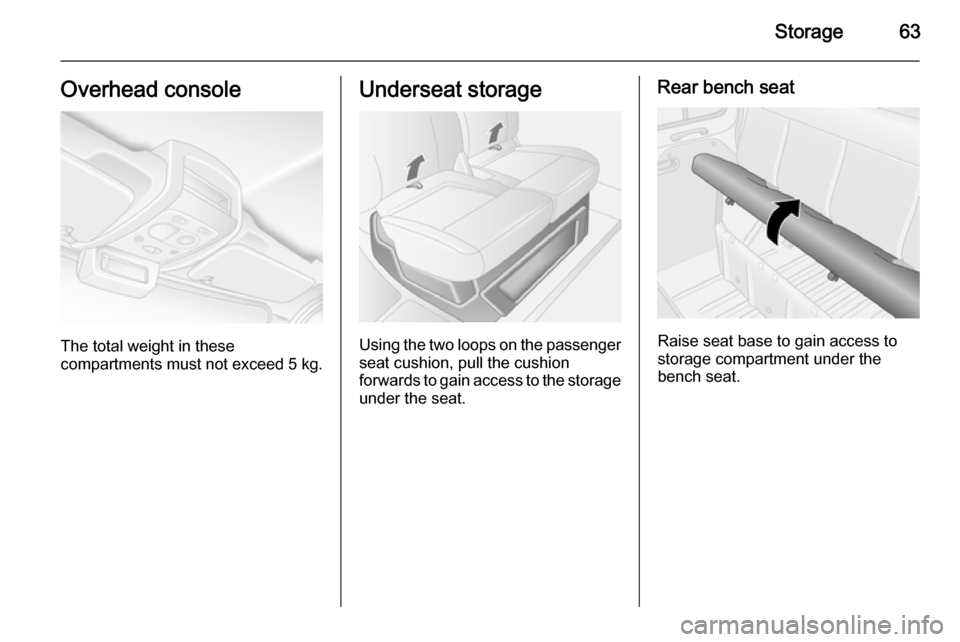
Storage63Overhead console
The total weight in these
compartments must not exceed 5 kg.
Underseat storage
Using the two loops on the passenger
seat cushion, pull the cushion
forwards to gain access to the storage
under the seat.
Rear bench seat
Raise seat base to gain access to
storage compartment under the
bench seat.