Page 108 of 344
106
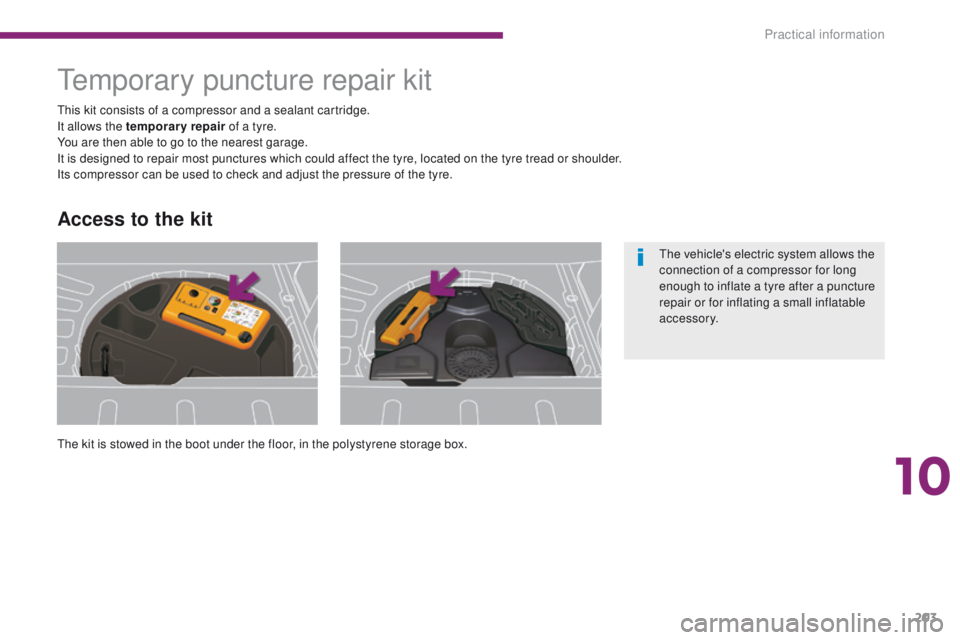
F Raise the boot carpet, hooking the two cords on the hooks, then gain access
to the storage box.
Depending on the configuration, this has areas
for storing:
-
a b
ox of spare bulbs,
-
a f
irst aid kit,
-
a t
yre repair kit,
-
t
wo warning triangles,
-
...
Storage box
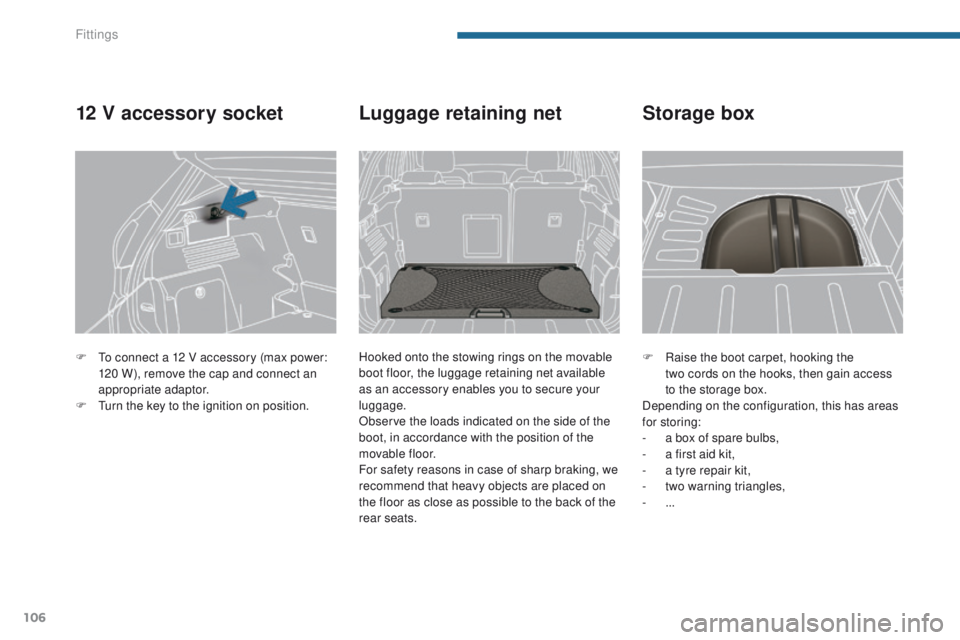
F To connect a 12 V accessory (max power: 120 W), remove the cap and connect an
appropriate adaptor.
F
T
urn the key to the ignition on position.
12 V accessory socket Luggage retaining net
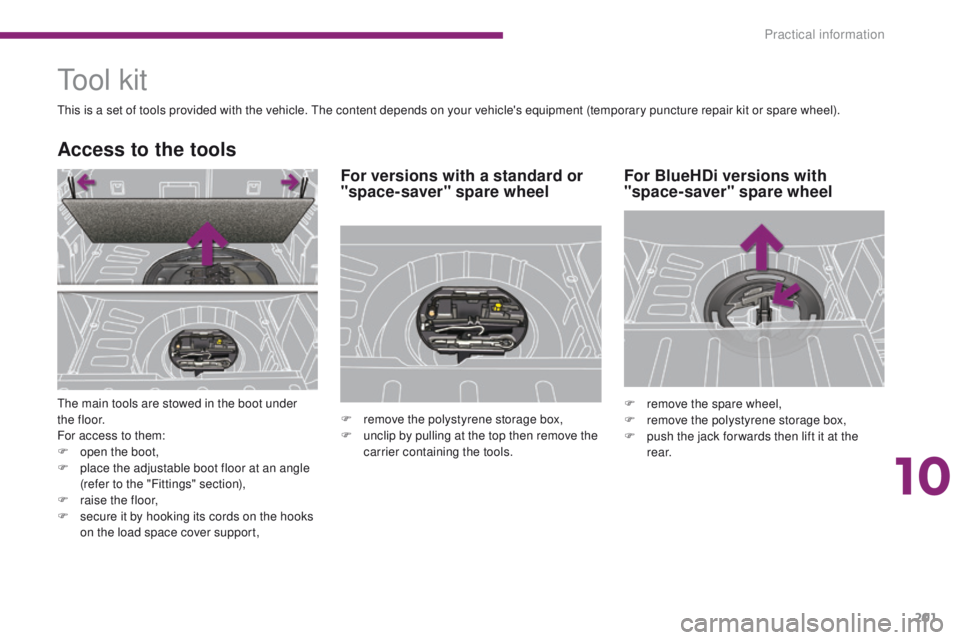
Hooked onto the stowing rings on the movable
boot floor, the luggage retaining net available
as an accessory enables you to secure your
luggage.
Observe the loads indicated on the side of the
boot, in accordance with the position of the
movable floor.
For safety reasons in case of sharp braking, we
recommend that heavy objects are placed on
the floor as close as possible to the back of the
rear seats.
Fittings
Page 109 of 344
107
Adjustable boot floor
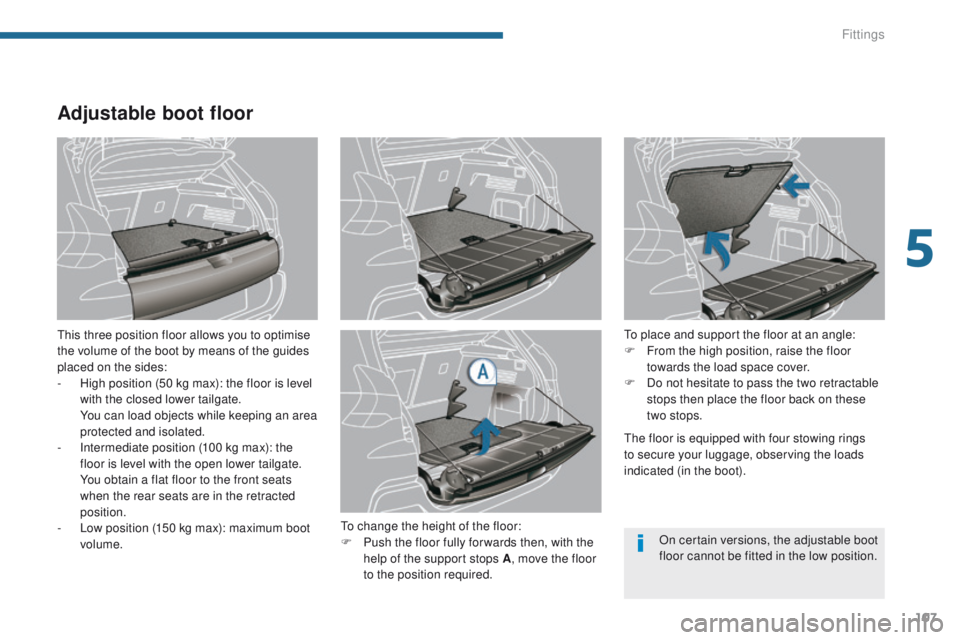
This three position floor allows you to optimise
the volume of the boot by means of the guides
placed on the sides:
-
H
igh position (50 kg max): the floor is level
with the closed lower tailgate.
Y
ou can load objects while keeping an area
protected and isolated.
-
I
ntermediate position (100 kg max): the
floor is level with the open lower tailgate.
Y
ou obtain a flat floor to the front seats
when the rear seats are in the retracted
position.
-
L
ow position (150 kg max): maximum boot
volume. To place and support the floor at an angle:
F
F rom the high position, raise the floor
towards the load space cover.
F
D
o not hesitate to pass the two retractable
stops then place the floor back on these
two stops.
To change the height of the floor:
F
P
ush the floor fully for wards then, with the
help of the support stops A , move the floor
to the position required. The floor is equipped with four stowing rings
to secure your luggage, observing the loads
indicated (in the boot).
On certain versions, the adjustable boot
floor cannot be fitted in the low position.
5
Fittings
Page 195 of 344
193
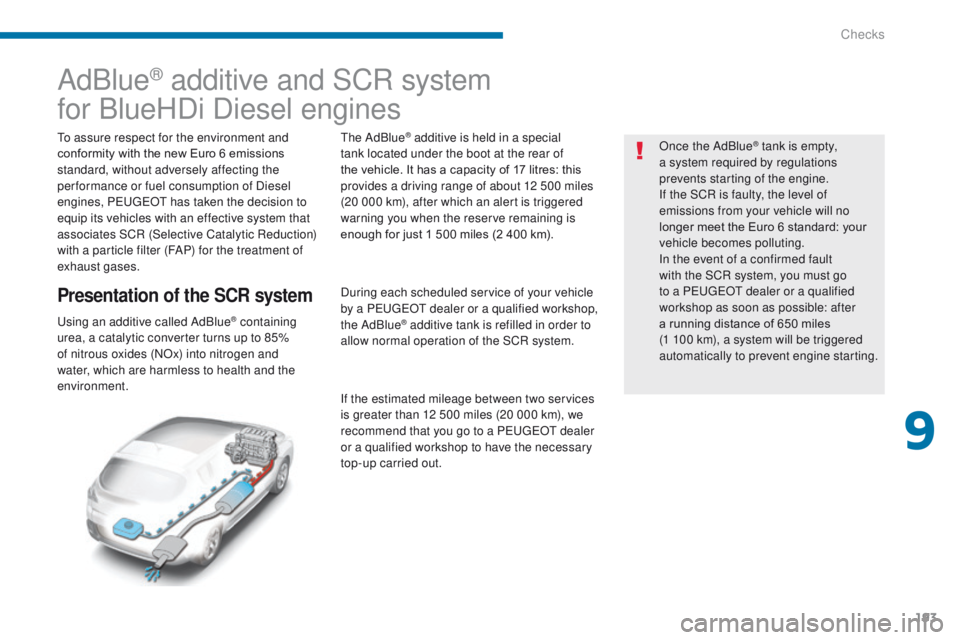
AdBlue® additive and SCR system
for BlueHDi Diesel engines
To assure respect for the environment and
conformity with the new Euro 6 emissions
standard, without adversely affecting the
per formance or fuel consumption of Diesel
engines, PEUGEOT has taken the decision to
equip its vehicles with an effective system that
associates SCR (Selective Catalytic Reduction)
with a particle filter (FAP) for the treatment of
exhaust gases.
Presentation of the SCR system
Using an additive called AdBlue® containing
urea, a catalytic converter turns up to 85%
of nitrous oxides (NOx) into nitrogen and
water, which are harmless to health and the
environment. The AdBlue
® additive is held in a special
tank located under the boot at the rear of
the vehicle. It has a capacity of 17 litres: this
provides a driving range of about 12 500 miles
(20 000 km), after which an alert is triggered
warning you when the reserve remaining is
enough for just 1 500 miles (2 400 km).
During each scheduled service of your vehicle
by a PEUGEOT dealer or a qualified workshop,
the AdBlue
® additive tank is refilled in order to
allow normal operation of the SCR system.
If the estimated mileage between two services
is greater than 12 500 miles (20 000 km), we
recommend that you go to a PEUGEOT dealer
or a qualified workshop to have the necessary
top-up carried out. Once the AdBlue
® tank is empty,
a
system required by regulations
prevents starting of the engine.
If the SCR is faulty, the level of
emissions from your vehicle will no
longer meet the Euro 6 standard: your
vehicle becomes polluting.
In the event of a confirmed fault
with the SCR system, you must go
to a PEUGEOT dealer or a qualified
workshop as soon as possible: after
a running distance of 650 miles
(1
100 km), a system will be triggered
automatically to prevent engine starting.
9
Checks
Page 201 of 344
199
Never store bottles of AdBlue® in your
vehicle.
Recommendations on storage
AdBlue® freezes at about -11°C and
deteriorates above 25°C. It is recommended
that bottles be stored in a cool area and
protected from direct sunlight.
Under these conditions, the additive can be
kept for at least a year.
If the additive has frozen, it can be used once it
has completely thawed out.
Procedure
Before topping-up, ensure that the vehicle is
parked on a flat and level sur face.
In wintry conditions, ensure that the
temperature of the vehicle is above -11°C.
Otherwise the AdBlue
® may be frozen and
so cannot be poured into its tank. Park your
vehicle in a warmer area for a few hours to
allow the top-up to be carried out.
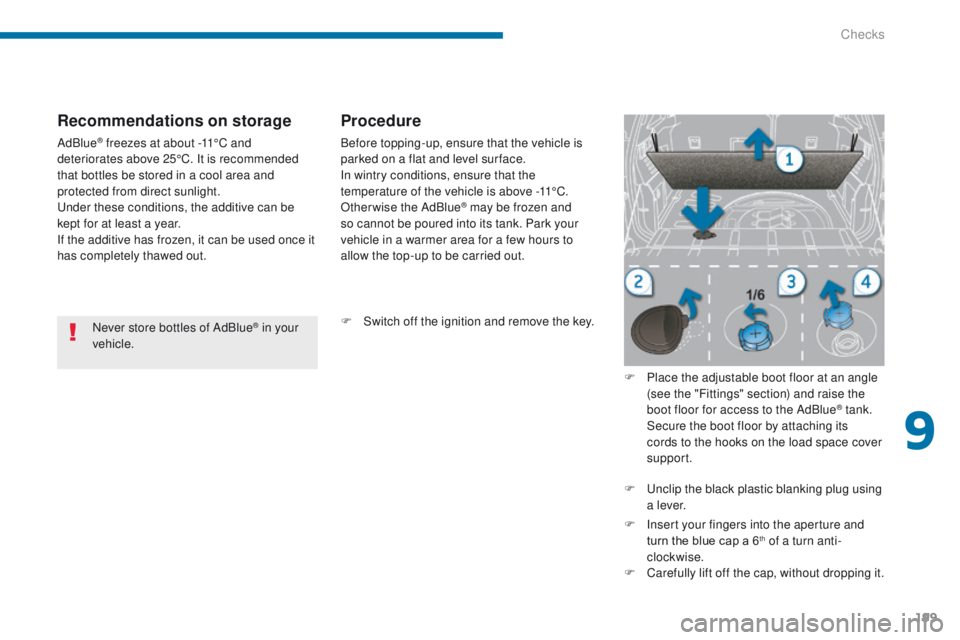
F
S
witch off the ignition and remove the key. F
P
lace the adjustable boot floor at an angle
(see the "Fittings" section) and raise the
boot floor for access to the AdBlue
® tank. S
ecure the boot floor by attaching its
cords to the hooks on the load space cover
support.
F
U
nclip the black plastic blanking plug using
a l eve r.
F
I
nsert your fingers into the aperture and
turn the blue cap a 6
th of a turn anti-
clockwise.
F
C
arefully lift off the cap, without dropping it.
9
Checks
Page 202 of 344
200
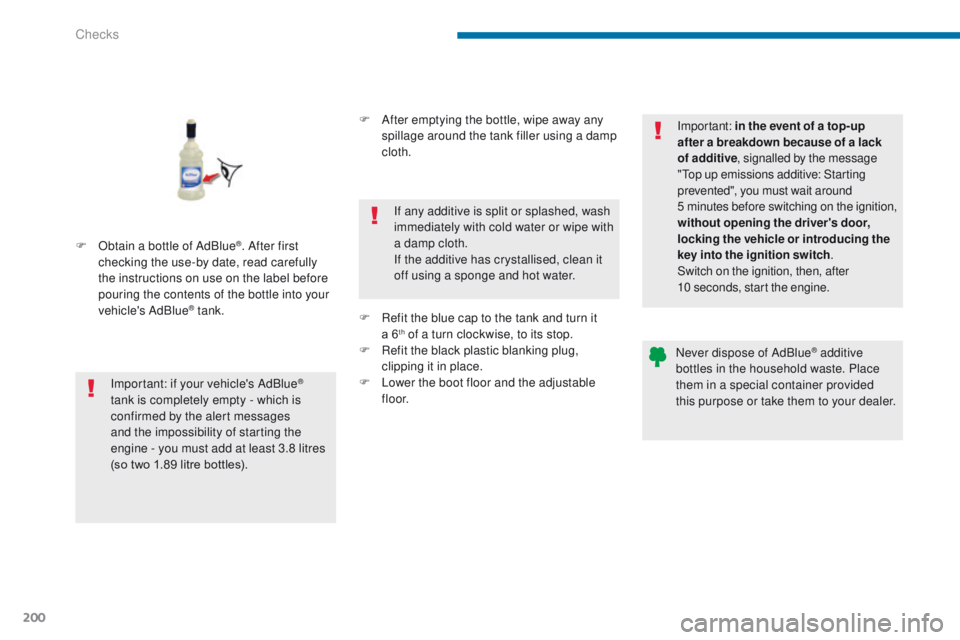
F Obtain a bottle of AdBlue®. After first
checking the use-by date, read carefully
the instructions on use on the label before
pouring the contents of the bottle into your
vehicle's AdBlue
® tank.
Important: if your vehicle's AdBlue
®
tank is completely empty - which is
confirmed by the alert messages
and the impossibility of starting the
engine - you must add at least 3.8 litres
(so
two
1.89 litre bottles). F
A
fter emptying the bottle, wipe away any
spillage around the tank filler using a damp
cloth.
If any additive is split or splashed, wash
immediately with cold water or wipe with
a damp cloth.
If the additive has crystallised, clean it
off using a sponge and hot water.
F
R
efit the blue cap to the tank and turn it
a 6
th of a turn clockwise, to its stop.
F
R
efit the black plastic blanking plug,
clipping it in place.
F
L
ower the boot floor and the adjustable
f l o o r. Important:
in the event of a top-up
after a breakdown because of a lack
of additive , signalled by the message
"Top up emissions additive: Starting
prevented", you must wait around
5 minutes before switching on the ignition,
without opening the driver's door,
locking the vehicle or introducing the
key into the ignition switch .
Switch on the ignition, then, after
10
seconds, start the engine.
Never dispose of AdBlue® additive
bottles in the household waste. Place
them in a special container provided
this purpose or take them to your dealer.
Checks
Page 203 of 344
201
Tool kit
This is a set of tools provided with the vehicle. The content depends on your vehicle's equipment (temporary puncture repair kit or spare wheel).
Access to the tools
The main tools are stowed in the boot under
t h e f l o o r.
For access to them:
F
o
pen the boot,
F
p
lace the adjustable boot floor at an angle
(refer to the "Fittings" section),
F
r
aise the floor,
F
s
ecure it by hooking its cords on the hooks
on the load space cover support,
For versions with a standard or
"space-saver" spare wheel
F remove the polystyrene storage box,
F u nclip by pulling at the top then remove the
carrier containing the tools.
For BlueHDi versions with
"space-saver" spare wheel
F remove the spare wheel,
F r emove the polystyrene storage box,
F
p
ush the jack for wards then lift it at the
r e a r.
10
Practical information
Page 205 of 344
203
Temporary puncture repair kit
The kit is stowed in the boot under the floor, in the polystyrene storage box. This kit consists of a compressor and a sealant cartridge.
It allows the temporary repair of a tyre.
You are then able to go to the nearest garage.
It is designed to repair most punctures which could affect the tyre, located on the tyre tread or shoulder.
Its compressor can be used to check and adjust the pressure of the tyre.
Access to the kit
The vehicle's electric system allows the
connection of a compressor for long
enough to inflate a tyre after a puncture
repair or for inflating a small inflatable
accessory.
10
Practical information
Page 211 of 344
209
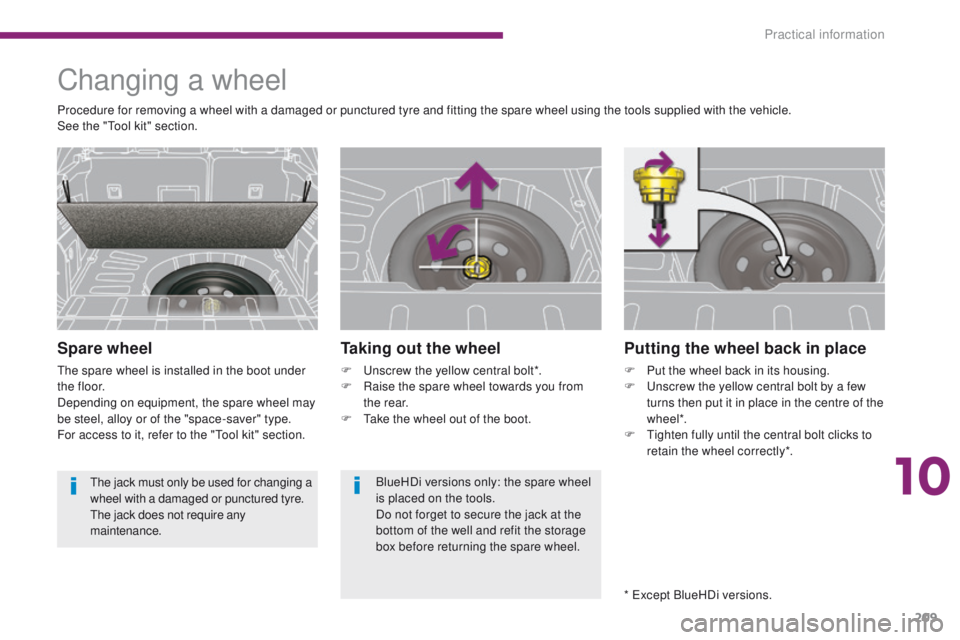
Putting the wheel back in place
F Put the wheel back in its housing.
F U nscrew the yellow central bolt by a few
turns then put it in place in the centre of the
w h e e l*.
F
T
ighten fully until the central bolt clicks to
retain the wheel correctly*.
Changing a wheel
Spare wheel
The spare wheel is installed in the boot under
t h e f l o o r.
Depending on equipment, the spare wheel may
be steel, alloy or of the "space-saver" type.
For access to it, refer to the "Tool kit" section.
Taking out the wheel
F Unscrew the yellow central bolt*.
F R aise the spare wheel towards you from
the rear.
F
T
ake the wheel out of the boot.
Procedure for removing a wheel with a damaged or punctured tyre and fitting the spare wheel using the tools supplied with the vehicle.
See the "Tool kit" section.
* Except BlueHDi versions.
BlueHDi versions only: the spare wheel
is placed on the tools.
Do not forget to secure the jack at the
bottom of the well and refit the storage
box before returning the spare wheel.
The jack must only be used for changing a
wheel with a damaged or punctured tyre.
The jack does not require any
maintenance.
10
Practical information