Page 62 of 154

6-2
64. Completely close the throttle lever and start
the engine by pushing the start switch.
TIPIf the engine fails to start, release the start switch,
then push it again. Pause a few seconds before
the next attempt. Each cranking should be as
short as possible to preserve battery energy. Do
not crank the engine more than 10 seconds on
each attempt. NOTICEECB00164For maximum engine life, never accelerate
hard when the engine is cold! EBU20525ShiftingThis ATV has a 5-speed forward transmission. The
transmission allows you to control the amount of
power you have available at a given speed or for
starting, accelerating, climbing hills, etc.
To shift into neutral, release the throttle lever, ap-
ply the clutch, and then repeatedly depress the
shift pedal until it stops. When it stops, it will be in first gear. Raise the ped-
al slightly to reach the neutral position, and then
release the clutch.
EBU20595To start out and accelerate
1. Release the throttle lever, apply the front or rear brake, and then release the parking
brake.
2. Pull the clutch lever to disengage the clutch.1. Shift pedal
2. Neutral position
1
2 2 3
4 5
N1
U1TD6AE0.book Page 2 Wednesday, January 8, 2014 8:46 AM
Page 79 of 154
7-12
7
To achieve maximum traction on unpaved surfac-
es, the two rear wheels turn together at the same
speed. Therefore, unless the wheel on the inside
of the turn is allowed to slip or lose some traction,
the ATV will resist turning. A special turning tech-
nique must be used to allow the ATV to make
turns quickly and easily. It is essential that this skill
be learned first at low speed.
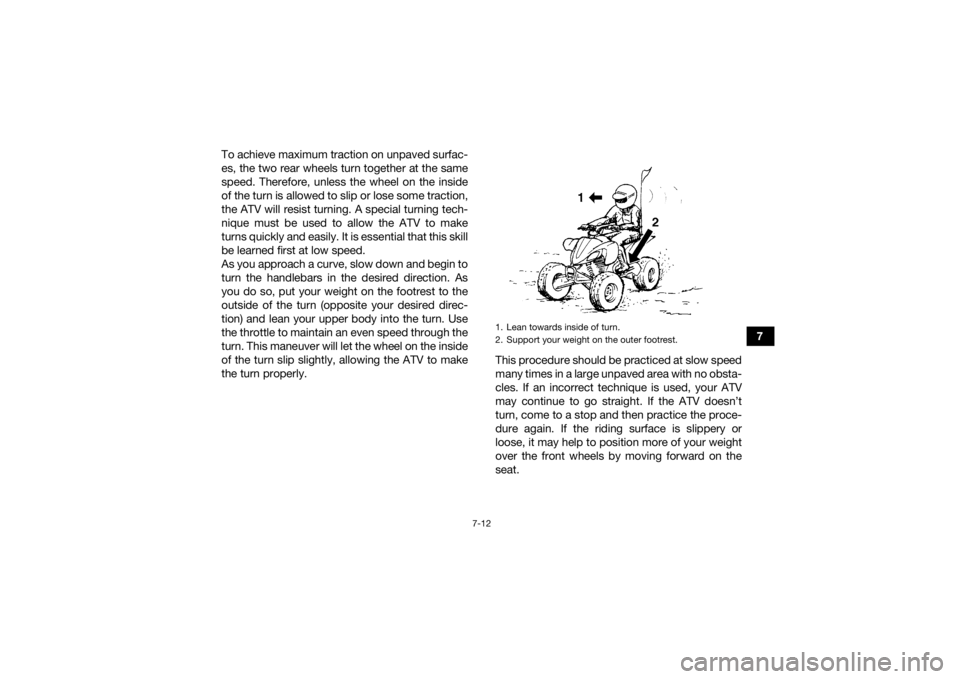
As you approach a curve, slow down and begin to
turn the handlebars in the desired direction. As
you do so, put your weight on the footrest to the
outside of the turn (opposite your desired direc-
tion) and lean your upper body into the turn. Use
the throttle to maintain an even speed through the
turn. This maneuver will let the wheel on the inside
of the turn slip slightly, allowing the ATV to make
the turn properly.
This procedure should be practiced at slow speed
many times in a large unpaved area with no obsta-
cles. If an incorrect technique is used, your ATV
may continue to go straight. If the ATV doesn’t
turn, come to a stop and then practice the proce-
dure again. If the riding surface is slippery or
loose, it may help to position more of your weight
over the front wheels by moving forward on the
seat.
1. Lean towards inside of turn.
2. Support your weight on the outer footrest.
U1TD6AE0.book Page 12 Wednesday, January 8, 2014 8:46 AM
Page 85 of 154

7-18
7
As you travel across a slope, lean your body in the
uphill direction. It may be necessary to correct the
steering when riding on loose surfaces by pointing
the front wheels slightly uphill. When riding on
slopes, be sure not to make sharp turns either up
or down hill.
If your ATV does begin to tip over, gradually steer
in the downhill direction if there are no obstacles
in your path. As you regain proper balance, grad-
ually steer again in the direction you wish to travel.
CROSSING THROUGH SHALLOW WATER
WARNING
EWB01642Operating this vehicle through deep or fast-
flowing water can lead to loss of control or an
overturn. To reduce your risk of drowning or
other injuries, use care when crossing through
water. Never operate this ATV water deeper
than the depth specified in your Owner’s Man-
ual, as tires may float, increasing the risk of an
overturn. The ATV can be used to cross slow moving, shal-
low water of up to a maximum of 35 cm (14 in) in
depth. Before entering the water, choose your
path carefully. Enter where there is no sharp drop
off, and avoid rocks or other obstacles which may
be slippery or upset the ATV. Drive slowly and
carefully.
U1TD6AE0.book Page 18 Wednesday, January 8, 2014 8:46 AM
Page 97 of 154

8-8
8
EBU29431TIPSome maintenance items need more frequent service if you are riding in unusually wet, dusty, sandy or
muddy areas, or at full-throttle.
Replace the fuel hose every five years and if cracked or damaged.
Hydraulic brake service
• Regularly check and, if necessary, correct the brake fluid level.
• Every two years replace the internal components of the brake master cylinders and calipers, and
change the brake fluid.23 *Moving parts and
cables •Lubricate.
√√√√
24 *Throttle lever • Check operation.
• Check throttle lever free play, and adjust if neces-
sary.
• Lubricate cable and lever housing. √√√√√
25 *Front and rear
brake switches • Check operation and correct if necessary.
√√√√√
26 *Lights and switches • Check operation and correct if necessary.
• Adjust headlight beams. √√√√√
NO. ITEM
CHECK OR MAINTENANCE
JOB INITIAL EVERY
Whichev- er comes first month136612
km (mi) 320
(200) 1300
(800) 2500
(1600) 2500
(1600) 5000
(3200)
hours 20 80 160 160 320U1TD6AE0.book Page 8 Wednesday, January 8, 2014 8:46 AM
Page 102 of 154

8-13
8To install the cowling
1. Place the cowling in the original position, and
then tighten the quick fasteners.
2. Install panels C, B and A.EBU29442Checking the spark plugThe spark plug is an important engine component,
which should be checked periodically, preferably
by a Yamaha dealer. Since heat and deposits will
cause any spark plug to slowly erode, the spark
plug should be removed and checked in accor-
dance with the periodic maintenance and lubrica-
tion chart. In addition, the condition of the spark
plug can reveal the condition of the engine.
The porcelain insulator around the center elec-
trode of the spark plug should be a medium-to-
light tan (the ideal color when the vehicle is ridden
normally). If the spark plug shows a distinctly dif-
ferent color, the engine could be operating im-
properly. Do not attempt to diagnose such
problems yourself. Instead, have a Yamaha dealer
check the vehicle.
If the spark plug shows signs of electrode erosion
and excessive carbon or other deposits, it should
be replaced.
1. Quick fastener
1. Quick fastener
1
1
1
1
U1TD6AE0.book Page 13 Wednesday, January 8, 2014 8:46 AM
Page 115 of 154
8-26
8
2. Remove the retainer by removing the bolts,
and then remove the tailpipe and gasket from
the muffler. 3. Tap the tailpipe lightly, and then use a wire
brush to remove any carbon deposits from
the spark arrester portion of the tailpipe and
inside of the tailpipe housing.
1. Tailpipe cover
2. Bolt2
1 2
1. Bolt
2. Retainer
3. Tailpipe
4. Gasket1
2
3
4
1
U1TD6AE0.book Page 26 Wednesday, January 8, 2014 8:46 AM
Page 122 of 154

8-33
85. Turn the parking brake free play adjusting nut
in direction (a) to increase the cable length,
and in direction (b) to decrease it.
TIPIf the cable length cannot be adjusted to specifi-
cation, consult a Yamaha dealer. 6. Tighten the locknut on the brake cable.
7. Slide the rubber cover to its original position.
8. Turn in the adjusting bolt at the rear brake cal-iper until it feels tight, then turn it out 1/8 turn
and tighten its locknut to the specified torque. NOTICE:
When tightening the locknut,
hold the adjusting bolt with a wrench so
that it does not turn together with the lock-
nut.
[ECB00522]
WARNING
EWB02091Operating with improperly serviced or adjust-
ed brakes could cause the brakes to malfunc-
tion, resulting in reduced braking
performance. This could increase the chance
of a collision or accident. After adjusting the
parking brake free play, block the rear of the
ATV off the ground and spin the rear wheels.
Check to make sure there is no brake drag. If
brake drag is noticed, perform the adjustment
again. EBU24744Brake light switchesThe brake light, which is activated by the brake
pedal and brake lever, should come on just before
braking takes effect.
1. Locknut
2. Parking brake free play adjusting nut
3. Rubber cover
1
2
3
(b)
(a)
Tightening torque: Locknut (rear brake caliper):16 Nm (1.6 m·kgf, 12 ft·lbf)
U1TD6AE0.book Page 33 Wednesday, January 8, 2014 8:46 AM
Page 123 of 154

8-34
8
The brake light switch for the brake pedal can be
adjusted as follows, but the front brake light
switch should be adjusted by a Yamaha dealer.
Turn the rear brake light switch adjusting nut while
holding the brake light switch in place. To make
the brake light come on earlier, turn the adjusting
nut in direction (a). To make the brake light come
on later, turn the adjusting nut in direction (b).
EBU30153Adjusting the clutch lever free playThe clutch lever free play must be checked and, if
necessary, adjusted at the intervals specified in
the periodic maintenance and lubrication chart. The clutch lever free play should measure 8.0–
13.0 mm (0.31–0.51 in) as shown. If the free play is
incorrect, adjust it as follows.
1. To increase the clutch lever free play, turn the clutch lever free play adjusting nut at the
clutch lever in direction (a), and to decrease it,
turn the nut in direction (b).
If the specified free play cannot be obtained,
proceed with the following steps.
2. Fully turn the adjusting nut at the clutch lever in direction (a) to loosen the clutch cable.
3. Slide the rubber cover back.
4. Loosen the locknut.1. Rear brake light switch
2. Rear brake light switch adjusting nut
1
2(a) (b)
1. Clutch lever free play
2. Clutch lever free play adjusting nut (clutch lever)
1
(a)
(b)
2
U1TD6AE0.book Page 34 Wednesday, January 8, 2014 8:46 AM
