2014 YAMAHA FX SVHO battery
[x] Cancel search: batteryPage 96 of 118

Care and storage
90
ter flows out continually from the jet
thrust nozzle.
(8) Run the engine at idling speed for about 3 minutes watching the engine condition.
If the engine stops while flushing, turn
the water supply off immediately and
perform the procedure again from step 7.
NOTICE: Do not supply water to the
cooling water passages when the en-
gine is not running. The water could
flow back through the muffler into the
engine, causing severe engine dam-
age.
[ECJ00123]
(9) Turn the water supply off.
(10) Discharge the remaining water out of the cooling water passages by alternately
squeezing and releasing the throttle lever
quickly for 10 to 15 seconds.
(11) Stop the engine.
(12) Remove the garden hose adapter, and then securely install the flushing hose
connector cap by tightening it until it
stops.
(13) Securely close the stern storage com- partment.
(14) Securely install the removable watertight storage compartment and seats in their
original positions.
EJU33736Cleaning the watercraft
(1) Remove the seats. (See page 49 for seatremoval and installation procedures.) (2) Rinse the engine and engine compart-
ment with a small amount of water.
NOTICE: Do not use high-pressure
water when rinsing the engine or en-
gine compartment as severe engine
damage could result.
[ECJ00572]
(3) Drain the water from the engine com- partment. (See page 61 for information
on draining the bilge water.)
(4) Wipe the engine and engine compart- ment with a dry cloth.
(5) Wash down the hull, deck, and jet pump with fresh water.
(6) Wipe the hull, deck, and jet pump with a dry cloth.
(7) Wipe all vinyl and rubber components, such as the seats and engine compart-
ment seals, with a vinyl protectant.
(8) To minimize corrosion, spray metallic parts of the hull, deck, and engine with a
rust inhibitor.
(9) Allow the engine compartment to air dry completely before installing the seats.
(10) Securely install the seats in their original positions.
EJU33687Battery care
If the watercraft will not be used for more than
a month, remove the battery from the water-
craft, check it, and then store it in a cool, dry
place.
WARNING
EWJ00792
Battery electrolyte is poisonous and dan-
gerous, causing severe burns, etc. Elec-
trolyte contains sulfuric acid. Avoid
contact with skin, eyes, or clothing.
Antidotes
External: Flush with water.
Internal: Drink large quantities of water or
milk. Follow with milk of magnesia, beaten
UF3J70E0.book Page 90 Wednesd ay, October 9, 2013 2:07 PM
Page 97 of 118
Care and storage
91
egg, or vegetable oil. Call a physician im-
mediately.
Eyes: Flush with water for 15 minutes and
get prompt medical attention.
Batteries produce explosive gases. Keep
sparks, flames, cigarettes, etc., well away.
If using or charging the battery in an en-
closed space, make sure that it is well
ventilated. Always shield your eyes when
working near batteries.
Keep out of the reach of children.
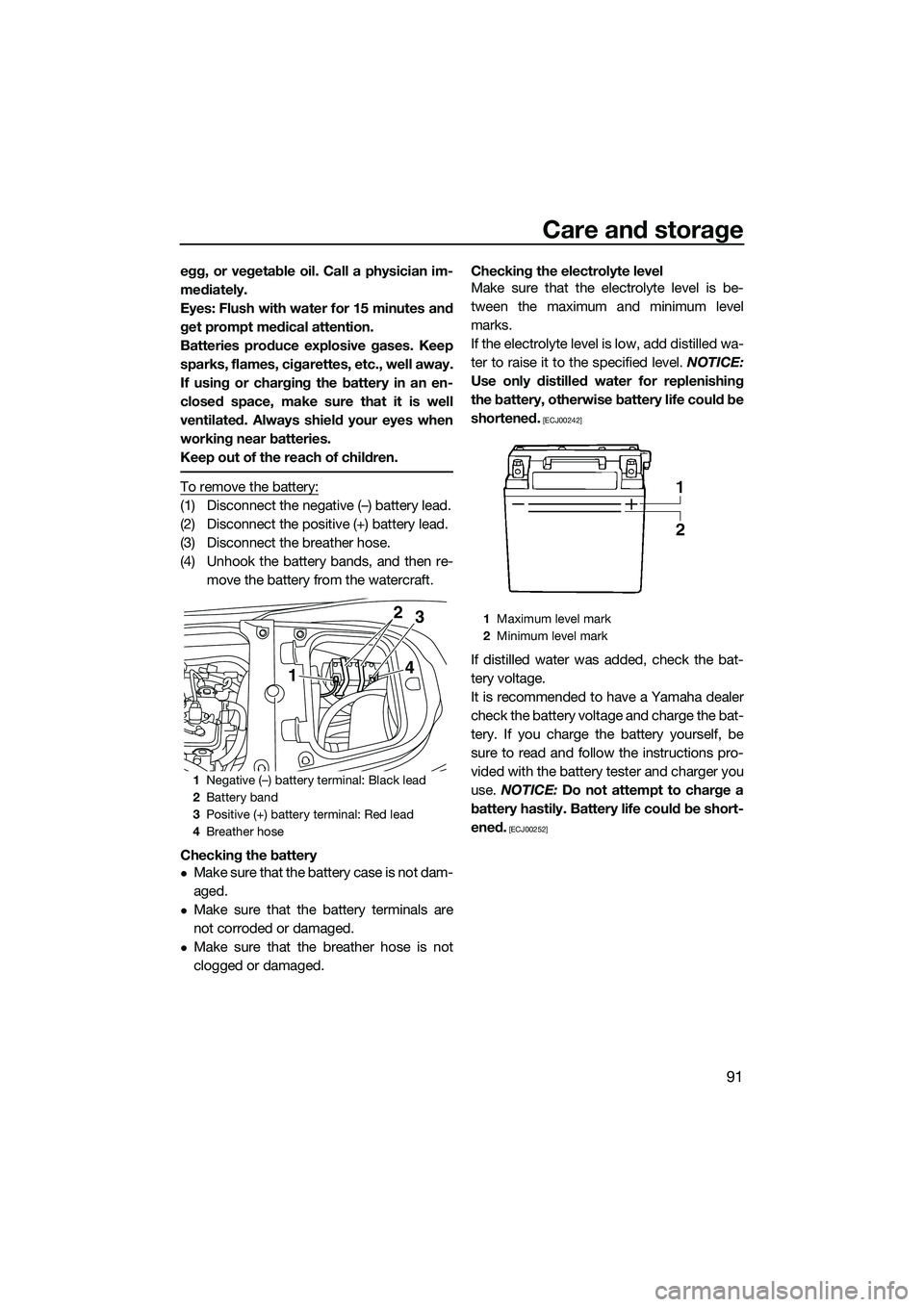
To remove the battery:
(1) Disconnect the negative (–) battery lead.
(2) Disconnect the positive (+) battery lead.
(3) Disconnect the breather hose.
(4) Unhook the battery bands, and then re-move the battery from the watercraft.
Checking the battery
Make sure that the battery case is not dam-
aged.
Make sure that the battery terminals are
not corroded or damaged.
Make sure that the breather hose is not
clogged or damaged. Checking the electrolyte level
Make sure that the electrolyte level is be-
tween the maximum and minimum level
marks.
If the electrolyte level is low, add distilled wa-
ter to raise it to the specified level.
NOTICE:
Use only distilled water for replenishing
the battery, otherwise battery life could be
shortened.
[ECJ00242]
If distilled water was added, check the bat-
tery voltage.
It is recommended to have a Yamaha dealer
check the battery voltage and charge the bat-
tery. If you charge the battery yourself, be
sure to read and follow the instructions pro-
vided with the battery tester and charger you
use. NOTICE: Do not attempt to charge a
battery hastily. Battery life could be short-
ened.
[ECJ00252]
1 Negative (–) battery terminal: Black lead
2 Battery band
3 Positive (+) battery terminal: Red lead
4 Breather hose
143
2
1
Maximum level mark
2 Minimum level mark
UF3J70E0.book Page 91 Wednesd ay, October 9, 2013 2:07 PM
Page 98 of 118
Care and storage
92
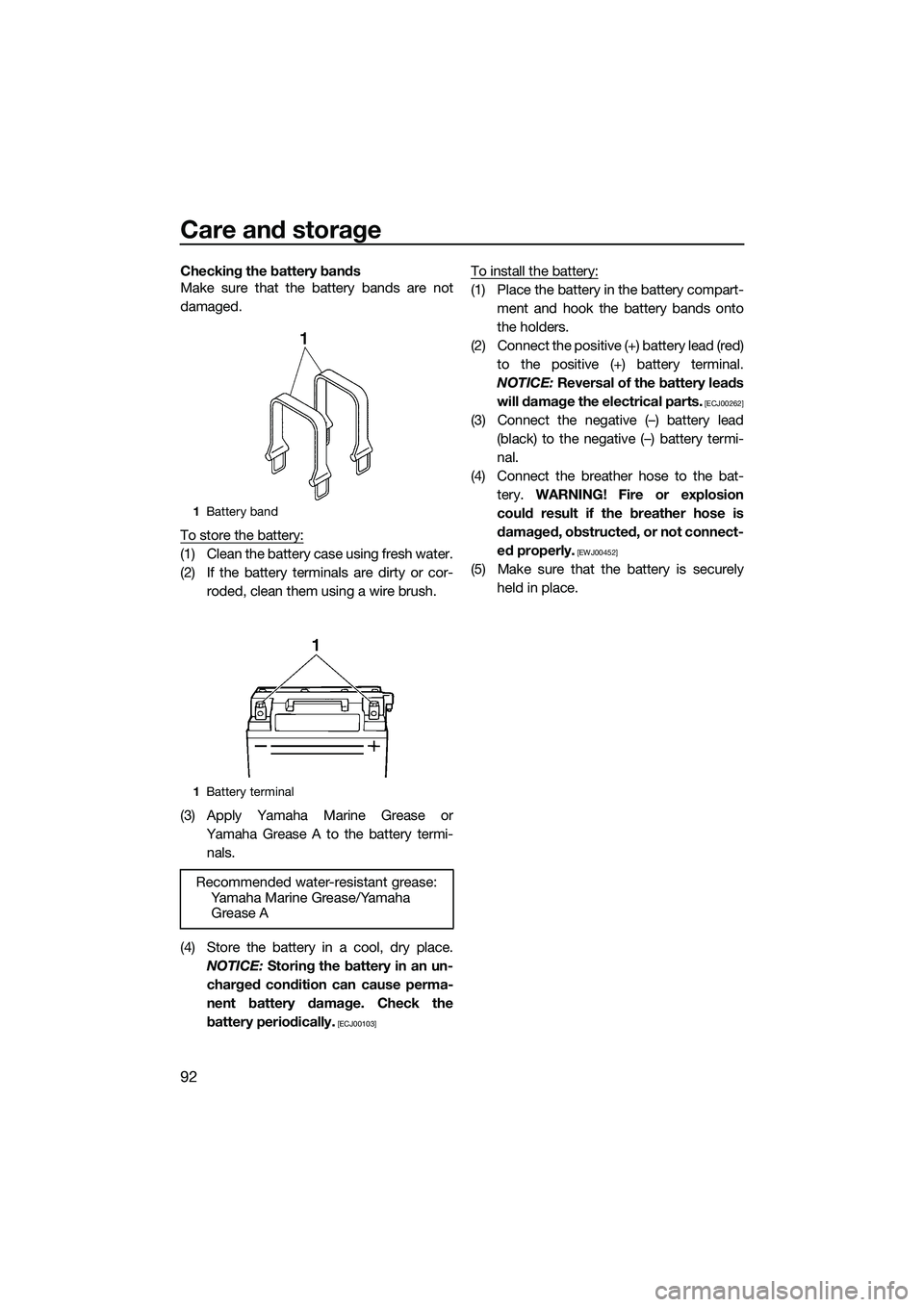
Checking the battery bands
Make sure that the battery bands are not
damaged.
To store the battery:
(1) Clean the battery case using fresh water.
(2) If the battery terminals are dirty or cor-roded, clean them using a wire brush.
(3) Apply Yamaha Marine Grease or Yamaha Grease A to the battery termi-nals.
(4) Store the battery in a cool, dry place. NOTICE: Storing the battery in an un-
charged condition can cause perma-
nent battery damage. Check the
battery periodically.
[ECJ00103]
To install the battery:
(1) Place the battery in the battery compart- ment and hook the battery bands onto
the holders.
(2) Connect the positive (+) battery lead (red) to the positive (+) battery terminal.
NOTICE: Reversal of the battery leads
will damage the electrical parts.
[ECJ00262]
(3) Connect the negative (–) battery lead (black) to the negative (–) battery termi-
nal.
(4) Connect the breather hose to the bat- tery. WARNING! Fire or explosion
could result if the breather hose is
damaged, obstructed, or not connect-
ed properly.
[EWJ00452]
(5) Make sure that the battery is securely held in place.
1Battery band
1 Battery terminal
Recommended water-resistant grease:
Yamaha Marine Grease/Yamaha
Grease A
UF3J70E0.book Page 92 Wednesd ay, October 9, 2013 2:07 PM
Page 103 of 118

Maintenance
97
EJU43100Periodic maintenance chart
The periodic maintenance chart gives general guidelines for periodic maintenance. Have a
Yamaha dealer perform the checks in the following chart. However, maintenance may need to be performed more frequently depending on your operating conditions. If you have any
questions, consult a Yamaha dealer.
This “ √” mark indicates items to be checked and serviced by a Yamaha dealer.
Item OperationInitial Thereafter every
Page
10 hours 50 hours
or 12
months *1 100
hours or 12
months *1 200
hours or 24
months *1
Fuel line Check fuel hoses and
clamps
√
—
Fuel filler cap/Wa-
ter separator Check O-rings for cracks
and deformation
√
—
Fuel tank Check installation and
straps
√
—
Water inlet strainer Check for clogs and dam-
age
√
—
Cooling water hos-
es Check for damage and
leakage, and check
clamps
√
—
Engine oil Replace √√ 99
Oil filter Replace √99
Intermediate hous-
ing Lubricate
√—
Spark plugs Check √√ —
Battery Check specific gravity of
electrolyte, terminals,
bands, and breather hose √
—
Battery leads Check terminals √—
Steering master Check operation and for
looseness
√√
—
Steering cable Check exterior and con-
nections, and lubricate
√
—
Q.S.T.S. cable Check exterior and con-
nections, and lubricate
√
—
Q.S.T.S. converter
and rod Check exterior and con-
nections, and lubricate
√√
—
Shift lever Check exterior and con-
nections, and lubricate
√
—
Shift cable and re-
verse gate Check exterior and con-
nections, and lubricate
√
—
UF3J70E0.book Page 97 Wednesd ay, October 9, 2013 2:07 PM
Page 106 of 118

Specifications
100
EJU34543
Specifications
Watercraft capacity:
Maximum people on board:3 person
Maximum load capacity: 240 kg (530 lb)
Dimensions:
Length:
3560 mm (140.2 in)
Width: 1230 mm (48.4 in)
Height: 1230 mm (48.4 in)
Dry weight: FX SVHO 396 kg (873 lb)
FX Cruiser SVHO 397 kg (875 lb)
Performance:
Maximum output (according to ISO 8665/SAE
J1228):183.9 kW@7500 r/min
Maximum fuel consumption:
77.7 L/h (20.5 US gal/h, 17.1 Imp.gal/h)
Cruising range at full throttle: 0.90 hour
Trolling speed: 1250 ±100 r/min
Engine:
Engine type:
Liquid cooled 4-stroke, DOHC
Number of cylinders: 4
Engine displacement:
1812 cm³
Bore × stroke:
86.0 × 78.0 mm (3.39 × 3.07 in)
Compression ratio: 8.5 : 1
Valve clearance-intake (cold):
0.14–0.23 mm (0.0055–0.0091 in)
Valve clearance-exhaust (cold): 0.36–0.45 mm (0.0142–0.0177 in)
Lubrication system: Wet sump
Cooling system:
Water
Starting system: Electric Ignition system:
T.C.I.
Spark plug: LFR7A
Spark plug gap:
0.8–0.9 mm (0.031–0.035 in)
Battery capacity: 12 V, 19 Ah
Charging system: Flywheel magneto
Drive unit:
Propulsion system:Jet pump
Jet pump type: Axial flow, single stage
Impeller rotation: Counterclockwise
Jet thrust nozzle angle:
24.0+24.0 °
Jet thrust nozzle trim angle: -10, -5, 0, 5, 10 °
Fuel and oil:
Recommended fuel:
Premium unleaded gasoline
Minimum octane rating (PON): 91
Minimum octane rating (RON): 95
Recommended engine oil type SAE:
SAE 10W-30, 10W-40, 20W-40, 20W-50
Recommended engine oil grade API: API SE,SF,SG,SH,SJ,SL
Fuel tank total capacity: 70 L (18.5 US gal, 15.4 Imp.gal)
Engine oil quantity with oil filter replacement:
3.6 L (3.81 US qt, 3.17 Imp.qt)
Engine oil quantity without oil filter replacement: 3.5 L (3.70 US qt, 3.08 Imp.qt)
Engine oil total quantity: 5.3 L (5.60 US qt, 4.66 Imp.qt)
UF3J70E0.book Page 100 Wednesd ay, October 9, 2013 2:07 PM
Page 107 of 118
Trouble recovery
101
EJU34562
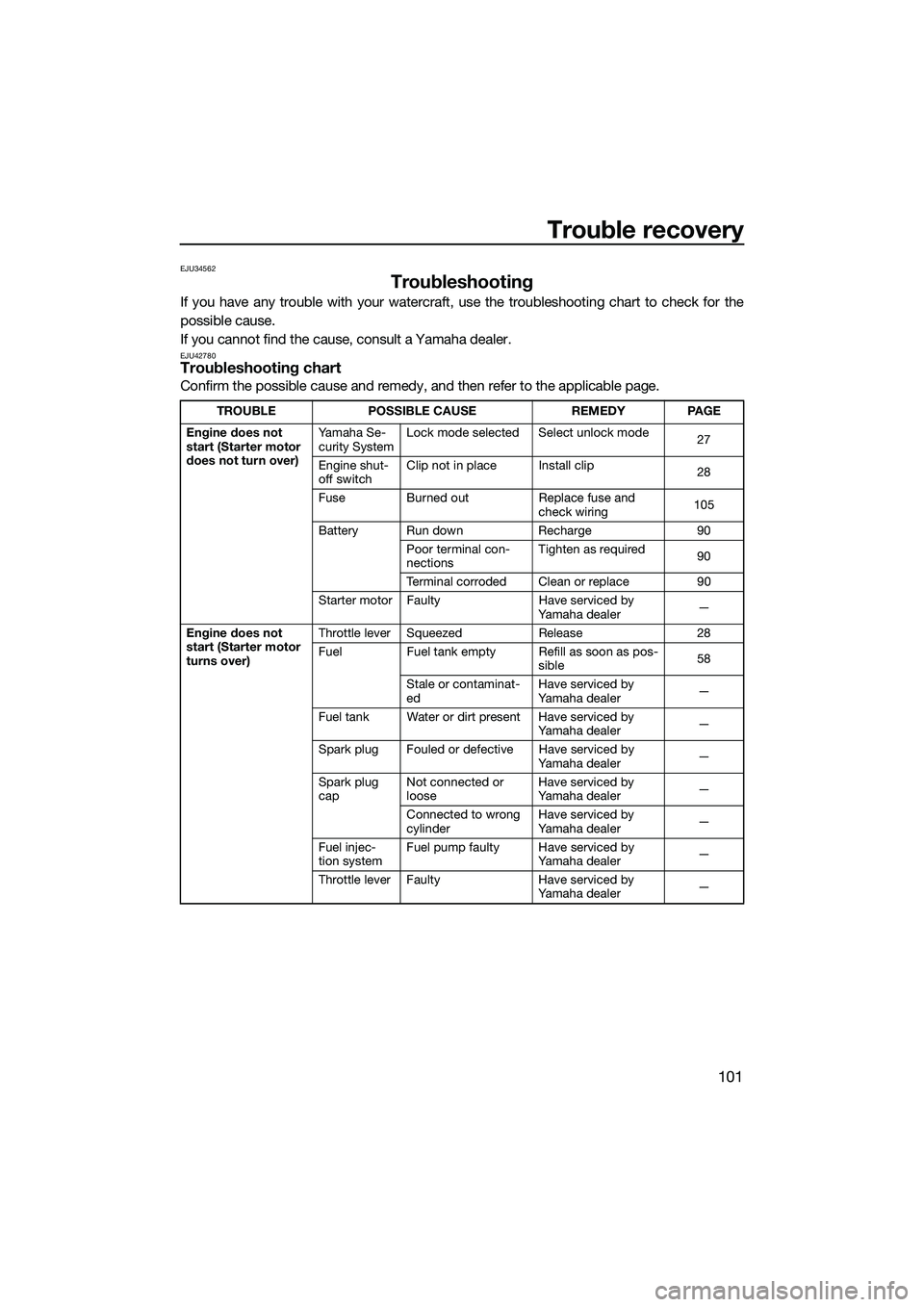
Troubleshooting
If you have any trouble with your watercraft, use the troubleshooting chart to check for the
possible cause.
If you cannot find the cause, consult a Yamaha dealer.
EJU42780Troubleshooting chart
Confirm the possible cause and remedy, and then refer to the applicable page.
TROUBLEPOSSIBLE CAUSE REMEDYPAGE
Engine does not
start (Starter motor
does not turn over) Ya m a h a S e -
curity System
Lock mode selected Select unlock mode
27
Engine shut-
off switch Clip not in place Install clip
28
Fuse Burned out Replace fuse and
check wiring 105
Battery Run down Recharge90
Poor terminal con-
nections Tighten as required
90
Terminal corroded Clean or replace 90
Starter motor Faulty Have serviced by
Yamaha dealer —
Engine does not
start (Starter motor
turns over) Throttle lever Squeezed
Release28
Fuel Fuel tank empty Refill as soon as pos-
sible 58
Stale or contaminat-
ed Have serviced by
Yamaha dealer
—
Fuel tank Water or dirt present Have serviced by Yamaha dealer—
Spark plug Fouled or defective Have serviced by Yamaha dealer—
Spark plug
cap Not connected or
loose Have serviced by
Yamaha dealer
—
Connected to wrong
cylinder Have serviced by
Yamaha dealer
—
Fuel injec-
tion system Fuel pump faulty Have serviced by
Yamaha dealer —
Throttle lever Faulty Have serviced by
Yamaha dealer —
UF3J70E0.book Page 101 Wednesd
ay, October 9, 2013 2:07 PM
Page 111 of 118

Trouble recovery
105
(2) Remove any weeds or debris fromaround the jet intake, drive shaft, impel-
ler, jet pump housing, and jet thrust noz-
zle.
If debris is difficult to remove, consult a
Yamaha dealer.
EJU34642Jumping the battery
If the watercraft battery has run down, the en-
gine can be started using a 12-volt booster
battery and jumper cables.
EJU34664Connecting the jumper cables
WARNING
EWJ01251
To avoid battery explosion and serious
damage to the electrical system:
Do not reverse the polarity of the jumper
cables when connecting to the batter-
ies.
Do not connect the negative (–) jumper
cable to the negative (–) terminal of the
watercraft battery.
Do not touch the positive (+) jumper ca-
ble to the negative (–) jumper cable.
(1) Connect the positive (+) jumper cable to the positive (+) battery terminals of both
batteries.
(2) Connect one end of the negative (–) jumper cable to the negative (–) battery
terminal of the booster battery. (3) Connect the other end of the negative (–)
jumper cable to an engine hanger.
(4) Start the engine, and then disconnect the jumper cables by reversing the steps
above. (See page 28 for information on
starting the engine.)
EJU36995Replacing the fuses
If a fuse is blown, replace it with the proper
fuse.
To replace a fuse:
(1) Remove the seats. (See page 49 for seatremoval and installation procedures.)
1Negative (–) jumper cable
2 Booster battery
3 Positive (+) jumper cable
4 Engine hanger
1 Good fuse
2 Blown fuse
1
4
3
2
2
1
UF3J70E0.book Page 105 Wednesd ay, October 9, 2013 2:07 PM
Page 112 of 118

Trouble recovery
106
(2) Remove the electrical box cover.
(3) Loosen the cap on the electrical box andremove it.
(4) Replace the blown fuse with the spare fuse of the correct amperage by using
the fuse puller on the reverse side of the
cap. WARNING! Do not use fuses of a
different amperage than recommend-
ed. Substitution with a fuse that has
an improper rating can cause exten- sive electrical system damage and
possible fire.
[EWJ00803]
(5) Securely install the cap by tightening it
until it stops.
(6) Securely install the electrical box cover in its original position.
1Electrical box cover
1
1Electrical box
2 Spare fuse
3 Fuse
4 Cap
1 Fuse puller
Fuse amperage:
Battery fuse: 30 A
Main relay drive fuse: 10 A
Electronic throttle valve fuse:
10 A
Security system fuse: 3 A
Main fuse: 20 A
1
4 3
2
UF3J70E0.book Page 106 Wednesd
ay, October 9, 2013 2:07 PM