2014 YAMAHA AEROX50 check engine
[x] Cancel search: check enginePage 35 of 78

OPERATION AND IMPORTANT RIDING POINTS
5-4
5
EAU16831
Engine break-inThere is never a more important period
in the life of your engine than the period
between 0 and 1000 km (600 mi). For
this reason, you should read the fol-
lowing material carefully.
Since the engine is brand new, do not
put an excessive load on it for the first
1000 km (600 mi). The various parts in
the engine wear and polish themselves
to the correct operating clearances.
During this period, prolonged full-throt-
tle operation or any condition that
might result in engine overheating
must be avoided.
EAU45583
0–150 km (0–90 mi)
Avoid prolonged operation above 1/3
throttle.
150–500 km (90–300 mi)
Avoid prolonged operation above 1/2
throttle.500–1000 km (300–600 mi)
Avoid prolonged operation above 3/4
throttle. NOTICE: After 1000 km (600
mi) of operation, be sure to change
the engine oil and final transmission
oil, and to clean the oil strainer.
[ECA16502]1000 km (600 mi) and beyond
The vehicle can now be operated nor-
mally.NOTICE
ECA10271
If any engine trouble should occur
during the engine break-in period,
immediately have a Yamaha dealer
check the vehicle.
EAU17214
ParkingWhen parking, stop the engine, and
then remove the key from the main
switch.
WARNING
EWA10312
Since the engine and exhaust
system can become very hot,
park in a place where pedestri-
ans or children are not likely to
touch them and be burned.
Do not park on a slope or on soft
ground, otherwise the vehicle
may overturn, increasing the
risk of a fuel leak and fire.
Do not park near grass or other
flammable materials which
might catch fire.
U1GBE0E0.book Page 4 Wednesday, June 26, 2013 4:04 PM
Page 37 of 78
PERIODIC MAINTENANCE AND ADJUSTMENT
6-2
6
EAU46872
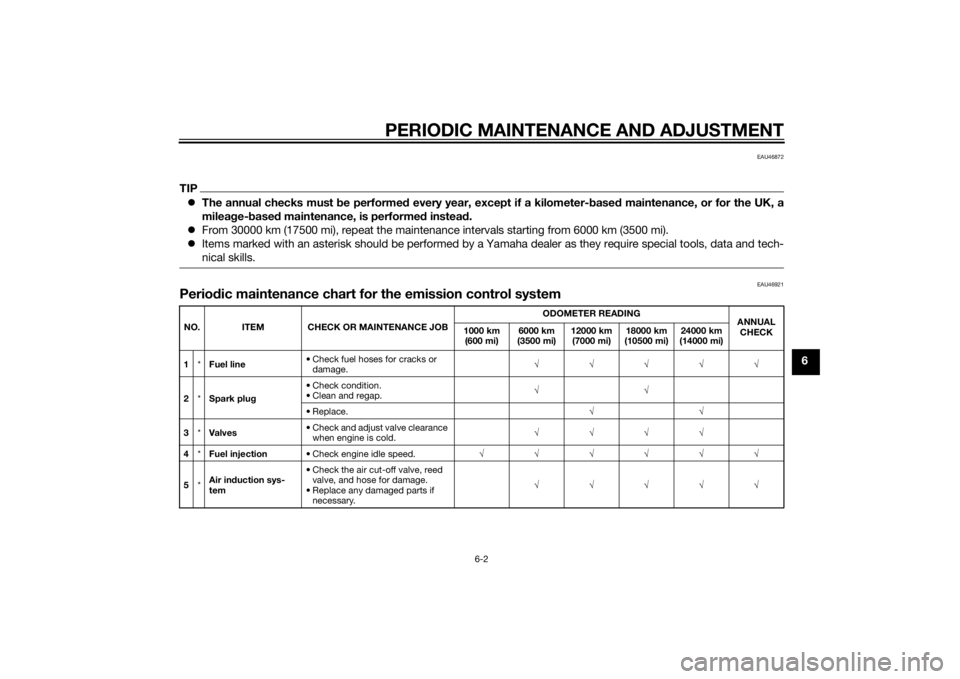
TIPThe annual checks must be performed every year, except if a kilometer-based maintenance, or for the UK, a
mileage-based maintenance, is performed instead.
From 30000 km (17500 mi), repeat the maintenance intervals starting from 6000 km (3500 mi).
Items marked with an asterisk should be performed by a Yamaha dealer as they require special tools, data and tech-
nical skills.
EAU46921
Periodic maintenance chart for the emission control systemNO. ITEM CHECK OR MAINTENANCE JOBODOMETER READING
ANNUAL
CHECK 1000 km
(600 mi)6000 km
(3500 mi)12000 km
(7000 mi)18000 km
(10500 mi)24000 km
(14000 mi)
1*Fuel line• Check fuel hoses for cracks or
damage.√√√√√
2*Spark plug• Check condition.
• Clean and regap.√√
•Replace.√√
3*Valves• Check and adjust valve clearance
when engine is cold.√√√√
4*Fuel injection• Check engine idle speed.√√√√√√
5*Air induction sys-
tem• Check the air cut-off valve, reed
valve, and hose for damage.
• Replace any damaged parts if
necessary.√√√√√
U1GBE0E0.book Page 2 Wednesday, June 26, 2013 4:04 PM
Page 39 of 78

PERIODIC MAINTENANCE AND ADJUSTMENT
6-4
6
10*Wheel bearings• Check bearing for looseness or
damage.√√√√
11*Steering bearings• Check bearing play and steering
for roughness.√√√√√
• Lubricate with lithium-soap-
based grease.Every 24000 km (14000 mi)
12*Chassis fasteners• Make sure that all nuts, bolts and
screws are properly tightened.√√√√√
13Front brake lever
pivot shaft• Lubricate with silicone grease.√√√√√
14Rear brake lever
pivot shaft• Lubricate with silicone grease.√√√√√
15 Centerstand• Check operation.
• Lubricate.√√√√√
16*Front fork• Check operation and for oil leak-
age.√√√√
17*Shock absorber as-
sembly• Check operation and shock ab-
sorber for oil leakage.√√√√
18 Engine oil• Change. (See page 3-2.)√2000 km (1200 mi) after the initial 1000 km (600 mi) and every
3000 km (1800 mi) thereafter
• Check oil level and vehicle for oil
leakage.Every 3000 km (1800 mi)√
19*Engine oil strainer• Clean.√Every 6000 km (3500 mi)
20*Cooling system• Check coolant level and vehicle
for coolant leakage.√√√√√
• Change coolant. Every 3 years NO. ITEM CHECK OR MAINTENANCE JOBODOMETER READING
ANNUAL
CHECK
1000 km
(600 mi)6000 km
(3500 mi)12000 km
(7000 mi)18000 km
(10500 mi)24000 km
(14000 mi)
U1GBE0E0.book Page 4 Wednesday, June 26, 2013 4:04 PM
Page 42 of 78

PERIODIC MAINTENANCE AND ADJUSTMENT
6-7
6
EAUM3251
Checking the spark plugThe spark plug is an important engine
component, which is easy to check.
Since heat and deposits will cause any
spark plug to slowly erode, the spark
plug should be removed and checked
in accordance with the periodic main-
tenance and lubrication chart. In addi-
tion, the condition of the spark plug
can reveal the condition of the engine.
To remove the spark plug
1. Remove panel A. (See page 6-6.)
2. Remove the battery. NOTICE:
When removing the battery, be
sure the key is turned to “ ”,
then disconnect the negative
lead before disconnecting the
positive lead.
[ECA17711]
3. Remove the partition between the
battery and the spark plug by re-
moving the screws.4. Remove the spark plug cap.
5. Remove the spark plug as shown,
with a spark plug wrench available
at a Yamaha dealer.To check the spark plug
1. Check that the porcelain insulator
around the center electrode of the
spark plug is a medium-to-light
tan (the ideal color when the vehi-
cle is ridden normally).
TIPIf the spark plug shows a distinctly dif-
ferent color, the engine could be oper-
ating improperly. Do not attempt to
diagnose such problems yourself. In-
stead, have a Yamaha dealer check
the vehicle.
1. Battery
2. Screw
3. Partition
4. Spark plug cap
1. Spark plug capZAUM1080
3 142
1. Spark plug wrench
U1GBE0E0.book Page 7 Wednesday, June 26, 2013 4:04 PM
Page 44 of 78

PERIODIC MAINTENANCE AND ADJUSTMENT
6-9
6
EAUM3170
Engine oil and oil strainerThe engine oil level should be checked
before each ride. In addition, the oil
must be changed and the oil strainer
cleaned at the intervals specified in the
periodic maintenance and lubrication
chart.
To check the engine oil level
1. Place the scooter on the center-
stand. A slight tilt to the side can
result in a false reading.
2. Start the engine, warm it up for
several minutes, and then turn it
off.3. Wait a few minutes until the oil set-
tles, remove the oil filler cap, wipe
the dipstick clean, insert it back
into the oil filler hole (without
screwing it in), and then remove it
again to check the oil level.
TIPThe engine oil should be between the
minimum and maximum level marks.4. If the engine oil is below the mini-
mum level mark, add sufficient oil
of the recommended type to raise
it to the correct level.
5. Insert the dipstick into the oil filler
hole, and then tighten the oil filler
cap.
To change the engine oil and clean
the oil strainer
1. Start the engine, warm it up for
several minutes, and then turn it
off.
2. Place an oil pan under the engine
to collect the used oil.3. Remove the engine oil filler cap
and the engine oil drain bolts A
and B to drain the oil from the
crankcase. NOTICE: When re-
moving the engine oil drain bolt
B, the O-ring, compression
spring, and oil strainer will fall
out. Take care not to lose these
parts.
[ECAT1022]
1. Engine oil filler cap
2. Maximum level mark
3. Minimum levelZAUM1071
1. Engine oil drain bolt A
U1GBE0E0.book Page 9 Wednesday, June 26, 2013 4:04 PM
Page 45 of 78

PERIODIC MAINTENANCE AND ADJUSTMENT
6-10
6 4. Clean the oil strainer with solvent,
and then check it for damage and
replace it if necessary.
5. Check the O-ring for damage and
replace it if necessary.
6. Install the oil strainer, compres-
sion spring, O-ring and engine oil
drain bolt B.
TIPMake sure that the O-ring is properly
seated.7. Install engine oil drain bolt A, and
then tighten both drain bolts to
their specified torques.8. Refill with the specified amount of
the recommended engine oil, and
then install and tighten the oil filler
cap.
NOTICE
ECA11671
Do not use oils with a diesel
specification of “CD” or oils of a
higher quality than specified. In
addition, do not use oils labeled
“ENERGY CONSERVING II” or
higher.
Be sure no foreign material en-
ters the crankcase.
9. Start the engine, and then let it idle
for several minutes while checking
it for oil leakage. If oil is leaking,
immediately turn the engine off
and check for the cause.
10. Turn the engine off, and then
check the oil level and correct it if
necessary.
To reset the oil change indicatorTIPThe oil change indicator can only be re-
set when “OIL CHANGE” appears in
the multi-function display.1. While the key is turned to “ ”,
hold the button pushed more than
eight seconds.
1. Engine oil drain bolt B
2. Strainer
3. Compression spring
4. O-ring
Tightening torque:
Engine oil drain bolt A:
23 Nm (2.3 m·kgf, 17 ft·lbf)
Engine oil drain bolt B:
32 Nm (3.2 m·kgf, 23 ft·lbf)
Recommended engine oil:
See page 8-1.
Oil change quantity:
0.78 L (0.82 US qt, 0.69 Imp.qt)
1. Oil filler hole
U1GBE0E0.book Page 10 Wednesday, June 26, 2013 4:04 PM
Page 46 of 78

PERIODIC MAINTENANCE AND ADJUSTMENT
6-11
62. Release the button, and the oil
change indicator will go off.
EAUT1562
Final transmission oilThe final transmission case must be
checked for oil leakage before each
ride. If any leakage is found, have a
Yamaha dealer check and repair the
scooter. In addition, the final transmis-
sion oil must be changed as follows at
the intervals specified in the periodic
maintenance and lubrication chart.
1. Start the engine, warm it up by rid-
ing the scooter for several min-
utes, and then stop the engine.
2. Place the scooter on the center-
stand.
3. Place an oil pan under the final
transmission case to collect the
used oil.4. Remove the oil filler bolt and drain
bolt to drain the oil from the final
transmission case.
5. Install the final transmission oil
drain bolt, and then tighten it to
the specified torque.
6. Refill with the specified amount of
the recommended final transmis-
sion oil, and then install the oil filler
bolt and tighten it to the specified
torque. WARNING! Make sure
that no foreign material enters
the final transmission case.
Make sure that no oil gets on
the tire or wheel.
[EWA11312]
1. Final transmission oil filler bolt
2. Final transmission oil drain boltZAUM1073
2
1
Tightening torque:
Final transmission oil drain bolt:
13 Nm (1.3 m·kgf, 9.4 ft·lbf)
Tightening torque:
Final transmission oil filler bolt:
23 Nm (2.3 m·kgf, 17 ft·lbf)
Recommended final transmission
oil:
See page 8-1.
Oil quantity:
0.10 L (0.11 US qt, 0.09 Imp.qt)
U1GBE0E0.book Page 11 Wednesday, June 26, 2013 4:04 PM
Page 47 of 78
PERIODIC MAINTENANCE AND ADJUSTMENT
6-12
6 7. Check the final transmission case
for oil leakage. If oil is leaking,
check for the cause.
EAU20071
CoolantThe coolant level should be checked
before each ride. In addition, the cool-
ant must be changed at the intervals
specified in the periodic maintenance
and lubrication chart.
EAUM3180
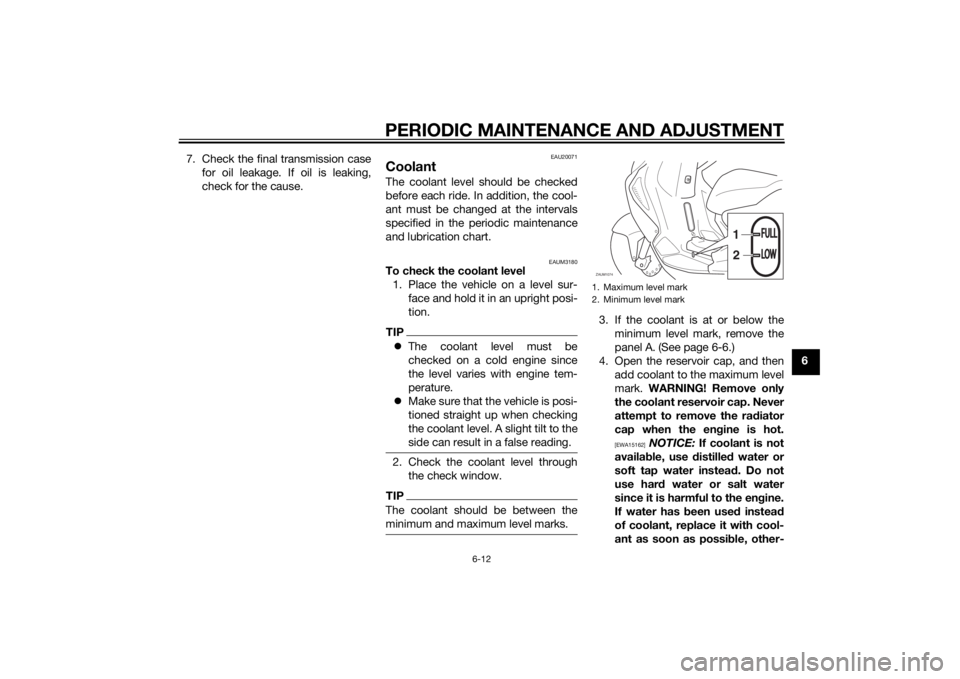
To check the coolant level
1. Place the vehicle on a level sur-
face and hold it in an upright posi-
tion.TIPThe coolant level must be
checked on a cold engine since
the level varies with engine tem-
perature.
Make sure that the vehicle is posi-
tioned straight up when checking
the coolant level. A slight tilt to the
side can result in a false reading.2. Check the coolant level through
the check window.TIPThe coolant should be between the
minimum and maximum level marks.
3. If the coolant is at or below the
minimum level mark, remove the
panel A. (See page 6-6.)
4. Open the reservoir cap, and then
add coolant to the maximum level
mark. WARNING! Remove only
the coolant reservoir cap. Never
attempt to remove the radiator
cap when the engine is hot.
[EWA15162]
NOTICE: If coolant is not
available, use distilled water or
soft tap water instead. Do not
use hard water or salt water
since it is harmful to the engine.
If water has been used instead
of coolant, replace it with cool-
ant as soon as possible, other-
1. Maximum level mark
2. Minimum level markZAUM1074
1
2
FULLFULLLOWLOW
U1GBE0E0.book Page 12 Wednesday, June 26, 2013 4:04 PM