2014 VOLVO XC70 Motor
[x] Cancel search: MotorPage 281 of 394

07 During your trip
Refueling
07
279
Octane rating
Minimum octane
G028920
Typical pump octane labelVolvo recommends premium fuel for best performance, but using 87 octane 1
or above
will not affect engine reliability.
Demanding drivingIn demanding driving conditions, such as operating the vehicle in hot weather, towing atrailer, or driving for extended periods athigher altitudes than normal, it may be advis-able to switch to higher octane fuel (91 orhigher) or to change gasoline brands to fullyutilize your engine's capacity, and for thesmoothest possible operation.
NOTE
When switching to higher octane fuel or changing gasoline brands, it may be nec-essary to fill the tank more than oncebefore a difference in engine operation isnoticeable.
Fuel FormulationsDo not use gasoline that contains lead as a knock inhibitor, and do not use lead addi-tives. Besides damaging the exhaust emis-sion control systems on your vehicle, leadhas been strongly linked to certain forms ofcancer. Many fuels contain benzene as a solvent. Unburned benzene has been strongly linkedto certain forms of cancer. If you live in anarea where you must fill your own gas tank,take precautions. These may include:
• standing upwind away from the filler noz- zle while refueling
• refueling only at gas stations with vaporrecovery systems that fully seal themouth of the filler neck during refueling
• wearing neoprene gloves while handling afuel filler nozzle.
Use of AdditivesWith the exception of gas line antifreeze dur- ing winter months, do not add solvents, thick-eners, or other store-bought additives to yourvehicle's fuel, cooling, or lubricating systems.Overuse may damage your engine, and someof these additives contain organically volatilechemicals. Do not needlessly expose yourselfto these chemicals.
WARNING
Never carry a cell phone that is
switched
on while refueling your vehicle. If the
phone rings, this may cause a spark that could ignite gasoline fumes, resulting infire and injury.
WARNING
Carbon monoxide is a poisonous, color- less, and odorless gas. It is present in allexhaust gases. If you ever smell exhaustfumes inside the vehicle, make sure thepassenger compartment is ventilated, andimmediately return the vehicle to a trainedand qualified Volvo service technician forcorrection.
1 AKI (ANTI KNOCK INDEX) is an average of the Research Octane Number (RON) and the Motor Octane Number (MON), MON+RON/2.
Page 313 of 394

08 Wheels and tires
Vehicle loading
08
311
Loads
Properly loading your vehicle will provide maximum return of vehicle design perform-ance. Before loading your vehicle, familiarize your- self with the following terms for determiningyour vehicle's weight ratings, with or withouta trailer, from the vehicle's Federal/CanadianMotor Vehicle Safety Standards (FMVSS/CMVSS) label, and the vehicle's tire informa-tion placard:
Curb weightThe weight of the vehicle including a full tankof fuel and all standard equipment. It doesnot include passengers, cargo, or optionalequipment.
Capacity weightAll weight added to the curb weight, includingcargo and optional equipment. When towing,trailer hitch tongue load is also part of cargoweight.
NOTE
For trailer towing information, please refer to the section "Towing a trailer" on page293.
Permissible axle weightThe maximum allowable weight that can be carried by a single axle (front or rear). Thesenumbers are shown on the Federal/CanadianMotor Vehicle Safety Standards (FMVSS/CMVSS) label. The total load on each axlemust never exceed its maximum permissibleweight.
Gross vehicle weight (GVW)The vehicle's curb weight + cargo + passen-gers.
NOTE
•The location of the various labels in your vehicle can be found on page370.
• A table listing important weight limitsfor your vehicle can be found on page373.
Steps for Determining Correct Load Limit
1. Locate the statement "the combined
weight of occupants and cargo should never exceed XXX pounds" on your vehi-cle's placard. 2. Determine the combined weight of the
driver and passengers that will be ridingin your vehicle.
3. Subtract the combined weight of the driver and passengers from XXX kilo-grams or XXX pounds.
4. The resulting figure equals the available amount of cargo and luggage loadcapacity. For example, if the "XXX"amount equals 1400 lbs. and there will befive 150 lb. passengers in your vehicle,the amount of available cargo and lug-gage load capacity is 650 lbs. (1400 – 750 (5 × 150) = 650 lbs.)
5. Determine the combined weight of lug- gage and cargo being loaded on the vehi-cle. That weight may not safely exceedthe available cargo and luggage loadcapacity calculated in Step 4.
6. If your vehicle will be towing a trailer, load from your trailer will be transferred to your vehicle. Consult this manual 1
to deter-
mine how this reduces the available cargo and luggage load capacity of yourvehicle.
1 See page 293.
Page 315 of 394

08 Wheels and tires
Uniform Tire Quality Grading
08
313
Quality grading information
ALL PASSENGER VEHICLE TIRES MUST CONFORM TO FEDERAL SAFETYREQUIREMENTS IN ADDITION TO THESEGRADES Quality grades can be found, where appli- cable, on the tire sidewall between thetread shoulder and maximum sectionwidth. For example: Treadwear 200 Traction AA Temperature A
TREADWEARThe treadwear grade is a comparative rating based on the wear rate of the tire when tes-ted under controlled conditions on a specifiedgovernment test course. For example, a tiregraded 150 would wear one and one half(1 1/2) times as well on the governmentcourse as a tire graded 100. The relative per-formance of tires depends upon the actualconditions of their use, however, and manydepart significantly from the norm due to var-iation in driving habits, maintenance practicesand differences in road characteristics andclimate.
TRACTIONThe traction grades, from highest to lowest,are AA, A, B, and C, as measured under con-trolled conditions on specified governmenttest surfaces of asphalt and concrete. A tiremarked C may have poor traction perform-ance. The traction grade assigned to this tireis based on braking (straight-ahead) tractiontests and is not a measure of cornering (turn-ing) traction.
WARNING
The traction grade assigned to this tire is based on braking (straight-ahead) tractiontests and is not a measure of cornering(turning) traction.
TEMPERATUREThe temperature grades are A (the highest), B, and C, representing the tire's resistance tothe generation of heat and its ability to dissi-pate heat when tested under controlled con-ditions on a specified indoor laboratory testwheel. Sustained high temperature can causethe material of the tire to degenerate andreduce tire life, and excessive temperaturecan lead to sudden tire failure. The grade Ccorresponds to a minimum level of perform-ance that all passenger vehicle tires mustmeet under the Federal Motor Safety Stand-ard No. 109. Grades B and A represent higherlevels of performance on the laboratory testwheel than the minimum required by law.
WARNING
The temperature grade for this tire is established for a tire that is properly infla-ted and not overloaded. Excessive speed,under-inflation, or excessive loading, eitherseparately or in combination, can causeheat buildup and tire failure.
Page 359 of 394

09 Maintenance and specifications
Fuses09
}}
357
PosFunctionA
Coils-A/C compressor5
Starter motor relay30
Ignition coils, condenser20
Engine Control Module10
Injection system, mass air meter, engine control module15
A/C compressor, engine valves, engine control mod-ule (6-cyl.), solenoids (6-cyl.non-turbo only)10
EVAP valve, heated oxygen sensor15
-
Fuel leakage detection5
–
Cooling fan80
Electro-hydraulic power steering100
Page 373 of 394
10 Specifications
Label information
10
371
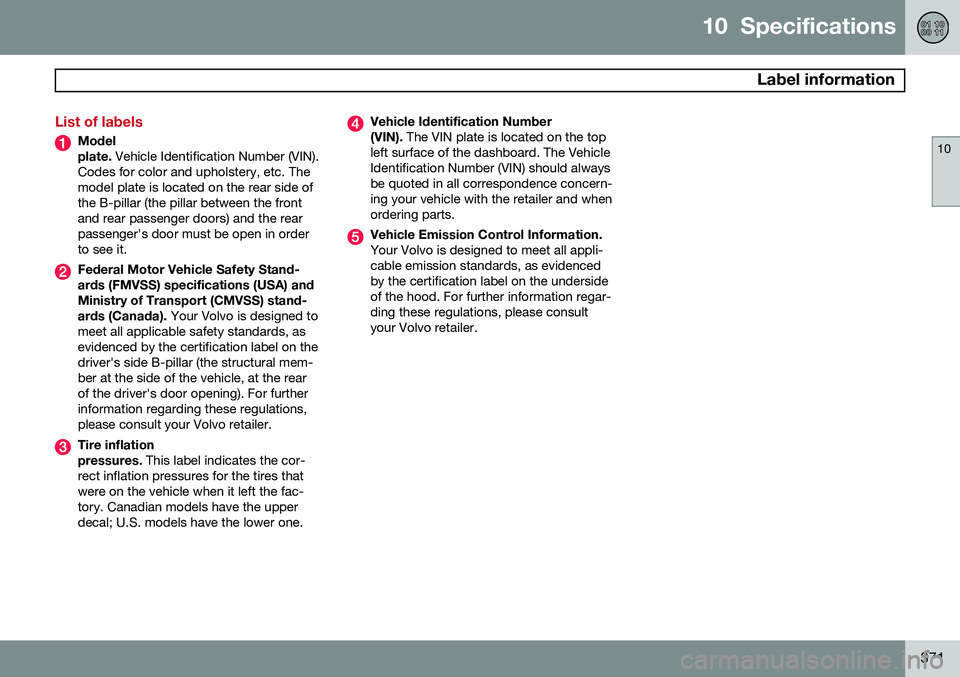
List of labels
Model plate. Vehicle Identification Number (VIN).
Codes for color and upholstery, etc. The model plate is located on the rear side ofthe B-pillar (the pillar between the frontand rear passenger doors) and the rearpassenger's door must be open in orderto see it.
Federal Motor Vehicle Safety Stand- ards (FMVSS) specifications (USA) andMinistry of Transport (CMVSS) stand- ards (Canada). Your Volvo is designed to
meet all applicable safety standards, as evidenced by the certification label on thedriver's side B-pillar (the structural mem-ber at the side of the vehicle, at the rearof the driver's door opening). For furtherinformation regarding these regulations,please consult your Volvo retailer.
Tire inflation pressures. This label indicates the cor-
rect inflation pressures for the tires that were on the vehicle when it left the fac-tory. Canadian models have the upperdecal; U.S. models have the lower one.
Vehicle Identification Number (VIN). The VIN plate is located on the top
left surface of the dashboard. The Vehicle Identification Number (VIN) should alwaysbe quoted in all correspondence concern-ing your vehicle with the retailer and whenordering parts.
Vehicle Emission Control Information. Your Volvo is designed to meet all appli- cable emission standards, as evidencedby the certification label on the undersideof the hood. For further information regar-ding these regulations, please consultyour Volvo retailer.
Page 388 of 394

11 Index
11
386
Instrument panel................................ 77, 197Integrated two-stage booster cushion...... 50
Interior Air Quality System....................... 206
Interior lighting................................. 102, 103iPod ® connector (audio system)............. 254
ISOFIX/LATCH anchors............................. 47
J
Jack attaching............................................. 322
location of........................................... 322
Jump starting........................................... 123
K
Key blade................................. 56, 62, 65, 66 private locking...................................... 65
Keyless drive general description............................... 66
starting the vehicle............................. 120
L
Labels list of................................................... 371
location of........................................... 370
LATCH anchors......................................... 47 Leather care............................................. 365
Lighting panel............................................ 97
Load anchoring eyelets........................... 285Loading floor rails............................................. 285
hooks for securing loads............ 285, 286
Loading the vehicle.......................... 283, 311 roof loads............................................ 287
Locking...................................................... 69 tailgate.................................................. 70
Locking the vehicle.................................... 59
Locks, child safety..................................... 53
Low beams................................................ 98
Low oil pressure warning light................... 81
M
Main instrument panel............................. 197
Maintenance............................................ 332 hoisting the vehicle............................. 333
performed by the owner..................... 333
Malfunction indicator light......................... 80
Media player (infotainment system)......... 249
Menu........................................................ 199
Messages in the instrument panel........... 197Mirrors defroster............................................. 111
power door......................................... 110
rearview, auto-dim function................ 111
retractable........................................... 110
vanity.................................................. 225
Moonroof................................................. 115 Motor oil checking............................................. 336
volumes.............................................. 376
MY CAR................................................... 199
N
Net in cargo area..................................... 290