2014 VOLVO V60 battery
[x] Cancel search: batteryPage 346 of 442

||
10 Maintenance and service
10
344
WARNING
The ignition system has very high voltage and output. The voltage in the ignition sys-tem is highly dangerous. The car's electri-cal system must always be in key position0 when work is being performed in the
engine compartment; see Key positions -functions at different levels (p. 70). Do not touch the spark plugs or ignition coil when the car's electrical system is inkey position II or when the engine is hot.
Engine compartment except 4 cyl. 2.0 l 2
The appearance of the engine compartment may differ depending on engine variant.
Coolant expansion tank
Power steering fluid reservoir
Engine oil dipstick
3
Radiator
Filling engine oil
Reservoir for brake and clutch fluid (located on the driver's side)
Battery
Relay and fuse box
Filling washer fluid
Air filter
WARNING
The ignition system has very high voltage and output. The voltage in the ignition sys-tem is highly dangerous. The car's electri-cal system must always be in key position0
when work is being performed in the
engine compartment; see Key positions -functions at different levels (p. 70). Do not touch the spark plugs or ignition coil when the car's electrical system is inkey position II or when the engine is hot.
Related information
• Bonnet - opening and closing (p. 343)
• Engine compartment - checking (p. 344)
Engine compartment - checking
Some oils and fluids should be checked at regular intervals.
Regular checkingCheck the following oils and fluids at regularintervals, e.g. when refuelling:
• Coolant
• Engine oil
• Power steering fluid (not cars with 4-cyl. 2.0 litre engine 4
)
• Washer fluid
WARNING
Remember that the radiator fan (located at the front of the engine compartment,behind the radiator) may start automati-cally some after the engine has beenswitched off. Always have the engine cleaned by a workshop. There is a risk of fire if theengine is hot.
Related information
• Bonnet - opening and closing (p. 343)
• Engine compartment - overview (p. 343)
• Coolant - level (p. 349)
• Engine oil - checking and filling (p. 346)
2
Also applies to the B4204T7 engine.3 Engines with electronic oil level sensor do not have a dipstick (5-cyl. diesel).
4 However, does apply to the B4204T7 engine.
ProCarManuals.co’
Page 363 of 442

10 Maintenance and service
10
361
1. Fold out the wiper arm.
2. Grip the inner section of the blade (by the arrow).
3. Turn anticlockwise to use the blade's end position against the wiper arm as a lever to detach the blade more easily.
4. Press the new wiper blade into position. Check that it is firmly installed.
5. Lower the wiper arm.
CleaningFor cleaning wiper blades and windscreen,see Car washing (p. 379).
IMPORTANT
Check the blades regularly. Neglected maintenance shortens the service life ofthe wiper blades.
Related information
• Washer fluid - filling (p. 361)
Washer fluid - filling
Washer fluid is used for cleaning the head- lamps and windows. Washer fluid with anti-freeze must be used during winter.
The windscreen and headlamp washers share a common reservoir.
IMPORTANT
Use washer fluid with antifreeze during the winter to avoid freezing in the pump, reser-voir and hoses.
For capacities, see Washer fluid - quality and volume (p. 401).
Related information
•Wiper blades (p. 359)
Battery
The service life and function of the battery is influenced by factors such as the number ofstarts, discharging, driving style, driving con-ditions, climatic conditions etc. The starter battery is a traditional 12 V bat- tery.
• Never disconnect the battery when the engine is running.
• Check that the cables to the battery arecorrectly connected and properly tight-ened.
WARNING
•The battery can generate oxyhydrogen gas, which is highly explosive. A sparkcan be formed if a jump lead is con-nected incorrectly, and this can beenough for the battery to explode.
• The battery contains sulphuric acid,which can cause serious burns.
• If sulphuric acid comes into contactwith eyes, skin or clothing, flush withlarge quantities of water. If acidsplashes into the eyes - seek medicalattention immediately.
IMPORTANT
Only a traditional battery charger should ever be used when charging the battery.
ProCarManuals.co’
Page 364 of 442

||
10 Maintenance and service
10
362
IMPORTANT
If the following instruction is not observed then the energy saving function for info-tainment may be temporarily disengaged,and/or the message in the information dis-play about the main battery's state ofcharge may be temporarily inapplicable,following the connection of an externalbattery or battery charger:
• The negative battery terminal on the car's starter battery must
never be
used for connecting an external bat-tery or battery charger - only the car
chassis may be used as the ground-
ing point.
See Jump starting with battery (p. 270) for a description of how the cable clampsmust be attached.
NOTE
The life of the battery is shortened if it becomes discharged repeatedly. The life of the battery is affected by several factors, including driving conditions andclimate. Battery starting capacity decrea-ses gradually with time and thereforeneeds to be recharged if the car is notused for a longer time or when it is onlydriven short distances. Extreme cold fur-ther limits starting capacity. To maintain the battery in good condition, at least 15 minutes of driving/week is rec-ommended or that the battery is con-nected to a battery charger with automatictrickle charging. A battery that is kept fully charged has a maximum service life.
Related information
• Battery - symbols (p. 362)
• Starter battery - replacement (p. 363)
• Battery - Start/Stop (p. 365)
Battery - symbols
There are information and warning symbols on the battery.
Symbols on the battery
Use protective goggles.
Further information is available in the owner'smanual.
Store the battery out of the reach of children.
The battery contains cor- rosive acid.
ProCarManuals.co’
Page 365 of 442

10 Maintenance and service
10
363
Avoid sparks and naked flames.
Risk of explosion.
Must be taken for recy- cling.
NOTE
An expended battery must be recycled in an environmentally safe manner as it con-tains lead.
Related information
•Battery (p. 361)
Starter battery - replacement
The starter battery in the car can be replaced without the help of a workshop. The starter battery is a traditional 12 V bat- tery.
RemovalFirst of all
: Take the remote control key from
the ignition switch and wait at least 5 minutesbefore any electrical connections are touched- this is because the car's electrical systemneeds to store the necessary information tocontrol modules.
Open the clips on the front cover and remove the cover.
Release the rubber moulding so that the rear cover is free.
ProCarManuals.co’
Page 366 of 442

||
10 Maintenance and service
10
364* Option/accessory, for more information, see Introduction.
Remove the rear cover by screwing one quarter turn and lifting it away.
WARNING
Connect and remove the positive and neg- ative cables in the correct order.
Detach the black negative cable.
Detach the red positive cable.
Detach the ventilation hose from the bat- tery.
Loosen the screw holding the battery clamp.
Move the battery aside.
Lift it up.
Cross-stay on the R-Design*
Cross-stay and plenum chamber cover.
Cars with R-Design have a cross-stay that must be removed before the main battery canbe replaced.
1. Remove the plenum chamber covers on the right and left-hand sides. Prize care- fully with a plastic knife or similar.
2. Loosen and remove the screws (one on the right and one on the left-hand side)that hold the cross-stay.
3. Remove the cross-stay. > Now the main battery can be removedin accordance with the previous sec-tion.
• Fitting the cross-stay takes place in the reverse order.
NOTE
Tighten the screws to 30 Nm. Check the torque with a torque wrench.
Fitting
1. Lower the battery into the battery box.
2. Move the battery inward and to the side
until it reaches the rear edge of the box.
3. Tighten the clamp that holds the battery.
4. Connect the ventilation hose. > Check that it is correctly connected toboth battery and outlet in the body.
5. Connect the red positive cable.
6. Connect the black negative cable.
7. Press in the rear cover. (See earlier sec- tion "Removal".)
8. Fit the rubber moulding. (See "Removal".)
9. Align the front cover and secure it with the clips. (See "Removal".)
ProCarManuals.co’
Page 367 of 442

10 Maintenance and service
10
* Option/accessory, for more information, see Introduction.365
For more information on the car's battery - Electrical system (p. 410).
Battery - Start/Stop
Cars with the Start/Stop function are equip- ped with two 12 V batteries - one extra pow-erful battery for starting and one support bat-tery that helps during the Start/Stop func-tion's starting sequence. For more information on Start/Stop - see Start/Stop* (p. 279). For more information on the car's battery - see Jump starting with battery (p. 270) andStarter battery - specification (p. 411).
BatteryStartingAuxiliary
Cold start capacity
A
,
CCA (A)760180
Size B
,
L×W×H (mm)278×175×190150×90×130
Capacity (Ah)7010
A In accordance with the SAE standard.
B Largest possible size.
IMPORTANT
When replacing batteries in cars with the Start/Stop function, the AGM 12
type bat-
teries must be fitted.
NOTE
• The higher the current take-off in the car (extra cooling/heating, etc.) themore the batteries must be charged =increased fuel consumption.
• When the capacity of the battery hasfallen below the lowest permissiblelevel then the Start/Stop function isdisengaged.
Temporarily reduced Start/Stop function due to high current take-off means: •
The engine starts automatically 13
without
the driver depressing the clutch pedal (manual gearbox).
• The engine starts automatically withoutthe driver lifting his/her foot off the footbrake pedal (automatic gearbox).
12
Absorbed Glass Mat
13 Automatic starting can only take place if the gear lever is in neutral position.
ProCarManuals.co’
Page 368 of 442
||
10 Maintenance and service
10
366
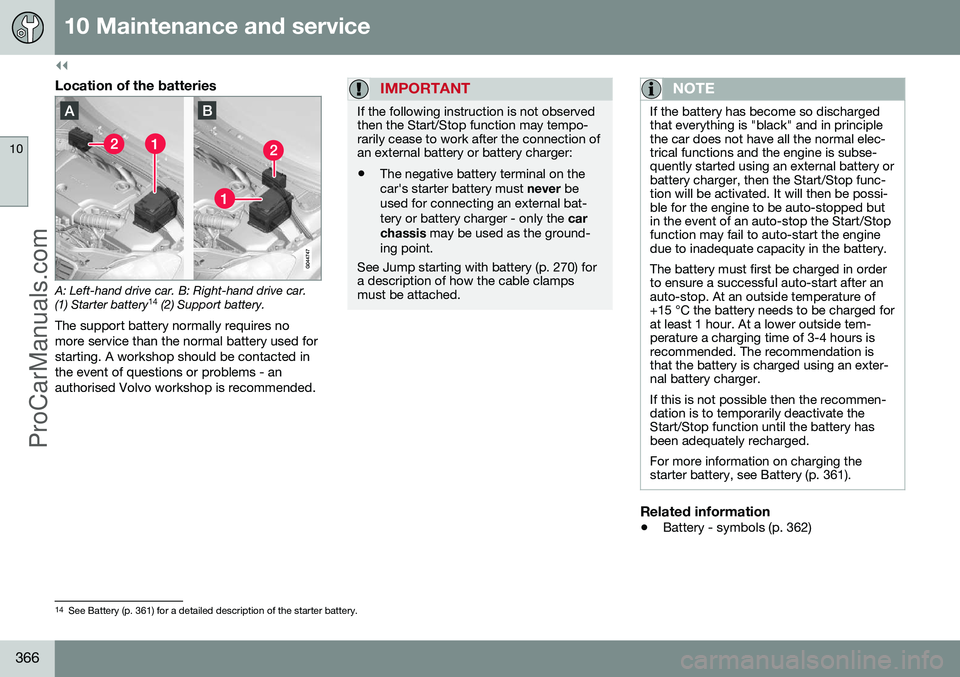
Location of the batteries
A: Left-hand drive car. B: Right-hand drive car. (1) Starter battery14
(2) Support battery.
The support battery normally requires no more service than the normal battery used forstarting. A workshop should be contacted inthe event of questions or problems - anauthorised Volvo workshop is recommended.
IMPORTANT
If the following instruction is not observed then the Start/Stop function may tempo-rarily cease to work after the connection ofan external battery or battery charger:
• The negative battery terminal on the car's starter battery must
never be
used for connecting an external bat-tery or battery charger - only the car
chassis may be used as the ground-
ing point.
See Jump starting with battery (p. 270) for a description of how the cable clampsmust be attached.
NOTE
If the battery has become so discharged that everything is "black" and in principlethe car does not have all the normal elec-trical functions and the engine is subse-quently started using an external battery orbattery charger, then the Start/Stop func-tion will be activated. It will then be possi-ble for the engine to be auto-stopped butin the event of an auto-stop the Start/Stopfunction may fail to auto-start the enginedue to inadequate capacity in the battery. The battery must first be charged in order to ensure a successful auto-start after anauto-stop. At an outside temperature of+15 °C the battery needs to be charged forat least 1 hour. At a lower outside tem-perature a charging time of 3-4 hours isrecommended. The recommendation isthat the battery is charged using an exter-nal battery charger. If this is not possible then the recommen- dation is to temporarily deactivate theStart/Stop function until the battery hasbeen adequately recharged. For more information on charging the starter battery, see Battery (p. 361).
Related information
• Battery - symbols (p. 362)
14
See Battery (p. 361) for a detailed description of the starter battery.
ProCarManuals.co’
Page 380 of 442

||
10 Maintenance and service
10
378
FunctionA
Primary fuse for relay/fuse box under the glovebox60
Primary fuse for central electri- cal unit in cargo area60
Ventilation fan40
––
––
Start relay30
Internal diode50
Support battery70
Central electronic module (CEM) - reference voltage sup-port battery; Charging pointsupport battery15
Related information
•Fuses - in engine compartment (p. 368)
• Fuses - under glovebox (p. 372)
• Fuses - in the control module under the glovebox (p. 374)
• Fuses - in cargo area (p. 376)
ProCarManuals.co’