2014 VOLKSWAGEN PASSAT engine compartment
[x] Cancel search: engine compartmentPage 34 of 392

Other important vehicle labels
Factory-installed safety certificates, stickers and signs containing important information regarding vehicle operation can be found in the engine compartment and on certain vehicle components, such as inside the fuel filler flap, on the passenger sun visor, on the driver door jamb or on the luggage compartment floor.
x Do not remove, alter or render unusable or illegible any safety certificates, stickers and labels.
x If vehicle components bearing safety certificates, stickers, or labels are replaced, make certain that the firm doing the work attaches new conforming certificates, stickers, or labels to the same part of the new components.
x Safety Compliance Certification Label: A safety certificate affixed to the door jamb in the driver door confirms that at time of production all necessary safety standards and requirements of the traffic safety agency of the respective country were met. The month and year of production as well as the vehicle identification number may be listed as well.
x Radiator fan and high voltage warning sticker: A warning sticker about the radiator fan and the high voltage of the electrical system is located in the engine compartment next to the engine hood release. The vehicle ignition system complies with the Canadian standard ICES-002.
x Fuel grade sticker: An information sticker listing the correct fuel grade for your vehicle, Refueling.
x Tire inflation pressure label: An information sticker listing the correct tire inflation pressure on the inside of the driver door (Tire inflation pressure).
Applicable only in the United States
Engine data
Page 49 of 392

All turn signals flash twice to confirm that the vehicle has been unlocked and once to confirm that it has been locked.
If the vehicle was unlocked and within the next few seconds no door or the luggage compartment lid has been opened, the vehicle is automatically locked again.
Unlocking and opening doors (Keyless Entry)
x Grasp the door handle of the driver or front passenger door so that you touch the unlocking sensor surface (A).
x Open the door.
Closing and locking doors (Keyless Exit)
x Close the driver door.
x Touch the sensor surface in the door handle on the driver or front passenger door (B). The vehicle is locked. The door being locked must be closed.
Unlocking and locking the luggage compartment lid
If the vehicle is locked and a valid remote control vehicle key is within range ⇒ fig. 38 of the luggage compartment lid, it unlocks automatically when opened.
x Open and close the luggage compartment lid as you would a standard luggage compartment lid, Luggage compartment lid.
The luggage compartment lid locks automatically when it is closed except in the following situations:
x The vehicle is completely unlocked.
x When an authorized remote control vehicle key is inside the vehicle.
Locking with a second vehicle key
If a remote control vehicle key is inside the passenger compartment, the vehicle can be locked from the outside only if a second valid remote control vehicle key is within range.
When the vehicle is locked from the outside, the keyless go (starting) function of any keys left in the passenger compartment will be deactivated. All other functions (remote central locking and unlocking as well as emergency starting) remain active and unchanged.
A key that was inside the vehicle when it was locked from the outside is reactivated:
x by pressing a button on the deactivated key.
x by pressing a door handle sensor when the deactivated key is outside of the vehicle, but within range.
x by starting the engine with the starter button on the center console (but not by starting the engine with the remote start button on a key that is outside of the vehicle, Remote start feature).
Automatic deactivation of sensors
If the vehicle has not been unlocked or locked for a longer period of time, the proximity sensors in the passenger door are automatically deactivated.
If a sensor on the door handle of a locked vehicle is activated too often, for instance by a bush or hedge that rubs against the vehicle, the sensors in the door handle on that side of the vehicle are switched off for about 30 minutes.
The door handle sensors become active again if one of the following events occurs:
x 30 minutes have passed.
x OR: The vehicle is unlocked using the 0 button in the remote control vehicle key.
x OR: The luggage compartment lid is opened.
x OR: The vehicle is mechanically unlocked with the vehicle key.
Page 51 of 392

Preparation for the anti-theft alarm system
If the vehicle is pre-equipped for installation of the anti-theft alarm system, the alarm system can be retrofitted by an authorized Volkswagen dealer or an authorized Volkswagen Service Facility.
The anti-theft alarm system makes it more difficult for someone to break into or steal the vehicle.
The anti-theft alarm system is automatically activated when the vehicle is locked by pressing the lock button on the remote control vehicle key.
When is the alarm triggered?
The anti-theft alarm system sounds for about 30 seconds and the turn signals flash for up to 5 minutes if the following occurs with respect to the locked vehicle:
x Opening a door that has been mechanically unlocked without switching on the ignition within about 15 seconds.
x Forcibly opening a door.
x Forcibly opening the engine hood.
x Forcibly opening the luggage compartment lid.
x Switching on the ignition with an invalid key.
x Disconnecting the vehicle battery.
Deactivating the alarm
Unlock the vehicle with the unlock button on the remote control vehicle key and switch on the ignition with a valid vehicle key.
For vehicles with Keyless Access, the alarm can be deactivated by grasping one of the door handles when a valid remote control vehicle key is in range or by holding the remote control vehicle key to the right of the steering column trim and pressing the starter button, Unlocking and locking vehicles with Keyless Access.
After the alarm has stopped and the vehicle is opened again in the same or a different area that is protected by the alarm, the alarm is triggered again. For example, the alarm will sound again if the luggage compartment lid is opened after one of the doors has been opened.
The anti-theft alarm system is not activated when the vehicle is locked with the power lock switch 1 on the inside of the driver or front passenger doors.
If the driver door is mechanically unlocked using the vehicle key bit, only the driver door is unlocked, but not the entire vehicle. Switching on the ignition deactivates the anti-theft alarm system and activates the central locking button. To unlock the doors, use the central locking button or remote control vehicle key.
If the vehicle battery is dead or weak, the anti-theft alarm system will not work properly.
Page 95 of 392
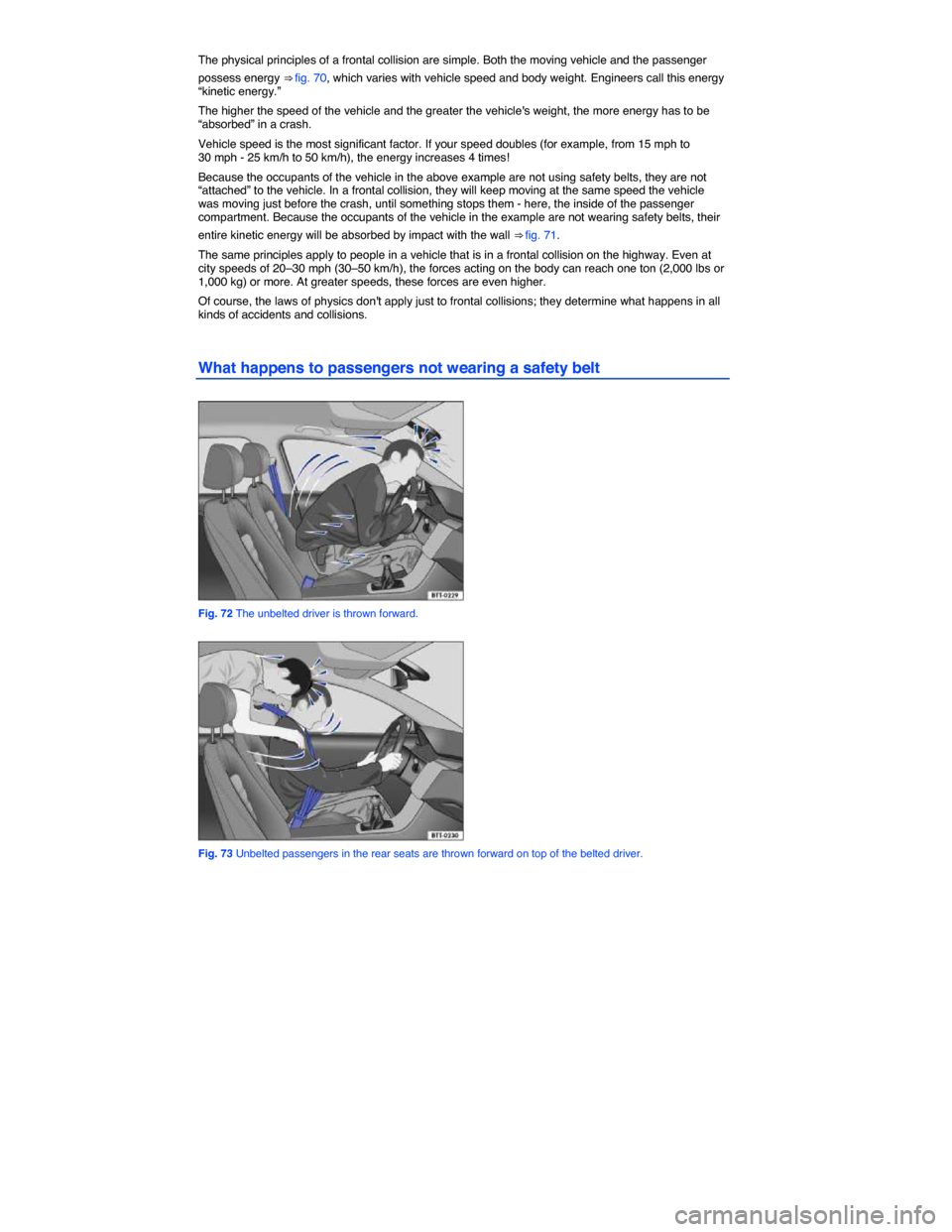
The physical principles of a frontal collision are simple. Both the moving vehicle and the passenger
possess energy ⇒ fig. 70, which varies with vehicle speed and body weight. Engineers call this energy “kinetic energy.”
The higher the speed of the vehicle and the greater the vehicle's weight, the more energy has to be “absorbed” in a crash.
Vehicle speed is the most significant factor. If your speed doubles (for example, from 15 mph to 30 mph - 25 km/h to 50 km/h), the energy increases 4 times!
Because the occupants of the vehicle in the above example are not using safety belts, they are not “attached” to the vehicle. In a frontal collision, they will keep moving at the same speed the vehicle was moving just before the crash, until something stops them - here, the inside of the passenger compartment. Because the occupants of the vehicle in the example are not wearing safety belts, their
entire kinetic energy will be absorbed by impact with the wall ⇒ fig. 71.
The same principles apply to people in a vehicle that is in a frontal collision on the highway. Even at city speeds of 20–30 mph (30–50 km/h), the forces acting on the body can reach one ton (2,000 lbs or 1,000 kg) or more. At greater speeds, these forces are even higher.
Of course, the laws of physics don't apply just to frontal collisions; they determine what happens in all kinds of accidents and collisions.
What happens to passengers not wearing a safety belt
Fig. 72 The unbelted driver is thrown forward.
Fig. 73 Unbelted passengers in the rear seats are thrown forward on top of the belted driver.
Page 122 of 392
x Dirt: Caked-on dust, wax, any other buildup on the windshield (lotus effect), or car-wash detergent residue can lower the rain sensor's sensitivity and cause it to react too slowly or not at all.
x Crack or chip in the windshield: If a stone hits and chips the windshield while the rain sensor is on, this will trigger a wiper cycle. After that, the rain sensor will recognize the change and re-calibrate itself to respond to the sensitive surface's reduced detection zone. Depending on the size of the chip, the sensor's reaction pattern may or may not change.
WARNING
The rain sensor cannot always recognize rain and activate the wipers.
x Switch the wipers on manually when water on the windshield reduces visibility.
Clean the rain sensor's sensitive surface (arrow) regularly and check the wiper blades for wear or damage.
To remove wax and coats of polish safely, we recommend using an alcohol-based windshield cleaner.
Checking and refilling windshield washer fluid
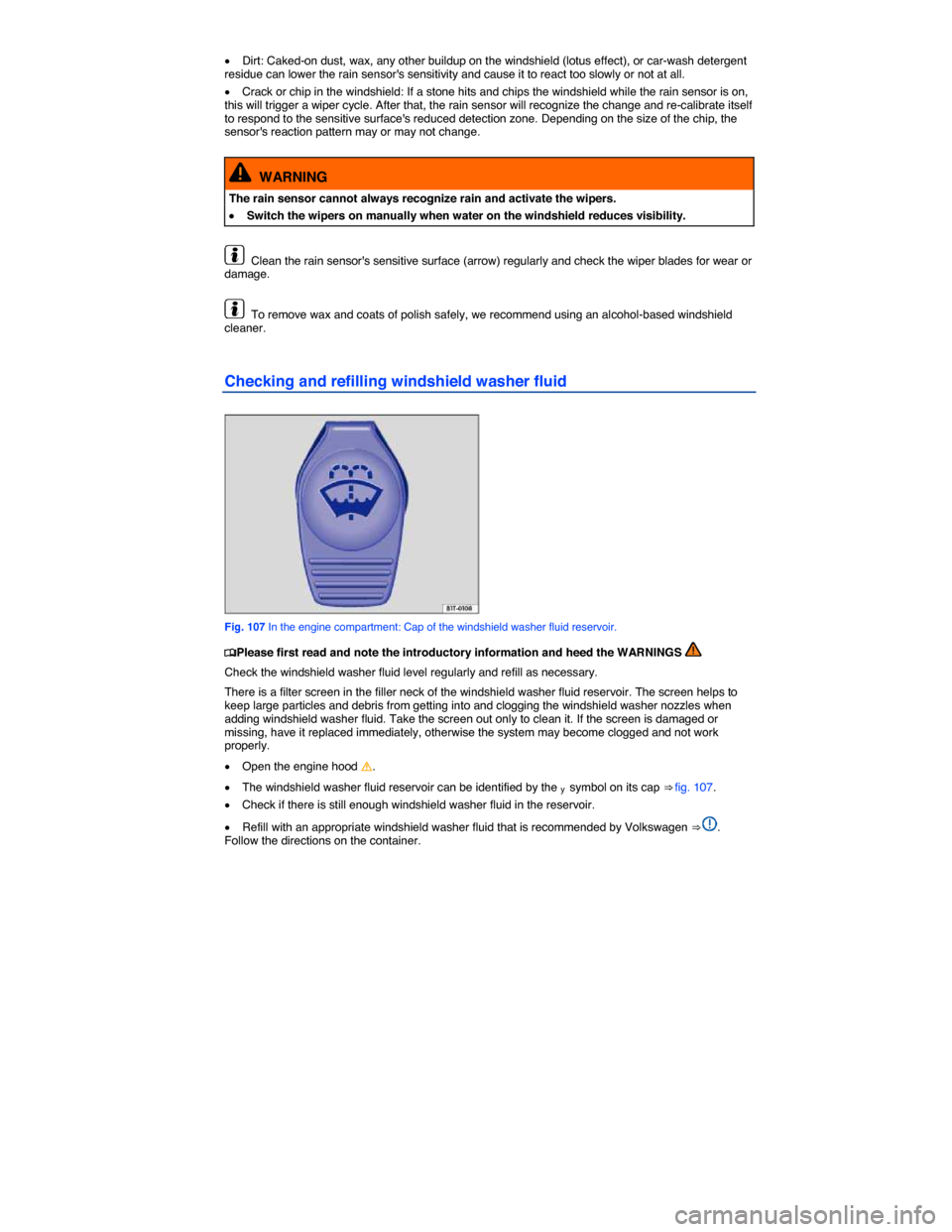
Fig. 107 In the engine compartment: Cap of the windshield washer fluid reservoir.
Page 133 of 392

x Factory-installed or retrofitted accessories.
x Hitch weight and tongue weight for trailer towing.
Please refer to the Gross Vehicle Weight Rating (GVWR) and the Gross front and rear Axle Weight Ratings (GAWR) for your vehicle, which are printed on the vehicle's Safety Compliance Certification Label on the driver door jamb.
WARNING
Exceeding maximum permissible weight ratings can result in vehicle damage, accidents, and serious personal injury.
x Never let the actual weights at the front and rear axles exceed the permissible Gross Axle Weight Rating. Also, never let the total of these actual weights exceed the Gross Vehicle Weight Rating.
x Always remember that the vehicle's handling and braking will be affected by extra load and the distribution of this load. Adjust your speed accordingly.
NOTICE
x Always distribute the load evenly and as low as possible in the vehicle. The vehicle capacity weight figures apply when the load is distributed evenly in the vehicle (passengers and luggage).
x When transporting a heavy load in the luggage compartment, carry the load as close to the rear axle (as far forward) as possible so that the vehicle's handling and braking are affected as little as possible.
Gasoline engines
Maximum power output (SAE net) Engine ID code Transmission Curb weight4 Gross vehicle weight rating
Gross front axle weight rating
Gross rear axle weight rating
170 hp (125 kW) CBTA
5S manual
3272 – 3300 lbs(1484 – 1497 kg)
4431 lbs (2010 kg) 2271 lbs(1030 kg) 2271 lbs (1030 kg)
6S automatic
3325 – 3360 lbs(1508 – 1524 kg)
4475 lbs (2030 kg) 2315 lbs(1050 kg) 2271 lbs (1030 kg)
280 hp (206 kW) CDVB DSG® 6S automatic
3448 – 3481 lbs(1564 – 1579 kg)
4630 lbs (2100 kg) 2381 lbs(1080 kg) 2359 lbs (1070 kg)
Diesel engines
4 Depending on equipment version.
Page 134 of 392

Maximum power output (SAE net) Engine ID codeTransmission Curb weight4 Gross vehicle weight rating
Gross front axle weight rating
Gross rear axle weight rating
140 hp (103 kW) with DPF CKRA 6S manual 3441 – 3468 lbs(1561 – 1573 kg)
4586 lbs (2080 kg) 2359 lbs (1070 kg) 2337 lbs (1060 kg)
DSG® 6S automatic 3497 – 3519 lbs(1586 – 1596 kg)
4652 lbs (2110 kg) 2425 lbs (1100 kg) 2337 lbs (1060 kg)
WARNING
Exceeding maximum permissible weight ratings can result in vehicle damage, accidents, and serious personal injury.
x Never let the actual weights at the front and rear axles exceed the permissible Gross Axle Weight Rating. Also, never let the total of these actual weights exceed the Gross Vehicle Weight Rating.
x Always remember that the vehicle's handling and braking will be affected by extra load and the distribution of this load. Adjust your speed accordingly.
NOTICE
x Always distribute luggage evenly and as low as possible within the vehicle. The vehicle capacity weight figures apply when the load is distributed evenly in the vehicle (passengers and luggage).
x When transporting a heavy load in the luggage compartment, carry the load as close to the rear axle (as far forward) as possible so that the vehicle's handling and braking are affected as little as possible.
Page 204 of 392

WARNING
Improper use of vehicle keys can result in serious personal injury.
x Always take the key with you when you leave the vehicle. The engine can be started and vehicle systems such as the power windows can be operated, leading to serious personal injury.
x Never leave children, disabled persons, or anyone who cannot help themselves in the vehicle. The doors can be locked with the remote control vehicle key. This could result in people being trapped in the vehicle in an emergency. For example, depending on the time of year, people trapped in the vehicle can be exposed to very high or very low temperatures.
x Heat build-up in the passenger and luggage compartment of a parked vehicle can result in temperatures in the vehicle that are much higher than the outside temperatures, particularly in summer. Temperatures can quickly reach levels that can cause unconsciousness and death, particularly to small children.
x Never remove the key from the ignition switch while the vehicle is moving or rolling to a stop. The steering wheel will lock and you will not be able to steer or control the vehicle.
Leaving the key in the ignition for a long time when the engine is not running will drain the vehicle battery.
Leaving the selector lever for a long period of time in any position other than Park (P) when the ignition is switched off can drain the vehicle battery.
On automatic transmission vehicles, the vehicle key can be removed from the ignition switch only when the transmission is in Park (P). You may have to press the release button on the transmission selector lever to put the lever into Park (P).
Starter button
Fig. 148 In the center console: Starter button of the Keyless Access locking and starting system.