2014 VAUXHALL ANTARA heating
[x] Cancel search: heatingPage 122 of 217
120Climate controlFixed air ventsAdditional air vents are located
beneath the windscreen, door
windows and in the front and rear foot
wells.
The area underneath the front seats
must be kept clear, to allow air flow to the rear passenger foot well.Maintenance
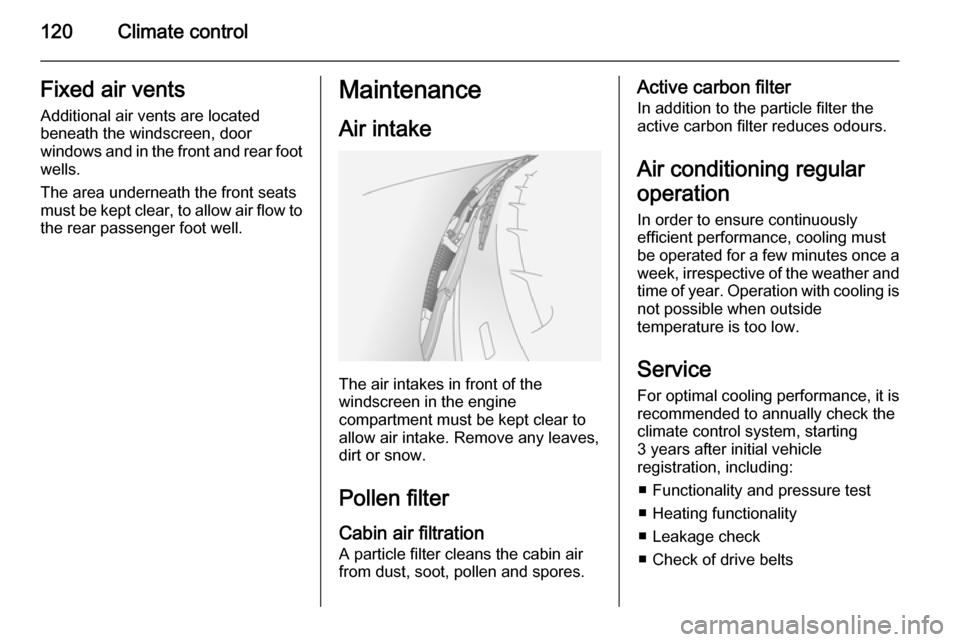
Air intake
The air intakes in front of the
windscreen in the engine
compartment must be kept clear to
allow air intake. Remove any leaves,
dirt or snow.
Pollen filterCabin air filtration
A particle filter cleans the cabin air
from dust, soot, pollen and spores.
Active carbon filter
In addition to the particle filter the
active carbon filter reduces odours.
Air conditioning regular
operation In order to ensure continuously
efficient performance, cooling must
be operated for a few minutes once a
week, irrespective of the weather and time of year. Operation with cooling is
not possible when outside
temperature is too low.
Service For optimal cooling performance, it isrecommended to annually check the
climate control system, starting
3 years after initial vehicle
registration, including:
■ Functionality and pressure test■ Heating functionality
■ Leakage check
■ Check of drive belts
Page 125 of 217

Driving and operating123Ignition switch positionsLOCK=Ignition offACC=Steering wheel lock
released, ignition offON=Ignition on, for diesel
engine: preheatingSTART=StartingStarting the engine
Manual transmission: operate clutch
and brake pedals.
Automatic transmission: operate
brake pedal and move selector lever
to P or N.
Do not operate accelerator pedal.
Diesel engines: turn the key to
position ON for preheating until
control indicator ! extinguishes
3 87.
Turn key briefly to position START
and release. Key returns
automatically to position ON.
Before restarting or to switch off the
engine, turn key back to LOCK.
Start attempts should not last longer
than 15 seconds. If engine does not
start, wait 10 seconds before
repeating starting procedure.
The increased engine speed
automatically returns to normal idling
speed as the engine temperature
rises. Drive at a moderate speed,
especially in cold weather, until
normal engine operating
temperatures have been reached.
During an Autostop, the engine can
be started by depressing the clutch
pedal.
Stop-start system 3 124.
Starting the vehicle at low
temperatures In extremely cold temperatures, i.e.
below -20 °С, it may be necessary to
crank the engine for up to
30 seconds for it to start.
Turn key to position START and hold
until engine starts. Start attempts
should not last longer than
Page 127 of 217

Driving and operating125
An Autostop is indicated by the
needle at the AUTOSTOP position in
the tachometer.
During an Autostop, the heating, power steering and brake
performance will be maintained.
Air conditioning system may or may
not inhibit the stop-start system
according to the cooling performance.
Caution
The steering assist can be
reduced during an Autostop.
Conditions for an Autostop
The stop-start system checks if each
of the following conditions is fulfilled.
■ The stop-start system is not manually deactivated
■ the bonnet is fully closed
■ the driver's door is closed or the driver's seat belt is fastened
■ the vehicle battery is sufficiently charged and in good condition
■ the engine is warmed up
■ the engine coolant temperature is not too high or low
■ the engine exhaust temperature is not too high, e.g. after driving with
high engine load
■ the ambient temperature is not too low
■ the defrosting function is not activated
■ the climate control system does not
inhibit an engine stop
■ the brake vacuum is sufficient■ the self-cleaning function of the diesel particle filter is not active
■ the vehicle has moved since the last Autostop
Otherwise an Autostop will be
inhibited.
Certain settings of the climate control
system may inhibit an Autostop. See
Climate control chapter for more
details 3 116.
Immediately after motorway driving
an Autostop may be inhibited.
New vehicle running-in 3 122.
Vehicle battery discharge protection
To ensure reliable engine restarts, several vehicle battery discharge
protection features are implemented
as part of the stop-start system.
Restart of the engine by the
driver
Depress the clutch pedal to restart the
engine.
The engine start is indicated by the
needle at the idle speed position in
the tachometer.
Page 136 of 217

134Driving and operating
Towing the vehicle 3 188.
Driving through water
Do not exceed the maximum wading
depth 3 204.
Check the depth of water: choose the
lowest entry and departure angles
before entering. Maintain a steady
engine speed, to help prevent water
from entering the exhaust system, but do not exceed 3 mph, to avoid
splashing the water.
Drive with the flow wherever possible,
not against it. If you have to drive
against the flow, try to drive at an
angle to it, so that the leading corner
of the vehicle will help deflect water
from the engine compartment. Avoid
splashing the water - if the ignition
system becomes wet, the engine may
stall.
Avoid water entering the air intake
system. If water enters the air intake
system, engine seizure with severe
costly damage may result.
Test the brakes after leaving the
water - wet brakes are less effective
than dry ones. Perform the serviceoperations for wading , involving
checks for water contamination, at
the earliest opportunity.
Service checks after wading
Check for the ingress of water into the following:
■ Brake fluid reservoir
■ Air cleaner element
■ Engine
■ Transmission
■ Axles
■ Interior of vehicle
Renew any lubricating oil or hydraulic
fluid that has a milky appearance,
indicating contamination with water.
Cleaning
Clean the vehicle thoroughly and as
soon as possible after driving off-
road.
Do not let mud remain dry on any part
of the vehicle as it becomes abrasive
and can damage paint, glass, seals,
bearings and brake components. If
left to build up, mud can seriously
affect the airflow through and overmechanical components and cause
localised overheating and failure of
parts, especially in the engine
compartment.
Ensure the radiator core and the area between the radiator and intercooler/
oil cooler (where installed) is cleaned, to maintain proper cooling air flow.
Check the radiator and cooler cores
for blockage (sand, silt etc.).
Check the tyre treads.
Clean and check the mechanical
parts of the vehicle, particularly the following areas:
■ Driveshafts, including sealing bellows
■ Front brake calipers, pads and discs
■ Front suspension
■ Clutch fork sealing bellows
■ Rear brake calipers, pads and discs
■ Rear suspension
■ Fuel tank and underguard
■ Breathers, axles and fuel tank
■ Load sensing valve
Page 146 of 217

144Driving and operatingCaution
Certain additives in petrol could, in
combination with ethanol, cause
reduced driveability. For this
reason, refuel with a full tank of
petrol every 6000 miles. Use up
the majority of this before
refuelling the car again.
Fuel for diesel engines
Only use diesel fuel that complies
with EN 590.
In countries outside the European
Union use Euro-Diesel fuel with a
sulphur concentration below 50 ppm.
Caution
Use of fuel that does not comply
with EN 590 or similar can lead to engine power loss, increased
wear or engine damage and loss
of warranty.
Do not use marine diesel oils, heating
oils, Aquazole and similar diesel-
water emulsions. Diesel fuels must
not be diluted with fuels for petrol
engines.
Refuelling9 Danger
Before refuelling, switch off engine
and any external heaters with
combustion chambers. Switch off
any mobile phones.
Follow the operating and safety
instructions of the filling station
when refuelling.
9 Danger
Fuel is flammable and explosive.
No smoking. No naked flames or
sparks.
If you can smell fuel in your
vehicle, have the cause of this
remedied immediately by a
workshop.
Caution
In case of misfuelling, do not
switch on ignition.
Fuel filler flap is located at left rear
side of vehicle.
The fuel filler flap can only be opened
if the vehicle is unlocked 3 20.
Release the fuel filler flap by pushing the flap.
To unlock fuel filler cap: turn it
anticlockwise. If hissing occurs, wait
until it stops before completely
unscrewing the cap.
Page 174 of 217

172Vehicle care
FuseCircuitAMPAmplifierAPO JACK
(CONSOLE)Power outlet
(centre console)APO JACK
(REAR CARGO)Power outlet
(load compart‐
ment)AWD/VENTAll-wheel drive,
ventilationBCM (CTSY)Courtesy lightsBCM (DIMMER)Instrument illu‐
minationBCM (INT LIGHT
TRLR FOG)Interior lights,
trailer fog lightBCM (PRK/TRN)Parking lights,
turn signalsBCM (STOP)Brake lightsBCM (TRN SIG)Turn signalsBCM (VBATT)Battery voltageFuseCircuitCIMCommunica‐
tions Integration
ModuleCLSTRInstrument
clusterDRLDaytime running
lightsDR/LCKDriver door lockDRVR PWR
SEATDriver power
seatDRV/PWR
WNDWDriver power
windowF/DOOR LOCKFuel filler flapFRT WSRFront washerFSCMFuel systemFSCM/VENT SOLFuel system,
vent solenoidHEATING MAT
SWHeating mat
switchHTD SEAT PWRSeat heatingFuseCircuitHVAC BLWRClimate control,
air conditioning
fanIPCInstrument panel clusterISRVM/RCMInterior mirror,
remote compass moduleKEY CAPTUREKey captureL/GATETailgateLOGISTIC MODELogistic modeOSRVMExterior mirrorsPASS PWR
WNDWPassenger
power windowPWR DIODEPower diodePWR MODINGPower modingRADIORadioRR FOGHeated rear
window
Page 193 of 217

Vehicle care191
If using a car wash, comply with the
car wash manufacturer's instructions.
The windscreen wiper and rear
window wiper must be switched off.
Remove antenna and external
accessories such as roof racks etc.
If you wash your vehicle by hand,
make sure that the insides of the
wheel housings are also thoroughly
rinsed out.
Clean edges and folds on opened
doors and the bonnet as well as the
areas they cover.Caution
Always use a cleaning agent with
a pH value of 4 to 9.
Do not use cleaning agents on hot surfaces.
Have the door hinges of all doors
greased by a workshop.
Do not clean the engine compartment with a steam-jet or high-pressure jet
cleaner.
When cleaning with a high-pressure
jet cleaner, ensure a minimum
distance of 30 cm when working
around the tailgate to prevent
unintended unlocking.
Thoroughly rinse and leather-off the
vehicle. Rinse leather frequently. Use
separate leathers for painted and
glass surfaces: remnants of wax on
the windows will impair vision.
Exterior lights
Headlight and other light covers are
made of plastic. Do not use any
abrasive or caustic agents, do not use an ice scraper, and do not clean them
dry.
Polishing and waxing Wax the vehicle regularly (at the
latest when water no longer beads).
Otherwise, the paintwork will dry out.
Polishing is necessary only if the paint
has become dull or if solid deposits
have become attached to it.
Paintwork polish with silicone forms a
protective film, making waxing
unnecessary.Plastic body parts must not be treated with wax or polishing agents.
Windows and windscreen wiper blades
Use a soft lint-free cloth or chamois leather together with window cleanerand insect remover.
When cleaning the rear window,
make sure the heating element inside
is not damaged.
For mechanical removal of ice, use a
sharp-edged ice scraper. Press the
scraper firmly against the glass so
that no dirt can get under it and
scratch the glass.
Clean smearing wiper blades with a
soft cloth and window cleaner.
Sunroof
Never clean with solvents or abrasive
agents, fuels, aggressive media
(e.g. paint cleaner, acetone-
containing solutions etc.), acidic or
highly alkaline media or abrasive
pads. Do not apply wax or polishing
agents to the sunroof.
Page 214 of 217

212
Fuel consumption - CO2-
Emissions ............................... 145
Fuel economy mode ....................88
Fuel filler cap ................................ 84
Fuel for diesel engines ..............144
Fuel for petrol engines ...............143
Fuel gauge ................................... 80
Fuses ......................................... 165
G
Gauges ......................................... 79
General information ...................146
Glovebox ..................................... 55
Graphic-Info-Display, Colour- Info-Display .............................. 93
H Halogen headlights ....................160
Hand brake ................................. 136
Hazard warning flashers ............107
Headlight flash ........................... 106
Headlight range adjustment ......106
Headlights .................. 105, 106, 159
Headlights when driving abroad 107
Headlight washer ..........................73
Head restraint adjustment .............8
Head restraints ............................ 33
Heated mirrors ............................. 28
Heated rear window ..................... 31
Heating ........................................ 38Heating and ventilation system . 114
High beam ........................... 89, 106
Hill start assist ........................... 137
Horn ....................................... 13, 73
I
Identification plate .....................198
Ignition switch positions .............123
Immobiliser ............................ 26, 89
Indicators ...................................... 79
Information displays...................... 91
Instrument cluster ........................79
Instrument panel fuse box .........170
Instrument panel illumination .....165
Instrument panel illumination control .................................... 110
Instrument panel overview ........... 10
Interior care ............................... 192
Interior lighting ............................ 110
Interior lights ...................... 110, 164
Interior mirrors .............................. 28
Interruption of power supply ......131
Introduction .................................... 3
ISOFIX child restraint systems ....54
J
Jump starting ............................. 187K
Kerb weight........................... 70, 204
Keys ............................................. 18
Keys, locks ................................... 18
Kickdown .................................... 130
L Lashing eyes ............................... 69
Light covers, misted.................... 109
Lighting ....................................... 105
Lighting features .........................112
Light switch ................................ 105
Load compartment ................22, 67
Load compartment cover .............67
Load compartment lighting ........111
Load compartment storage ..........67
Loading information .....................70
Low engine oil level .....................88
Low fuel ....................................... 89
M Malfunction indicator light ............84
Manual anti-dazzle ......................28
Manual mode ............................. 130
Manual transmission .................. 132
Mirror adjustment ........................... 9
Mirrors .................................... 27, 28
Misted light covers .....................109