2014 TOYOTA YARIS Rear brake
[x] Cancel search: Rear brakePage 2 of 400

TABLE OF CONTENTSIndex
2
1-1. Key informationKeys ..................................... 28
1-2. Opening, closing and locking the doors
Wireless remote control ....... 31
Side doors ............................ 34
Back door ............................. 38
1-3. Adjustable components (seats, mirrors, steering
wheel)
Front seats ........................... 43
Rear seats ............................ 47
Head restraints ..................... 51
Seat belts ............................. 54
Steering wheel ..................... 62
Anti-glare inside rear view mirror .................................. 63
Outside rear view mirrors ..... 64
1-4. Opening and closing the windows
Power windows .................... 67
1-5. Refueling Opening the fuel tank cap .... 69
1-6. Theft deterrent system Engine immobilizer system ................................ 72
Alarm (Puerto Rico).............. 74
Theft prevention labels (except Canada) ................ 77 1-7. Safety information
Correct driving posture ......... 78
SRS airbags ......................... 80
Front passenger occupant classification system ........... 92
Child restraint systems ......... 98
Installing child restraints ..... 102
2-1. Driving procedures Driving the vehicle .............. 112
Engine (ignition) switch....... 124
Automatic transmission ...... 127
Manual transmission........... 129
Turn signal lever ................. 130
Parking brake ..................... 131
Horn .................................... 132
2-2. Instrument cluster Gauges and meters ............ 133
Indicators and warning lights ................................. 136
Multi-information display ..... 140
2-3. Operating the lights and wipers
Headlight switch ................. 145
Fog light switch ................... 149
Windshield wiper and washer .............................. 151
Rear window wiper and washer .............................. 154
1Before driving
2When driving
Page 49 of 400

49
1-3. Adjustable components (s
eats, mirrors, steering wheel)
1
Before driving
CAUTION
■When folding the rear seatbacks down
Observe the following precautions. Failure to do so may result in death or
serious injury.
●Do not fold the seatbacks down while driving.
● Stop the vehicle on level ground, set the parking brake and shift the shift
lever to P (vehicles with an automatic transmission) or N (vehicles with a
manual transmission).
● Do not allow anyone to sit on a folded seatback or in the luggage compart-
ment while driving.
● Do not allow children to enter the luggage compartment.
● For vehicles with a split rear seats, do not allow anyone sit on the rear cen-
ter seat if the rear right seat is folded down, as the seat belt buckle for the
rear center seat belt is then concealed under the folded seat and cannot
be used.
● Be careful not to catch your hand when folding the rear seatbacks.
● If it is necessary to detach the head restraints, remove it from the vehicle
or store it securely in the luggage compartment. This will prevent it from
injuring passengers in the event of sudden braking, sudden swerving or an
accident.
● Depending on the position of the front seat, it may interfere when trying to
fold down the rear seatbacks. If this happens, adjust the position of the
front seat.
Page 111 of 400
When driving2
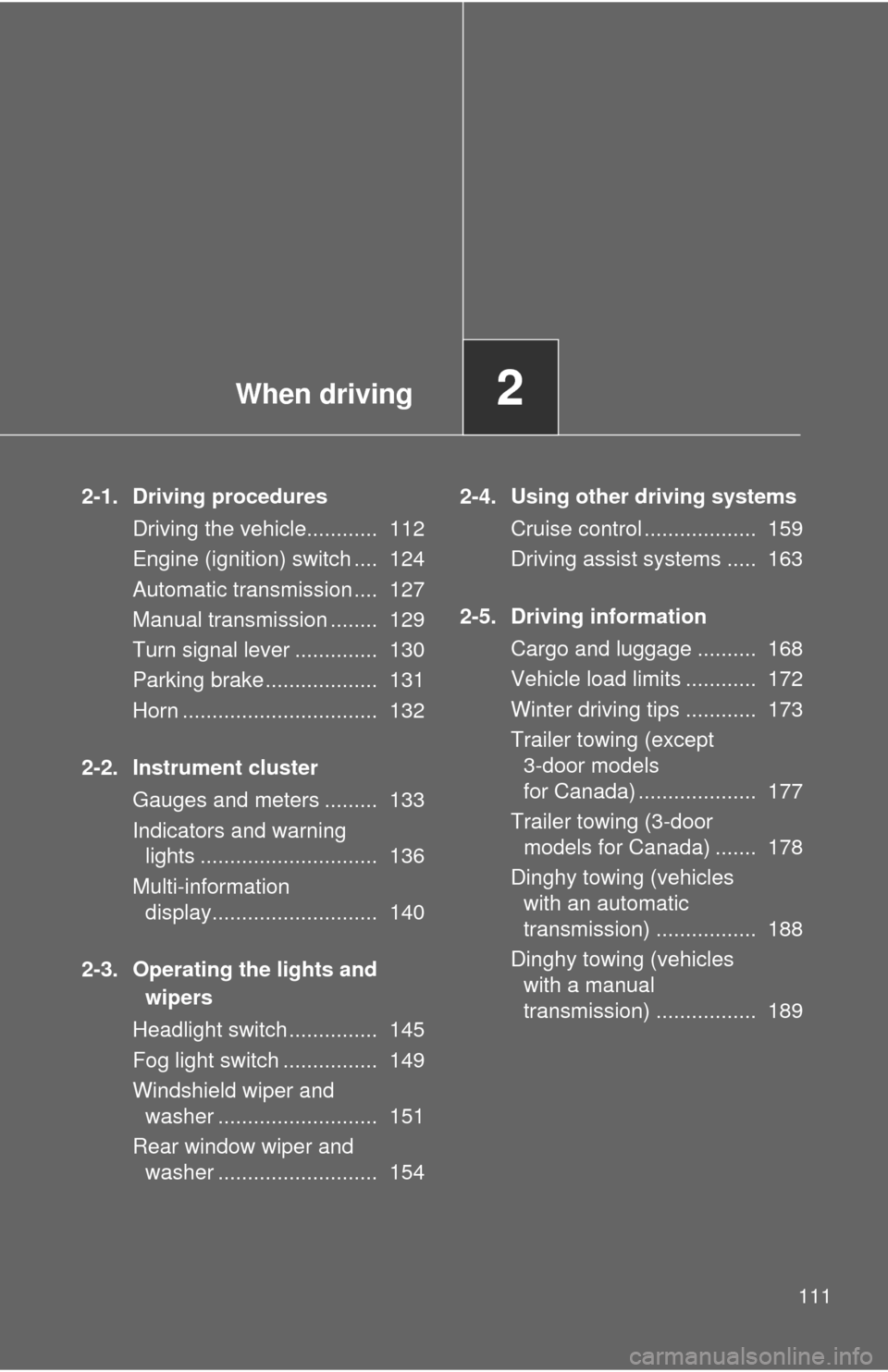
111
2-1. Driving proceduresDriving the vehicle............ 112
Engine (ignition) switch .... 124
Automatic transmission .... 127
Manual transmission ........ 129
Turn signal lever .............. 130
Parking brake ................... 131
Horn ................................. 132
2-2. Instrument cluster Gauges and meters ......... 133
Indicators and warning lights .............................. 136
Multi-information display............................ 140
2-3. Operating the lights and wipers
Headlight switch ............... 145
Fog light switch ................ 149
Windshield wiper and washer ........................... 151
Rear window wiper and washer ........................... 154 2-4. Using other driving systems
Cruise control ................... 159
Driving assist systems ..... 163
2-5. Driving information Cargo and luggage .......... 168
Vehicle load limits ............ 172
Winter driving tips ............ 173
Trailer towing (except 3-door models
for Canada) .................... 177
Trailer towing (3-door models for Canada) ....... 178
Dinghy towing (vehicles with an automatic
transmission) ................. 188
Dinghy towing (vehicles with a manual
transmission) ................. 189
Page 117 of 400

117
2-1. Driving procedures
2
When driving
CAUTION
●
Do not shift the shift lever to R while the vehicle is moving forward.
Doing so can damage the transmission and may result in a loss of vehicle\
control.
● Do not shift the shift lever to D (vehicles with an automatic transmission) or
1 (vehicles with a manual transmission) while the vehicle is moving back-
ward.
Doing so can damage the transmission and may result in a loss of vehicle\
control.
● Moving the shift lever to N while the vehicle is moving will disengage the
engine from the transmission. Engine braking is not available when N is
selected.
● During normal driving, do not turn off the engine. Turning the engine off
while driving will not cause loss of steering or braking control, but the
power assist to these systems will be lost. This will make it more difficult to
steer and brake, so you should pull over and stop the vehicle as soon as it
is safe to do so.
However, in the event of an emergency, such as if it becomes impossible
to stop the vehicle in the normal way: P. 339
● Use engine braking (downshift) to maintain a safe speed when driving
down a steep hill.
Using the brakes continuously may cause the brakes to overheat and lose
effectiveness. ( P. 127,129)
● When stopped on an inclined surface, use the brake pedal and parking
brake to prevent the vehicle from rolling backward or forward and causing
an accident.
● Do not adjust the positions of the steering wheel, the seat, or the inside or
outside rear view mirrors while driving.
Doing so may result in a loss of vehicle control that can cause accidents,
resulting in death or serious injury.
● Always check that all passengers’ arms, heads or other parts of their body
are not outside the vehicle, as this may result in death or serious injury.
Page 170 of 400
170 2-5. Driving information
As shown in the example above, if the number of occupants
increases, the cargo and luggage load will be reduced by an amount
that equals the increased weight du e to the additional occupants. In
other words, if an increase in the number of occupants causes an
excess of the total load capacity (combined weight of occupants plus
cargo and luggage load), you must reduce the cargo and luggage on
your vehicle.
CAUTION
■Things that must not be carried in the luggage compartment
The following things may cause a fire if loaded in the luggage compart-
ment:
●Receptacles containing gasoline
●Aerosol cans
■Storage precautions
Observe the following precautions.
Failure to do so may result in death or serious injury.
●Stow cargo and luggage in the luggage compartment whenever possi-
ble.
●Do not stack cargo and luggage in the luggage compartment higher
than the seatbacks.
Such items may be thrown about and possibly injure people in the
vehicle in the event of sudden braking or in an accident.
●Do not place cargo or luggage in or on the following locations as the
item may get under the clutch, brake or accelerator pedal and prevent
the pedals from being depressed properly, block the driver’s vision, or
hit the driver or passengers, causing an accident:
• At the feet of the driver
• On the front passenger or rear seats (when stacking items)
• On the luggage cover
• On the instrument panel
• On the dashboard
●Secure all items in the occupant compartment, as they may shift and
injure someone in the event of an accident or sudden braking.
Page 182 of 400

182 2-5. Driving information
●Crosswinds and rough roads will adversely affect handling of your
vehicle and trailer, causing sway . Periodically check the rear to
prepare for being passed by large trucks or buses, which may
cause your vehicle and trailer to sway. If swaying occurs, firmly grip
the steering wheel, reduce speed immediately but gradually, and
steer straight ahead. Never increase speed. If you make no
extreme correction with the stee ring or brakes, your vehicle and
trailer will stabilize.
● Take care when passing other v ehicles. Passing requires consider-
able distance. After passing a vehi cle, do not forget the length of
your trailer, and be sure you hav e plenty of room before changing
lanes.
● To maintain engine braking efficiency and charging system perfor-
mance when using engine braking, do not use the transmission in
D (vehicles with an automatic transmission) or 5 (vehicles with a
manual transmission).
● Due to the added load of the trailer, your vehicle’s engine may
overheat on hot days (at temper atures over 85°F [30°C]) when
driving up a long or steep grade. If the high engine coolant temper-
ature warning light flashes or co mes on overheating, immediately
turn off the air conditioning (if in use), pull your vehicle off the road
and stop in a safe place. ( P. 334)
Page 185 of 400
185
2-5. Driving information
2
When driving
CAUTION
■
Trailer towing precautions
●Follow all the instructions described in this section. Failure to do so could
cause an accident resulting in death or serious injury.
● Exceeding the towing capacity, GVWR or GAWR can cause an accident
resulting in death or serious personal injuries.
■ To avoid accident or injury
●Do not exceed 45 mph (72 km/h) or the posted towing speed limit, which-
ever is lower. As instability (swaying) of the towing vehicle-trailer combina-
tion increases as speed increases, exceeding 45 mph (72 km/h) may
cause loss of control.
● Do not exceed the trailer hitch assembly weight, gross vehicle weight,
gross axle weight and trailer tongue load capacities.
● Never load more weight in the back than in the front of the trailer. About
60% of the load should be in the front half of the trailer, and the remaining
40% in the rear.
● Do not use cruise control when you are towing.
● Slow down and downshift before descending steep or long downhill
grades. Do not make sudden downshifts while descending steep or long
downhill grades.
● Avoid holding the brake pedal down too long or applying the brakes too
frequently. This could cause the brakes to overheat and result in reduced
braking efficiency.
● Do not tow the vehicle with the compact spare tire installed.
Page 280 of 400

280 4-3. Do-it-yourself maintenance
7 IGN15 AMultiport fuel injection system/
sequential multiport fuel injection
system
8 MET 7.5 A Gauges and meters
9 EPS 50 A Electric power steering system
10 ABS NO.2 30 AAnti-lock brake system, vehicle sta-
bility control system
11 DEF 30 ARear window defogger, outside
rear view mirror defoggers
12 SPARE 10 A Spare fuse
13 PTC 80 APTC heater, outside rear view mir-
ror defoggers
14 HTR 40 A Air conditioning system
15 H-LP CLN 30 A No circuit
16 RDI FAN 30 A Electric cooling fan
17 ABS NO.1 50 AAnti-lock brake system, vehicle sta-
bility control system
18 BBC 40 A No circuit
19 ST 30 A Starting system
20 AMP 15 A No circuit
21 D/L NO.2 25 A No circuit
22 D.C.C 30 A DOME, ECU-B NO.1, ECU-B NO.2
23 STR LOCK 20 A No circuit
24 ECU-B NO.1 5 A Multiport fuel injection system/
sequential multiport fuel injection
system, main body ECU
25 DOME 15 AInterior light, personal lights, audio
system, vehicle stability control
system
26 MIR-HTR 10 A No circuit
FuseAmpereCircuit