Page 346 of 400
346 6-1. Specifications
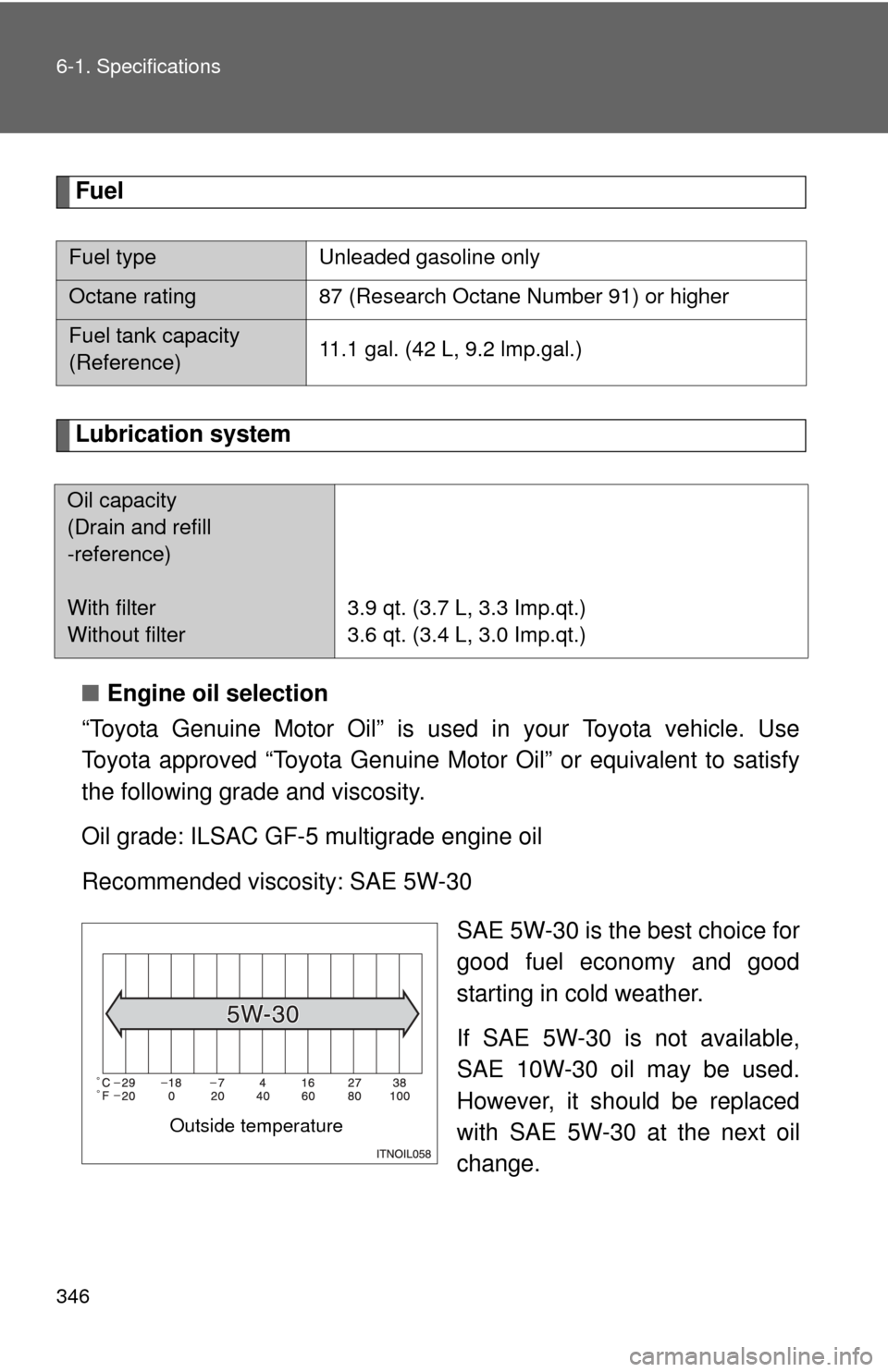
Fuel
Lubrication system■ Engine oil selection
“Toyota Genuine Motor Oil” is used in your Toyota vehicle. Use
Toyota approved “Toyota Genuine Motor Oil” or equivalent to satisfy
the following grade and viscosity.
Oil grade: ILSAC GF-5 multigrade engine oil
Recommended viscosity: SAE 5W-30
SAE 5W-30 is the best choice for
good fuel economy and good
starting in cold weather.
If SAE 5W-30 is not available,
SAE 10W-30 oil may be used.
However, it should be replaced
with SAE 5W-30 at the next oil
change.
Fuel typeUnleaded gasoline only
Octane rating 87 (Research Octane Number 91) or higher
Fuel tank capacity
(Reference) 11.1 gal. (42 L, 9.2 lmp.gal.)
Oil capacity
(Drain and refill
-reference)
With filter
Without filter 3.9 qt. (3.7 L, 3.3 Imp.qt.)
3.6 qt. (3.4 L, 3.0 Imp.qt.)
Outside temperature
Page 358 of 400
358 6-1. Specifications
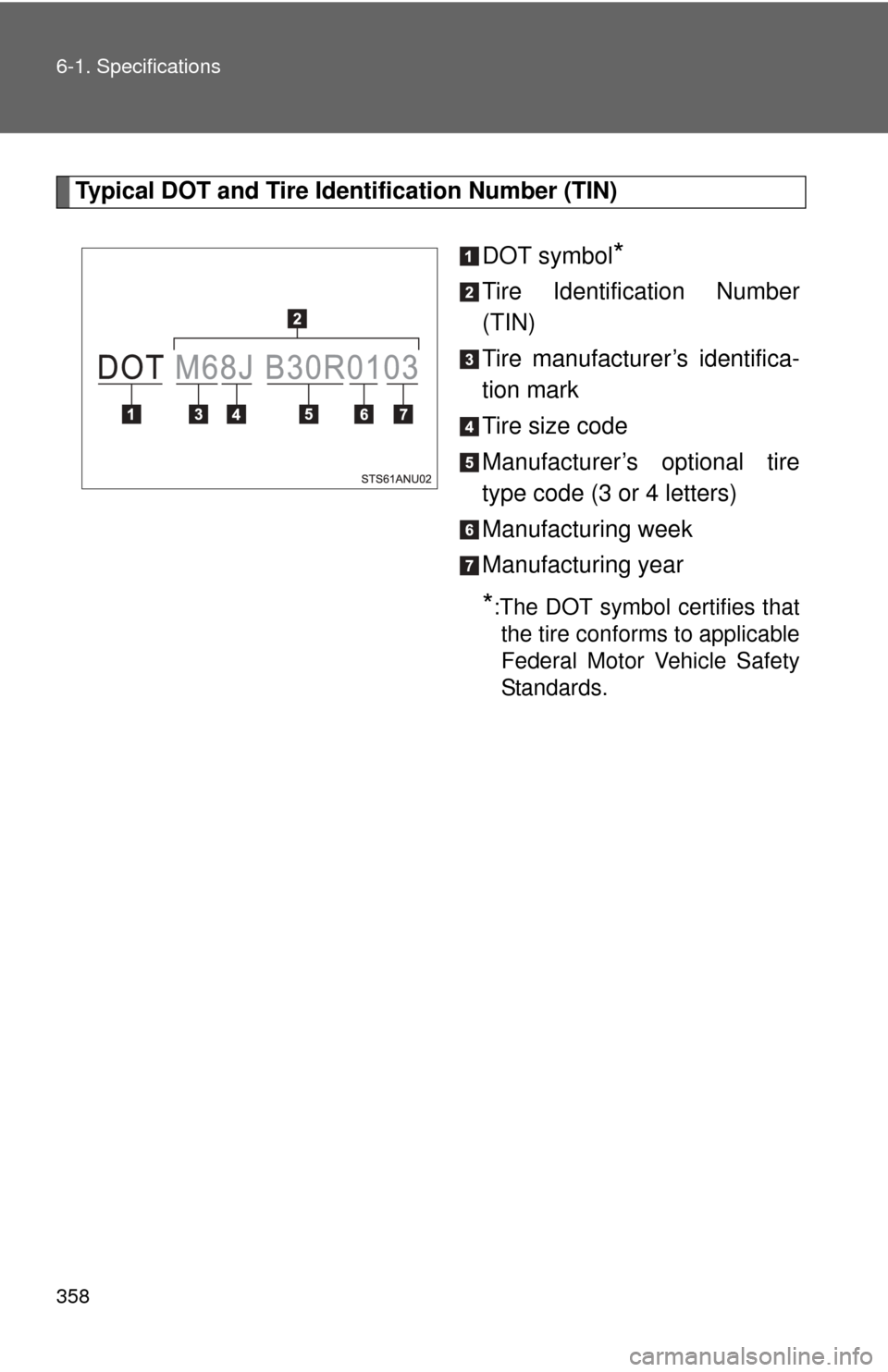
Typical DOT and Tire Identification Number (TIN)DOT symbol
*
Tire Identification Number
(TIN)
Tire manufacturer’s identifica-
tion mark
Tire size code
Manufacturer’s optional tire
type code (3 or 4 letters)
Manufacturing week
Manufacturing year
*:The DOT symbol certifies thatthe tire conforms to applicable
Federal Motor Vehicle Safety
Standards.
Page 361 of 400

361
6-1. Specifications
6
Vehicle specifications
■
Treadwear
The treadwear grade is a comparative rating based on the wear
rate of the tire when tested under controlled conditions on a speci-
fied government test course.
For example, a tire graded 150 would wear one and a half (1 - 1/2)
times as well on the government course as a tire graded 100.
The relative performance of tires depends upon the actual conditions
of their use. Performance may diff er significantly from the norm due
to variations in driving habits, service practices and differences in
road characteristics and climate.
■ Traction AA, A, B, C
The traction grades, from highest to lowest, are AA, A, B and C,
and they represent the tire’s ab ility to stop on wet pavement as
measured under controlled cond itions on specified government
test surfaces of asphalt and concrete.
A tire marked C may have poor traction performance.
Warning: The traction grade assigned to this tire is based on braking
(straight ahead) traction tests and does not include cornering (turn-
ing) traction.
■ Temperature A, B, C
The temperature grades are A (the highest), B, and C, represent-
ing the tire’s resistance to the generation of heat and its ability to
dissipate heat when tested under controlled conditions on a speci-
fied indoor laboratory test wheel.
Sustained high temperature can cause the material of the tire to
degenerate and reduce tire life, and excessive temperature can lead
to sudden tire failure.
Grade C corresponds to a level of performance which all passenger
car tires must meet under the Federal Motor Vehicle Safety Standard
No. 109.
Grades B and A represent higher levels of performance on the labo-
ratory test wheel than the minimum required by law.
Page 362 of 400
362 6-1. Specifications
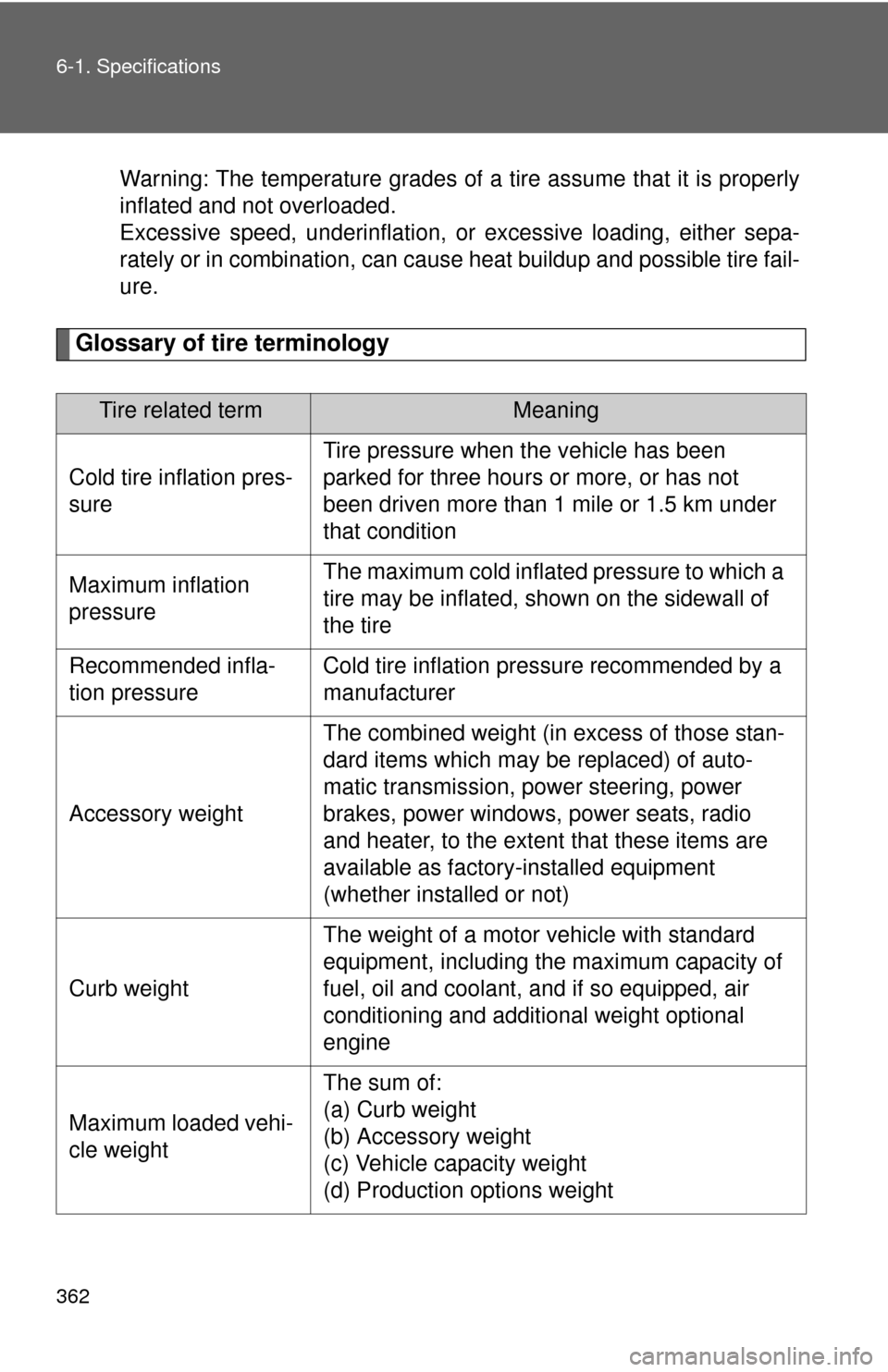
Warning: The temperature grades of a tire assume that it is properly
inflated and not overloaded.
Excessive speed, underinflation, or excessive loading, either sepa-
rately or in combination, can cause heat buildup and possible tire fail-
ure.
Glossary of tire terminology
Tire related termMeaning
Cold tire inflation pres-
sure
Tire pressure when the vehicle has been
parked for three hours or more, or has not
been driven more than 1 mile or 1.5 km under
that condition
Maximum inflation
pressureThe maximum cold inflated pressure to which a
tire may be inflated, s hown on the sidewall of
the tire
Recommended infla-
tion pressureCold tire inflation pressure recommended by a
manufacturer
Accessory weight
The combined weight (in excess of those stan-
dard items which may be replaced) of auto-
matic transmission, power steering, power
brakes, power windows, power seats, radio
and heater, to the extent that these items are
available as factory-installed equipment
(whether installed or not)
Curb weight
The weight of a motor vehicle with standard
equipment, including the maximum capacity of
fuel, oil and coolant, and if so equipped, air
conditioning and additional weight optional
engine
Maximum loaded vehi-
cle weight
The sum of:
(a) Curb weight
(b) Accessory weight
(c) Vehicle capacity weight
(d) Production options weight
Page 372 of 400
372
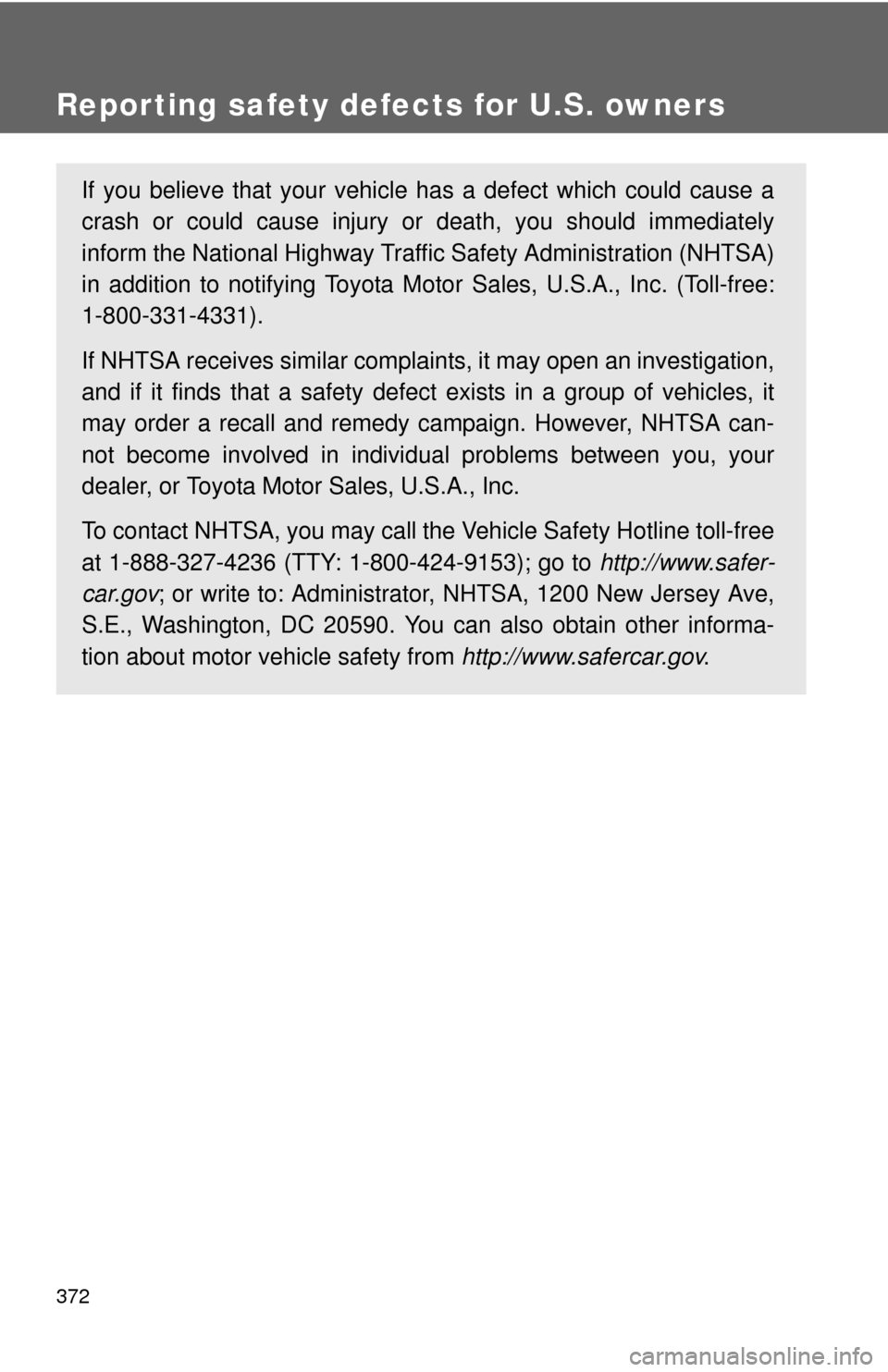
Reporting safety defects for U.S. owners
If you believe that your vehicle has a defect which could cause a
crash or could cause injury or death, you should immediately
inform the National Highway Traffi c Safety Administration (NHTSA)
in addition to notifying Toyota Motor Sales, U.S.A., Inc. (Toll-free:
1-800-331-4331).
If NHTSA receives similar complaints, it may open an investigation,
and if it finds that a safety defec t exists in a group of vehicles, it
may order a recall and remedy campaign. However, NHTSA can-
not become involved in individ ual problems between you, your
dealer, or Toyota Motor Sales, U.S.A., Inc.
To contact NHTSA, you may call the Vehicle Safety Hotline toll-free
at 1-888-327-4236 (TTY: 1-800-424-9153); go to http://www.safer-
car.gov; or write to: Administrator, NHTSA, 1200 New Jersey Ave,
S.E., Washington, DC 20590. You can also obtain other informa-
tion about motor vehicle safety from http://www.safercar.gov.
Page 400 of 400
400
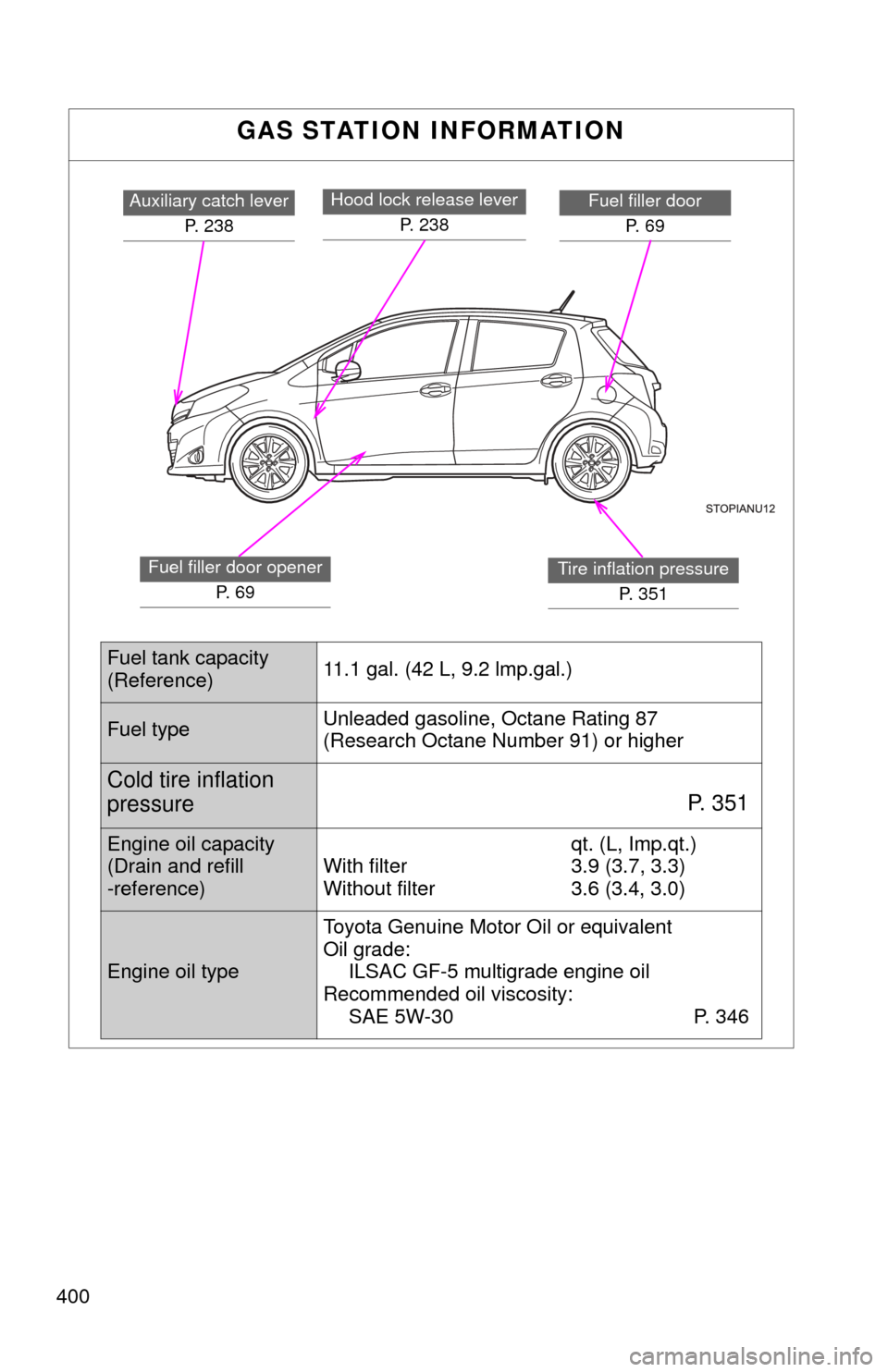
GAS STATION INFORMATION
Auxiliary catch leverP. 238Fuel filler doorP. 6 9Hood lock release lever P. 2 3 8
Fuel filler door openerP. 6 9Tire inflation pressureP. 351
Fuel tank capacity
(Reference) 11.1 gal. (42 L, 9.2 lmp.gal.)
Fuel type
Unleaded gasoline, Octane Rating 87
(Research Octane Number 91) or higher
Cold tire inflation
pressure
P. 3 5 1
Engine oil capacity
(Drain and refill
-reference)qt. (L, Imp.qt.)
With filter 3.9 (3.7, 3.3)
Without filter 3.6 (3.4, 3.0)
Engine oil type Toyota Genuine Motor Oil or equivalent
Oil grade:
ILSAC GF-5 multigrade engine oil
Recommended oil viscosity: SAE 5W-30 P. 346