Page 484 of 560
484 5-2. Steps to take in an emergency
VERSO-S_EE
CAUTION
When fixing the flat tire
After inflation of the tire has completed, the sealant may splatter when the
hose is disconnected or some air is let out of the tire.
Follow the operation procedure to repair the tire. If the procedures not fol-
lowed, the sealant may spray out.
Keep back from the tire while it is being repaired, as there is a chance of it
bursting while the repair operation is being performed. If you notice any
cracks or deformation of the tire, turn off the compressor switch and stop
the repair operation immediately.
The repair kit may overheat if operated for a long period of time. Do not
operate the repair kit continuously for more than 40 minutes.
Parts of the repair kit become hot during operation. Be careful when han-
dling the repair kit during and after operation. Do not touch the metal part
around the connecting area between the bottle and compressor. It will be
extremely hot.
Do not attach the vehicle speed warning sticker to an area other than the
one indicated. If the sticker is attached to an area where an SRS airbag is
located, such as the pad of the steering wheel, it may prevent the SRS air-
bag from operating properly.
Driving to spread the liquid sealant evenly
Observe the following precautions to reduce the risk of accidents.
Failing to do so may result in a loss of vehicle control and cause death or
serious injury.
Drive the vehicle carefully at a low speed. Be especially careful when turn-
ing and cornering.
If the vehicle does not drive straight or you feel a pull through the steering
wheel, stop the vehicle and check the following.
• Tire condition. The tire may have separated from the wheel.
• Tire inflation pressure. If the tire inflation pressure is 130 kPa (1.3
kgf/cm
2 or bar, 19 psi) or less, the tire may be severely damaged.
Page 502 of 560
502 5-2. Steps to take in an emergency
VERSO-S_EE
Precautions when the battery is discharged (vehicles with a smart
entry & start system)
In some cases, it may not be possible to unlock the doors using the smart
entry & start system when the battery is discharged. Use the wireless
remote control or the mechanical key to lock or unlock the doors.
The engine may not start on the first attempt after the battery has
recharged but will start normally after the second attempt. This is not a
malfunction.
The “ENGINE START STOP” switch mode is memorized by the vehicle.
When the battery is reconnected, the system will return to the mode it
was in before the battery was discharged. Before disconnecting the bat-
tery, turn the “ENGINE START STOP” switch off.
If you are unsure what mode the “ENGINE START STOP” switch was in
before the battery discharged, be especially careful when reconnecting
the battery.
When the battery is removed or discharged (vehicle with an alarm)
Make sure that the key is not inside the vehicle when recharging or replacing
the battery. The key may be locked in the vehicle if the alarm is activated.
(P. 120)
Page 508 of 560
508 5-2. Steps to take in an emergency
VERSO-S_EEStart the engine and turn the air conditioning system on to
check that the radiator cooling fan operates and to check for
coolant leaks from the radiator or hoses.
The fan operates when the air conditioning system is turned on
immediately after a cold start. Confirm that the fan is operating by
checking the fan sound and air flow. If it is difficult to check these,
turn the air conditioning system on and off repeatedly.
(The fan may not operate in freezing temperatures.)
If the fan is not operating:
Stop the engine immediately and contact any authorized
Toyota dealer or repairer, or another duly qualified and
equipped professional.
If the fan is operating:
Have the vehicle inspected at the nearest authorized
Toyota dealer or repairer, or another duly qualified and
equipped professional.
CAUTION
To prevent an accident or injury when inspecting under the hood of
your vehicle
If steam is seen coming from under the hood, do not open the hood until
the steam has subsided. The engine compartment may be very hot, caus-
ing serious injuries such as burns.
Keep hands and clothing (especially a tie, a scarf or a muffler) away from
the fans and belts. Failure to do so may cause the hands or clothing to be
caught, resulting in serious injury.
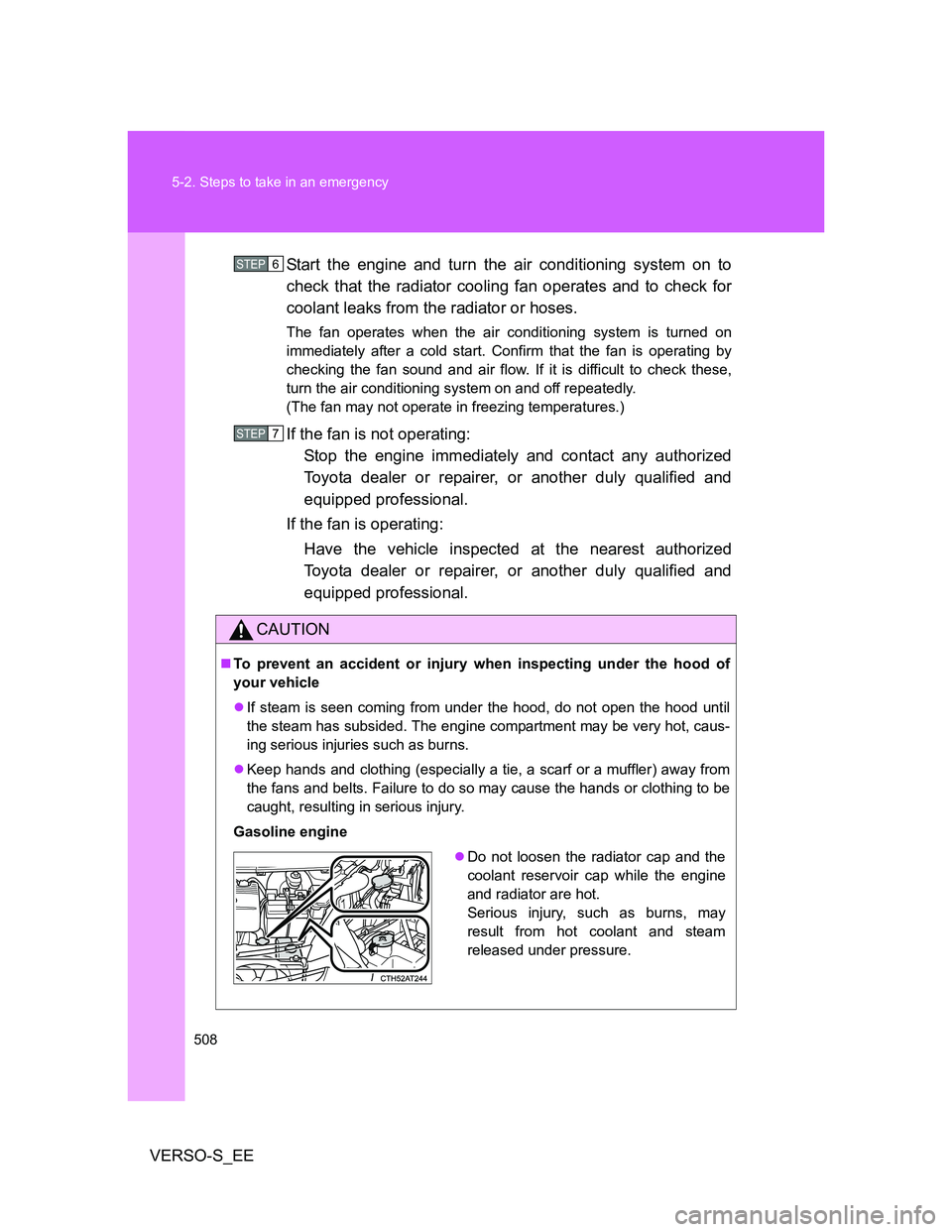
Gasoline engine
STEP6
STEP7
Do not loosen the radiator cap and the
coolant reservoir cap while the engine
and radiator are hot.
Serious injury, such as burns, may
result from hot coolant and steam
released under pressure.
Page 557 of 560
557
VERSO-S_EE
What to do if...
What to do if...
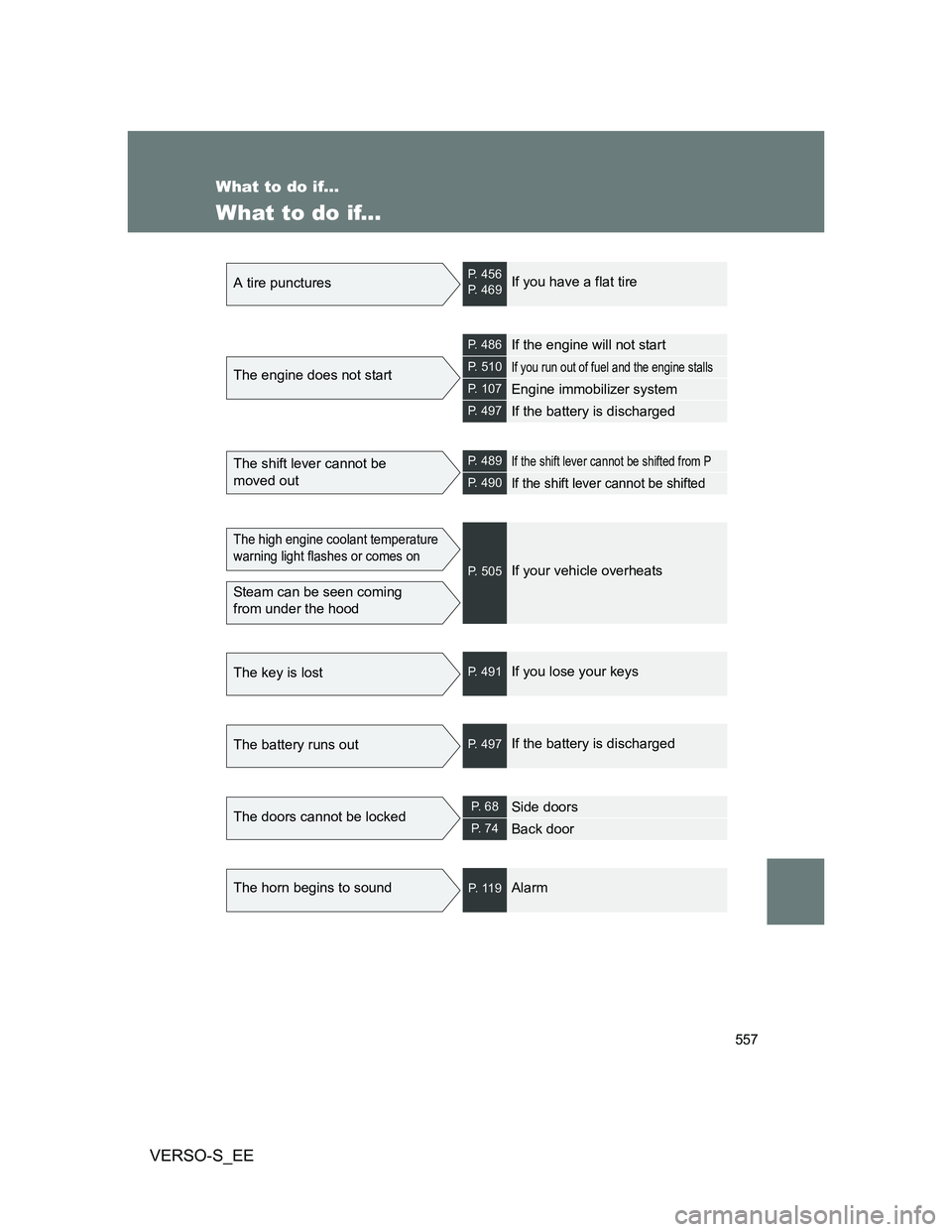
A tire puncturesP. 456
P. 469If you have a flat tire
The engine does not start
P. 486If the engine will not start
P. 510If you run out of fuel and the engine stalls
P. 107Engine immobilizer system
P. 497If the battery is discharged
The shift lever cannot be
moved outP. 489If the shift lever cannot be shifted from P
P. 490If the shift lever cannot be shifted
The high engine coolant temperature
warning light flashes or comes on
Steam can be seen coming
from under the hood
P. 505If your vehicle overheats
The key is lostP. 491If you lose your keys
The battery runs outP. 497If the battery is discharged
The doors cannot be lockedP. 6 8Side doors
P. 7 4Back door
The horn begins to soundP. 1 1 9Alarm