Page 66 of 650

66 1-2. Opening, closing and locking the doors
Conditions affecting operation
Vehicles without smart entry & start system
The wireless remote control function may not operate normally in the fol-
lowing situations.
Near a TV tower, radio station, electric power plant, airport or other
facility that generates strong radio waves
When carrying a portable radio, cellular phone or other wireless com-
munication device
When multiple wireless keys are in the vicinity
When the wireless key has come into contact with, or is covered by a
metallic object
When a wireless key (that emits radio waves) is being used nearby
When the wireless key has been left near an electrical appliance such
as a personal computer
When the wireless key battery is depleted
If window tint with a metallic content or metallic objects are attached to
the rear window
Vehicles with smart entry & start system
P. 63
Customization that can be configured at any authorized Toyota dealer
or repairer, or another duly qualified and equipped professional
Settings (e.g. wireless remote control system) can be changed.
(Customizable features P. 629)
VERSO_WE.book Page 66 Thursday, June 19, 2014 11:31 AM
Page 124 of 650
124
1-6. Theft deterrent system
Engine immobilizer system
The vehicle’s keys have built-in transponder chips that prevent the
engine from starting if the key has not been previously registered in
the vehicle’s on-board computer.
Never leave the keys inside the vehicle when you leave the vehicle.
This system is designed to help prevent vehicle theft but does not
guarantee absolute security against all vehicle thefts.
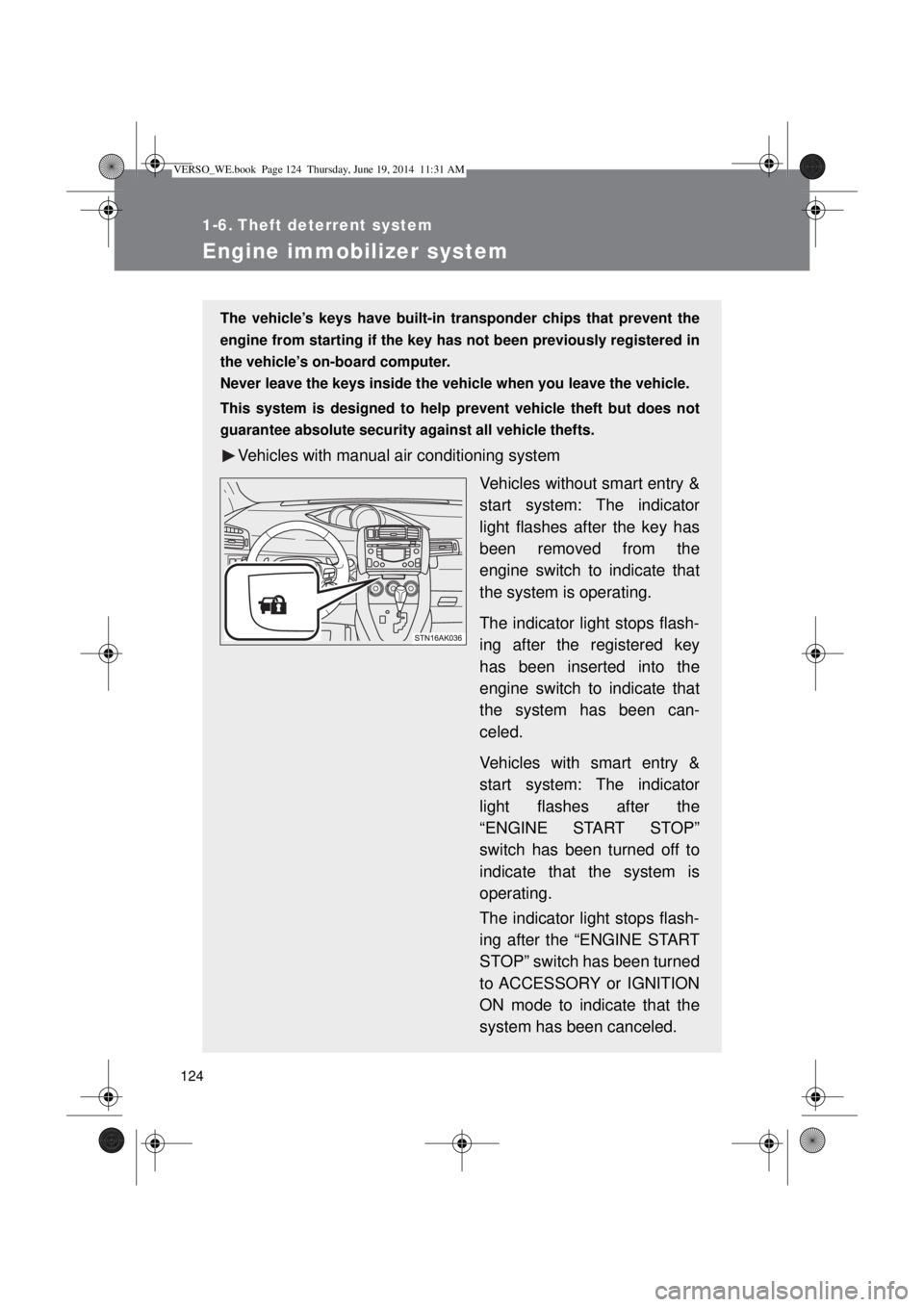
Vehicles with manual air conditioning system
Vehicles without smart entry &
start system: The indicator
light flashes after the key has
been removed from the
engine switch to indicate that
the system is operating.
The indicator light stops flash-
ing after the registered key
has been inserted into the
engine switch to indicate that
the system has been can-
celed.
Vehicles with smart entry &
start system: The indicator
light flashes after the
“ENGINE START STOP”
switch has been turned off to
indicate that the system is
operating.
The indicator light stops flash-
ing after the “ENGINE START
STOP” switch has been turned
to ACCESSORY or IGNITION
ON mode to indicate that the
system has been canceled.
VERSO_WE.book Page 124 Thursday, June 19, 2014 11:31 AM
Page 125 of 650
125 1-6. Theft deterrent system
1
Before driving
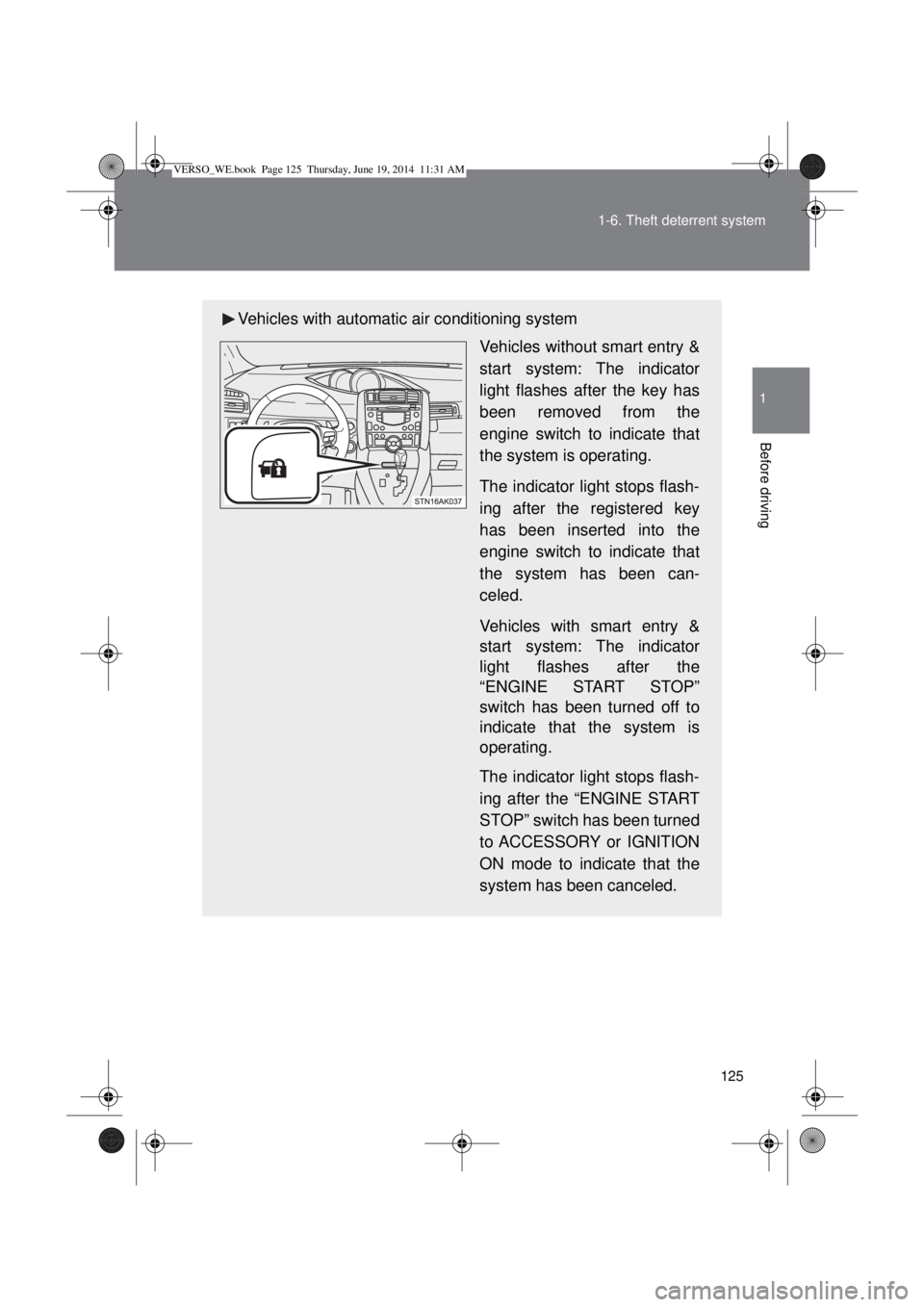
Vehicles with automatic air conditioning system
Vehicles without smart entry &
start system: The indicator
light flashes after the key has
been removed from the
engine switch to indicate that
the system is operating.
The indicator light stops flash-
ing after the registered key
has been inserted into the
engine switch to indicate that
the system has been can-
celed.
Vehicles with smart entry &
start system: The indicator
light flashes after the
“ENGINE START STOP”
switch has been turned off to
indicate that the system is
operating.
The indicator light stops flash-
ing after the “ENGINE START
STOP” switch has been turned
to ACCESSORY or IGNITION
ON mode to indicate that the
system has been canceled.
VERSO_WE.book Page 125 Thursday, June 19, 2014 11:31 AM
Page 137 of 650
137 1-6. Theft deterrent system
1
Before driving
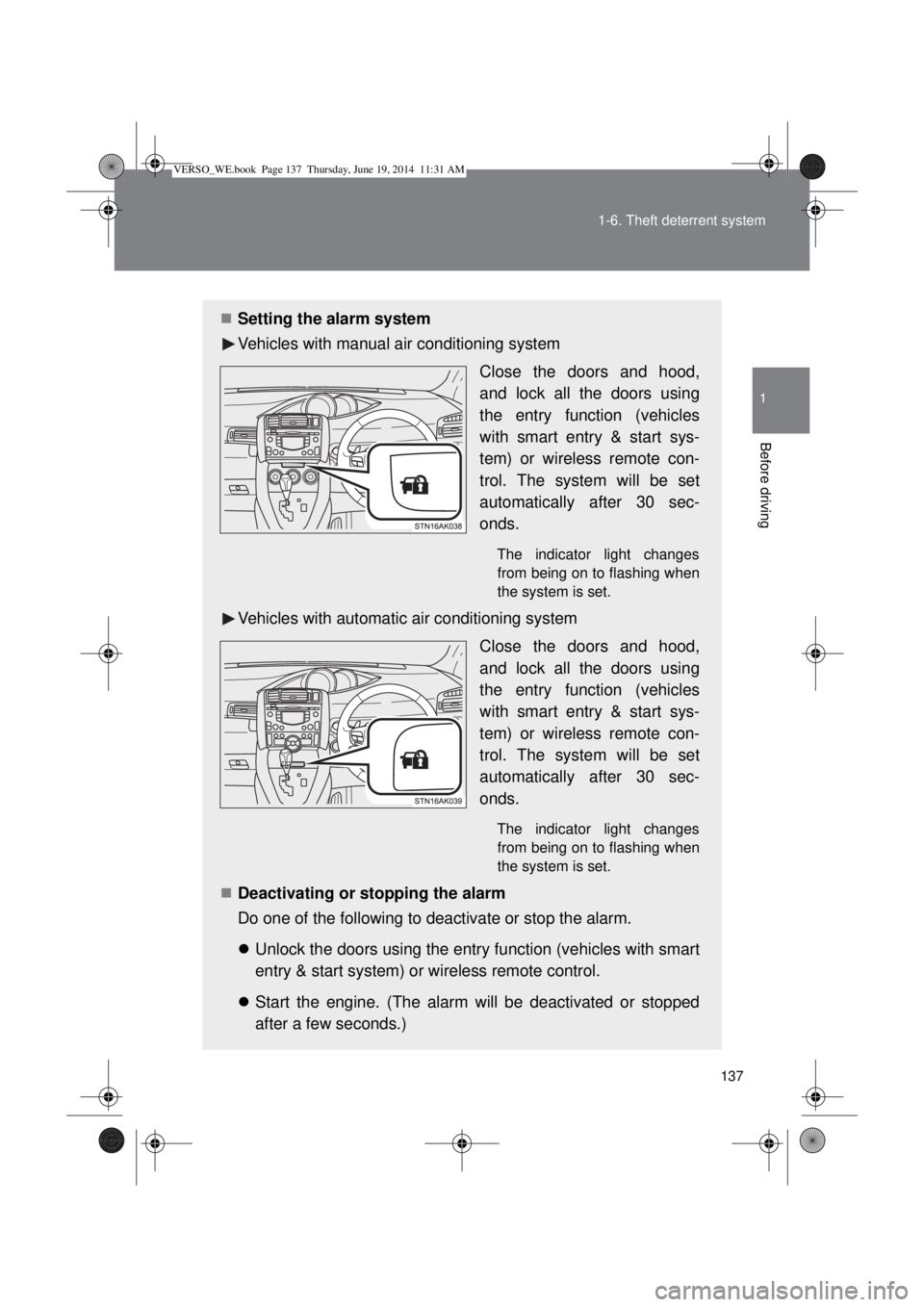
Setting the alarm system
Vehicles with manual air conditioning system
Close the doors and hood,
and lock all the doors using
the entry function (vehicles
with smart entry & start sys-
tem) or wireless remote con-
trol. The system will be set
automatically after 30 sec-
onds.
The indicator light changes
from being on to flashing when
the system is set.
Vehicles with automatic air conditioning system
Close the doors and hood,
and lock all the doors using
the entry function (vehicles
with smart entry & start sys-
tem) or wireless remote con-
trol. The system will be set
automatically after 30 sec-
onds.
The indicator light changes
from being on to flashing when
the system is set.
Deactivating or stopping the alarm
Do one of the following to deactivate or stop the alarm.
Unlock the doors using the entry function (vehicles with smart
entry & start system) or wireless remote control.
Start the engine. (The alarm will be deactivated or stopped
after a few seconds.)
VERSO_WE.book Page 137 Thursday, June 19, 2014 11:31 AM
Page 149 of 650

149 1-7. Safety information
1
Before driving
If the SRS airbags deploy (inflate)
Bruising and slight abrasions may result from contact with a deploying
(inflating) SRS airbag.
A loud noise and white powder will be emitted.
Vehicles without SRS curtain shield airbags: Parts of the airbag module
(steering wheel hub, airbag cover and inflator) as well as the front seats
may be hot for several minutes. The airbag itself may also be hot.
Vehicles with SRS curtain shield airbags: Parts of the airbag module
(steering wheel hub, airbag cover and inflator) as well as the front seats,
parts of the front and rear pillars, and roof side rails, may be hot for sev-
eral minutes. The airbag itself may also be hot.
The windshield may crack.
Operating conditions (SRS front airbags)
The SRS front airbags will deploy in the event of an impact that exceeds
the set threshold level (the level of force corresponding to an approxi-
mately 20-30 km/h [12-18 mph] frontal collision with a fixed wall that does
not move or deform).
However, this threshold velocity will be considerably higher in the following
situations:
• If the vehicle strikes an object, such as a parked vehicle or sign pole,
which can move or deform on impact
• If the vehicle is involved in an underride collision, such as a collision in
which the front of the vehicle “underrides”, or goes under, the bed of a
truck
Depending on the type of collision, it is possible that only the seat belt
pretensioners will activate.
Operating conditions (SRS side airbags and curtain shield airbags [if
equipped])
The SRS side airbags and curtain shield airbags (if equipped) will deploy in
the event of an impact that exceeds the set threshold level (the level of force
corresponding to the impact force produced by an approximately 1500 kg
[3300 lb.] vehicle colliding with the vehicle cabin from a direction perpendicu-
lar to the vehicle orientation at an approximate speed of 20-30 km/h [12-18
mph]).
VERSO_WE.book Page 149 Thursday, June 19, 2014 11:31 AM
Page 150 of 650
150 1-7. Safety information
Conditions under which the SRS airbags may deploy (inflate), other
than a collision
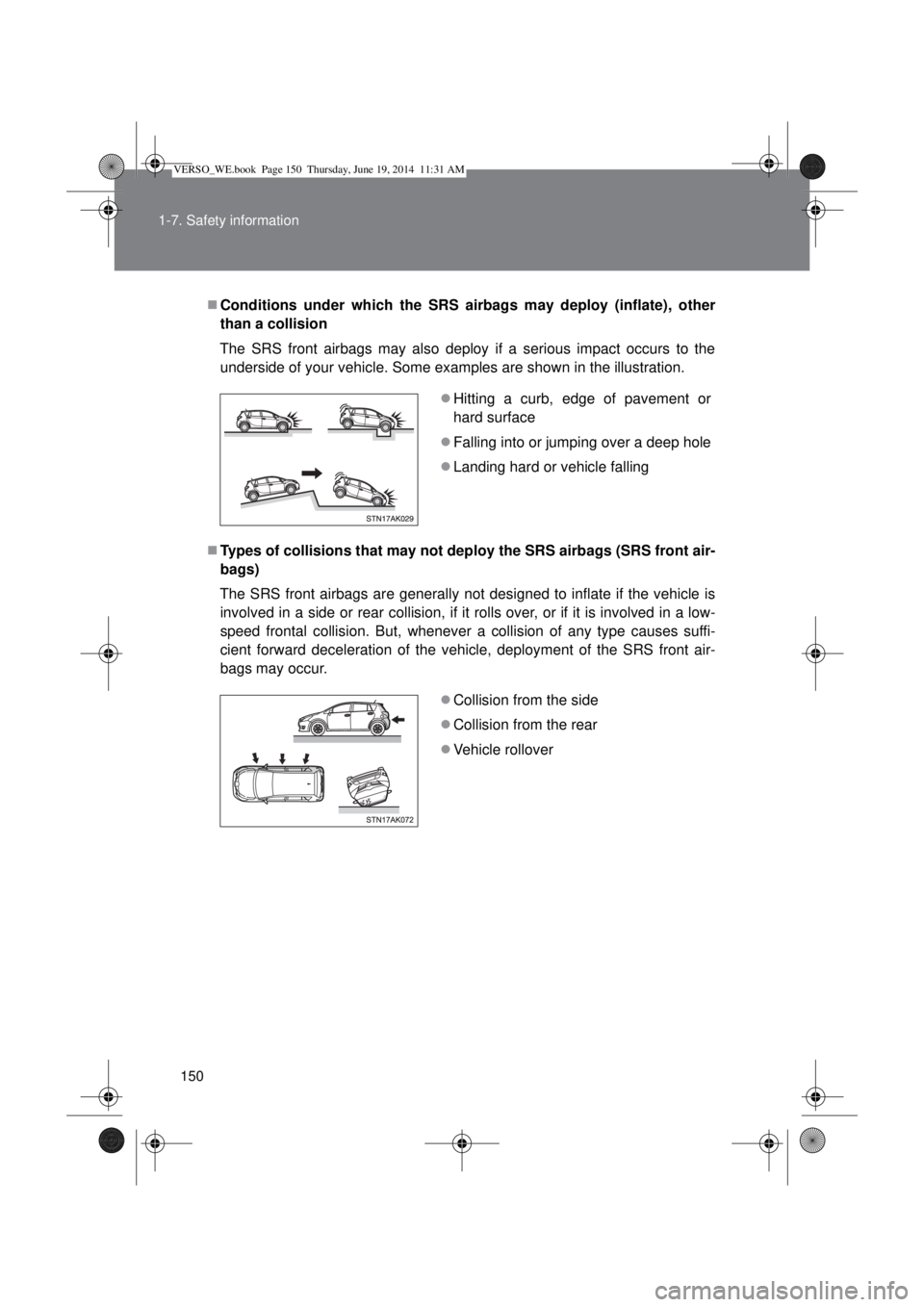
The SRS front airbags may also deploy if a serious impact occurs to the
underside of your vehicle. Some examples are shown in the illustration.
Types of collisions that may not deploy the SRS airbags (SRS front air-
bags)
The SRS front airbags are generally not designed to inflate if the vehicle is
involved in a side or rear collision, if it rolls over, or if it is involved in a low-
speed frontal collision. But, whenever a collision of any type causes suffi-
cient forward deceleration of the vehicle, deployment of the SRS front air-
bags may occur.Hitting a curb, edge of pavement or
hard surface
Falling into or jumping over a deep hole
Landing hard or vehicle falling
Collision from the side
Collision from the rear
Vehicle rollover
VERSO_WE.book Page 150 Thursday, June 19, 2014 11:31 AM
Page 177 of 650
177
1
1-7. Safety information
Before driving
Airbag manual on-off system
This system deactivates the front passenger airbag.
Only deactivate the airbags when using a child restraint system on
the front passenger seat.
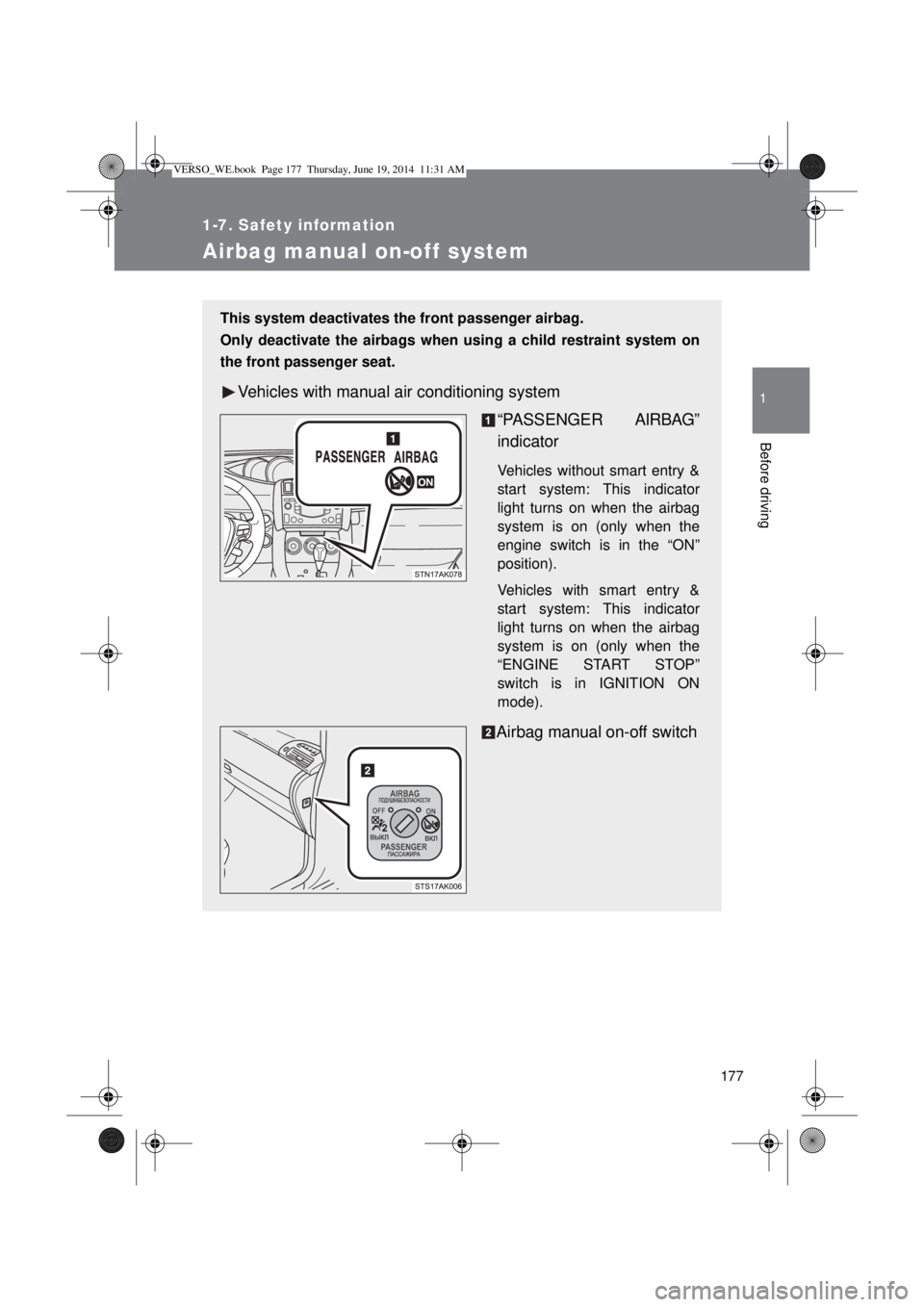
Vehicles with manual air conditioning system
“PASSENGER AIRBAG”
indicator
Vehicles without smart entry &
start system: This indicator
light turns on when the airbag
system is on (only when the
engine switch is in the “ON”
position).
Vehicles with smart entry &
start system: This indicator
light turns on when the airbag
system is on (only when the
“ENGINE START STOP”
switch is in IGNITION ON
mode).
Airbag manual on-off switch
VERSO_WE.book Page 177 Thursday, June 19, 2014 11:31 AM
Page 178 of 650
178 1-7. Safety information
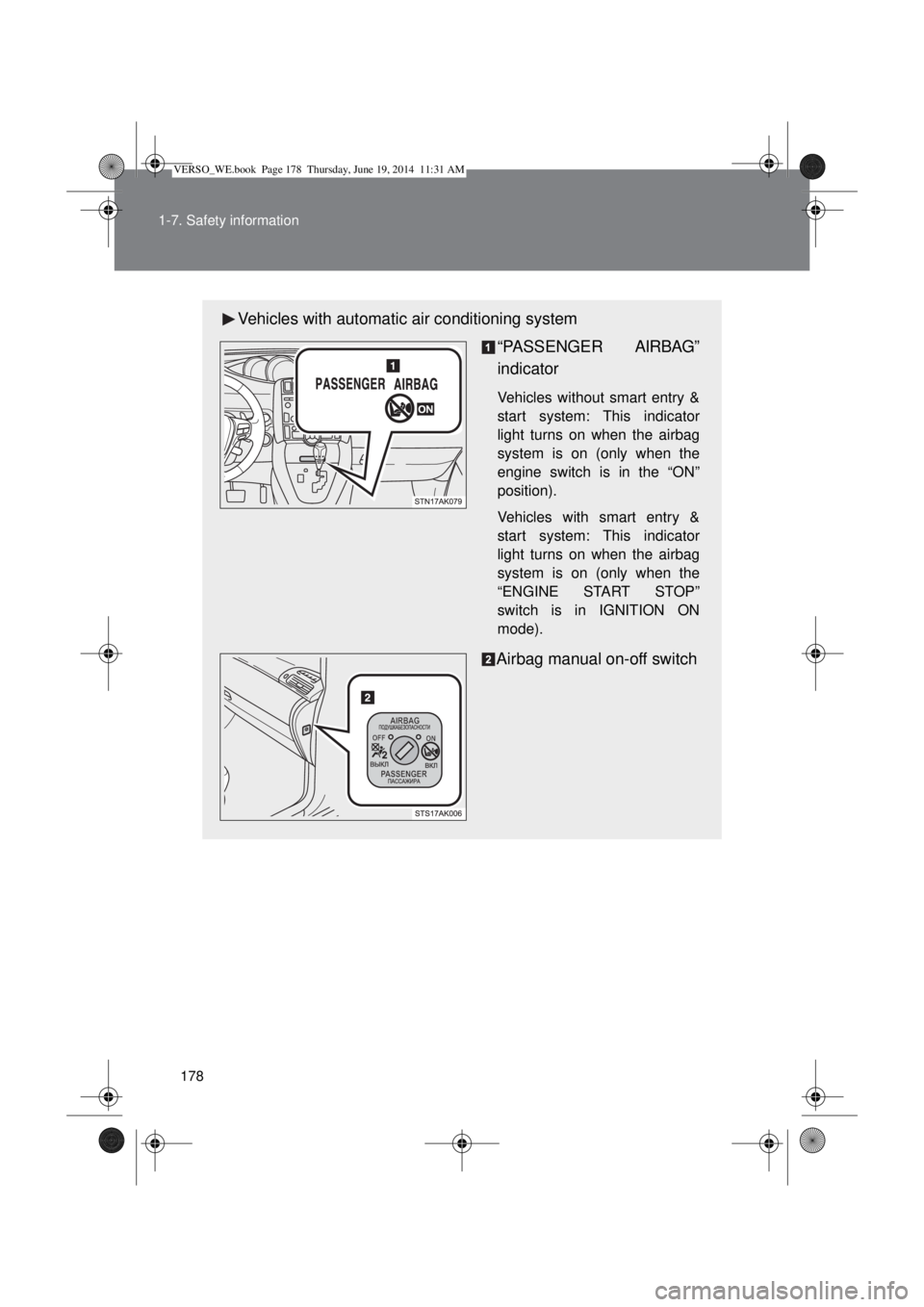
Vehicles with automatic air conditioning system
“PASSENGER AIRBAG”
indicator
Vehicles without smart entry &
start system: This indicator
light turns on when the airbag
system is on (only when the
engine switch is in the “ON”
position).
Vehicles with smart entry &
start system: This indicator
light turns on when the airbag
system is on (only when the
“ENGINE START STOP”
switch is in IGNITION ON
mode).
Airbag manual on-off switch
VERSO_WE.book Page 178 Thursday, June 19, 2014 11:31 AM