Page 223 of 544
223
2-4. Using other driving systems
2
When driving
URBAN CRUISER_OM_OM52F47E_(EE)
Driving assist systems
To help enhance driving safety and performance, the following sys-
tems operate automatically in response to various driving situations.
Be aware, however, that these systems are supplementary and
should not be relied upon too heavily when operating the vehicle.
■ ABS (Anti-lock Brake System)
Helps to prevent wheel lock when the brakes are applied suddenly, or if
the brakes are applied while driving on a slippery road surface.
■Brake assist
Generates an increased level of braking force after the brake pedal is
depressed when the system detects a panic stop situation.
■VSC (Vehicle Stability Control) (if equipped)
Helps the driver to control skidding when swerving suddenly or turning
on slippery road surfaces.
■TRC (Traction Control) (if equipped)
Helps to maintain drive power and pr event the drive wheels from spin-
ning when starting the vehicle or accelerating on slippery roads.
■ Active Torque Control 4WD system (4WD models)
Automatically switches from front -wheel drive to four-wheel drive
(4WD) according to the driving conditions, helping to ensure reliable
handling and stability. Examples of conditions where the system will
switch to 4WD are when cornering going uphill, starting off or accelerat-
ing, and when the road surface is slippery due to snow, rain, etc.
■ EPS (Electric Power Steering)
Employs an electric motor to reduce the amount of effort needed to turn
the steering wheel.
Page 225 of 544

225
2-4. Using other driving systems
2
When driving
URBAN CRUISER_OM_OM52F47E_(EE)
■
Turning off both TRC and VSC systems
To turn the TRC and VSC systems off, press and hold for more than 3
seconds while the vehicle is stopped.
The “TRC OFF” indicator light and VSC OFF indicator light will come on.
Press again to turn the systems back on.
■ When the “TRC OFF” indicator light comes on even if the VSC OFF
switch has not been pressed
TRC cannot be operated. Contact any aut horized Toyota dealer or repairer,
or another duly qualified and equipped professional.
■ Sounds and vibrations caused by the ABS, brake assist, TRC and VSC
systems
●A sound may be heard from the engine compartment when the brake
pedal is depressed repeatedly, when the engine is started or just after the
vehicle begins to move. This sound does not indicate that a malfunction
has occurred in any of these systems.
● Any of the following conditions may occur when the above systems are
operating. None of these indicates that a malfunction has occurred.
• Vibrations may be felt through the vehicle body and steering.
• A motor sound may be heard after the vehicle comes to a stop.
• The brake pedal may pulsate slightly after the ABS is activated.
• The brake pedal may move down slightly after the ABS is activated.
■ EPS operation sound
When the steering wheel operates, a motor sound (whirring sound) may be
heard. This dose not indicate a malfunction.
Page 229 of 544
229
2-4. Using other driving systems
2
When driving
URBAN CRUISER_OM_OM52F47E_(EE)
Four-wheel drive lock (4WD models)
■Four-wheel drive lock mode can be operated when
Vehicles without smart entry & start system
The engine switch is in the “ON” position.
Vehicles with smart entry & start system
The “ENGINE START STOP” switch is in IGNITION ON mode.
■ Four-wheel drive lock mode
●Four-wheel drive lock mode is canceled when the brakes are applied to
ensure the ABS and VSC system operate effectively.
● Four-wheel drive lock mode is canceled when the vehicle speed exceeds
40 km/h (25 mph).
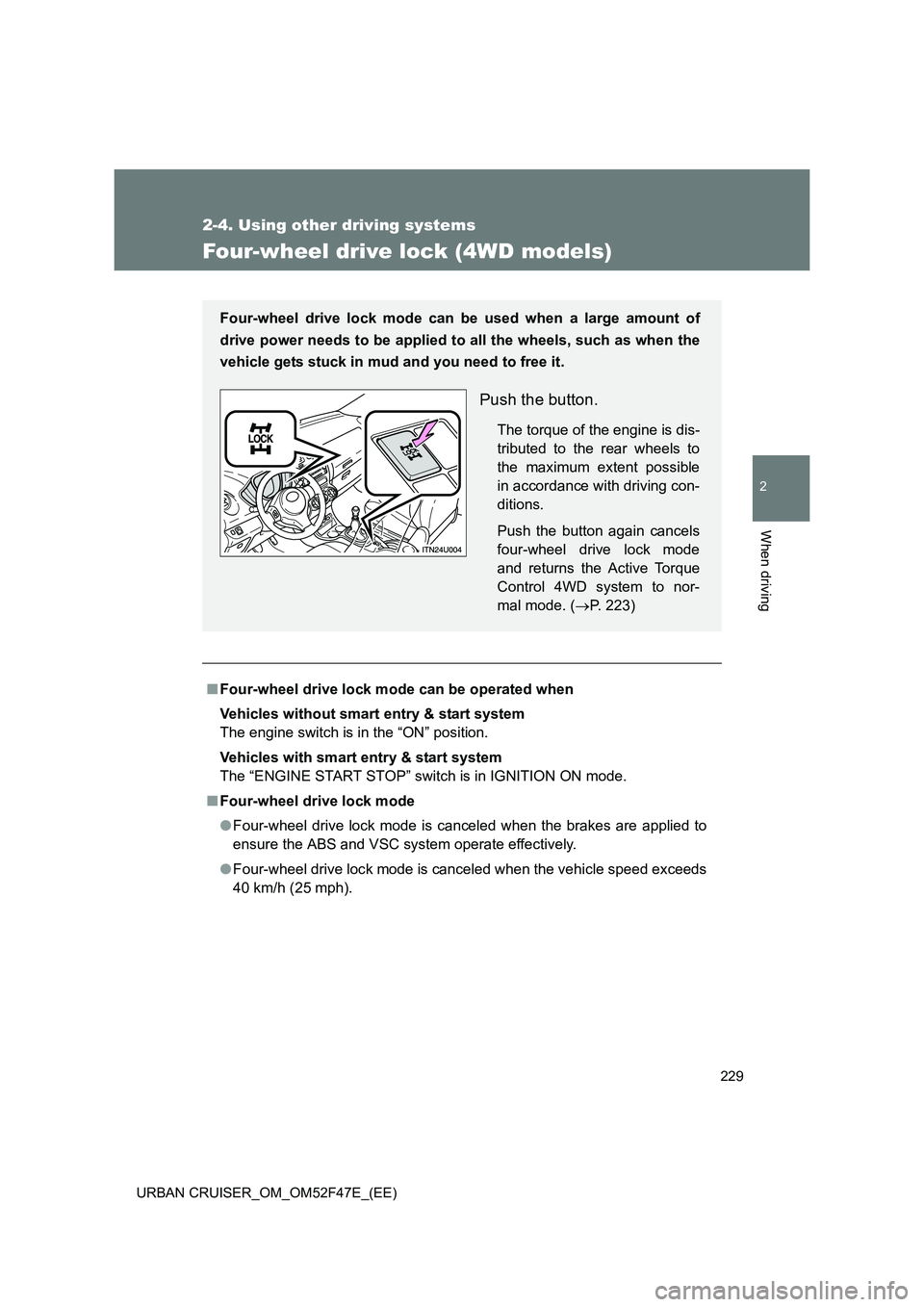
Four-wheel drive lock mode can be used when a large amount of
drive power needs to be applied to all the wheels, such as when the
vehicle gets stuck in mud and you need to free it.
Push the button.
The torque of the engine is dis-
tributed to the rear wheels to
the maximum extent possible
in accordance with driving con-
ditions.
Push the button again cancels
four-wheel drive lock mode
and returns the Active Torque
Control 4WD system to nor-
mal mode. (
→P. 223)
Page 233 of 544
233
2-5. Driving information
2
When driving
URBAN CRUISER_OM_OM52F47E_(EE)
CAUTION
■
Storage precautions
Observe the following precautions.
Failing to do so may result in death or serious injury.
●Stow cargo and luggage in the luggage compartment whenever possible.
● Do not stack anything in the luggage compartment higher than the seat-
backs. Such items may be thrown about and possibly injure people in the
vehicle in the event of sudden braking or in an accident.
● Do not place cargo or luggage in or on the following locations as the item
may get under the clutch, brake or accelerator pedal and prevent the ped-
als from being depressed properly, block the driver’s vision, or hit the
driver or passengers, causing an accident.
• At the feet of the driver
• On the front passenger or rear seats (when stacking items)
• On the instrument panel
• On the dashboard
• Auxiliary box or tray that has no lid
● Secure all items in the occupant compartment, as they may shift and injure
someone during sudden braking, sudden swerving or an accident.
● When you fold down the rear seats, long items should not be place directly
behind the front seats.
● Never allow anyone to ride in the enlarged luggage compartment. It is not
designed for passengers. They should ri de in their seats with their seat
belts properly fastened. Otherwise, they are much more likely to suffer
death or serious injury, in the event of sudden braking, sudden swerving or
an accident.
Page 236 of 544
236
2-5. Driving information
URBAN CRUISER_OM_OM52F47E_(EE)
■ Before driving the vehicle
Perform the following according to the driving conditions.
● Do not try to forcibly open a window or move a wiper that is
frozen. Pour warm water over the frozen area to melt the ice.
Wipe away the water immediately to prevent it from freezing.
● To ensure proper operation of the climate control system fan,
remove any snow that has accumulated on the air inlet vents
in front of the windshield.
● Remove any ice that has accumulated on the vehicle chassis.
● Periodically check for and remove any excess ice or snow
that may have accumulated in the wheel well or on the
brakes.
■ When driving the vehicle
Accelerate the vehicle slowly and drive at a reduced speed suit-
able to road conditions.
■ When parking the vehicle (in the winter time or in the cold
latitudes)
Park the vehicle and move the shift lever to “R” without setting
the parking brake. The parking brake may freeze up, preventing
it from being released. If necessary block the wheels to prevent
inadvertent sliding or creeping.
Page 246 of 544

246
2-5. Driving information
URBAN CRUISER_OM_OM52F47E_(EE)
■ Increasing vehicle-to-vehicle distance
At a speed of 10 km/h (6 mph), the distance to the vehicle running
ahead of you should be equivalent to or greater than the combined
length of your vehicle and trailer. Avoid sudden braking that may
cause skidding. Otherwise, the vehicle may spin out of control.
This is especially true when driving on wet or slippery road sur-
faces.
■ Sudden acceleration/steering input/cornering
Executing sharp turns when towing may result in the trailer collid-
ing with your vehicle. Decelerate well in advance when approach-
ing turns and take them slowly and carefully to avoid sudden
braking.
■ Important points regarding turning
The wheels of the trailer will travel closer to the inside of the curve
than the wheels of the vehicle. To make allowance for this, take the
turns wider than you would normally.
■ Important points regarding stability
Vehicle movement resulting from uneven road surfaces and strong
crosswinds will affect handling. The vehicle may also be rocked by
passing buses or large trucks. Frequently check behind when mov-
ing alongside such vehicles. As soon as such vehicle movement
occurs, immediately start to decelerate smoothly by slowly apply-
ing the brakes. Always steer the vehicle straight ahead while brak-
ing.
■ Passing other vehicles
Consider the total combined length of your vehicle and trailer, and
ensure that the vehicle-to-vehicle distance is sufficient before exe-
cuting lane changes.
Page 247 of 544
247
2-5. Driving information
2
When driving
URBAN CRUISER_OM_OM52F47E_(EE)
■
Transmission information
To maintain engine braking efficiency, when using engine braking,
do not use the transmission in “6” gear. ( →P. 189)
■ If the engine overheats...
Towing a loaded trailer up a long steep incline in temperatures
exceeding 30 °C (85 °F) may result in the engine overheating. If the
engine coolant temperature gauge indicates that the engine is
overheating, turn the air conditioning off immediately, leave the
road and stop the vehicle in a safe place. ( →P. 493)
■ When parking the vehicle
Always place wheel chocks under the wheels of both the vehicle
and trailer. Firmly set the parking brake and shift the shift lever to
“1” or “R”.
Page 248 of 544
248
2-5. Driving information
URBAN CRUISER_OM_OM52F47E_(EE)
CAUTION
Follow all the instructions described in this section. Failure to do so could
cause an accident resulting in death or serious injury.
■ Trailer towing precautions
When towing, make sure that none of the weight limits are exceeded.
(→ P. 240)
■ Vehicle speed in towing
Observe the legal maximum speeds for trailer towing.
■ Before descending hills or long declines
Reduce speed and downshift. However, never downshift suddenly while
descending steep or long downhill grades.
■ Operation of the brake
Do not hold the brake pedal depressed often or for long periods.
Doing so may result in the brake overheating or reduce braking effects.