Page 244 of 544

244
2-5. Driving information
URBAN CRUISER_OM_OM52F47E_(EE)
■ Tire information
Increase the air pressure of the trailer tires in accordance with the total trailer
weight and according to the values recommended by the manufacturer of
your trailer.
■ Trailer lights
Check that the turn signal lights and stoplights are operating correctly every
time you hitch up the trailer. Directly wiring up to your vehicle may damage
the electrical system and stop the lights from functioning correctly.
■ Break-in schedule
Toyota recommends that vehicles fitted with new power train components
should not be used for towing trailers for the first 800 km (500 miles).
■ Maintenance
●Maintenance must be performed more frequently when using the vehicle
for towing due to the greater weight burden placed on the vehicle com-
pared to normal driving.
● Retighten all bolts securing the hitching ball and bracket after towing for
approximately 1000 km (600 miles).
■ Safety checks before towing
●Check that the maximum load limit for the towing hitch/bracket and hitch
ball is not exceeded. Bear in mind that the coupling weight of the trailer
will add to the load exerted on the vehicle. Also make sure that the total
load exerted on the vehicle is within the range of the weight limits.
(→ P. 240)
● Ensure that the trailer load is secure.
● Supplementary outside rear view mirrors should be added to the vehicle
if the traffic behind cannot be clearly seen with standard mirrors. Adjust
the extending arms of these mirrors on both sides of the vehicle so that
they always provide maximum visibility of the road behind.
Page 349 of 544
4Maintenance and care
349
URBAN CRUISER_OM_OM52F47E_(EE)
4-1. Maintenance and care Cleaning and protecting the vehicle exterior ......... 350
Cleaning and protecting the vehicle interior .......... 354
4-2. Maintenance Maintenance requirements................... 358
4-3. Do-it-yourself maintenance Do-it-yourself service precautions ..................... 362
Hood ................................. 366
Positioning a floor jack ...... 368
Engine compartment......... 370
Tires .................................. 388
Tire inflation pressure ....... 391
Wheels .............................. 393
Air conditioning filter ......... 395
Key battery........................ 398
Checking and replacing fuses ............................... 402
Light bulbs ........................ 418
Page 360 of 544

360
4-2. Maintenance
URBAN CRUISER_OM_OM52F47E_(EE)
■ Does your vehicle need repair?
Be on the alert for changes in performance and sounds, and visual tip-offs
that indicate service is needed. Some important clues are:
●Engine missing, stum bling, or pinging
● Appreciable loss of power
● Strange engine noises
● A fluid leak under the vehicle (However , water dripping from the air condi-
tioning after use is normal.)
● Change in exhaust sound (This may indicate a dangerous carbon mon-
oxide leak. Drive with the windows open and have the exhaust system
checked immediately.)
● Flat-looking tires, excessive tire squeal when cornering, uneven tire wear
● Vehicle pulls to one side when driving straight on a level road
● Strange noises related to suspension movement
● Loss of brake effectiveness, spongy feeling brake pedal, pedal almost
touches the floor, vehicle pulls to one side when braking
● Engine coolant temperature continually higher than normal
If you notice any of these clues, take your vehicle to any authorized Toyota
dealer or repairer, or another duly qualified and equipped professional, as
soon as possible. Your vehicle may need adjustment or repair.
Page 388 of 544
388
4-3. Do-it-yourself maintenance
URBAN CRUISER_OM_OM52F47E_(EE)
Tires
Replace or rotate tires in accordance with maintenance schedules
and treadwear.
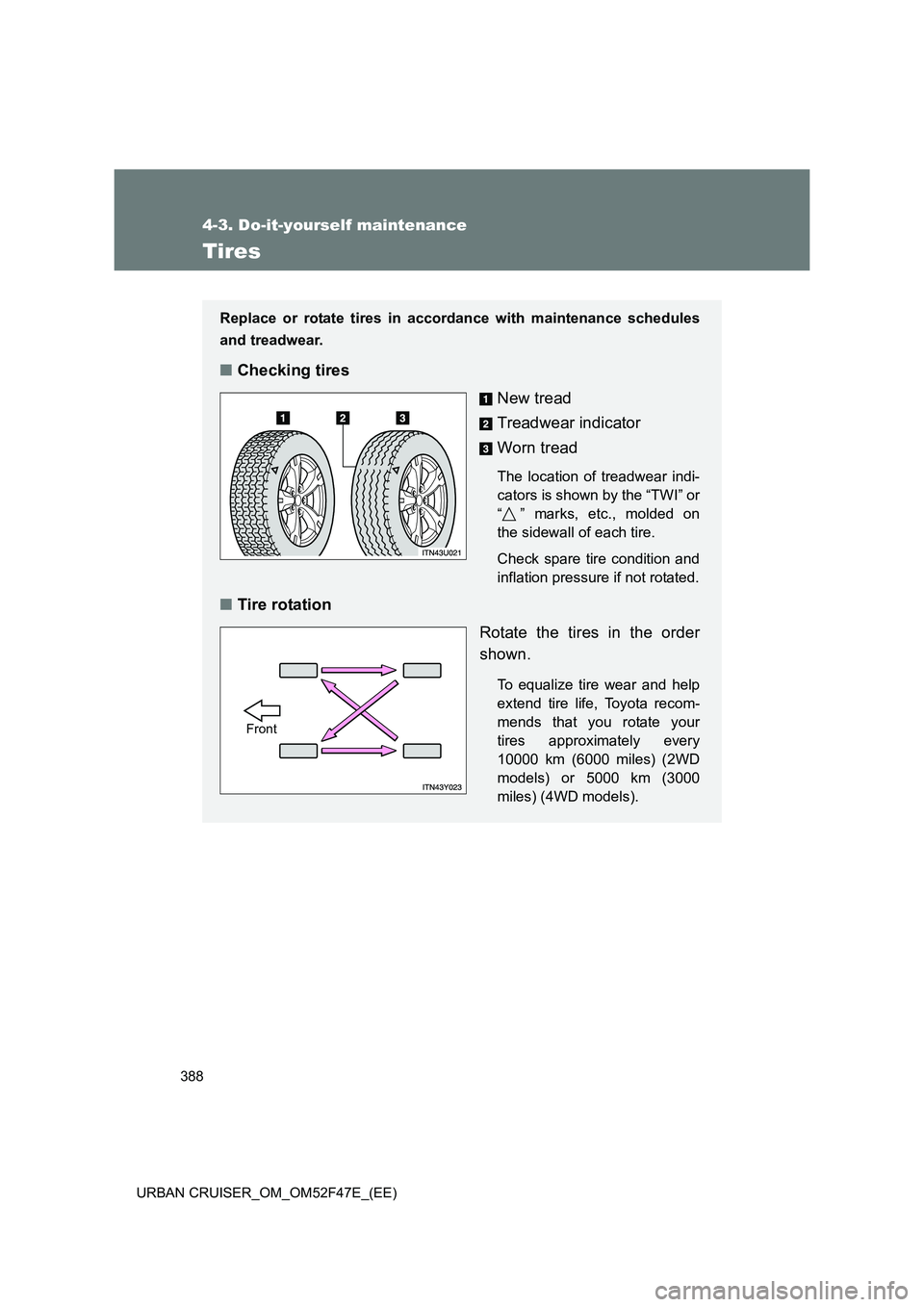
■Checking tires
New tread
Treadwear indicator
Worn tread
The location of treadwear indi-
cators is shown by the “TWI” or
“ ” marks, etc., molded on
the sidewall of each tire.
Check spare tire condition and
inflation pressure if not rotated.
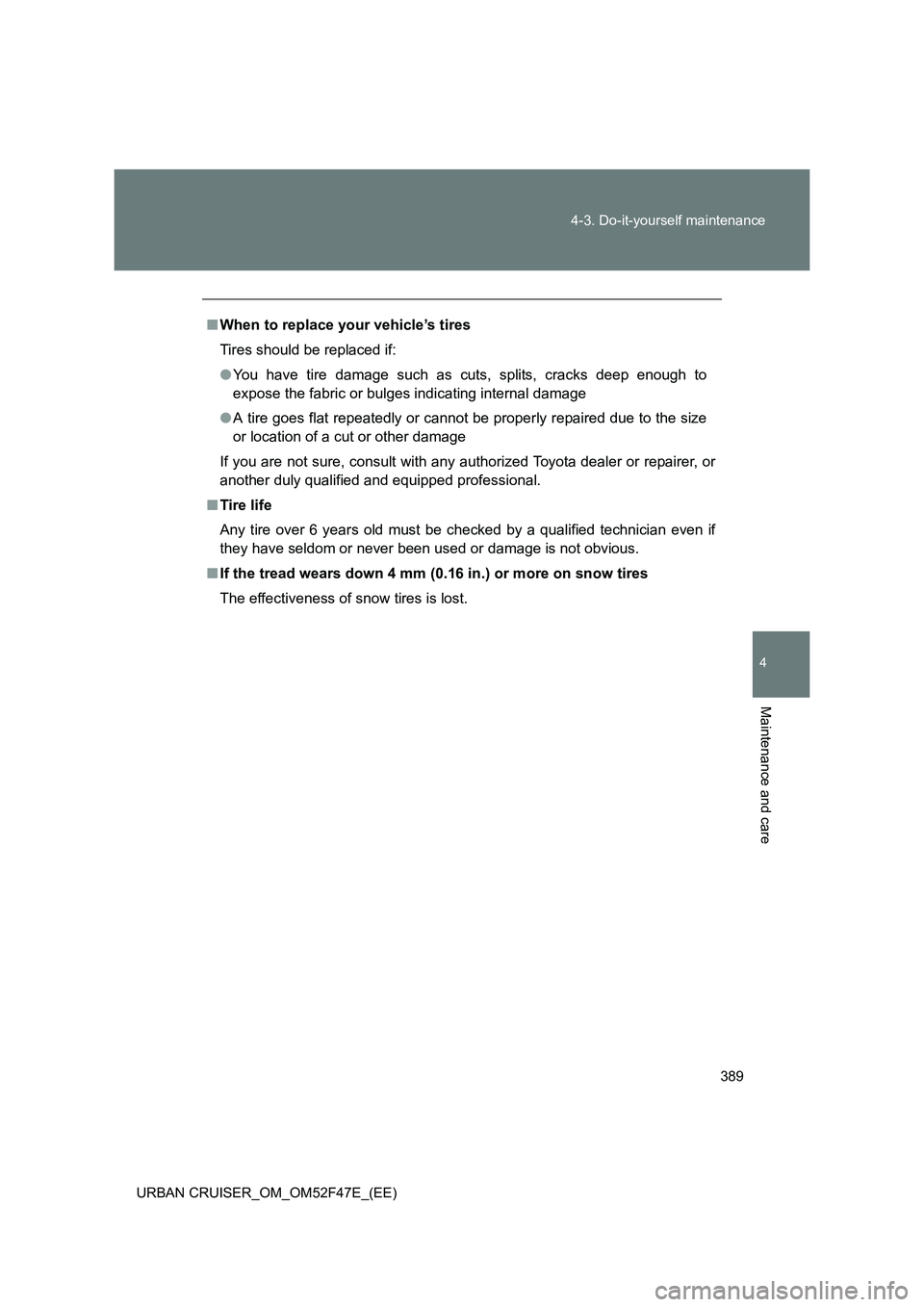
■Tire rotation
Rotate the tires in the order
shown.
To equalize tire wear and help
extend tire life, Toyota recom-
mends that you rotate your
tires approximately every
10000 km (6000 miles) (2WD
models) or 5000 km (3000
miles) (4WD models).
Front
Page 389 of 544
389
4-3. Do-it-yourself maintenance
4
Maintenance and care
URBAN CRUISER_OM_OM52F47E_(EE)
■
When to replace your vehicle’s tires
Tires should be replaced if:
●You have tire damage such as cuts, splits, cracks deep enough to
expose the fabric or bulges indicating internal damage
● A tire goes flat repeatedly or cannot be properly repaired due to the size
or location of a cut or other damage
If you are not sure, consult with any authorized Toyota dealer or repairer, or
another duly qualified and equipped professional.
■ Tire life
Any tire over 6 years old must be checked by a qualified technician even if
they have seldom or never been used or damage is not obvious.
■ If the tread wears down 4 mm (0.16 in.) or more on snow tires
The effectiveness of snow tires is lost.
Page 390 of 544
390
4-3. Do-it-yourself maintenance
URBAN CRUISER_OM_OM52F47E_(EE)
CAUTION
■ When inspecting or replacing tires
Observe the following precautions to prevent accidents.
Failure to do so may cause damage to parts of the drive train, as well as
dangerous handling characteristics, which may lead to an accident resulting
in death or serious injury.
●Do not mix tires of different makes, models or tread patterns.
Also, do not mix tires of remarkably different treadwear.
● Do not use tire sizes other than those recommended by Toyota.
● Do not mix differently constructed tires (radial, bias-belted or bias-ply
tires).
● Do not mix summer, all season and snow tires.
● Do not use tires that have been used on another vehicle.
Do not use tires if you do not know how they were used previously.
NOTICE
■Driving on rough roads
Take particular care when driving on roads with loose surfaces or pot holes.
These conditions may cause losses in tire inflation pressure, reducing the
cushioning ability of the tires. In addition, driving on rough roads may cause
damage to the tires themselves, as well as the vehicle’s wheels and body.
■ If tire inflation pressures become low while driving
Do not continue driving, or your tires and/or wheels may be ruined.
Page 391 of 544
391
4-3. Do-it-yourself maintenance
4
Maintenance and care
URBAN CRUISER_OM_OM52F47E_(EE)
Tire inflation pressure
■Effects of incorrect tire inflation pressure
Driving with incorrect tire inflation pressure may result in the following:
● Reduced fuel efficiency
● Reduced driving comfort and tire life
● Reduced safety
● Damage to the drive train
If a tire needs frequent refilling, have it checked by any authorized Toyota
dealer or repairer, or another duly qualified and equipped professional.
■ Instructions for checking tire inflation pressure
When checking tire inflation pressure, observe the following:
●Check only when the tires are cold.
If your vehicle has been parked for at least 3 hours and has not been
driven for more than 1.5 km or 1 mile, you will get an accurate cold tire
inflation pressure reading.
● Always use a tire pressure gauge.
The appearance of the tire can be misleading. In addition, tire inflation
pressures that are even just a few pounds off can degrade ride and han-
dling.
● Do not bleed or reduce tire inflation pressure after driving. It is normal for
the tire inflation pressure to be higher after driving.
● Never exceed the vehicle capacity weight.
Passengers and luggage weight should be placed so that the vehicle is
balanced.
Make sure to maintain the proper ti
re inflation pressure. Tire inflation
pressure should be checked at least once per month. However,
Toyota recommends that tire inflation pressure be checked once
every two weeks. ( →P. 521)
Page 392 of 544
392
4-3. Do-it-yourself maintenance
URBAN CRUISER_OM_OM52F47E_(EE)
CAUTION
■ Proper inflation is critical to save tire performance
Keep your tires properly inflated. Otherwise, the following conditions may
occur and result in an accident causing death or serious injury.
●Excessive wear
● Uneven wear
● Poor handling
● Possibility of blowouts resulting from overheated tires
● Poor sealing of the tire bead
● Wheel deformation and/or tire separation
● A greater possibility of tire damage from road hazards
NOTICE
■When inspecting and adjusting tire inflation pressure
Be sure to reinstall the tire valve caps.
Without the valve caps, dirt or moisture could get into the valve and cause
air leakage, which could result in an accident. If the caps have been lost,
replace them as soon as possible.