Page 392 of 544
392
4-3. Do-it-yourself maintenance
URBAN CRUISER_OM_OM52F47E_(EE)
CAUTION
■ Proper inflation is critical to save tire performance
Keep your tires properly inflated. Otherwise, the following conditions may
occur and result in an accident causing death or serious injury.
●Excessive wear
● Uneven wear
● Poor handling
● Possibility of blowouts resulting from overheated tires
● Poor sealing of the tire bead
● Wheel deformation and/or tire separation
● A greater possibility of tire damage from road hazards
NOTICE
■When inspecting and adjusting tire inflation pressure
Be sure to reinstall the tire valve caps.
Without the valve caps, dirt or moisture could get into the valve and cause
air leakage, which could result in an accident. If the caps have been lost,
replace them as soon as possible.
Page 458 of 544
458
5-2. Steps to take in an emergency
URBAN CRUISER_OM_OM52F47E_(EE)
■ The compact spare tire
●The compact spare tire saves in your luggage compartment.
● Its lighter weight helps to enhance fuel economy.
● It permits easier installation in case of a flat tire.
● Make sure to check the tire inflation pressure of the compact spare tire.
(→ P. 521)
■ If you have a flat front tire on a road covered with snow or ice
Install the compact spare tire on the rear of the vehicle. Perform the following
steps and fit tire chains to the front tires.
Replace a rear tire with the compact spare tire.
Replace the flat front tire with the tire removed from the rear of the
vehicle.
Fit tire chains to the front tires.
STEP1
STEP2
STEP3
Page 470 of 544
470
5-2. Steps to take in an emergency
URBAN CRUISER_OM_OM52F47E_(EE)
Check the specified tire inflation
pressure.
Tire inflation pressure is speci-
fied on the label in the glove box
as shown. ( →P. 521)
Start the engine.
To inject the sealant and inflate
the tire, turn the compressor
switch on.
Use the kit with the top facing
upward.
STEP8
STEP9
STEP10
Page 471 of 544
5
471
5-2. Steps to take in an emergency
When trouble arises
URBAN CRUISER_OM_OM52F47E_(EE)
Inflate the tire until the recom-
mended pressure is reached.
The sealant will be injected
and the pressure will spike to
300 kPa (3.0 kgf/cm
2 or bar,
44 psi) or 400 kPa (4.0 kgf/
cm
2 or bar, 58 psi), then grad-
ually decrease.
The air pressure gauge will
display the actual tire inflation
pressure about 1 minute after
the switch is turned on.
• Turn the compressor switch
off and then check the tire
inflation pressure. Being care-
ful not to over inflate, check
and repeat the inflation proce-
dure until the recommended
tire inflation pressure is
reached.
• If the needle of the air pres-
sure gauge reaches the red
zone (450 kPa [4.5 kgf/cm
2 or
bar, 65 psi] or more), there
may be a malfunction in the
tire or in the kit itself. Stop
operation immediately.
STEP11
Page 472 of 544
472
5-2. Steps to take in an emergency
URBAN CRUISER_OM_OM52F47E_(EE)
• If the tire inflation pressure is still lower than the recom-
mended level after inflation for
10 minutes with the switch on,
the tire is too damaged to be
repaired. Turn the compressor
switch off and contact any
authorized Toyota dealer, tire
dealer or repairer, or another
duly qualified and equipped
professional.
• If the tire inflation pressure
exceeds the recommended
level, let out some air to adjust
the tire inflation pressure.
(→ P. 476)
Disconnect the hose from the valve on the tire and then pull
out the power plug from the cigarette lighter socket.
To spread the liquid sealant evenly within the tire, immediately
drive for about 5 km (3 miles).
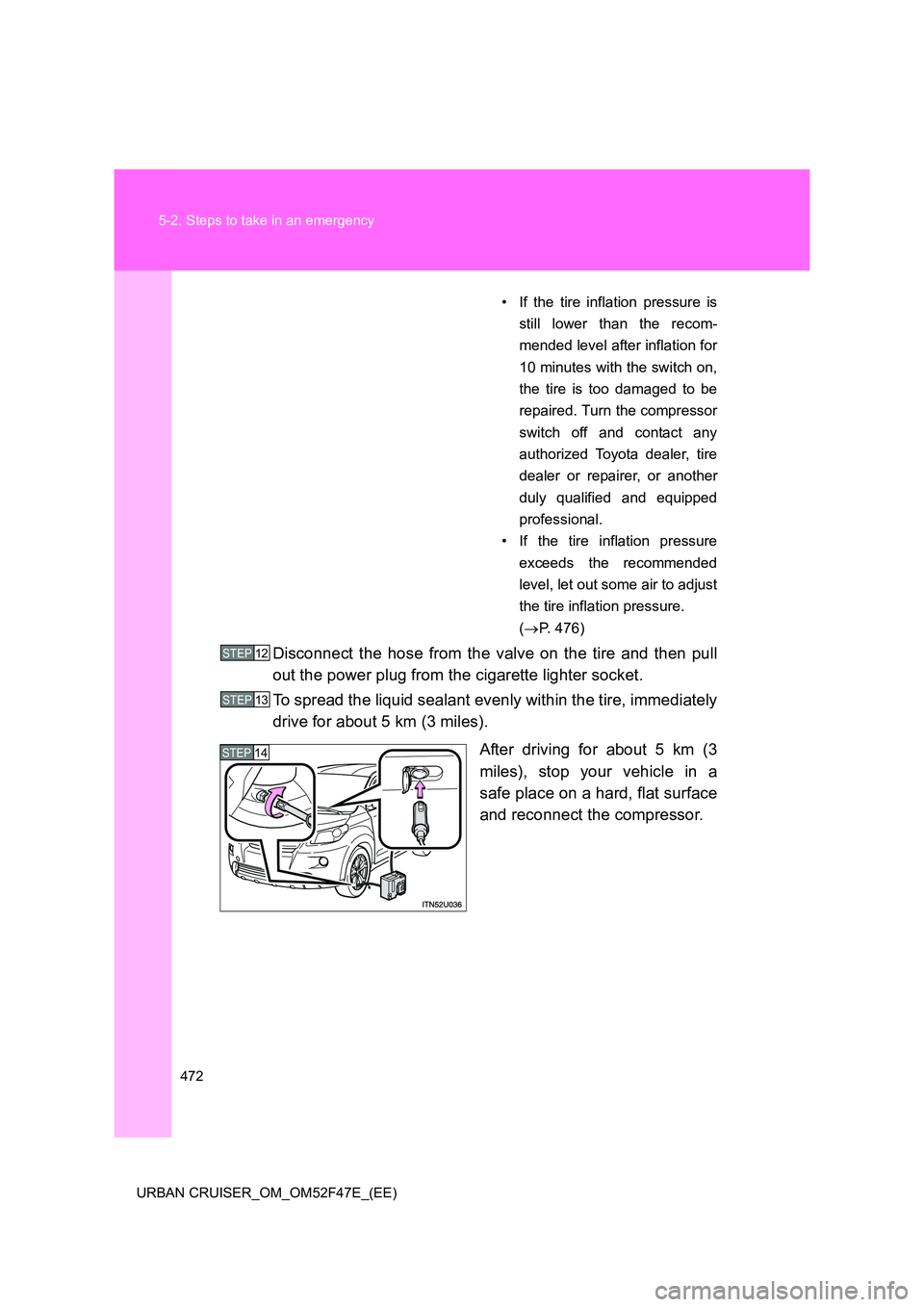
After driving for about 5 km (3
miles), stop your vehicle in a
safe place on a hard, flat surface
and reconnect the compressor.STEP12
STEP13
STEP14
Page 473 of 544
5
473
5-2. Steps to take in an emergency
When trouble arises
URBAN CRUISER_OM_OM52F47E_(EE)
Turn the compressor switch on
and wait for several seconds,
then turn it off. Check the tire
inflation pressure.
If the tire inflation pressure is
below 130 kPa (1.3 kgf/cm
2 or
bar, 19 psi): The puncture can-
not be repaired. Contact any
authorized Toyota dealer, tire
dealer or repairer, or another
duly qualified and equipped
professional.
If the tire inflation pressure is
between 130 kPa (1.3 kgf/cm
2
or bar, 19 psi) and a point
below the recommended level:
The tire can be repaired. Pro-
ceed to .
If the tire inflation pressure is
at the recommended level:
Proceed to .
Turn the compressor switch on to inflate the tire until the rec-
ommended tire inflation pressure is reached. Drive for about 5
km (3 miles) and then perform .
STEP15
STEP16
STEP17
STEP16
STEP14
Page 476 of 544
476
5-2. Steps to take in an emergency
URBAN CRUISER_OM_OM52F47E_(EE)
■ If the tire is inflated to more than the recommended level
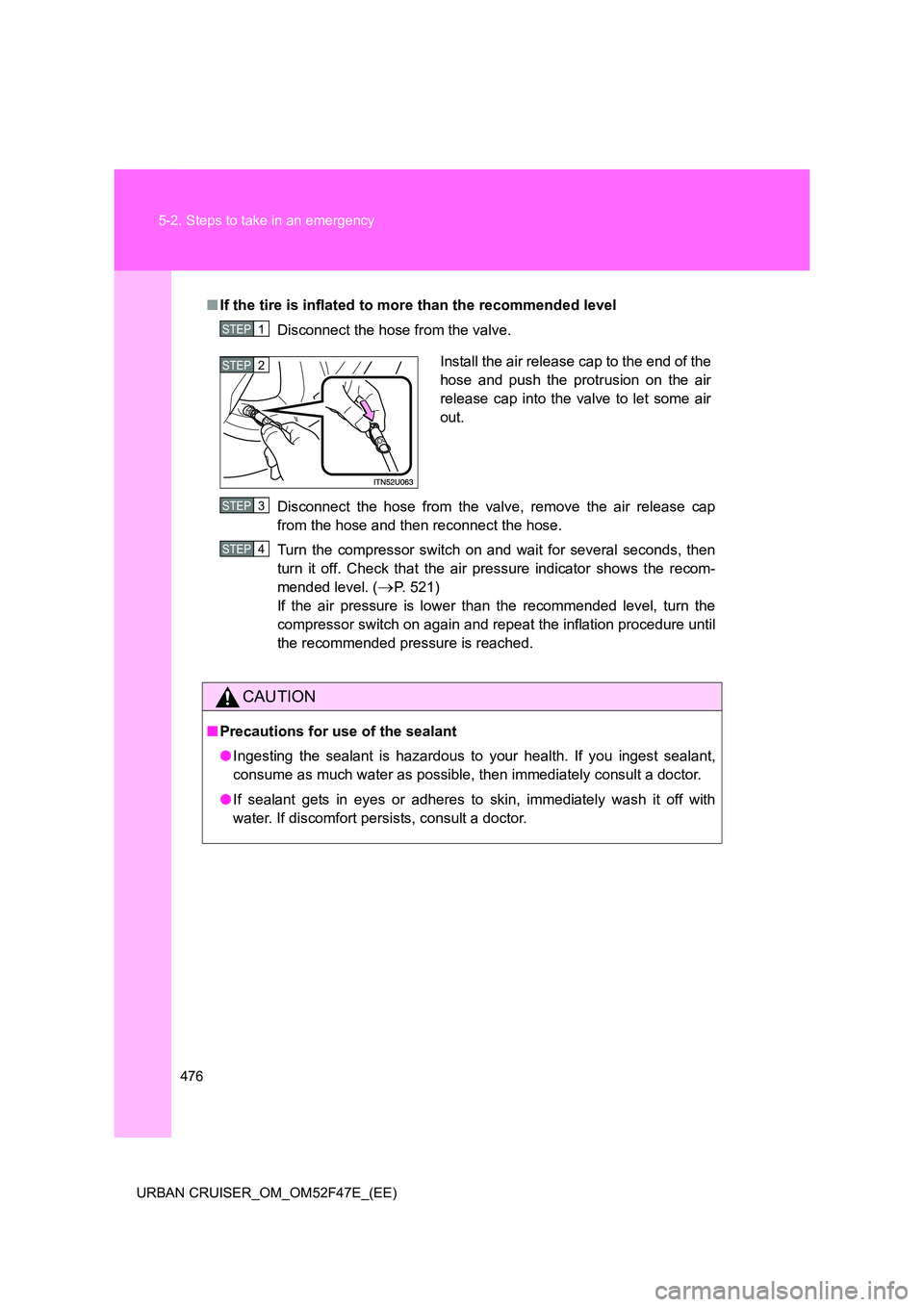
Disconnect the hose from the valve.
Disconnect the hose from the valve, remove the air release cap
from the hose and then reconnect the hose.
Turn the compressor switch on and wait for several seconds, then
turn it off. Check that the air pressure indicator shows the recom-
mended level. (
→P. 521)
If the air pressure is lower than the recommended level, turn the
compressor switch on again and repeat the inflation procedure until
the recommended pressure is reached.
CAUTION
■ Precautions for use of the sealant
●Ingesting the sealant is hazardous to your health. If you ingest sealant,
consume as much water as possible, then immediately consult a doctor.
● If sealant gets in eyes or adheres to skin, immediately wash it off with
water. If discomfort persists, consult a doctor.
STEP1
Install the air release cap to the end of the
hose and push the protrusion on the air
release cap into the valve to let some air
out.STEP2
STEP3
STEP4
Page 477 of 544

5
477
5-2. Steps to take in an emergency
When trouble arises
URBAN CRUISER_OM_OM52F47E_(EE)
CAUTION
■
When fixing the flat tire
●Stop your vehicle in a safe and flat area.
● Connect the valve and hose securely with the tire installed on the vehicle.
● If the hose is not properly connected to the valve, air leakage may occur or
sealant may be sprayed out.
● If the hose comes off the valve while inflating the tire, there is a risk that
the hose will move abruptly due to air pressure.
● After inflation of the tire has completed, the sealant may splatter when the
hose is disconnected or some air is let out of the tire.
● Keep back from the tire while it is being repaired, as there is a chance of it
bursting while the repair operation is being performed. If you notice any
cracks or deformation of the tire, turn off the compressor switch and stop
the repair operation immediately.
● The kit may overheat if operated for a long period of time. Do not operate
the compressor continuously for more than 10 minutes.
● Parts of the kit become hot during operation. Be careful handling the kit
during and after operation.
● Do not attach the vehicle speed warning sticker to an area other than the
one indicated. If the sticker is attached to an area where an SRS airbag is
located, such as the pad of the steering wheel, it may prevent the SRS air
bag from operating properly.