2014 TOYOTA TUNDRA check engine
[x] Cancel search: check enginePage 461 of 576

4618-2. Steps to take in an emergency
8
When trouble arises
NOTICE
■To prevent causing serious damage to the transmission and transfer
(4WD models) when towing using a wheel-lift type truck
2WD models: Never tow this vehicle from the front with the rear wheels on
the ground.
4WD models: Never tow this vehicle with any of the wheels in contact with
the ground.
■ To prevent damage to the vehicle when towing using a wheel-lift type
truck
● Do not tow the vehicle from the rear when the engine switch is in the
“LOCK” position or the key is removed. The steering lock mechanism is
not strong enough to hold the front wheels straight.
● When raising the vehicle from the rear, ensure adequate ground clearance
for towing at the opposite end of the raised vehicle. Without adequate
clearance, the vehicle could be damaged while being towed from the rear.
■ To prevent body damage when towing with a sling-type truck
Do not tow with a sling-type truck, either from the front or rear.
■ To prevent causing serious damage to the transmission and transfer in
emergency towing (4WD models)
Never tow a vehicle from the rear with four wheels on the ground. This may
cause serious damage to the transmission and transfer.
■ Emergency towing eyelet precautions
● Before emergency towing, check that the eyelet is not broken or damaged
and that the installation bolts are not loose.
● Fasten the towing cable or chain securely to the eyelet.
● Do not jerk the eyelet. Apply steady and even force.
● To avoid damaging the eyelet, do not pull from the side or at a vertical
angle. Always pull straight ahead.
Page 467 of 576
4678-2. Steps to take in an emergency
8
When trouble arises
*1: Parking brake engaged warning buzzer:A buzzer will sound if the vehicle is driven at a speed of approximately
3 mph (5 km/h) or more.
*2: The light may come on when the oil level is extremely low. It is notdesigned to indicate low oil level, and the oil level must be checked using
the engine oil level dipstick.
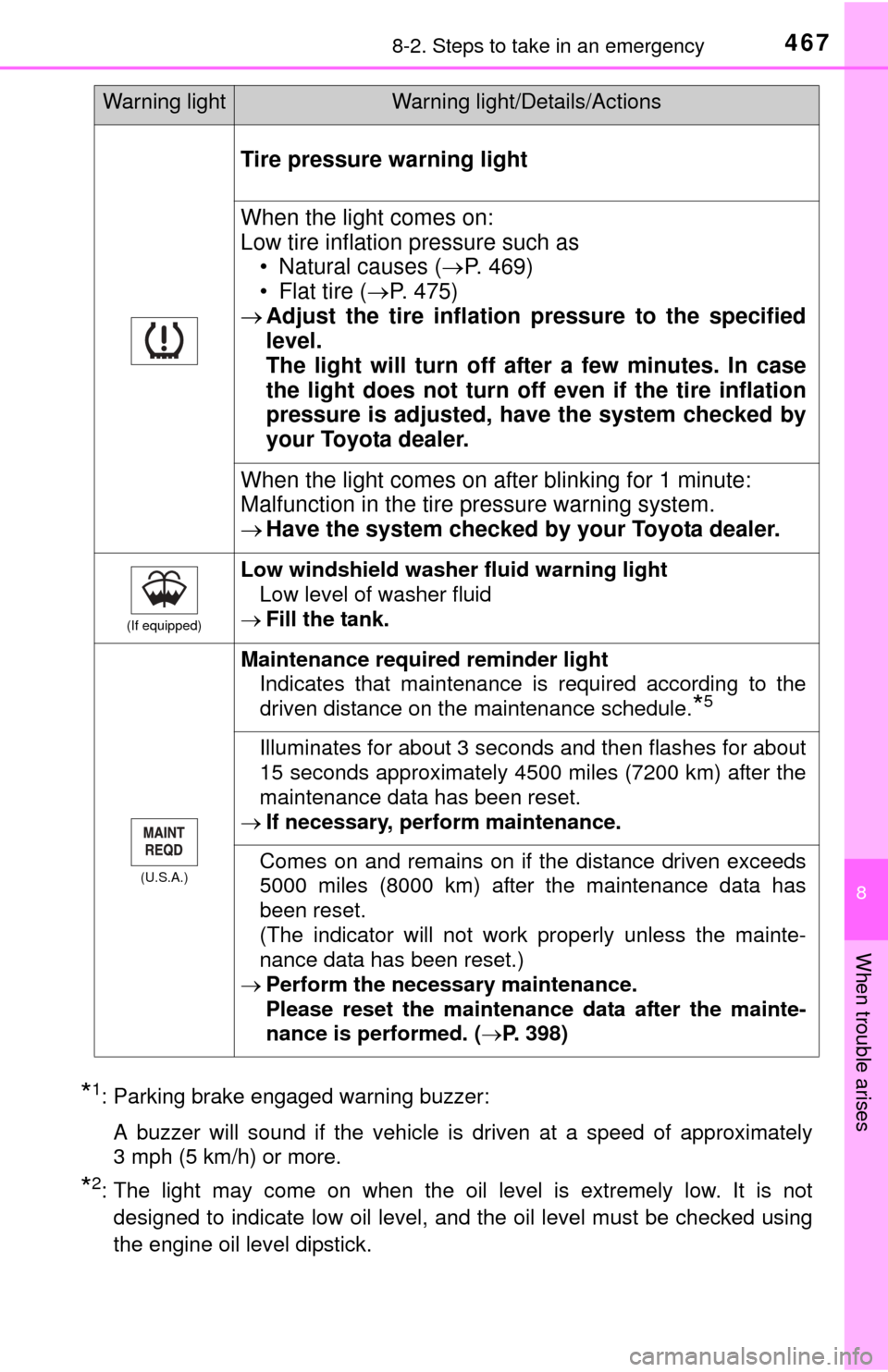
Tire pressure warning light
When the light comes on:
Low tire inflation pressure such as • Natural causes ( P. 469)
• Flat tire ( P. 475)
Adjust the tire inflation pressure to the specified
level.
The light will turn off after a few minutes. In case
the light does not turn off even if the tire inflation
pressure is adjusted, have the system checked by
your Toyota dealer.
When the light comes on after blinking for 1 minute:
Malfunction in the tire pressure warning system.
Have the system checked by your Toyota dealer.
(If equipped)
Low windshield washer fluid warning light
Low level of washer fluid
Fill the tank.
(U.S.A.)
Maintenance required reminder light
Indicates that maintenance is required according to the
driven distance on the maintenance schedule.
*5
Illuminates for about 3 seconds and then flashes for about
15 seconds approximately 4500 miles (7200 km) after the
maintenance data has been reset.
If necessary, perform maintenance.
Comes on and remains on if the distance driven exceeds
5000 miles (8000 km) after the maintenance data has
been reset.
(The indicator will not work properly unless the mainte-
nance data has been reset.)
Perform the necessary maintenance.
Please reset the maintenance data after the mainte-
nance is performed. ( P. 398)
Warning lightWarning light/Details/Actions
Page 469 of 576

4698-2. Steps to take in an emergency
8
When trouble arises
■If the malfunction indicator la mp comes on while driving
First check the following:
● Is the fuel tank empty?
If it is, fill the fuel tank immediately.
● Is the fuel tank cap loose?
If it is, tighten it securely.
The light will go off after several driving trips.
If the light does not go off even after several trips, contact your Toyota dealer
as soon as possible.
■
When the tire pressure warning light comes on
Check the tire inflation pressure and adjust to the appropriate level. Push-
ing the tire pressure warning reset switch will not turn off the tire pressure
warning light.
■The tire pressure warning light may come on due to natural causes
The tire pressure warning light may come on due to natural causes such
as natural air leaks and tire inflation pressure changes caused by temper-
ature. In this case, adjusting the ti re inflation pressure will turn off the
warning light (after several minutes).
■When a tire is replaced with a spare tire
The temporary spare tire is not equipped with a tire pressure warning
valve and transmitter. If a tire goes flat, the tire pressure warning light will
not turn off even though the flat tire has been replaced with the temporary
spare tire. Replace the temporary spare tire with the repaired tire and
adjust the tire inflation pressure. Th e tire pressure warning light will go off
after several minutes.
■Conditions that the tire pressure warning system may not function
properly
P. 4 2 1
■If the tire pressure warning light frequently comes on after blinking
for 1 minute
If the tire pressure warning light frequently comes on after blinking for 1
minute when the engine switch is turned to “ON” position, have it checked
by your Toyota dealer.
■Warning buzzer
In some cases, the buzzer may not be heard because of noisy place or an
audio sound.
Page 497 of 576
4978-2. Steps to take in an emergency
8
When trouble arises
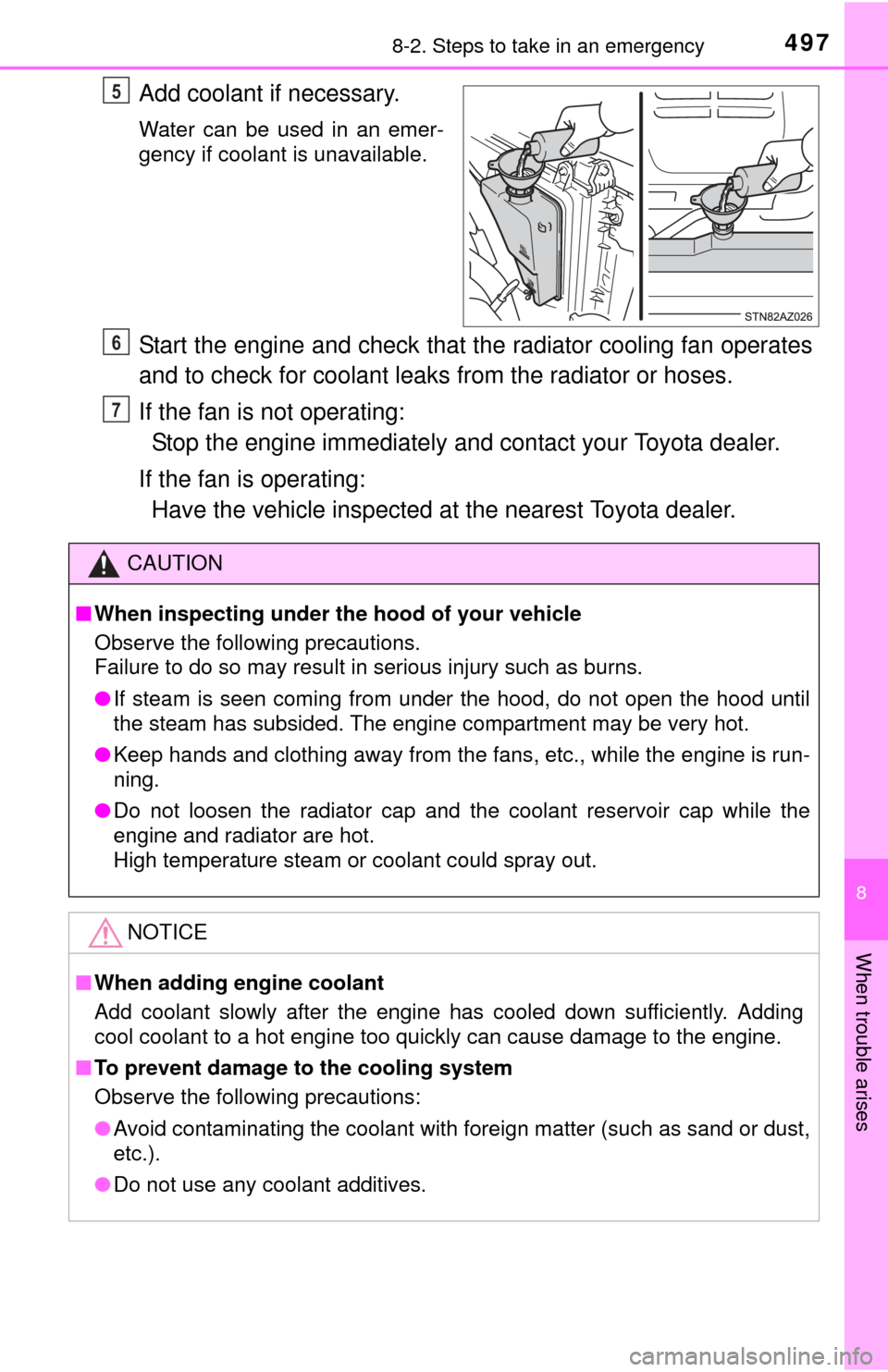
Add coolant if necessary.
Water can be used in an emer-
gency if coolant is unavailable.
Start the engine and check that the radiator cooling fan operates
and to check for coolant leaks from the radiator or hoses.
If the fan is not operating: Stop the engine immediately and contact your Toyota dealer.
If the fan is operating: Have the vehicle inspected at the nearest Toyota dealer.
5
CAUTION
■ When inspecting under the hood of your vehicle
Observe the following precautions.
Failure to do so may result in serious injury such as burns.
● If steam is seen coming from under the hood, do not open the hood until
the steam has subsided. The engine compartment may be very hot.
● Keep hands and clothing away from the fans, etc., while the engine is run-
ning.
● Do not loosen the radiator cap and the coolant reservoir cap while the
engine and radiator are hot.
High temperature steam or coolant could spray out.
NOTICE
■When adding engine coolant
Add coolant slowly after the engine has cooled down sufficiently. Adding
cool coolant to a hot engine too quickly can cause damage to the engine.
■ To prevent damage to the cooling system
Observe the following precautions:
● Avoid contaminating the coolant with foreign matter (such as sand or dust,
etc.).
● Do not use any coolant additives.
6
7
Page 508 of 576
5089-1. Specifications
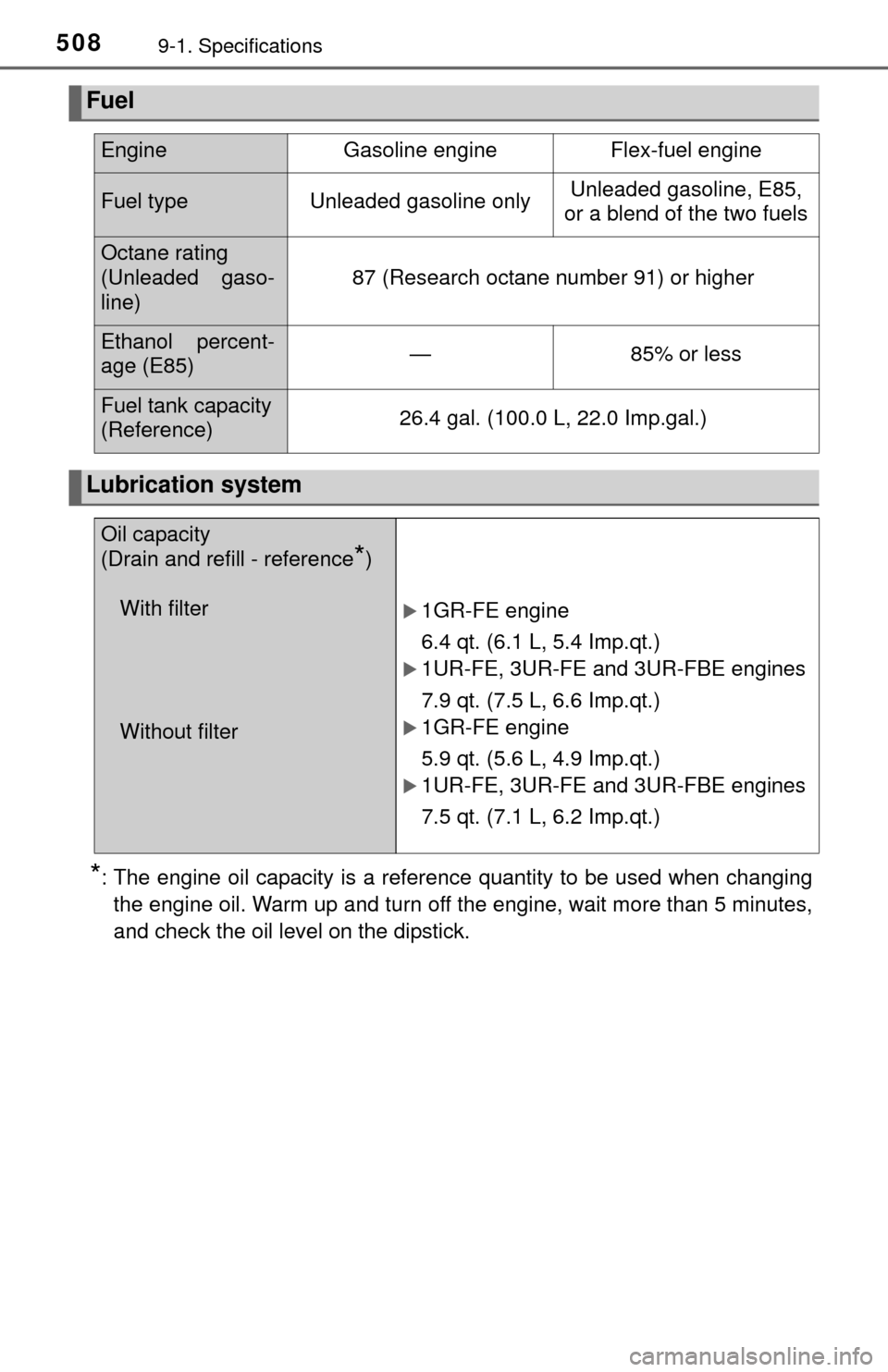
*: The engine oil capacity is a reference quantity to be used when changingthe engine oil. Warm up and turn off the engine, wait more than 5 minutes,
and check the oil level on the dipstick.
Fuel
EngineGasoline engineFlex-fuel engine
Fuel typeUnleaded gasoline onlyUnleaded gasoline, E85,
or a blend of the two fuels
Octane rating
(Unleaded gaso-
line)
87 (Research octane number 91) or higher
Ethanol percent-
age (E85)—85% or less
Fuel tank capacity
(Reference)26.4 gal. (100.0 L, 22.0 Imp.gal.)
Lubrication system
Oil capacity
(Drain and refill - reference
*)
With filter
Without filter
1GR-FE engine
6.4 qt. (6.1 L, 5.4 Imp.qt.)
1UR-FE, 3UR-FE and 3UR-FBE engines
7.9 qt. (7.5 L, 6.6 Imp.qt.)
1GR-FE engine
5.9 qt. (5.6 L, 4.9 Imp.qt.)
1UR-FE, 3UR-FE and 3UR-FBE engines
7.5 qt. (7.1 L, 6.2 Imp.qt.)
Page 511 of 576
5119-1. Specifications
9
Vehicle specifications
*: Your Toyota vehicle is filled with “Toyota Genuine Differential Gear Oil” atthe factory. Use Toyota approved “Toyota Genuine Differential Gear Oil” or
an equivalent oil of matching quality to satisfy the above specification.
Please contact your Toyota dealer for further details.
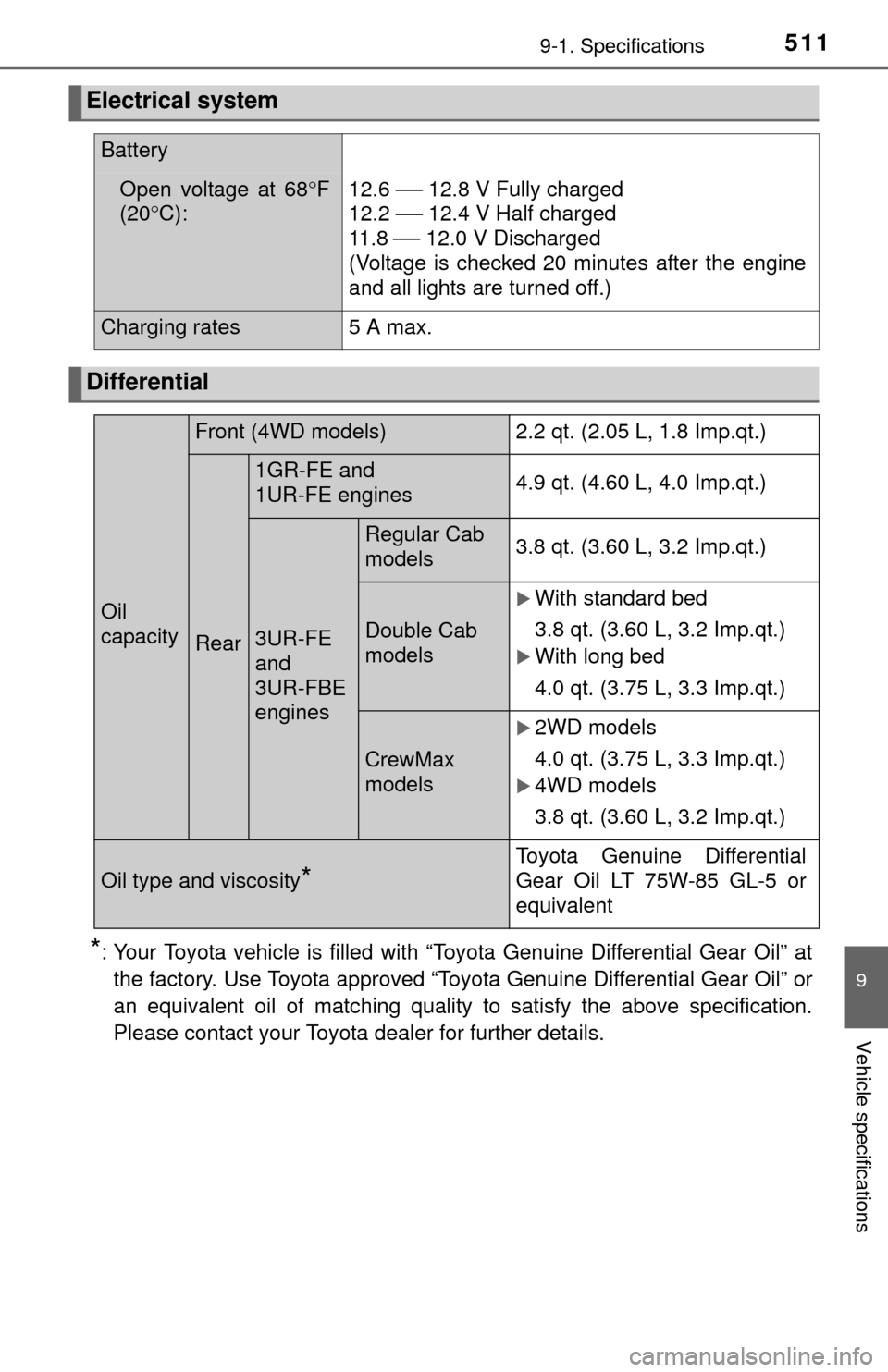
Electrical system
Battery
Open voltage at 68 F
(20 C):12.6 12.8 V Fully charged
12.2
12.4 V Half charged
11 . 8
12.0 V Discharged
(Voltage is checked 20 minutes after the engine
and all lights are turned off.)
Charging rates5 A max.
Differential
Oil
capacity
Front (4WD models) 2.2 qt. (2.05 L, 1.8 Imp.qt.)
Rear
1GR-FE and
1UR-FE engines4.9 qt. (4.60 L, 4.0 Imp.qt.)
3UR-FE
and
3UR-FBE
engines
Regular Cab
models3.8 qt. (3.60 L, 3.2 Imp.qt.)
Double Cab
models
With standard bed
3.8 qt. (3.60 L, 3.2 Imp.qt.)
With long bed
4.0 qt. (3.75 L, 3.3 Imp.qt.)
CrewMax
models
2WD models
4.0 qt. (3.75 L, 3.3 Imp.qt.)
4WD models
3.8 qt. (3.60 L, 3.2 Imp.qt.)
Oil type and viscosity*
Toyota Genuine Differential
Gear Oil LT 75W-85 GL-5 or
equivalent
Page 558 of 576
558What to do if... (Troubleshooting)
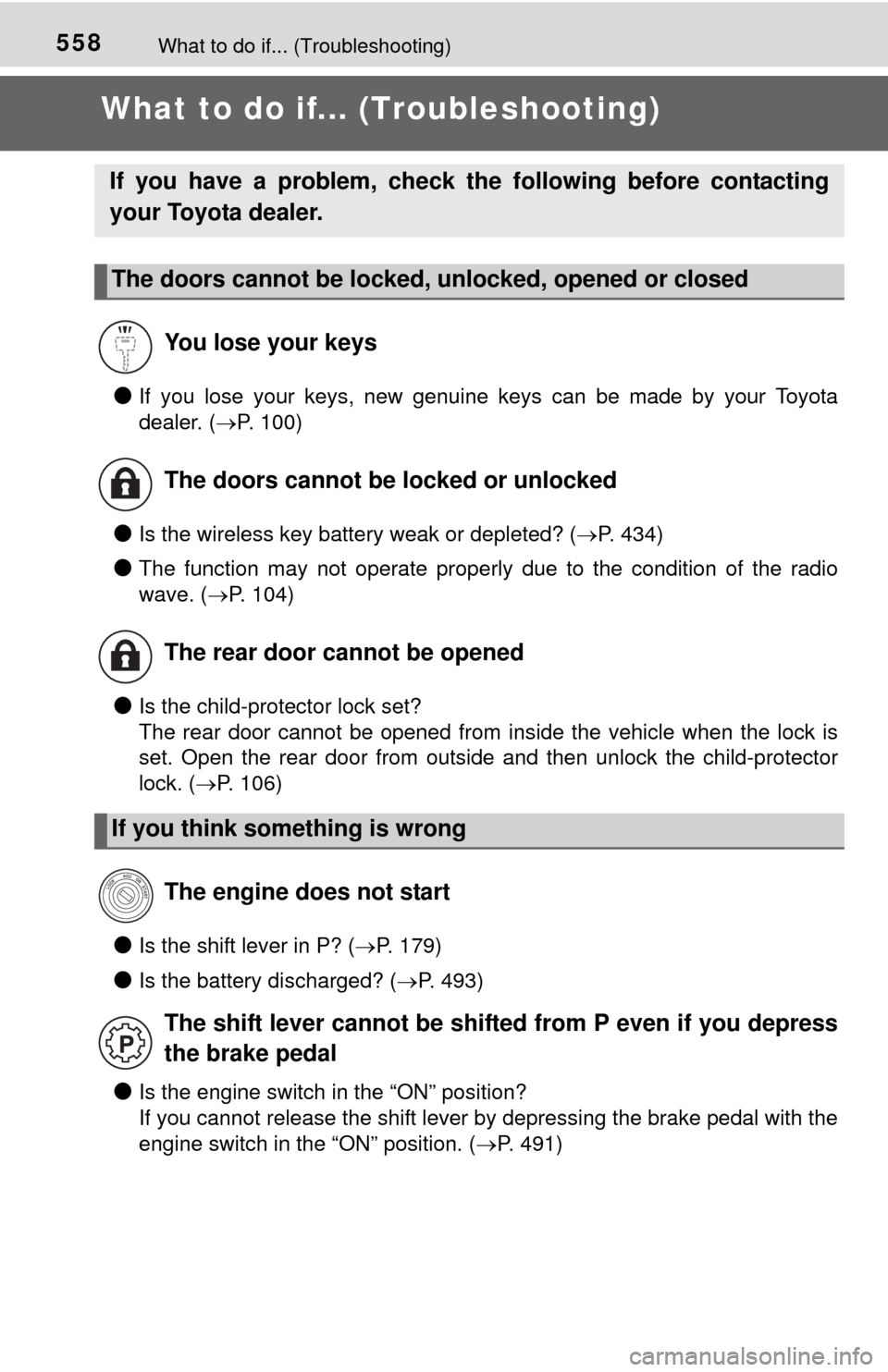
What to do if... (Troubleshooting)
●If you lose your keys, new genuine keys can be made by your Toyota
dealer. (P. 100)
●Is the wireless key battery weak or depleted? ( P. 434)
●The function may not operate properly due to the condition of the radio
wave. (P. 104)
●Is the child-protector lock set?
The rear door cannot be opened from inside the vehicle when the lock is
set. Open the rear door from outside and then unlock the child-protector
lock. (P. 106)
●Is the shift lever in P? ( P. 179)
●Is the battery discharged? ( P. 493)
●Is the engine switch in the “ON” position?
If you cannot release the shift lever by depressing the brake pedal with the
engine switch in the “ON” position. ( P. 491)
If you have a problem, check th e following before contacting
your Toyota dealer.
The doors cannot be locked, unlocked, opened or closed
You lose your keys
The doors cannot be locked or unlocked
The rear door cannot be opened
If you think something is wrong The engine does not start
The shift lever cannot be shifted from P even if you depress
the brake pedal
Page 563 of 576
563Alphabetical index
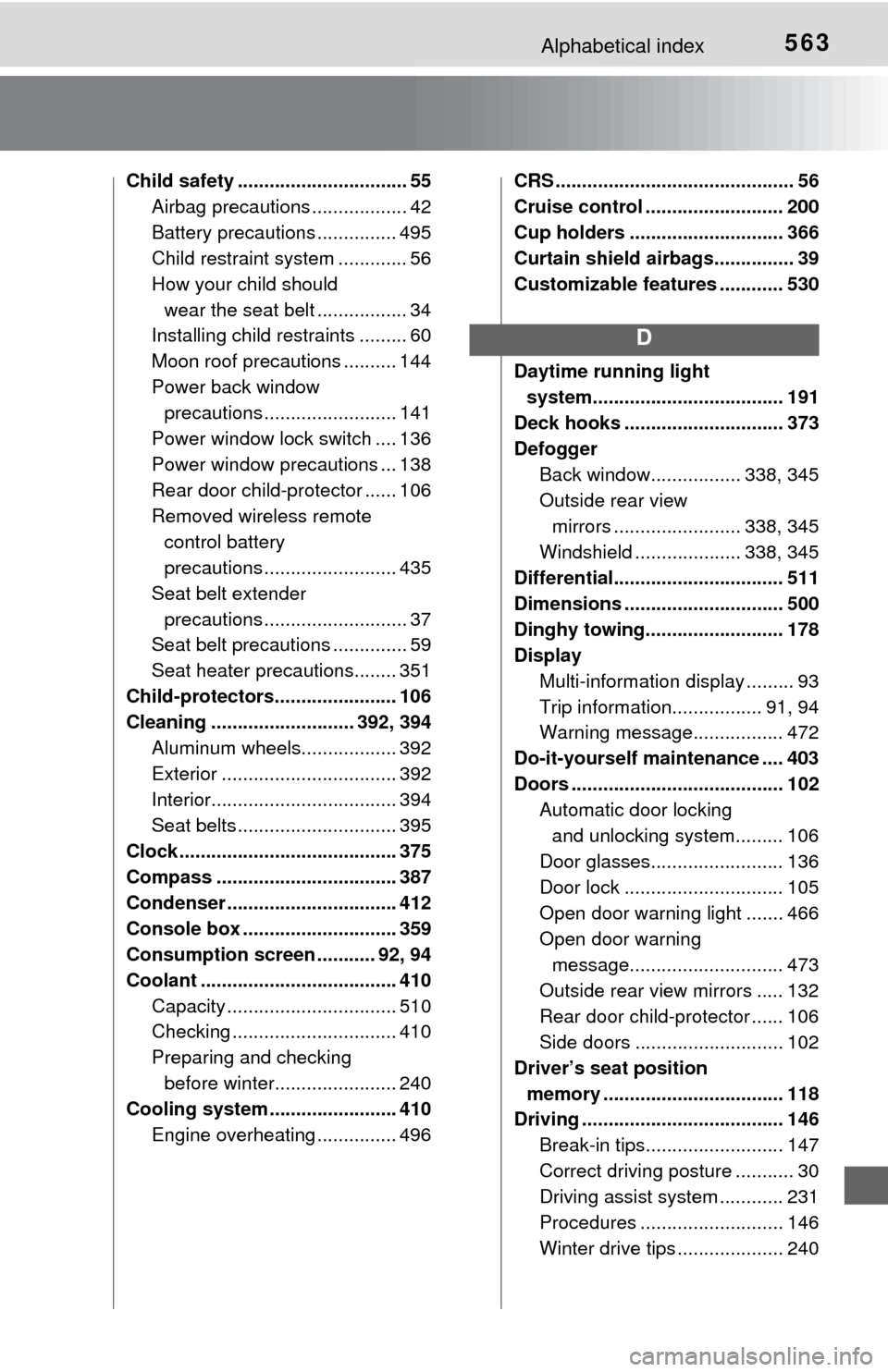
Child safety ................................ 55Airbag precautions .................. 42
Battery precautions ............... 495
Child restraint system ............. 56
How your child should wear the seat belt ................. 34
Installing child restraints ......... 60
Moon roof precautions .......... 144
Power back window precautions ......................... 141
Power window lock switch .... 136
Power window precautions ... 138
Rear door child-protector ...... 106
Removed wireless remote control battery
precautions ......................... 435
Seat belt extender precautions ........................... 37
Seat belt precautions .............. 59
Seat heater precautions........ 351
Child-protectors....................... 106
Cleaning ........................... 392, 394 Aluminum wheels.................. 392
Exterior ................................. 392
Interior................................... 394
Seat belts .............................. 395
Clock ......................................... 375
Compass .................................. 387
Condenser ................................ 412
Console box ............................. 359
Consumption screen ........... 92, 94
Coolant ..................................... 410 Capacity ................................ 510
Checking ............................... 410
Preparing and checking before winter....................... 240
Cooling system ........................ 410
Engine overheating ............... 496 CRS ............................................. 56
Cruise control .......................... 200
Cup holders ............................. 366
Curtain shield airbags............... 39
Customizable features ............ 530
Daytime running light
system.................................... 191
Deck hooks .............................. 373
Defogger
Back window................. 338, 345
Outside rear view mirrors ........................ 338, 345
Windshield .................... 338, 345
Differential................................ 511
Dimensions .............................. 500
Dinghy towing.......................... 178
Display
Multi-information display ......... 93
Trip information................. 91, 94
Warning message................. 472
Do-it-yourself maintenance .... 403
Doors ........................................ 102 Automatic door locking
and unlocking system......... 106
Door glasses......................... 136
Door lock .............................. 105
Open door warning light ....... 466
Open door warning message............................. 473
Outside rear view mirrors ..... 132
Rear door child-protector ...... 106
Side doors ............................ 102
Driver’s seat position memory .................................. 118
Driving ...................................... 146
Break-in tips.......................... 147
Correct driving posture ........... 30
Driving assist system ............ 231
Procedures ........................... 146
Winter drive tips .................... 240
D