Page 159 of 576
1594-1. Before driving
4
Driving
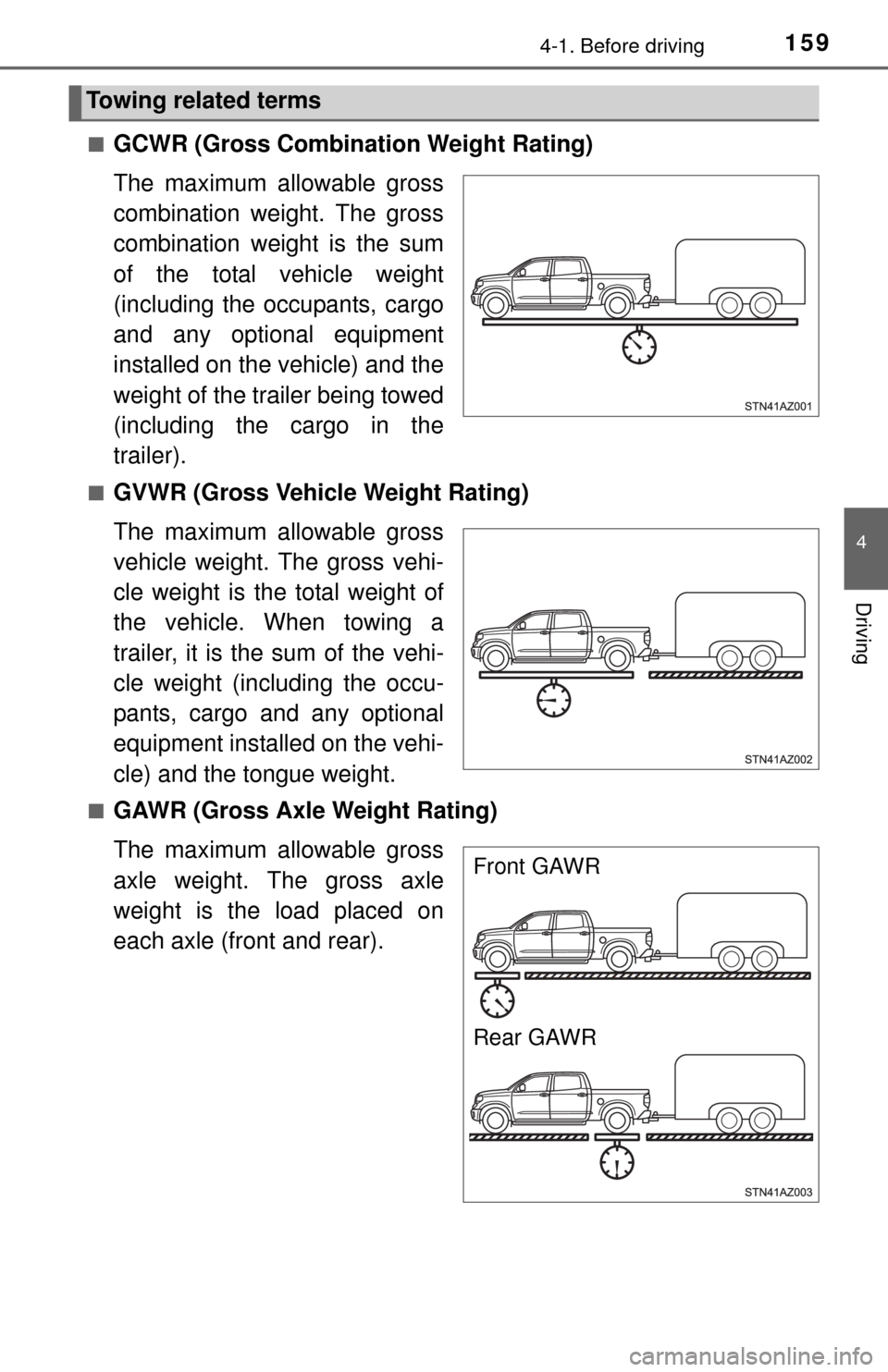
■GCWR (Gross Combination Weight Rating)
The maximum allowable gross
combination weight. The gross
combination weight is the sum
of the total vehicle weight
(including the occupants, cargo
and any optional equipment
installed on the vehicle) and the
weight of the trailer being towed
(including the cargo in the
trailer).
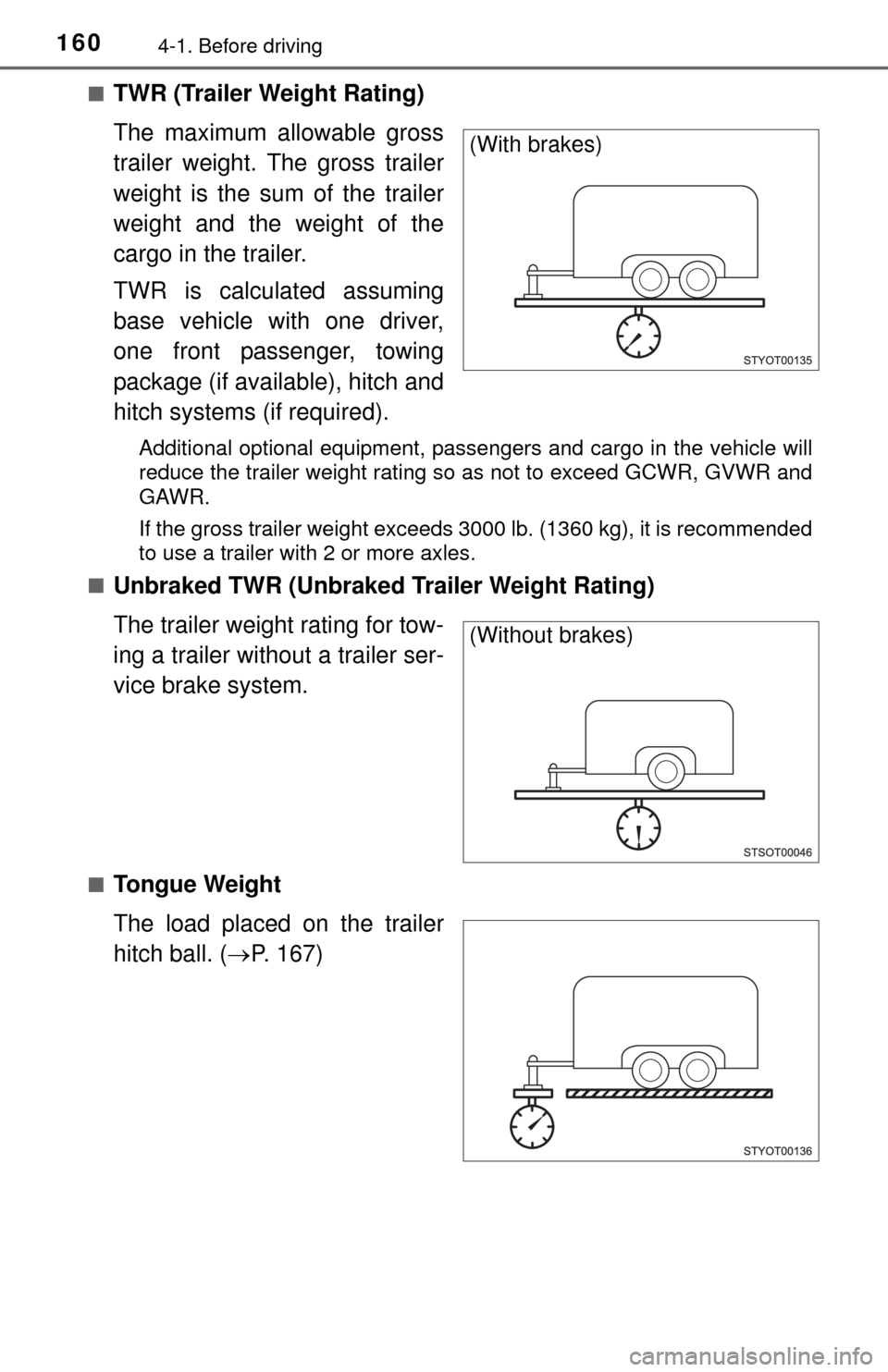
■GVWR (Gross Vehicle Weight Rating)
The maximum allowable gross
vehicle weight. The gross vehi-
cle weight is the total weight of
the vehicle. When towing a
trailer, it is the sum of the vehi-
cle weight (including the occu-
pants, cargo and any optional
equipment installed on the vehi-
cle) and the tongue weight.
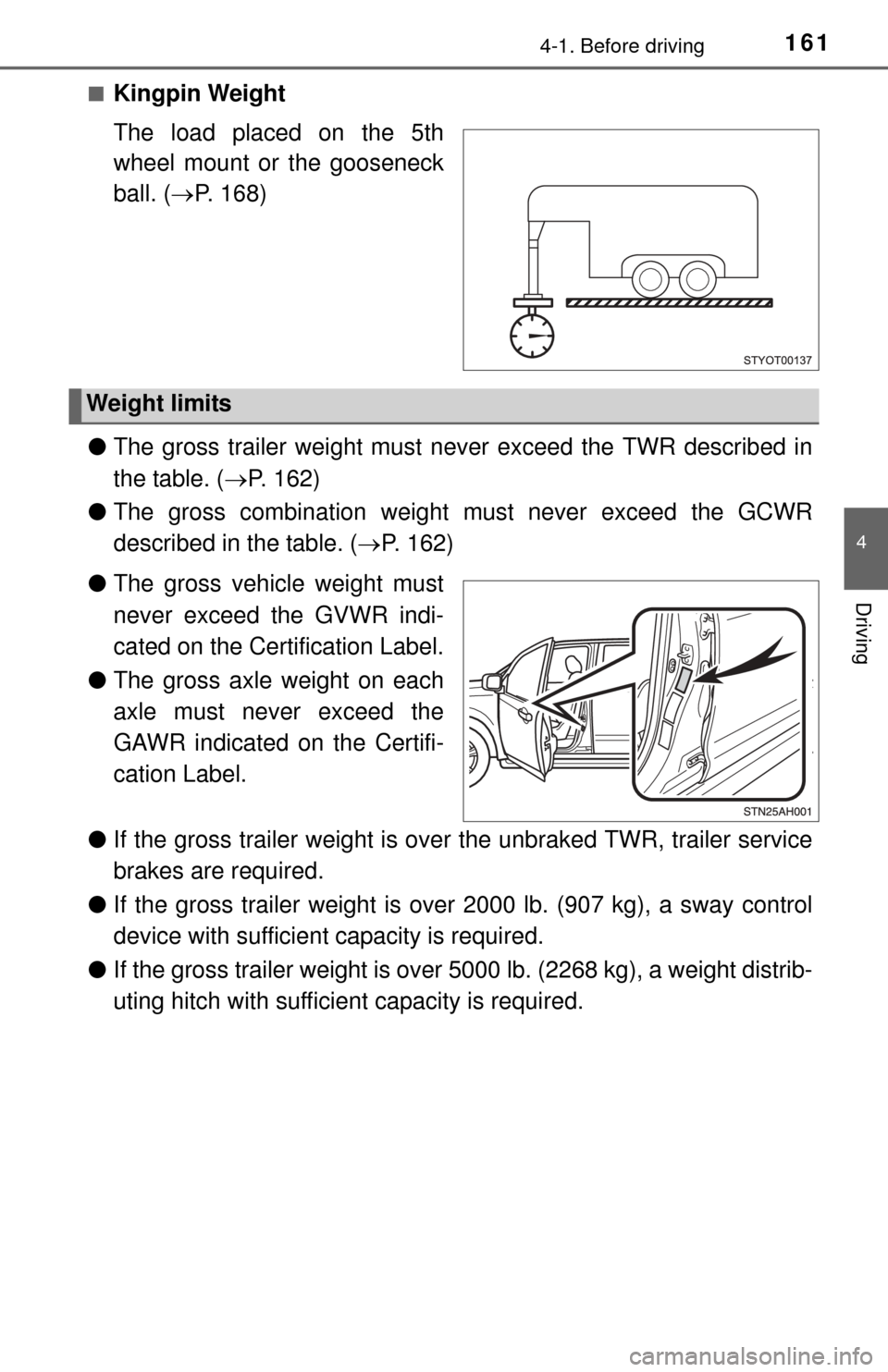
■GAWR (Gross Axle Weight Rating)
The maximum allowable gross
axle weight. The gross axle
weight is the load placed on
each axle (front and rear).
Towing related terms
Front GAWR
Rear GAWR
Page 160 of 576
1604-1. Before driving
■TWR (Trailer Weight Rating)
The maximum allowable gross
trailer weight. The gross trailer
weight is the sum of the trailer
weight and the weight of the
cargo in the trailer.
TWR is calculated assuming
base vehicle with one driver,
one front passenger, towing
package (if available), hitch and
hitch systems (if required).
Additional optional equipment, passengers and cargo in the vehicle will
reduce the trailer weight rating so as not to exceed GCWR, GVWR and
GAWR.
If the gross trailer weight exceeds 3000 lb. (1360 kg), it is recommended
to use a trailer with 2 or more axles.
■
Unbraked TWR (Unbraked Trailer Weight Rating)
The trailer weight rating for tow-
ing a trailer without a trailer ser-
vice brake system.
■Tongue Weight
The load placed on the trailer
hitch ball. ( P. 167)
(With brakes)
(Without brakes)
Page 161 of 576
1614-1. Before driving
4
Driving
■Kingpin Weight
The load placed on the 5th
wheel mount or the gooseneck
ball. (P. 168)
● The gross trailer weight must never exceed the TWR described in
the table. ( P. 162)
● The gross combination weight must never exceed the GCWR
described in the table. ( P. 162)
● The gross vehicle weight must
never exceed the GVWR indi-
cated on the Certification Label.
● The gross axle weight on each
axle must never exceed the
GAWR indicated on the Certifi-
cation Label.
● If the gross trailer weight is over the unbraked TWR, trailer service
brakes are required.
● If the gross trailer weight is over 2000 lb. (907 kg), a sway control
device with sufficient capacity is required.
● If the gross trailer weight is over 5000 lb. (2268 kg), a weight distrib-
uting hitch with sufficient capacity is required.
Weight limits
Page 162 of 576
1624-1. Before driving
Confirm that the gross trailer weight, gross combination weight, gross
vehicle weight, gross axle weight and tongue weight are all within the
limits.
■GCWR*4 and TWR*4
Regular Cab models
*1: The model code is indicated on the Certification Label. (P. 506)
*2: Vehicles without towing package
*3: Vehicles with towing package
GCWR, TWR, Unbraked TWR, Fifth wheel and Gooseneck towing
TWR
*4: These models meet the tow-vehicle trailering requirement of SAE International per SAE J2807.
Model code*1EngineDriving
systemBed typeGCWRTWR
GSK51L-THASKA 1GR-FE
engine
2WD
Long10000 lb.
(4535 kg) 4800 lb.
(2175 kg)
USK51L-THTSKA 3UR-FE engine 14000 lb.
(6350 kg)
*28500 lb.
(3855 kg)
*2
16000 lb.
(7255 kg)
*310500 lb.
(4760 kg)
*3
USK56L-THTSKA
4WD14000 lb.
(6350 kg)*28200 lb.
(3715 kg)
*2
16000 lb.
(7255 kg)
*310200 lb.
(4625 kg)
*3
USK56L-THTSGA 3UR-FBE
engine 14000 lb.
(6350 kg)*28200 lb.
(3715 kg)
*2
16000 lb.
(7255 kg)
*310200 lb.
(4625 kg)
*3
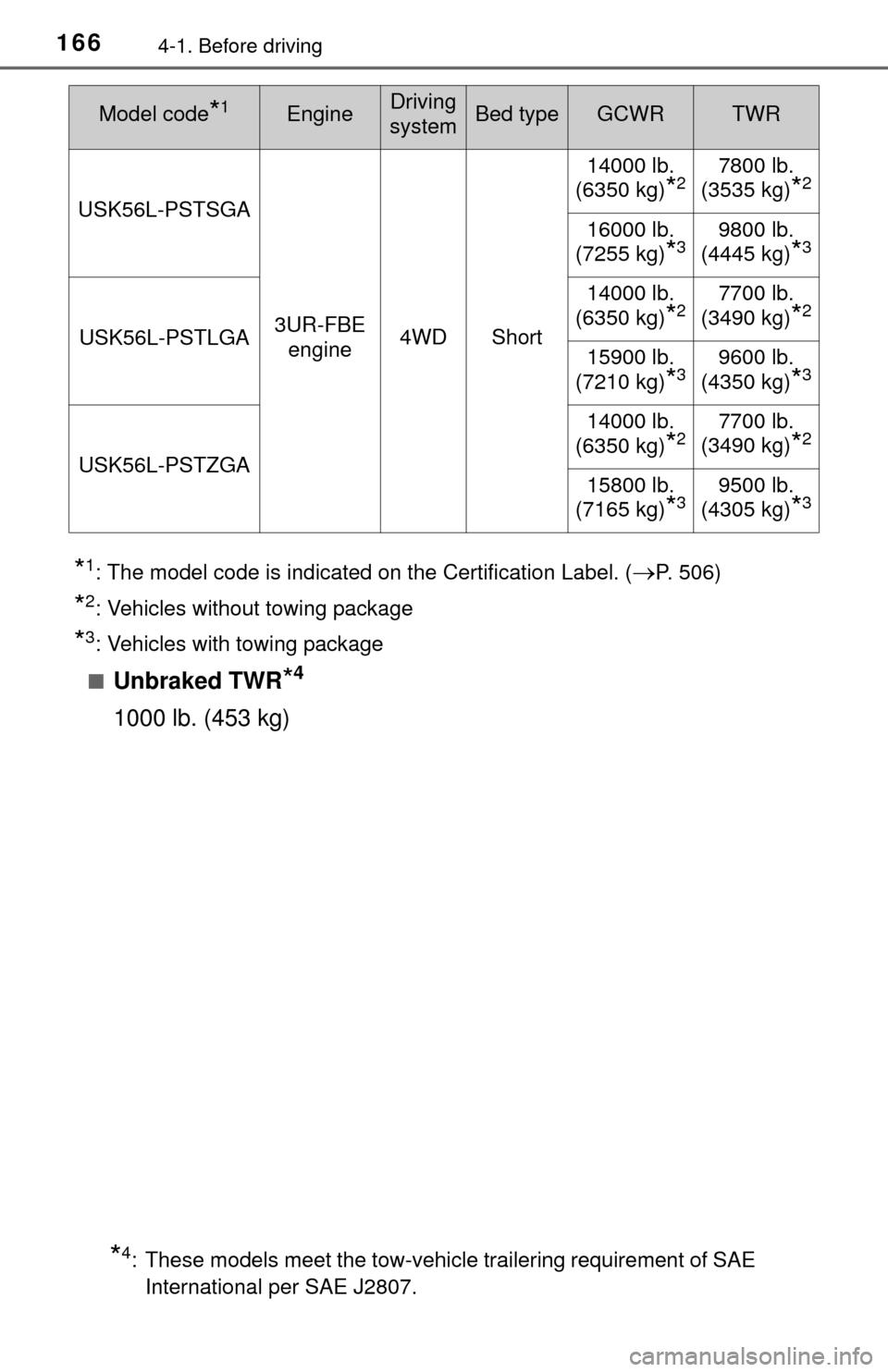
Page 166 of 576
1664-1. Before driving
*1: The model code is indicated on the Certification Label. (P. 506)
*2: Vehicles without towing package
*3: Vehicles with towing package
■
Unbraked TWR*4
1000 lb. (453 kg)
USK56L-PSTSGA
3UR-FBE engine 4WD Short 14000 lb.
(6350 kg)*27800 lb.
(3535 kg)
*2
16000 lb.
(7255 kg)
*39800 lb.
(4445 kg)
*3
USK56L-PSTLGA 14000 lb.
(6350 kg)*27700 lb.
(3490 kg)
*2
15900 lb.
(7210 kg)
*39600 lb.
(4350 kg)
*3
USK56L-PSTZGA 14000 lb.
(6350 kg)*27700 lb.
(3490 kg)
*2
15800 lb.
(7165 kg)
*39500 lb.
(4305 kg)
*3
*4: These models meet the tow-vehicle trailering requirement of SAE
International per SAE J2807.
Model code*1EngineDriving
systemBed typeGCWRTWR
Page 167 of 576
1674-1. Before driving
4
Driving
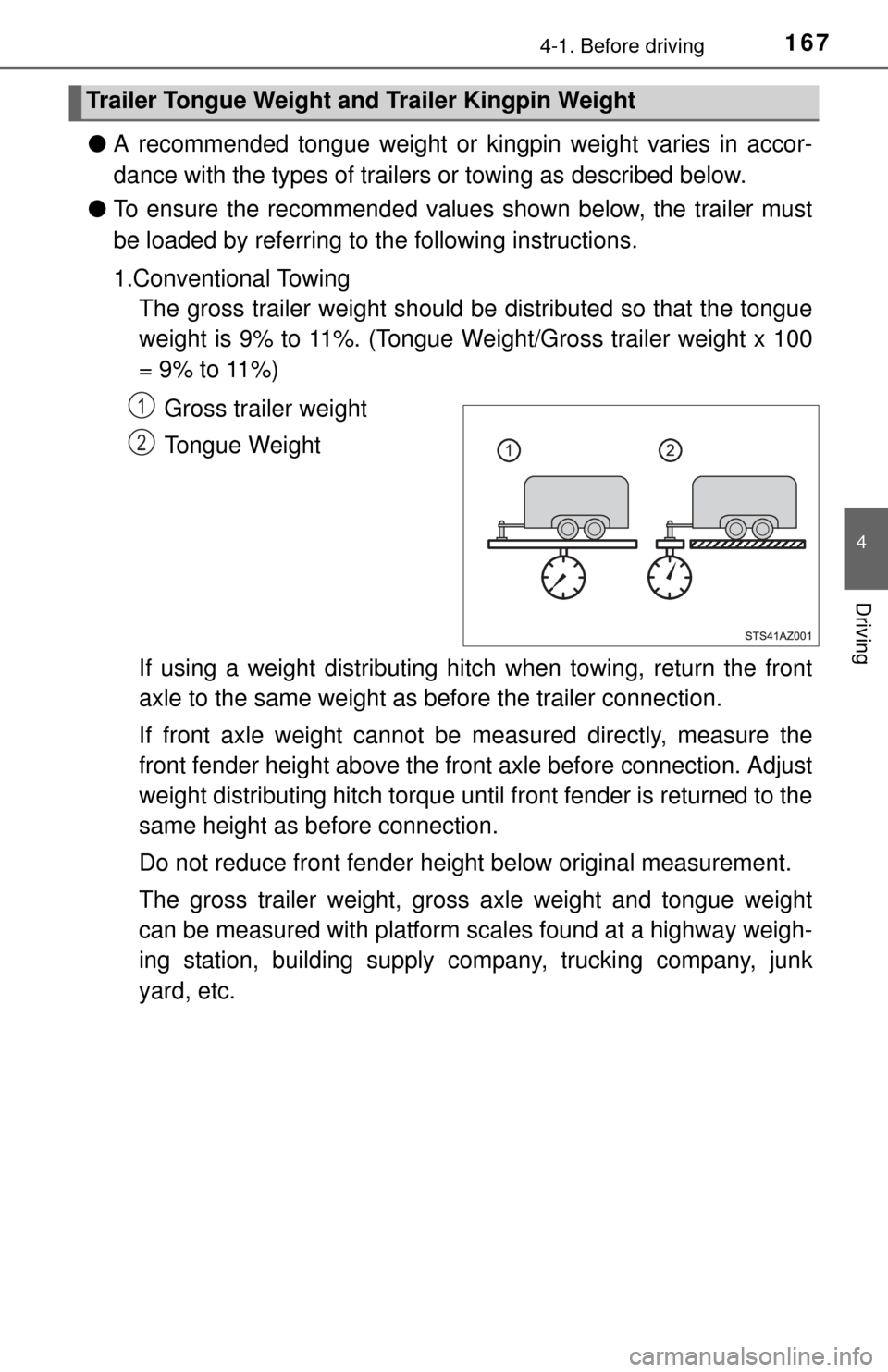
●A recommended tongue weight or kingpin weight varies in accor-
dance with the types of trailers or towing as described below.
● To ensure the recommended values shown below, the trailer must
be loaded by referring to the following instructions.
1.Conventional Towing
The gross trailer weight should be distributed so that the tongue
weight is 9% to 11%. (Tongue Weight/Gross trailer weight x 100
= 9% to 11%)
Gross trailer weight
Tongue Weight
If using a weight distributing hitch when towing, return the front
axle to the same weight as before the trailer connection.
If front axle weight cannot be measured directly, measure the
front fender height above the front axle before connection. Adjust
weight distributing hitch torque until front fender is returned to the
same height as before connection.
Do not reduce front fender height below original measurement.
The gross trailer weight, gross axle weight and tongue weight
can be measured with platform scales found at a highway weigh-
ing station, building supply company, trucking company, junk
yard, etc.
Trailer Tongue Weight and Trailer Kingpin Weight
1
2
Page 168 of 576
1684-1. Before driving
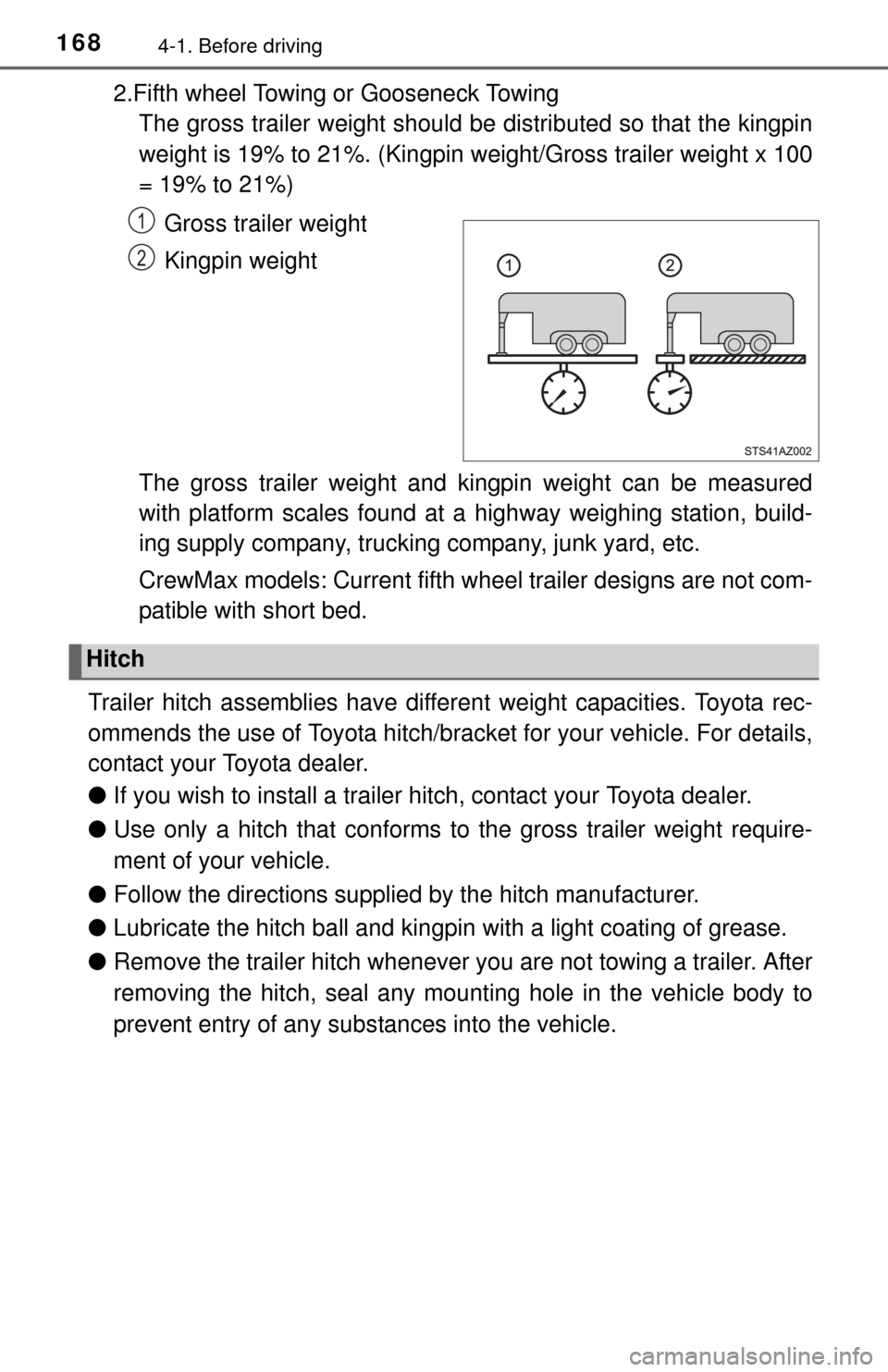
2.Fifth wheel Towing or Gooseneck TowingThe gross trailer weight should be distributed so that the kingpin
weight is 19% to 21%. (Kingpin weight/Gross trailer weight x 100
= 19% to 21%)
Gross trailer weight
Kingpin weight
The gross trailer weight and kingpin weight can be measured
with platform scales found at a highway weighing station, build-
ing supply company, trucking company, junk yard, etc.
CrewMax models: Current fifth wheel trailer designs are not com-
patible with short bed.
Trailer hitch assemblies have different weight capacities. Toyota rec-
ommends the use of Toyota hitch/bracket for your vehicle. For details,
contact your Toyota dealer.
● If you wish to install a trailer hitch, contact your Toyota dealer.
● Use only a hitch that conforms to the gross trailer weight require-
ment of your vehicle.
● Follow the directions supplied by the hitch manufacturer.
● Lubricate the hitch ball and kingpin with a light coating of grease.
● Remove the trailer hitch whenever you are not towing a trailer. After
removing the hitch, seal any mounting hole in the vehicle body to
prevent entry of any subs tances into the vehicle.
1
2
Hitch
Page 169 of 576
1694-1. Before driving
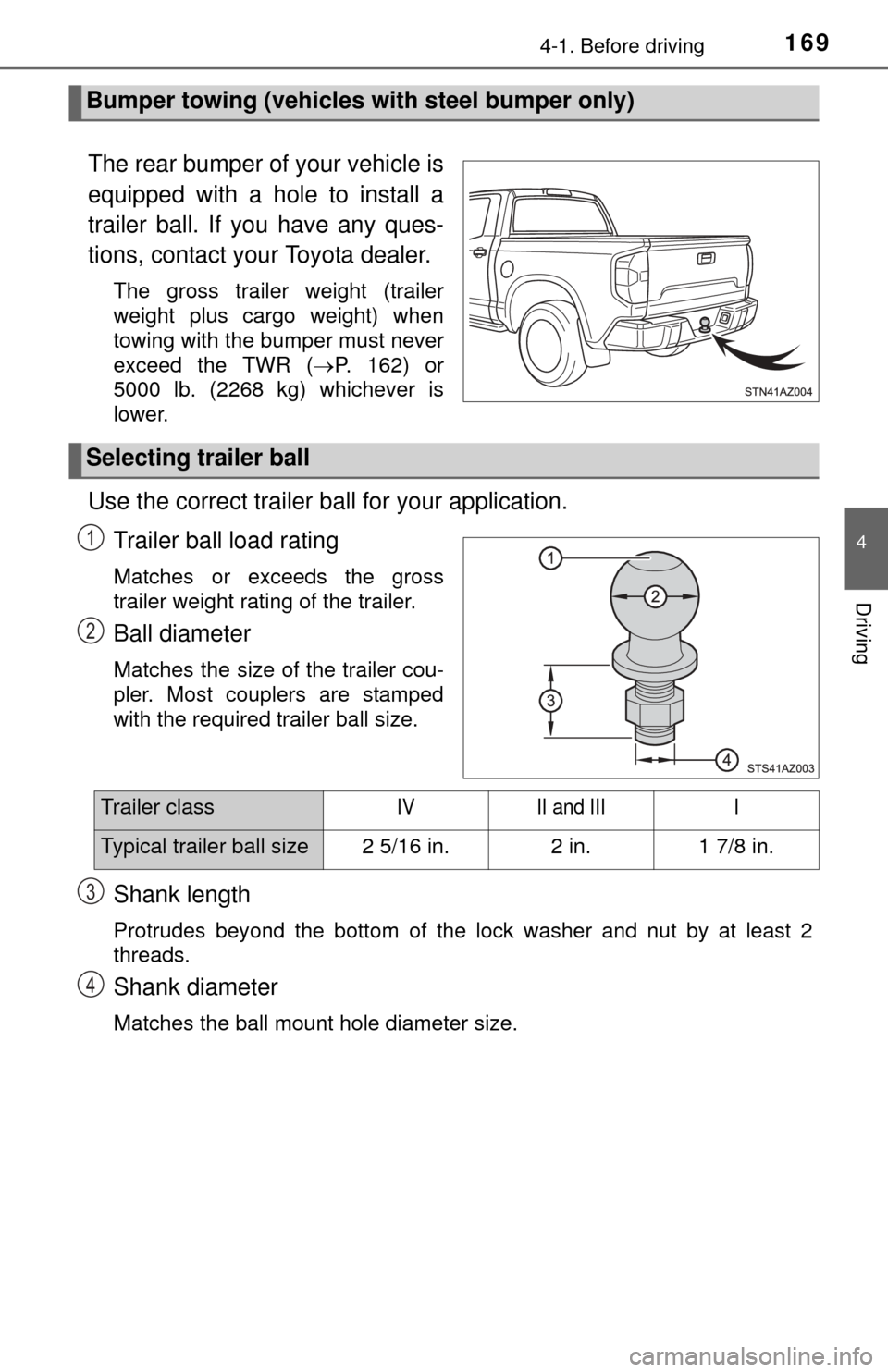
4
Driving
The rear bumper of your vehicle is
equipped with a hole to install a
trailer ball. If you have any ques-
tions, contact your Toyota dealer.
The gross trailer weight (trailer
weight plus cargo weight) when
towing with the bumper must never
exceed the TWR (P. 162) or
5000 lb. (2268 kg) whichever is
lower.
Use the correct trailer ball for your application.
Trailer ball load rating
Matches or exceeds the gross
trailer weight rating of the trailer.
Ball diameter
Matches the size of the trailer cou-
pler. Most couplers are stamped
with the required trailer ball size.
Shank length
Protrudes beyond the bottom of the lock washer and nut by at least 2
threads.
Shank diameter
Matches the ball mount hole diameter size.
Bumper towing (vehicles with steel bumper only)
Selecting trailer ball
1
2
Trailer classIVII and IIII
Typical trailer ball size2 5/16 in.2 in.1 7/8 in.
3
4