Page 291 of 668

291
2-5. Driving information
2
When driving
Connecting and disconnecting
a trailer (vehicles with
electronically modulated air suspension)
If a height control system is install ed in your vehicle, you have to con-
nect and disconnect your trailer more carefully.
● Connecting
Set the height control of elec tronically modulated air suspen-
sion system to N mode.
Turn off the engine, or set the electronically modulated air
suspension system to MAN. (manual).
Connect the trailer.
Turn the engine switch to the START position and start the
engine.
Press the height control mode select switch to cancel the
MAN. (manual) condition that was set on .
Check that the MAN. indicator turns off.
Set the height control of elec tronically modulated air suspen-
sion system to N mode.
■ Service connector for towing br ake controller (with towing package)
Your vehicle is equipped with a service
connector for the trailer brake controller
as shown.
Access the service connector.
Remove the scuff plate.
Remove the clip (screw type) and trim
board.
Page 292 of 668
292 2-5. Driving information
●Disconnecting
Set the height control of elec tronically modulated air suspen-
sion system to N mode.
Set the electronically modulate d air suspension system to
MAN. (manual).
Turn off the engine.
Set the supporting leg of the trailer on the ground and raise
the hitch by 4 in. (100 mm).
Turn the engine switch to the START position and start the
engine.
Press the height control mode select switch to cancel the
MAN. (manual) condition that was set on . Check that
the MAN. indicator turns off.
Wait until vehicle height is stabilized.
Make sure the hitch is disconne cted. If the hitch does not dis-
connect, raise the hitch higher and repeat steps 2 through 7.
Move the vehicle forward in LO mode where the hitch does
not touch anything in N mode.
Set the height control of elec tronically modulated air suspen-
sion system to N mode.
Page 296 of 668
296 2-5. Driving information
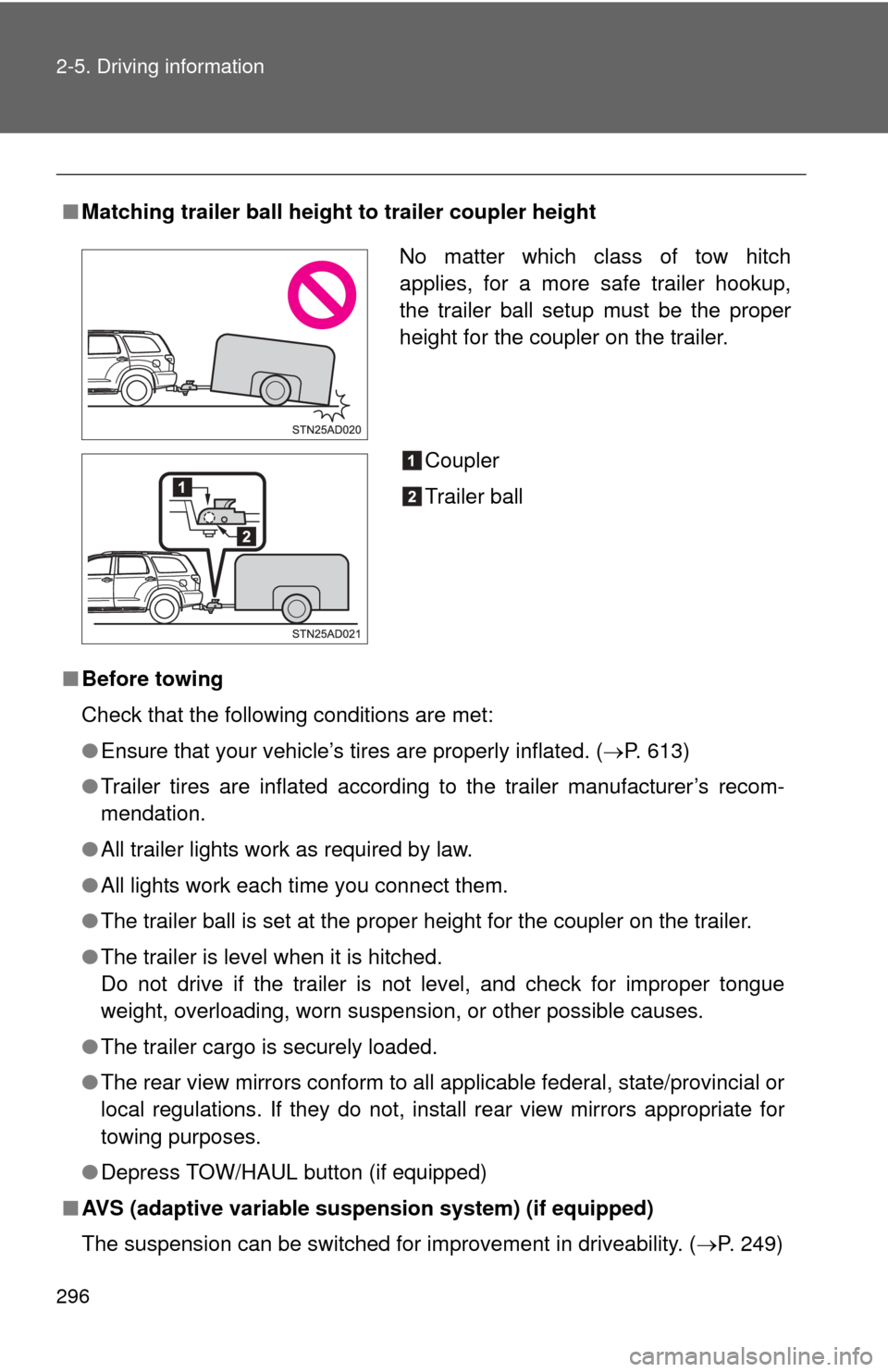
■Matching trailer ball height to trailer coupler height
■ Before towing
Check that the following conditions are met:
●Ensure that your vehicle’s tires are properly inflated. ( P. 613)
● Trailer tires are inflated according to the trailer manufacturer’s recom-
mendation.
● All trailer lights work as required by law.
● All lights work each time you connect them.
● The trailer ball is set at the proper height for the coupler on the trai\
ler.
● The trailer is level when it is hitched.
Do not drive if the trailer is not level, and check for improper tongue
weight, overloading, worn suspension, or other possible causes.
● The trailer cargo is securely loaded.
● The rear view mirrors conform to all applicable federal, state/provincial or
local regulations. If they do not, install rear view mirrors appropriate for
towing purposes.
● Depress TOW/HAUL button (if equipped)
■ AVS (adaptive variable suspension system) (if equipped)
The suspension can be switched for improvement in driveability. ( P. 249)
No matter which class of tow hitch
applies, for a more safe trailer hookup,
the trailer ball setup must be the proper
height for the coupler on the trailer.
Coupler
Trailer ball
Page 298 of 668

298 2-5. Driving information
If you cannot find any problems, the speed at which trailer swaying occu\
rred
is beyond the limit of your particular vehicle-trailer combination.
Drive at a lower speed to prevent instability. Remember that swaying of the
towing vehicle-trailer increases as speed increases.
CAUTION
■Trailer towing precautions
●To tow a trailer safely, use extreme care and drive the vehicle in accor-
dance with the trailer’s characteristics and operating conditions. Failure to
do so could cause an accident resulting in death or serious injury. Vehicle
stability and braking performance are affe cted by trailer stability, brake set-
ting and performance, and the hitch. Y our vehicle will handle differently
when towing a trailer.
● Vehicles with electronically modulated air suspension: Set the vehicle
height to the LO mode and turn off the rear height control air suspension
when you connect a trailer, otherwise the vehicle height may change due
to the automatic leveling function, and you may catch part of your body in
the vehicle, resulting in an accident.
■ To avoid accident or injury
●Do not exceed the TWR, unbraked TWR, GCWR, GVWR or GAWR.
● If the gross trailer weight is over 2000 lb. (907 kg), a sway control device
with sufficient capacity is required.
● If the gross trailer weight is over 5000 lb. (2268 kg), a weight distributing
hitch with sufficient capacity is required.
● Adjust the tongue weight within the appropriate range. Place heavier loads
as close to the trailer axle as possible.
● Do not exceed 65 mph (104 km/h), the posted towing speed limit or the
speed limit for your trailer as set forth in your trailer owner’s manual,
whichever is lowest. Slow down sufficiently before making a turn, in cross-
winds, on wet or slippery surface, etc. to help avoid an accident. If you
experience a vehicle-trailer instability from reducing a certain speed, slow
down and make sure you keep your vehicle speed under the speed of
which you experience the instability.
● Do not make jerky, abrupt or sharp turns.
Page 578 of 668
578
5-2. Steps to take in an emergency
If you have a flat tire
Remove the flat tire and replace it with the spare provided.
■Before jacking up the vehicle
●Stop the vehicle on a hard, flat surface.
● Press the height control mode select switch to set the height
control system to manual mode (if equipped)
● Set the parking brake.
● Shift the shift lever to P.
● Stop the engine.
● Turn on the emergency flashers.
■ Location of the spare tire
■ Location of the jack and tools
Page 604 of 668
604
6-1. Specifications
Maintenance data (fuel, oil level, etc.)
Dimensions
*: Unladen vehicle
Overall length205.1 in. (5210 mm)
Overall width79.9 in. (2030 mm)
Overall height*
Without roof rails
74.6 in. (1895 mm)
With roof rails
77.0 in. (1955 mm)
Wheelbase122.0 in. (3100 mm)
Front tread 67.9 in. (1725 mm)
Rear tread69.1 in. (1755 mm)
Page 622 of 668
622 6-1. Specifications
Tire size■ Typical tire size information
The illustration indicates typical
tire size.
Tire use
(P = Passenger car,
T = Temporary use)
Section width (millimeters)
Aspect ratio
(tire height to section width)
Tire construction code
(R = Radial, D = Diagonal)
Wheel diameter (inches)
Load index (2 digits or 3 digits)
Speed symbol
(alphabet with one letter)
■ Tire dimensions
Section width
Tire height
Wheel diameter
Page 659 of 668

659
Alphabetical index
Engine coolant
Capacity ............................... 609
Checking .............................. 498
Preparing and checking before winter ...................... 277
Engine coolan t temperature
gauge ..................................... 168
Engine immobilizer system .... 105
Engine oil
Capacity ............................... 608
Checking .............................. 494
Preparing and checking before winter ...................... 277
Engine switch .......................... 158
Event data recorder .................. 25
FFV ................................... 100, 615
Flex-fuel ........................... 100, 615
Flexible fuel vehicle ........ 100, 615
Floor mat .................................. 457
Fluid Brake .................................... 500
Washer ................................. 506
Fog lights Replacing light bulbs ............ 539
Switch ................................... 193
Wattage ................................ 614
Four-wheel drive system ........ 250
Front air conditioning
system ................................... 304
Front passenger occupant
classification system............ 125
Front passenger’s seat belt reminder light ........................ 563
Front seats Adjustment ............................. 48
Front side marker lights
Replacing light bulbs ............ 539
Switch ................................... 187
Wattage ................................ 614 Front turn signal lights
Replacing light bulbs .............539
Wattage .................................614
Fuel Capacity ................................607
Fuel gauge ............................168
Fuel pump shut off system ....560
Gas station information .........668
Information ............................615
Refueling ...............................100
Type ......................................607
Fuel filler door ..........................100
Fuel pump shut off system .....560
Fuses.........................................527
Garage door opener.................464
Gas station information...........668
Gauges ......................................168
Glove box..................................411
Hands-free system (for cellular phone) ................380
Hazard lights Switch....................................552
Head restraints Adjusting ................................66
Headlight cleaner .....................201
Headlights
Replacing light bulbs .............539
Switch....................................187
Wattage .................................614
Heaters Seat heaters ..................447, 450
Side mirror.............................317
Height control Electronically modulated air
suspension..........................244
Hood ..........................................492
F
*: Refer to “NAVIGATION SYSTEM OWNER’S MANUAL”.
G
H
Page:
< prev 1-8 9-16 17-24


