Page 592 of 732
592
RAV4_OM_OM42A04U_(U)
6-3. Do-it-yourself maintenance
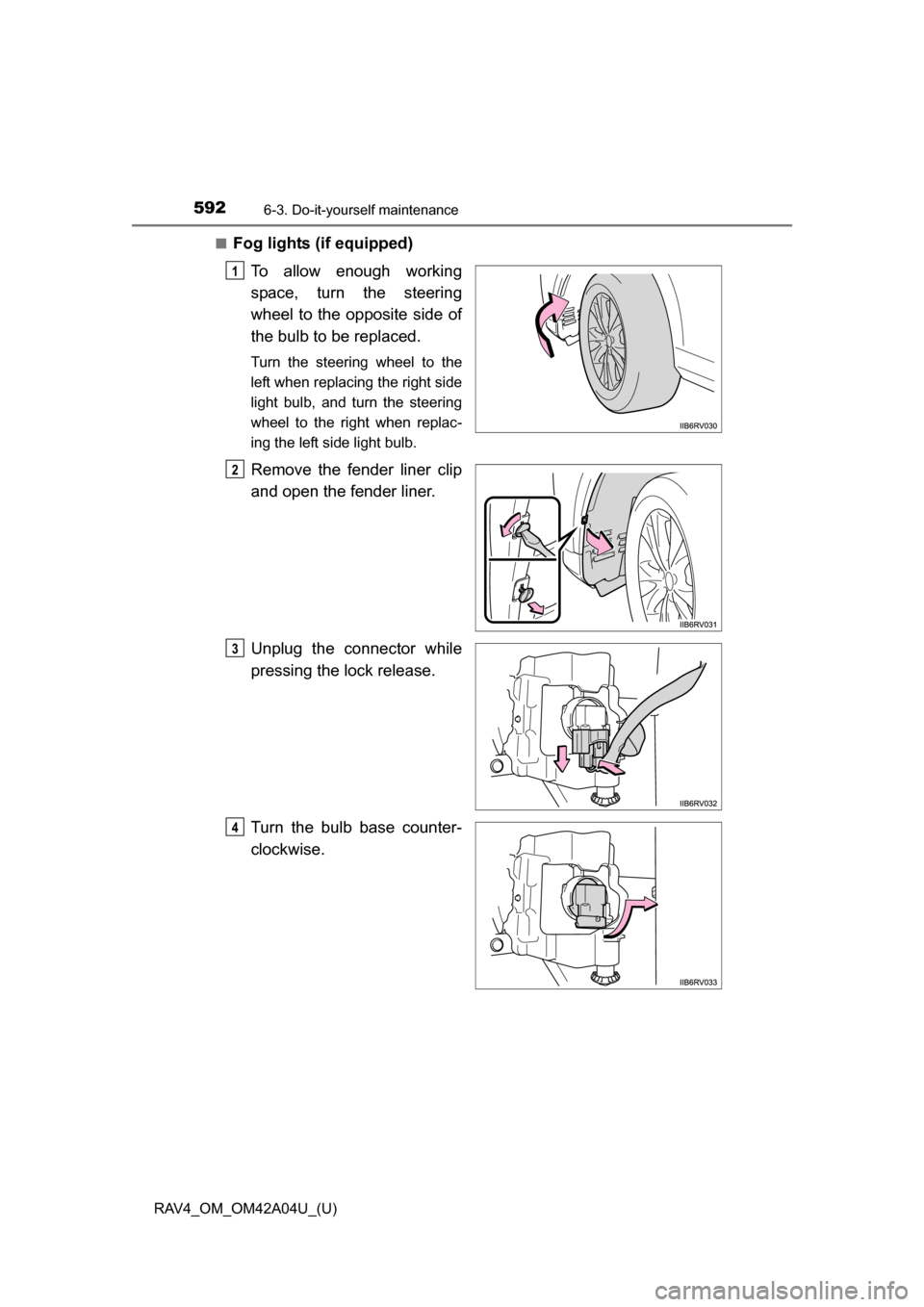
■Fog lights (if equipped)To allow enough working
space, turn the steering
wheel to the opposite side of
the bulb to be replaced.
Turn the steering wheel to the
left when replacing the right side
light bulb, and turn the steering
wheel to the right when replac-
ing the left side light bulb.
Remove the fender liner clip
and open the fender liner.
Unplug the connector while
pressing the lock release.
Turn the bulb base counter-
clockwise.
1
2
3
4
Page 602 of 732
6027-1. Essential information
RAV4_OM_OM42A04U_(U)
CAUTION
■If the engine has to be turned off while driving
●Power assist for the brakes and steering wheel will be lost, making the
brake pedal harder to depress and the steering wheel heavier to turn.
Decelerate as much as possible before turning off the engine.
● Vehicles without a smart key system: Never attempt to remove the key, as
doing so will lock the steering wheel.
Page 603 of 732

603
RAV4_OM_OM42A04U_(U)
7
When trouble arises
7-2. Steps to take in an emergency
If your vehicle needs to be towed
The following may indicate a problem with your transmission. Contact
your Toyota dealer before towing.
●The engine is operating but the vehicle will not move.
● The vehicle makes an abnormal sound.
If a tow truck is not available in an
emergency, your vehicle may be
temporarily towed using a cable or
chain secured to the emergency
towing eyelet(s). This should only
be attempted on hard surfaced
roads for short distances at low
speeds.
A driver must be in the vehicle to
steer and operate the brakes. The
vehicle’s wheels, drive train,
axles, steering and brakes must
be in good condition.
If towing is necessary, we re commend having your vehicle
towed by your Toyota dealer or a commercial towing service,
using a lift-type truc k or flat bed truck.
Use a safety chain system for all towing, and abide by all state/
provincial and local laws.
2WD models: If towing your vehicle with a wheel-lift type truck
from the front, the vehicle’s rear wheels and axles must be in
good conditions. ( P. 605, 608)
If they are damaged, use a to wing dolly or flat bed truck.
AWD models: If towing your vehicl e with a wheel-lift type truck,
use a towing dolly. ( P. 605, 608)
Before towing
Emergency towing
Page 604 of 732
6047-2. Steps to take in an emergency
RAV4_OM_OM42A04U_(U)
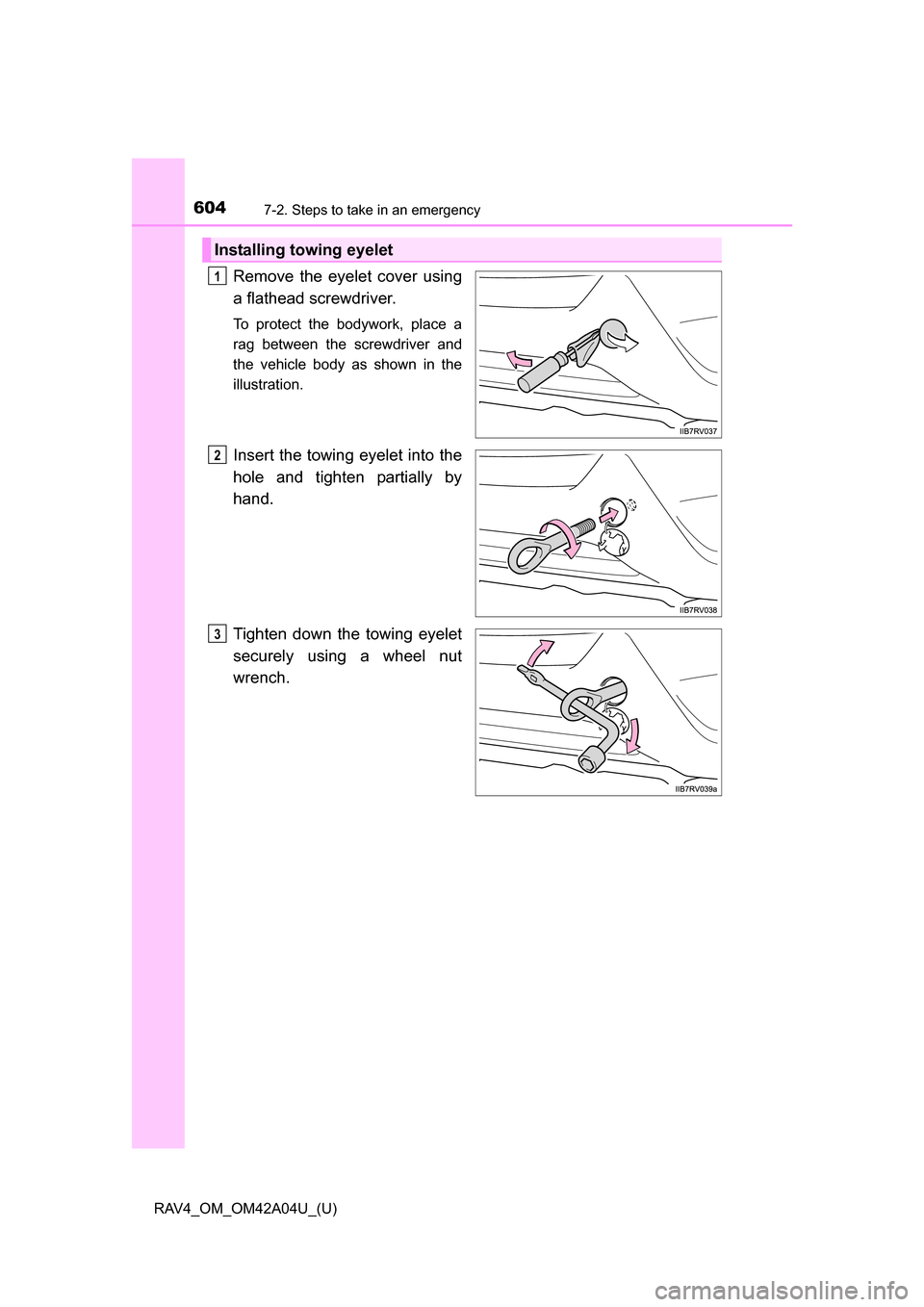
Remove the eyelet cover using
a flathead screwdriver.
To protect the bodywork, place a
rag between the screwdriver and
the vehicle body as shown in the
illustration.
Insert the towing eyelet into the
hole and tighten partially by
hand.
Tighten down the towing eyelet
securely using a wheel nut
wrench.
Installing towing eyelet
1
2
3
Page 605 of 732
6057-2. Steps to take in an emergency
RAV4_OM_OM42A04U_(U)
7
When trouble arises
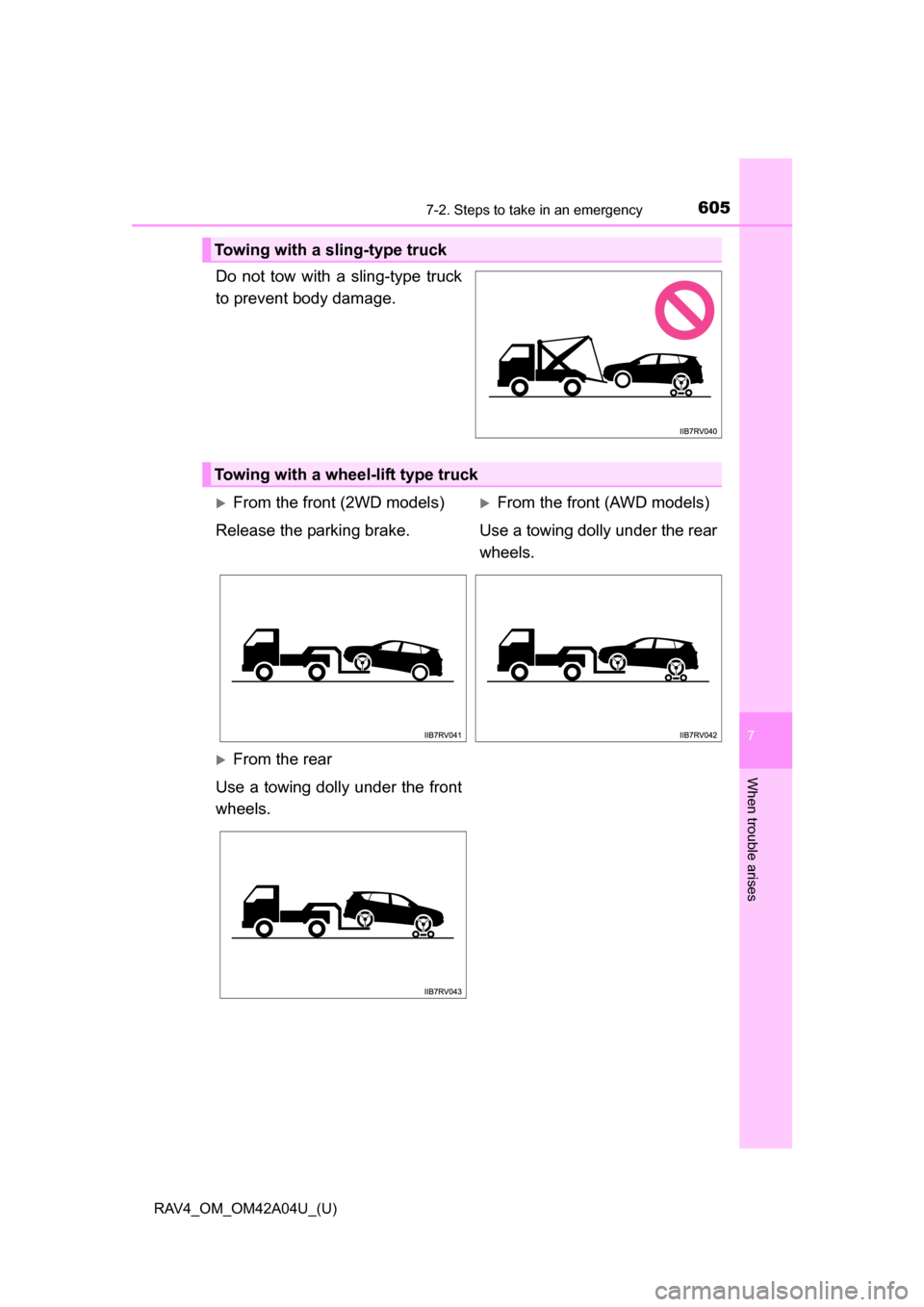
Do not tow with a sling-type truck
to prevent body damage.
Towing with a sling-type truck
Towing with a wheel-lift type truck
From the front (2WD models)From the front (AWD models)
Release the parking brake. Use a towing dolly under the rear
wheels.
From the rear
Use a towing dolly under the front
wheels.
Page 608 of 732
6087-2. Steps to take in an emergency
RAV4_OM_OM42A04U_(U)
NOTICE
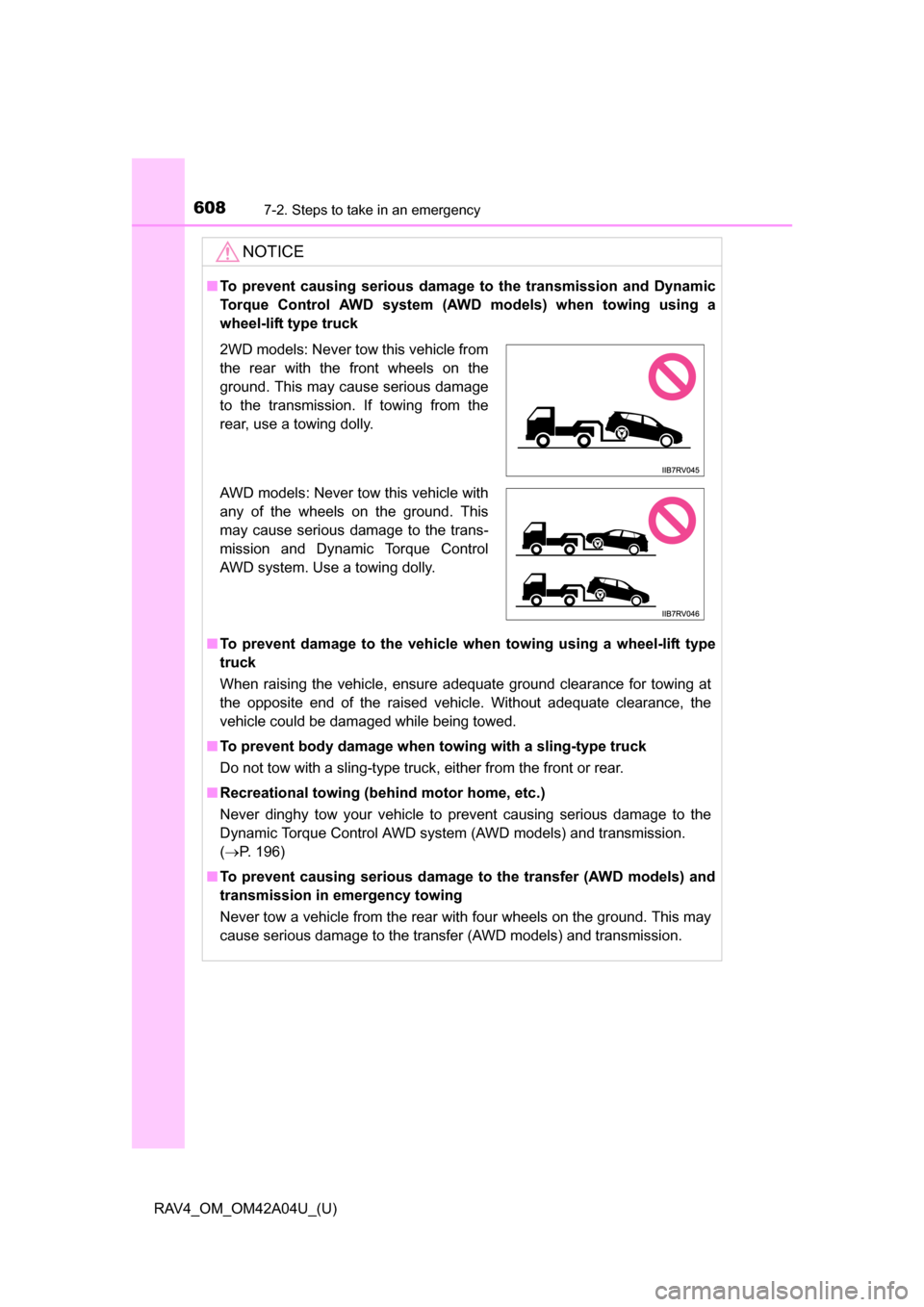
■To prevent causing serious damage to the transmission and Dynamic
Torque Control AWD system (AWD models) when towing using a
wheel-lift type truck
■ To prevent damage to the vehicle when towing using a wheel-lift type
truck
When raising the vehicle, ensure adequate ground clearance for towing at
the opposite end of the raised vehicle. Without adequate clearance, the
vehicle could be damaged while being towed.
■ To prevent body damage when towing with a sling-type truck
Do not tow with a sling-type truck, either from the front or rear.
■ Recreational towing (beh ind motor home, etc.)
Never dinghy tow your vehicle to prevent causing serious damage to the
Dynamic Torque Control AWD system (AWD models) and transmission.
( P. 196)
■ To prevent causing serious damage to the transfer (AWD models) and
transmission in emergency towing
Never tow a vehicle from the rear with four wheels on the ground. This may
cause serious damage to the transfer (AWD models) and transmission.
2WD models: Never tow this vehicle from
the rear with the front wheels on the
ground. This may cause serious damage
to the transmission. If towing from the
rear, use a towing dolly.
AWD models: Never tow this vehicle with
any of the wheels on the ground. This
may cause serious damage to the trans-
mission and Dynamic Torque Control
AWD system. Use a towing dolly.
Page 617 of 732
6177-2. Steps to take in an emergency
RAV4_OM_OM42A04U_(U)
7
When trouble arises
Dynamic Torque Control
AWD system warning light
(if equipped)
When the light blinks:
The system has been over-
loaded and front-wheel drive
has been automatically
engaged.Drop your speed or stop the
vehicle until the light stops
blinking. (Do not stop the
engine.)
When the light comes on:
Malfunction in the Dynamic
Torque Control AWD system.Have the system checked by
your Toyota dealer.
Intuitive parking assist
indicator (warning
buzzer)
*4 (if equipped)
Indicates that the intuitive
parking assist sensor is
dirty or covered with ice.Clean the sensors.
Warning lightWarning light/DetailsCorrection procedure
Page 623 of 732

6237-2. Steps to take in an emergency
RAV4_OM_OM42A04U_(U)
7
When trouble arises
■When a tire is replaced with a compact spare tire (vehicles with a
compact spare tire and the tire pressure warning system)
The compact spare tire is not equipped with a tire pressure warning valve
and transmitter. If a tire goes flat, the tire pressure warning light will not
turn off even though the flat tire has been replaced with the spare tire.
Replace the spare tire with the standard tire and adjust the tire inflation
pressure. The tire pressu re warning light will go off after a few minutes.
■If the tire pressure warning system is not functioning
The tire pressure warning system will be disabled in the following condi-
tions:
(When the condition becomes normal, the system will work properly.)
●If tires not equipped with tire pressure warning valves and transmitters are
used
● If the ID code on the tire pressure warning valves and transmitters is not
registered in the tire pressure warning computer
● If the tire inflation pressure is 73 psi (500 kPa, 5.1 kgf/cm
2 or bar) or higher
The tire pressure warning system may be disabled in the following condi-
tions:
(When the condition be comes normal, the system will work properly.)
●If electronic devices or facilities using similar radio wave frequencies are
nearby
● If a radio set at a similar frequency is in use in the vehicle
● If a window tint that affects the radio wave signals is installed
● If there is a lot of snow or ice on the vehicle, particularly around the wheels
or wheel housings
● If non-genuine Toyota wheels are used (Even if you use Toyota wheels, the
tire pressure warning system may not work properly with some types of
tires.)
● If tire chains are used
■
If the tire pressure warning light frequently comes on after blinking
for 1 minute (vehicles with the tire pressure warning system)
If the tire pressure warning light frequently comes on after blinking for 1
minute when the engine switch is turned to the “ON” position (vehicles
without a smart key system) or IGNI TION ON mode (vehicles with a
smart key system), have it checked by your Toyota dealer.