Page 439 of 612
4397-3. Do-it-yourself maintenance
7
Maintenance and care
COROLLA_TMMMS_TMMC_U (OM12F00U)
■Engine oil consumption
A certain amount of engine oil will be consumed while driving. In the following
situations, oil consumption may increase, and engine oil may need to be
refilled in between oil maintenance intervals.
●When the engine is new, for example directly after purchasing the vehicle or
after replacing the engine
●If low quality oil or oil of an inappropriate viscosity is used
●When driving at high engine speeds or with a heavy load, or when driving
while accelerating or decelerating frequently
●When leaving the engine idling for a long time, or when driving frequently
through heavy traffic
CAUTION
■Used engine oil
●Used engine oil contains potentially harmful contaminants which may
cause skin disorders such as inflammation and skin cancer, so care
should be taken to avoid prolonged and repeated contact. To remove used
engine oil from your skin, wash thoroughly with soap and water.
●Dispose of used oil and filters only in a safe and acceptable manner. Do
not dispose of used oil and filters in household trash, in sewers or onto the
ground.
Call your Toyota dealer, service station or auto parts store for information
concerning recycling or disposal.
●Do not leave used engine oil within the reach of children.
NOTICE
■To prevent serious engine damage
Check the oil level on a regular basis.
■When replacing the engine oil
●Be careful not to spill engine oil on the vehicle components.
●Avoid overfilling, or the engine could be damaged.
●Check the oil level on the dipstick every time you refill the vehicle.
●Be sure the engine oil filler cap is properly tightened.
Page 440 of 612
4407-3. Do-it-yourself maintenance
COROLLA_TMMMS_TMMC_U (OM12F00U)
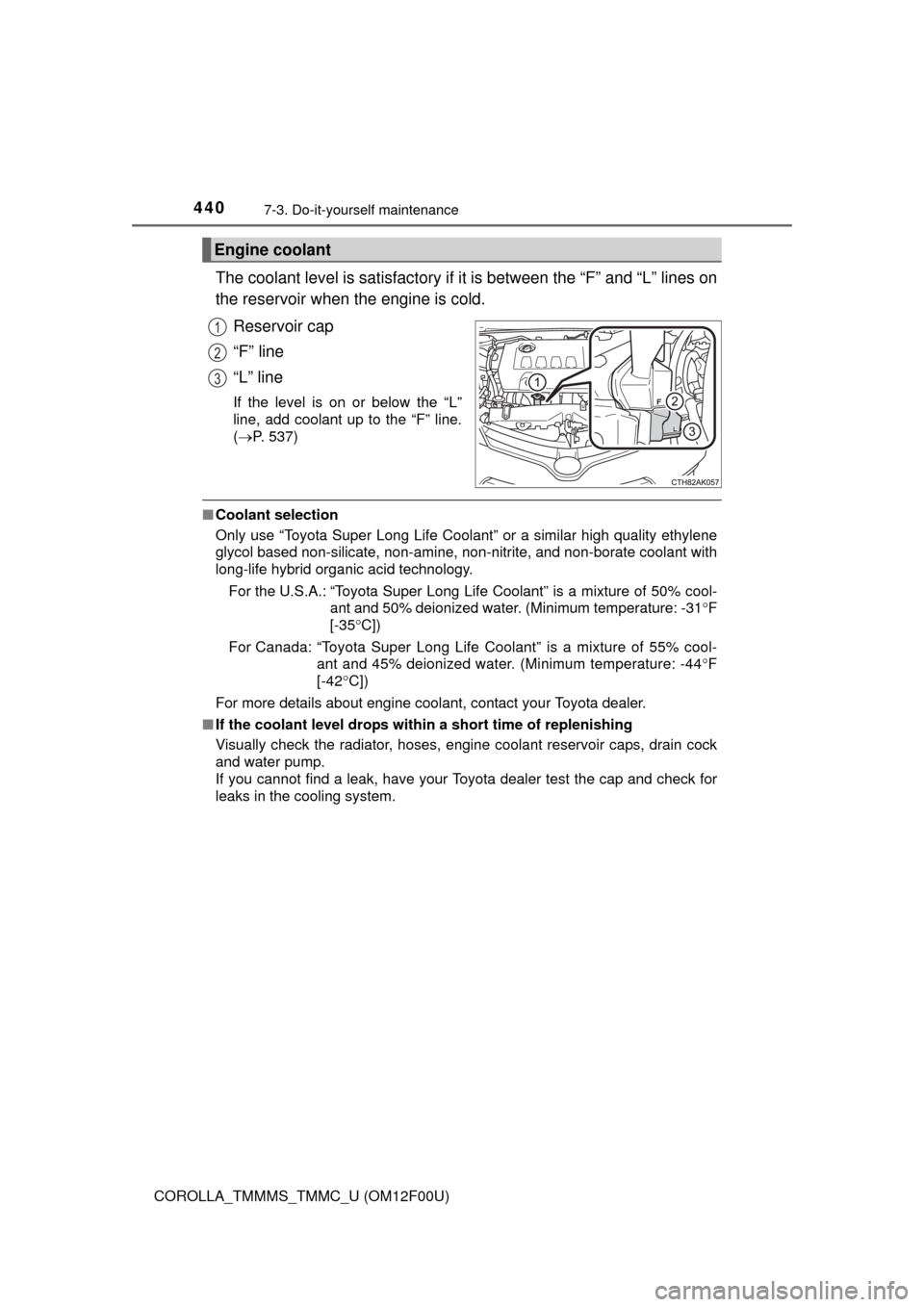
The coolant level is satisfactory if it is between the “F” and “L” lines on
the reservoir when the engine is cold.
Reservoir cap
“F” line
“L” line
If the level is on or below the “L”
line, add coolant up to the “F” line.
(P. 537)
■Coolant selection
Only use “Toyota Super Long Life Coolant” or a similar high quality ethylene
glycol based non-silicate, non-amine, non-nitrite, and non-borate coolant with
long-life hybrid organic acid technology.
For the U.S.A.: “Toyota Super Long Life Coolant” is a mixture of 50% cool-
ant and 50% deionized water. (Minimum temperature: -31F
[-35C])
For Canada: “Toyota Super Long Life Coolant” is a mixture of 55% cool-
ant and 45% deionized water. (Minimum temperature: -44F
[-42C])
For more details about engine coolant, contact your Toyota dealer.
■If the coolant level drops within a short time of replenishing
Visually check the radiator, hoses, engine coolant reservoir caps, drain cock
and water pump.
If you cannot find a leak, have your Toyota dealer test the cap and check for
leaks in the cooling system.
Engine coolant
1
2
3
Page 442 of 612
4427-3. Do-it-yourself maintenance
COROLLA_TMMMS_TMMC_U (OM12F00U)
Check the radiator and condenser and clear away any foreign objects.
If either of the above parts is extremely dirty or you are not sure of
their condition, have your vehicle inspected by your Toyota dealer.
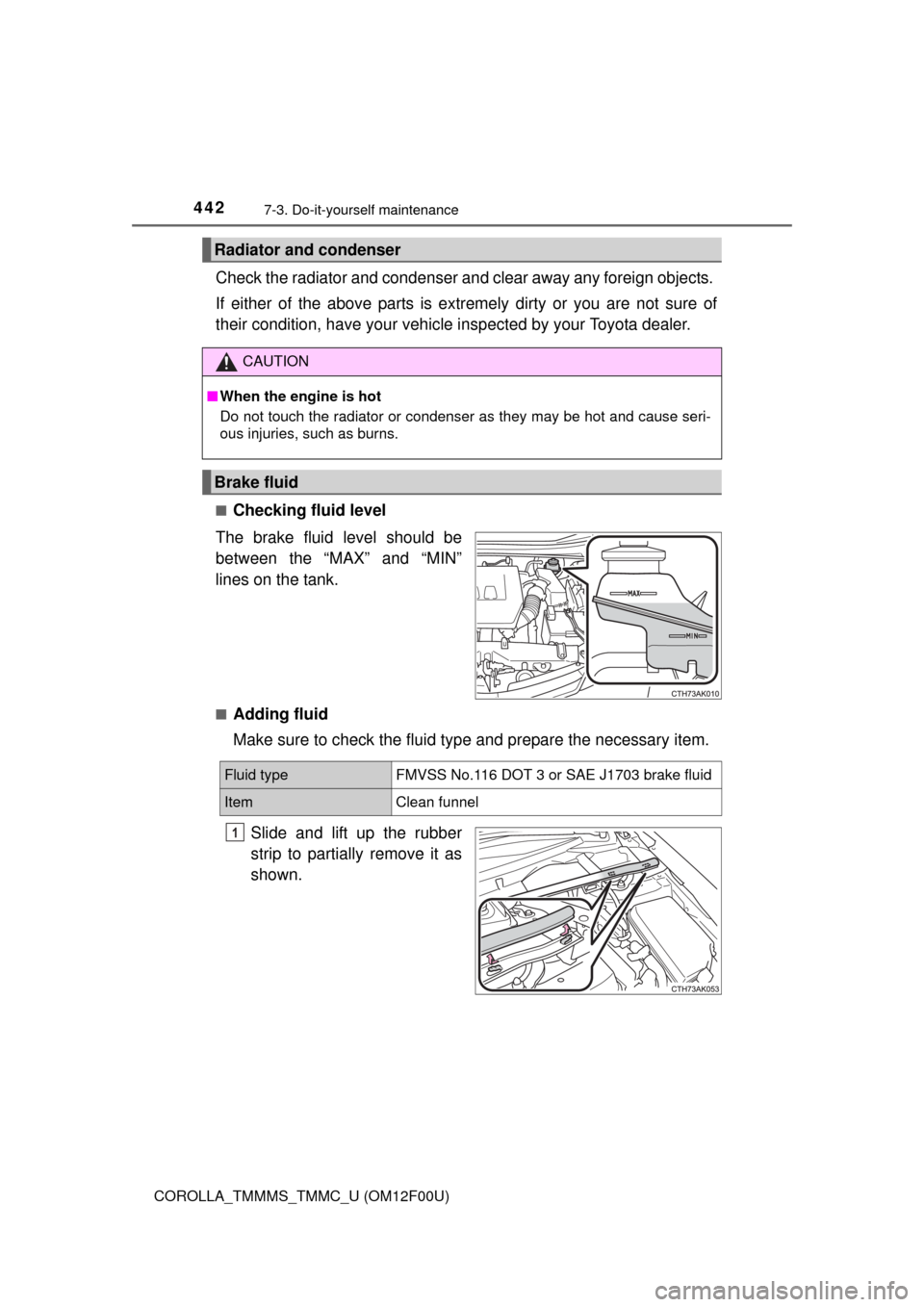
■Checking fluid level
The brake fluid level should be
between the “MAX” and “MIN”
lines on the tank.
■Adding fluid
Make sure to check the fluid type and prepare the necessary item.
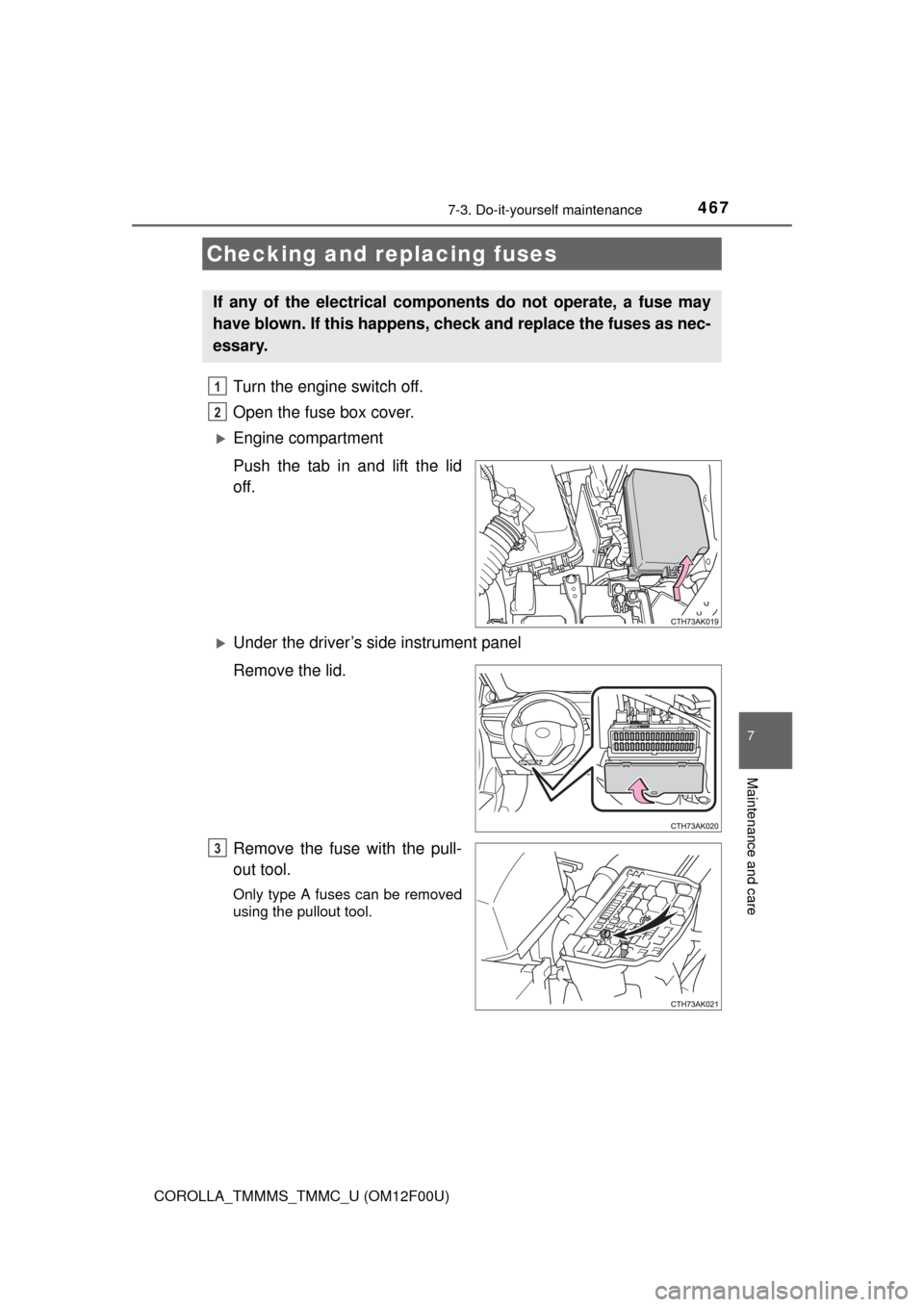
Slide and lift up the rubber
strip to partially remove it as
shown.
Radiator and condenser
CAUTION
■When the engine is hot
Do not touch the radiator or condenser as they may be hot and cause seri-
ous injuries, such as burns.
Brake fluid
Fluid typeFMVSS No.116 DOT 3 or SAE J1703 brake fluid
ItemClean funnel
1
Page 444 of 612
4447-3. Do-it-yourself maintenance
COROLLA_TMMMS_TMMC_U (OM12F00U)
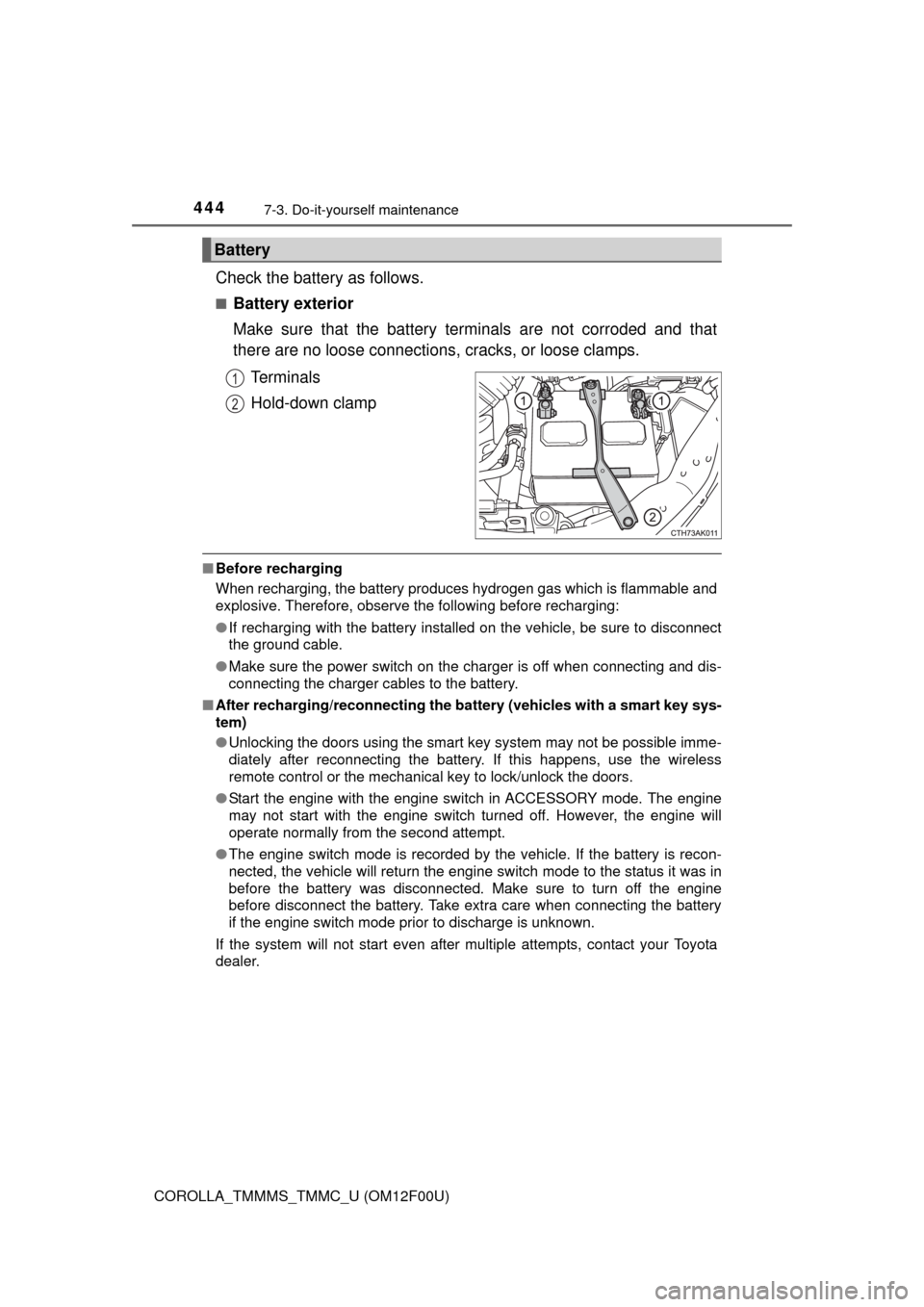
Check the battery as follows.
■Battery exterior
Make sure that the battery terminals are not corroded and that
there are no loose connections, cracks, or loose clamps.
Terminals
Hold-down clamp
■Before recharging
When recharging, the battery produces hydrogen gas which is flammable and
explosive. Therefore, observe the following before recharging:
●If recharging with the battery installed on the vehicle, be sure to disconnect
the ground cable.
●Make sure the power switch on the charger is off when connecting and dis-
connecting the charger cables to the battery.
■After recharging/reconnecting the battery (vehicles with a smart key sys-
tem)
●Unlocking the doors using the smart key system may not be possible imme-
diately after reconnecting the battery. If this happens, use the wireless
remote control or the mechanical key to lock/unlock the doors.
●Start the engine with the engine switch in ACCESSORY mode. The engine
may not start with the engine switch turned off. However, the engine will
operate normally from the second attempt.
●The engine switch mode is recorded by the vehicle. If the battery is recon-
nected, the vehicle will return the engine switch mode to the status it was in
before the battery was disconnected. Make sure to turn off the engine
before disconnect the battery. Take extra care when connecting the battery
if the engine switch mode prior to discharge is unknown.
If the system will not start even after multiple attempts, contact your Toyota
dealer.
Battery
1
2
Page 467 of 612
4677-3. Do-it-yourself maintenance
7
Maintenance and care
COROLLA_TMMMS_TMMC_U (OM12F00U)
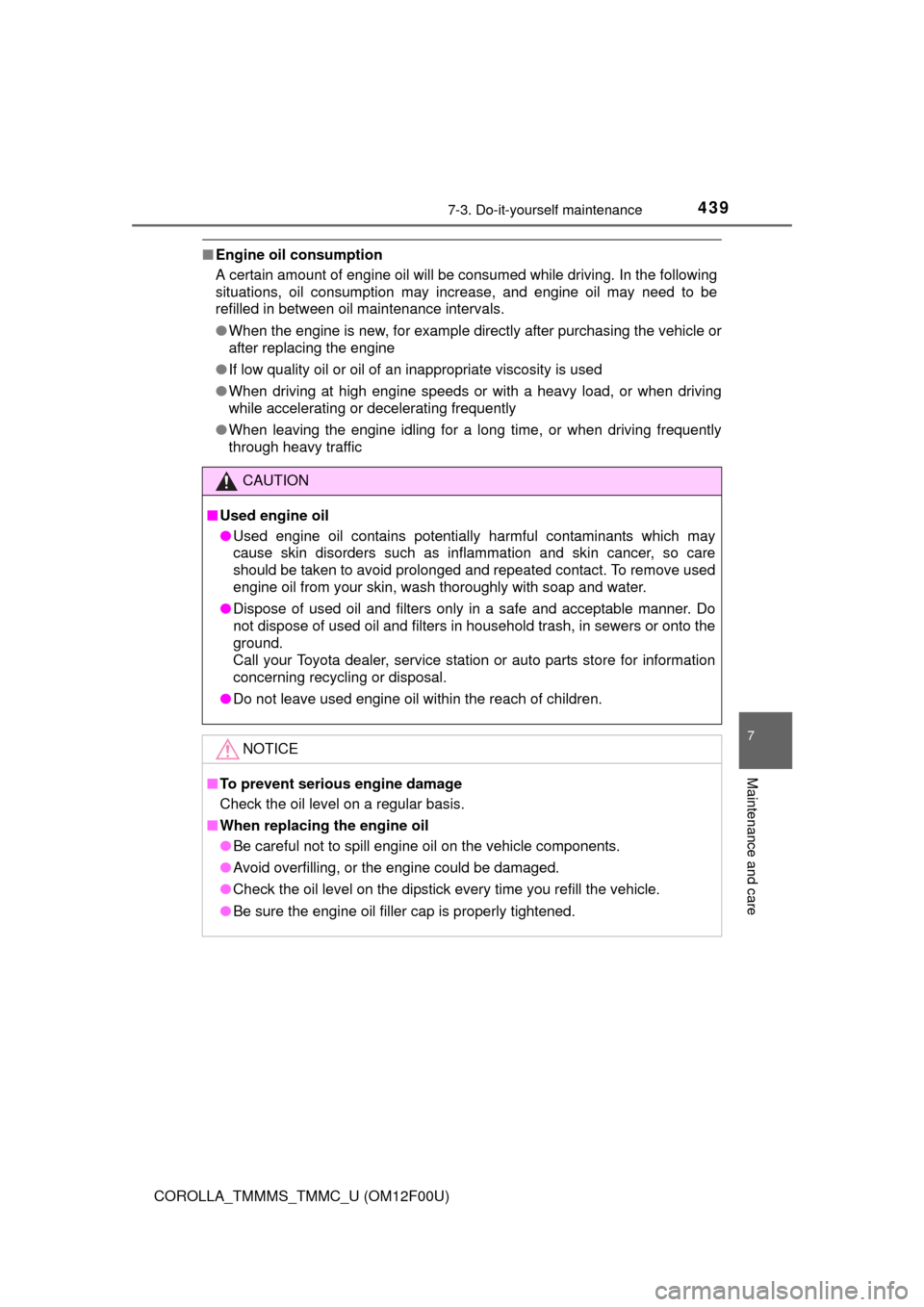
Turn the engine switch off.
Open the fuse box cover.
Engine compartment
Push the tab in and lift the lid
off.
Under the driver’s side instrument panel
Remove the lid.
Remove the fuse with the pull-
out tool.
Only type A fuses can be removed
using the pullout tool.
Checking and replacing fuses
If any of the electrical components do not operate, a fuse may
have blown. If this happens, check and replace the fuses as nec-
essary.
1
2
3
Page 497 of 612

4978-2. Steps to take in an emergency
8
When trouble arises
COROLLA_TMMMS_TMMC_U (OM12F00U)
After taking the specified steps to correct the suspected problem,
check that the warning light turns off.
Follow the correction procedures. (vehicles with a smart key
system and with a drive monitor display)
Interior
buzzerExterior
buzzerWarning
lightWarning light/Details/Action
Continuous Continuous
(Flashes in yel-
low)
Smart key system indicator light (except
vehicles with a manual transmission)
The electronic key was carried outside the
vehicle and the driver’s door was opened and
closed while any shift position other than P
was selected without turning off the engine
switch.
Change the shift position to P.
Bring the electronic key back into the vehi-
cle.
Once3 times
(Flashes in yel-
low)
Smart key system indicator light (except
vehicles with a manual transmission)
The electronic key was carried outside the
vehicle and the driver’s door was opened and
closed while the shift position P was selected
without turning off the engine switch.
Turn the engine switch off or bring the
electronic key back into the vehicle.
Smart key system indicator light
Indicates that a door other than the driver’s
door has been opened and closed with the
engine switch in any mode other than off and
the electronic key outside of the detection
area.
Confirm the location of the electronic key.
Page 500 of 612

5008-2. Steps to take in an emergency
COROLLA_TMMMS_TMMC_U (OM12F00U)■
When a tire is replaced with a spare tire (vehicles with a tire pressure
warning system)
The compact spare tire is not equipped with a tire pressure warning valve
and transmitter. If a tire goes flat, the tire pressure warning light will not
turn off even though the flat tire has been replaced with the spare tire.
Replace the spare tire with the repaired tire and adjust the tire inflation
pressure. The tire pressure warning light will go off after a few minutes.
■Conditions that the tire pressure warning system may not function
properly (vehicles with a tire pressure warning system)
The tire pressure warning system will be disabled in the following condi-
tions:
(When the condition becomes normal, the system will work properly.)
●If tires not equipped with tire pressure warning valves and transmitters
are used
●If the ID code on the tire pressure warning valves and transmitters is not
registered in the tire pressure warning computer
●If the tire inflation pressure is 73 psi (500 kPa, 5.1 kgf/cm2 or bar) or
higher
The tire pressure warning system may be disabled in the following condi-
tions:
(When the condition becomes normal, the system will work properly.)
●If electronic devices or facilities using similar radio wave frequencies are
nearby
●If a radio set at similar frequency is in use in the vehicle
●If a window tint that affects the radio wave signals is installed
●If there is a lot of snow or ice on the vehicle, in particular around the
wheels or wheel housings
●If non-genuine Toyota wheels are used (Even if you use Toyota wheels,
the tire pressure warning system may not work properly with some types
of tires.)
●If tire chains are used
■If the tire pressure warning light frequently comes on after blinking
for 1 minute (vehicles with a tire pressure warning system)
If the tire pressure warning light frequently comes on after blinking for 1
minute when the engine switch is turned on, have it checked by your
Toyota dealer.
■Warning buzzer
In some cases, the buzzer may not be heard because of noisy place or an
audio sound.
■Electric power steering system warning light (warning buzzer)
When the battery charge becomes insufficient or the voltage temporarily
drops, the electric power steering system warning light may come on and the
warning buzzer may sound.
Page 507 of 612
5078-2. Steps to take in an emergency
8
When trouble arises
COROLLA_TMMMS_TMMC_U (OM12F00U)
After taking the specified steps to correct the suspected problem,
check that the warning message and light go off.
Have the malfunction repaired immediately. (vehicles with a
smart key system)
Interior
buzzerExterior
buzzerWarning messageDetails/Actions
Con-
tinu-
ous
(Vehicles with a continuously variable
transmission)
The driver’s door was opened
while any shift lever other than
P was selected without turning
off the engine switch.
Shift the shift lever to P.
Con-
tinu-
ousContin-
uous
(Vehicles with a continuously variable
transmission)
The driver’s door was opened
and closed while the electronic
key was not in the vehicle, the
shift lever was not in P and the
engine switch was not turned
off.
Shift the shift lever to P.
Bring the electronic key
back into the vehicle.
(Flashes)
(Displayed alternately)
(Flashes)