2014 TOYOTA CAMRY Total load capacity
[x] Cancel search: Total load capacityPage 213 of 620

213
2-4. Using other
driving systems
2
When driving
CAUTION
■Replacing tires
Make sure that all tires are of the specified size, brand, tread pattern and
total load capacity. In addition, make sure that the tires are inflated to the
recommended tire inflation pressure level.
The ABS, TRAC and VSC systems will not function correctly if different tires
are installed on the vehicle.
Contact your Toyota dealer for further information when replacing tires or
wheels.
■ Handling of tires and suspension
Using tires with any kind of problem or modifying the suspension will affect
the driving assist systems, and may cause a system to malfunction.
Page 224 of 620
224
2-5. Driving information
Cargo and luggage
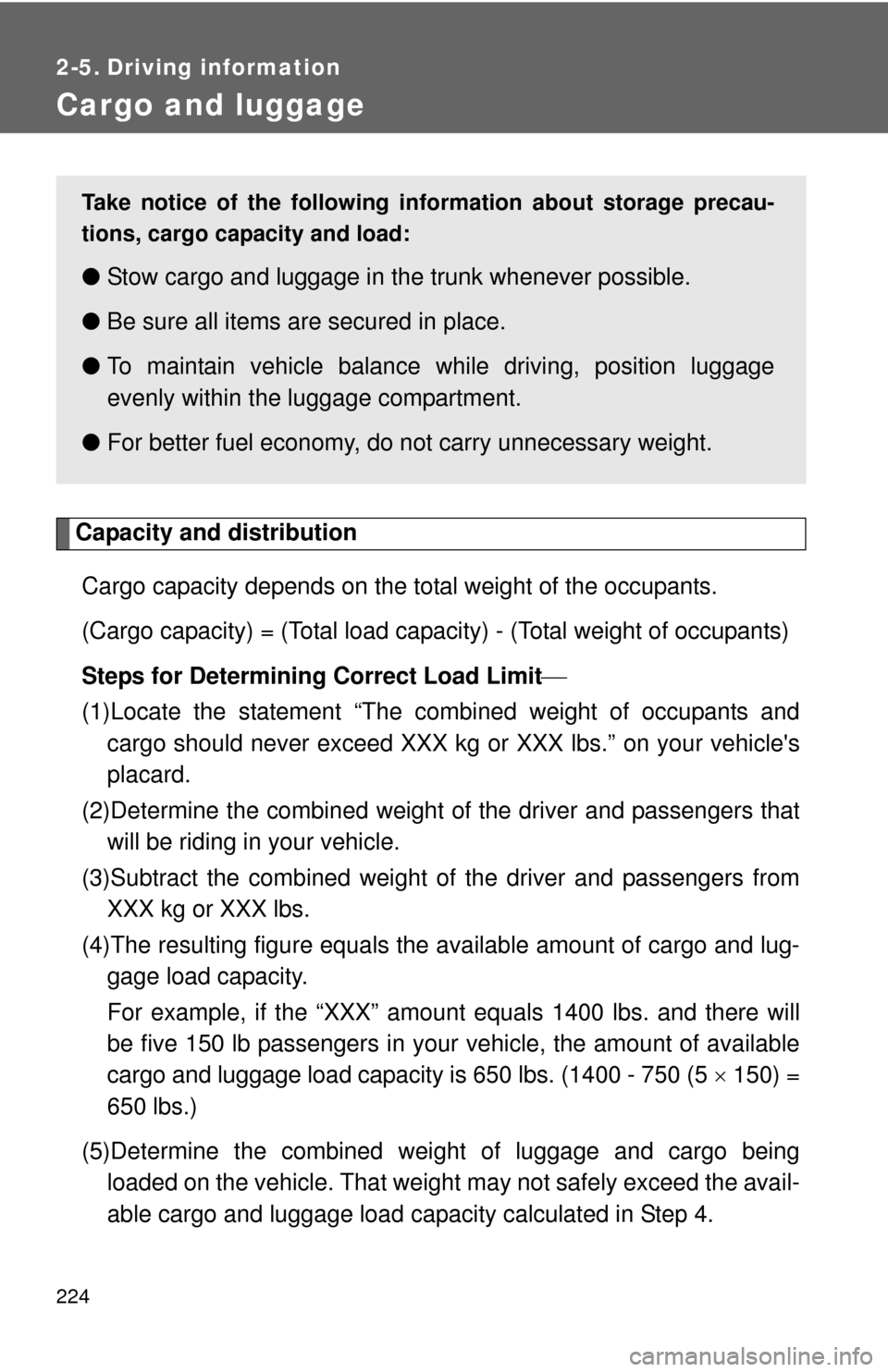
Capacity and distributionCargo capacity depends on the total weight of the occupants.
(Cargo capacity) = (Total load capacity) - (Total weight of occupants)
Steps for Determining Correct Load Limit
(1)Locate the statement “The co mbined weight of occupants and
cargo should never exceed XXX kg or XXX lbs.” on your vehicle's
placard.
(2)Determine the combined weight of the driver and passengers that
will be riding in your vehicle.
(3)Subtract the combined weight of the driver and passengers from XXX kg or XXX lbs.
(4)The resulting figure equals the available amount of cargo and lug- gage load capacity.
For example, if the “XXX” amount equals 1400 lbs. and there will
be five 150 lb passengers in your vehicle, the amount of available
cargo and luggage load capacity is 650 lbs. (1400 - 750 (5 150) =
650 lbs.)
(5)Determine the combined weight of luggage and cargo being loaded on the vehicle. That weight may not safely exceed the avail-
able cargo and luggage load capacity calculated in Step 4.
Take notice of the following information about storage precau-
tions, cargo capacity and load:
● Stow cargo and luggage in the trunk whenever possible.
● Be sure all items are secured in place.
● To maintain vehicle balance while driving, position luggage
evenly within the luggage compartment.
● For better fuel economy, do no t carry unnecessary weight.
Page 225 of 620

225
2-5. Driving information
2
When driving
(6)If your vehicle will be towing a tr
ailer, load from your trailer will be
transferred to your vehicle. Cons ult this manual to determine how
this reduces the available cargo and luggage load capacity of your
vehicle.
( P. 552)
Toyota does not recommend towing a trailer with your vehicle. Your
vehicle is not designed for trailer towing.
Calculation formula for your vehicle
Cargo capacity
Total load capacity (vehicle
capacity weight) (P. 552)
When 2 people with the combined weight of A lb. (kg) are riding in your
vehicle, which has a total load capacity (vehicle capacity weight) of B lb.
(kg), the available amount of cargo an d luggage load capacity will be C
lb. (kg) as follows:
B*
2 lb. (kg) - A*1 lb. (kg) = C*3 lb. (kg)
*
1: A = Weight of people
*2: B = Total load capacity
*3: C = Available cargo and luggage load
In this condition, if 3 more passengers with the combined weight of D lb.
(kg) get on, the available cargo an d luggage load will be reduced E lb.
(kg) as follows:
C lb. (kg) - D*4 lb. (kg) = E*5 lb. (kg)
*
4: D = Additional weight of people
*5: E = Available cargo and luggage load
Page 226 of 620
226 2-5. Driving information
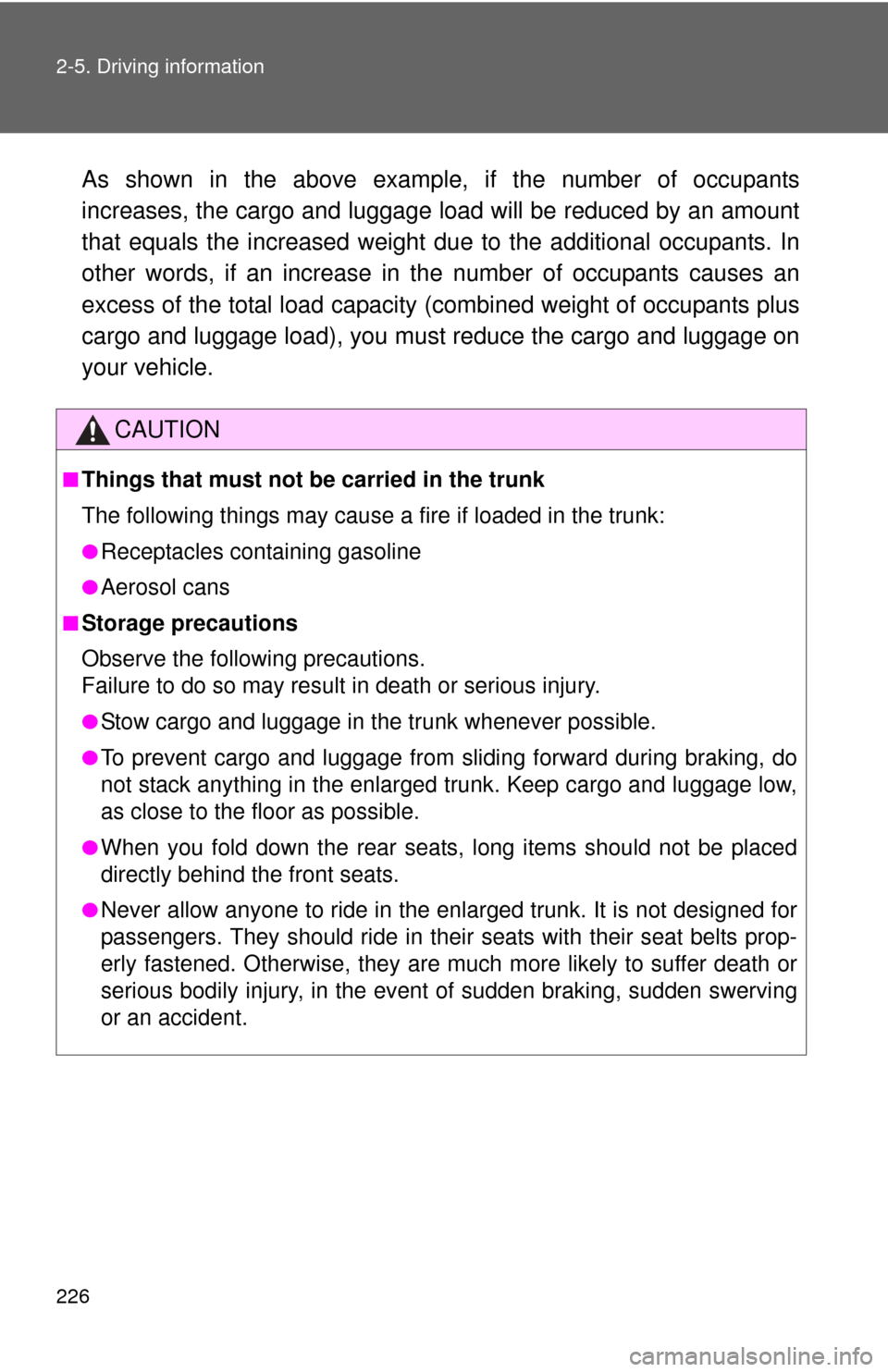
As shown in the above example, if the number of occupants
increases, the cargo and luggage load will be reduced by an amount
that equals the increased weight du e to the additional occupants. In
other words, if an increase in the number of occupants causes an
excess of the total load capacity (combined weight of occupants plus
cargo and luggage load), you must reduce the cargo and luggage on
your vehicle.
CAUTION
■Things that must not be carried in the trunk
The following things may cause a fire if loaded in the trunk:
●Receptacles containing gasoline
●Aerosol cans
■Storage precautions
Observe the following precautions.
Failure to do so may result in death or serious injury.
●Stow cargo and luggage in the trunk whenever possible.
●To prevent cargo and luggage from sliding forward during braking, do
not stack anything in the enlarged trunk. Keep cargo and luggage low,
as close to the floor as possible.
●When you fold down the rear seats, long items should not be placed
directly behind the front seats.
●Never allow anyone to ride in the enlarged trunk. It is not designed for
passengers. They should ride in their seats with their seat belts prop-
erly fastened. Otherwise, they are much more likely to suffer death or
serious bodily injury, in the event of sudden braking, sudden swerving
or an accident.
Page 227 of 620
227
2-5. Driving information
2
When driving
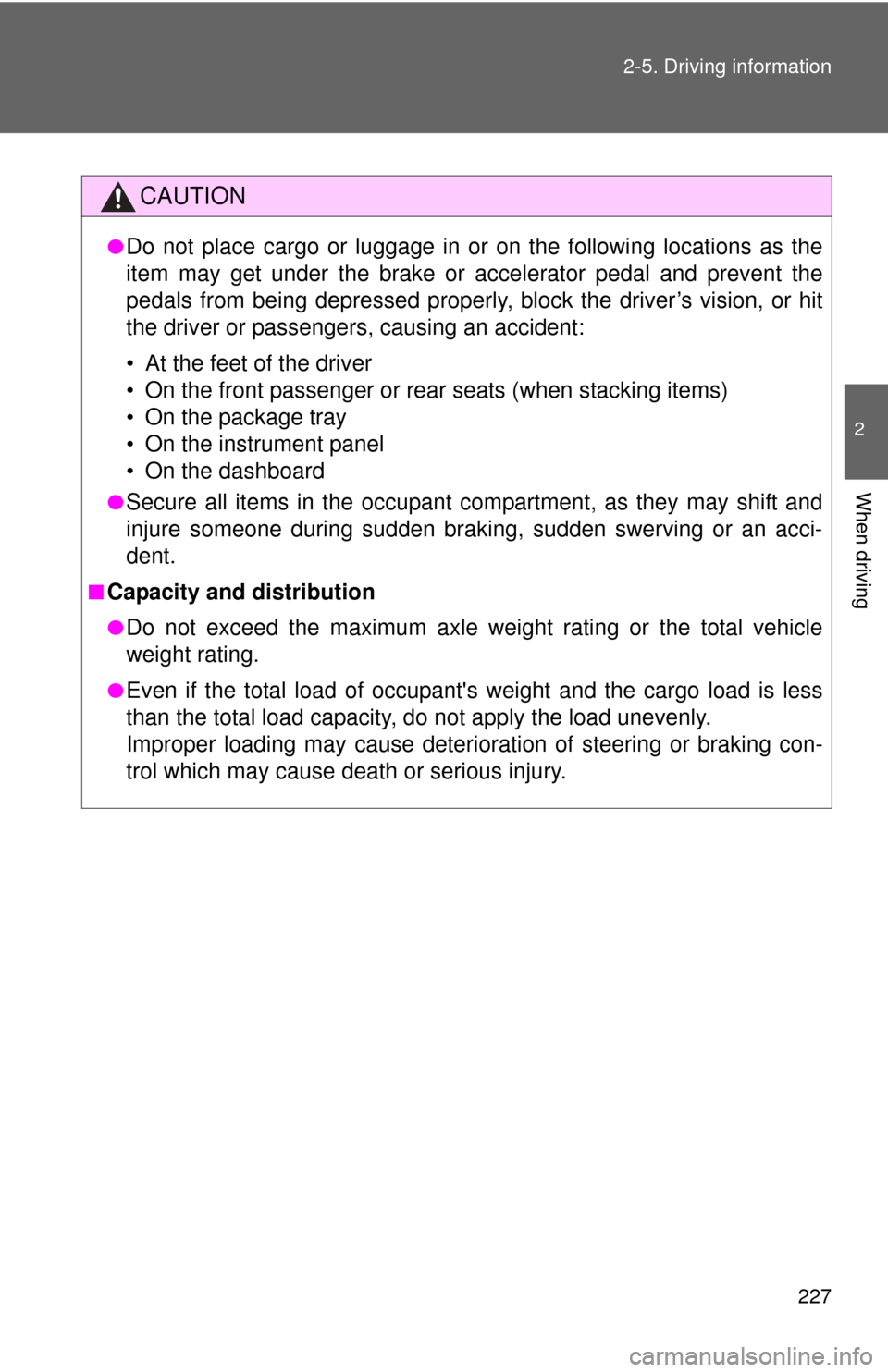
CAUTION
●Do not place cargo or luggage in or on the following locations as the
item may get under the brake or accelerator pedal and prevent the
pedals from being depressed properly,
block the driver’s vision, or hit
the driver or passengers, causing an accident:
• At the feet of the driver
• On the front passenger or rear seats (when stacking items)
• On the package tray
• On the instrument panel
• On the dashboard
●Secure all items in the occupant compartment, as they may shift and
injure someone during sudden braking, sudden swerving or an acci-
dent.
■Capacity and distribution
●Do not exceed the maximum axle weight rating or the total vehicle
weight rating.
●Even if the total load of occupant's weight and the cargo load is less
than the total load capacity, do not apply the load unevenly.
Improper loading may cause deterioration of steering or braking con-
trol which may cause death or serious injury.
Page 228 of 620

228
2-5. Driving information
Vehicle load limits
■Total load capacity and seating capacity
These details are also described on the tire and loading information
label. (P. 460)
CAUTION
■Overloading the vehicle
Do not overload the vehicle.
It may not only cause damage to the ti res, but also degrade steering and
braking ability, resulting in an accident.
Vehicle load limits include total load capacity, seating capacity,
towing capacity and cargo capacity.
■ Total load capacity (vehicle capacity weight): ( P. 552)
Total load capacity means the combined weight of occupants, cargo
and luggage.
■ Seating capacity: 5 occupants (Front 2, Rear 3)
Seating capacity means the maxi mum number of occupants whose
estimated average weight is 150 lb. (68 kg) per person.
■ Towing capacity
Toyota does not recommend towing a trailer with your vehicle.
■Cargo capacity
Cargo capacity may increase or decrease depending on the weight
and the number of occupants.
Page 576 of 620
576 6-1. Specifications
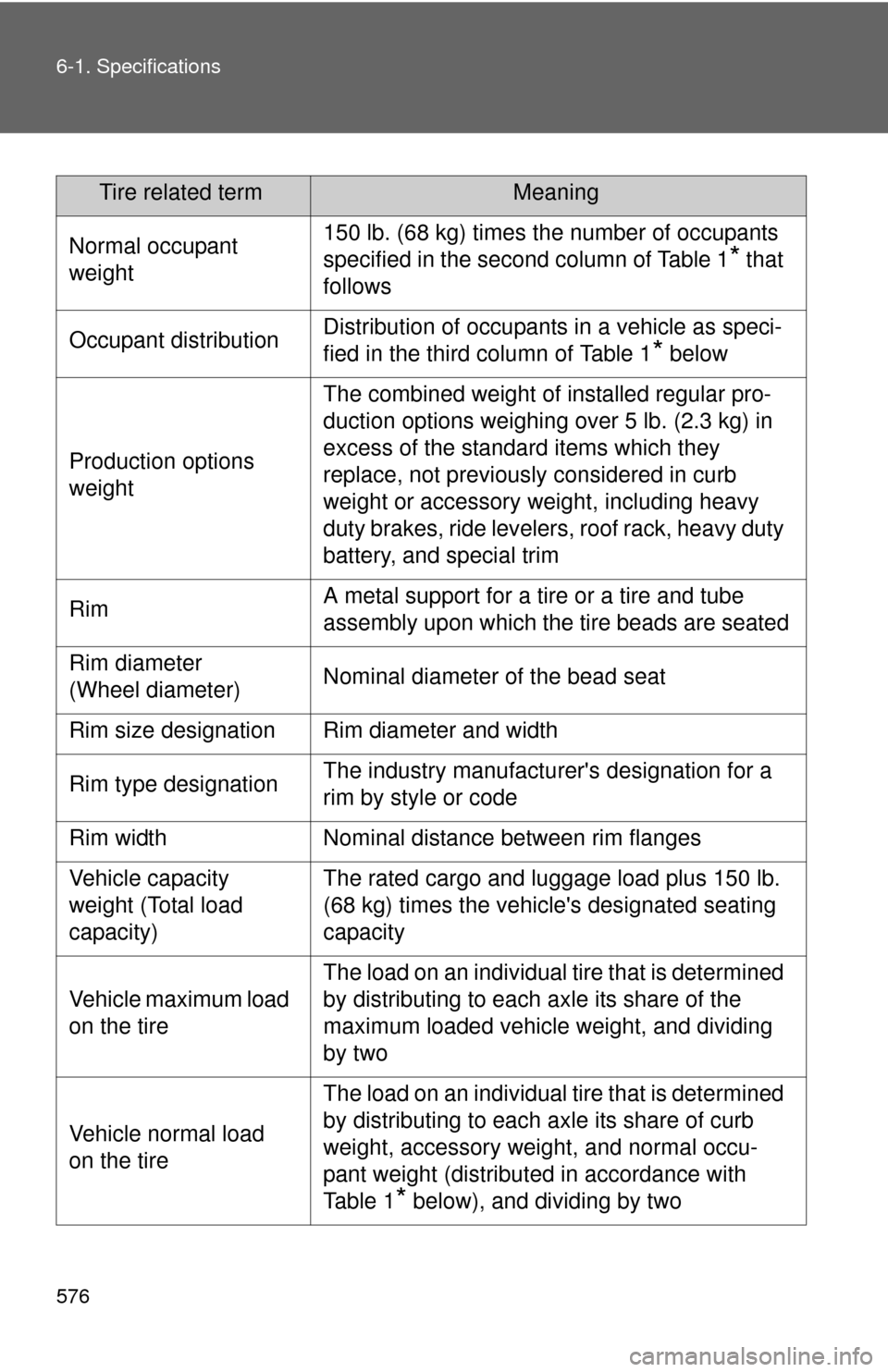
Tire related termMeaning
Normal occupant
weight 150 lb. (68 kg) times the number of occupants
specified in the second column of Table 1
* that
follows
Occupant distribution Distribution of occupants in a vehicle as speci-
fied in the third column of Table 1
* below
Production options
weight The combined weight of installed regular pro-
duction options weighing over 5 lb. (2.3 kg) in
excess of the standard items which they
replace, not previously considered in curb
weight or accessory weight, including heavy
duty brakes, ride levelers, roof rack, heavy duty
battery, and special trim
Rim A metal support for a tire or a tire and tube
assembly upon which the tire beads are seated
Rim diameter
(Wheel diameter) Nominal diameter of the bead seat
Rim size designation Rim diameter and width
Rim type designation The industry manufacturer's designation for a
rim by style or code
Rim width Nominal distance between rim flanges
Vehicle capacity
weight (Total load
capacity) The rated cargo and luggage load plus 150 lb.
(68 kg) times the vehicl
e's designated seating
capacity
Vehicle maximum load
on the tire The load on an individual tire that is determined
by distributing to each axle its share of the
maximum loaded vehicle weight, and dividing
by two
Vehicle normal load
on the tire The load on an individual tire that is determined
by distributing to each axle its share of curb
weight, accessory weight, and normal occu-
pant weight (distributed in accordance with
Ta b l e 1
* below), and dividing by two
Page 614 of 620

614 Alphabetical index
Tachometer............................... 172
Tail lightsReplacing light bulbs ............. 486
Switch.................................... 191
Wattage ................................. 563
Theft deterrent system Alarm .......................................99
Engine immobilizer system .....96
Tire inflation pressure ............. 460
Tire information Glossary ................................ 575
Size ....................................... 572
Tire identification number ...... 571
Uniform tire quality
grading ................................ 573
Tires Chains ................................... 229
Checking ............................... 454
If you have a flat tire .............. 520
Inflation pressure................... 460
Inflation pressure sensor ....... 455
Replacing .............................. 520
Rotating tires ......................... 454
Size ....................................... 561
Snow tires ............................. 229
Spare tire............................... 520
Tire pressure warning
system ........................ 454, 508
Warning light ......................... 508 Tools ......................................... 520
Total load capacity .................. 228
Towing
Dinghy towing ....................... 234
Trailer towing ........................ 233
TRAC ......................................... 209
Traction control ....................... 209
Trip information ....................... 172
Trip meter ................................. 172
Trunk Opener .................................... 61
Trunk light Trunk light ............................... 62
Wattage................................. 563
Turn signal lights Replacing light bulbs ............. 486
Switch ................................... 168
Wattage................................. 563
Valet key ..................................... 30
Vanity lights Vanity lights........................... 385
Wattage................................. 563
Vanity mirrors .......................... 385
Vehicle data recordings ............ 23
Vehicle identification number ................................... 552
Vehicle stability control .......... 209
VSC ........................................... 209T
V