Page 515 of 620

5
When trouble arises
515
5-2. Steps to take in an emergency
■
If the malfunction indicator lamp comes on while driving
First check the following:
● Is the fuel tank empty?
If it is, fill the fuel tank immediately.
● Is the fuel tank cap loose?
If it is, tighten it securely.
The malfunction indicator lamp will go off after several driving trips.
If the malfunction indicator lamp does not go off even after several trips, con-
tact your Toyota dealer as soon as possible.
■
The tire pressure warning light may come on due to natural causes
(vehicles with a tire pressure warning system)
The tire pressure warning light may come on due to natural causes such
as natural air leaks and tire inflat ion pressure changes caused by tem-
perature. In this case, adjusting the tire inflation pressure will turn off the
warning light (after a few minutes).
■When a tire is replaced with a spare tire (vehicles with a tire pres-
sure warning system)
The compact spare tire is not equipped with a tire pressure warning
valve and transmitter. If a tire goes flat, the tire pressure warning light will
not turn off even though the flat tire has been replaced with the spare
tire. Replace the spare tire with the re paired tire and adjust the tire infla-
tion pressure. The tire pressure wa rning light will go off after a few min-
utes.
Page 521 of 620
5
When trouble arises
521
5-2. Steps to take in an emergency
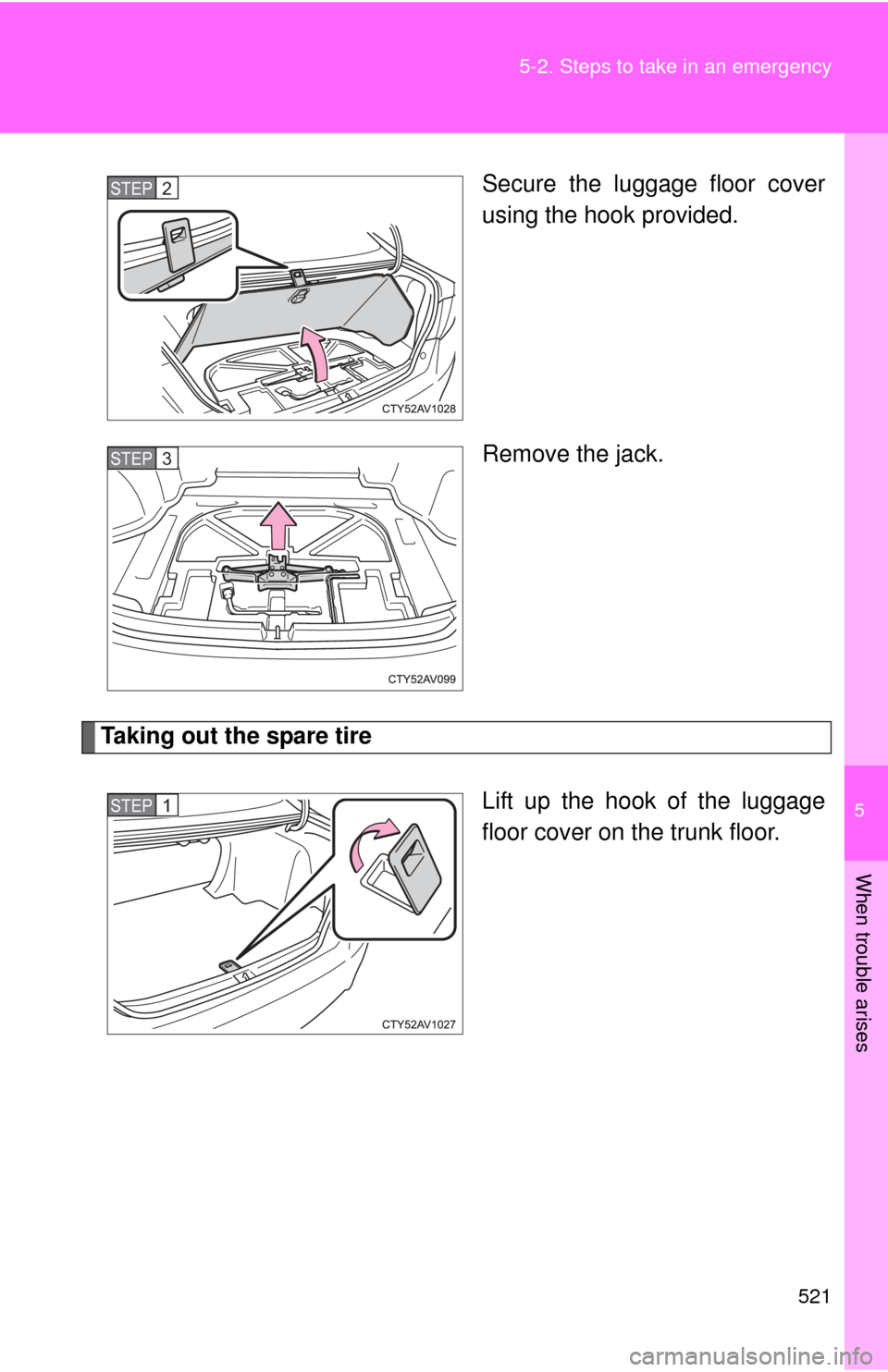
Secure the luggage floor cover
using the hook provided.
Remove the jack.
Taking out the spare tire
Lift up the hook of the luggage
floor cover on the trunk floor.
STEP2
STEP3
STEP1
Page 522 of 620
522 5-2. Steps to take in an emergency
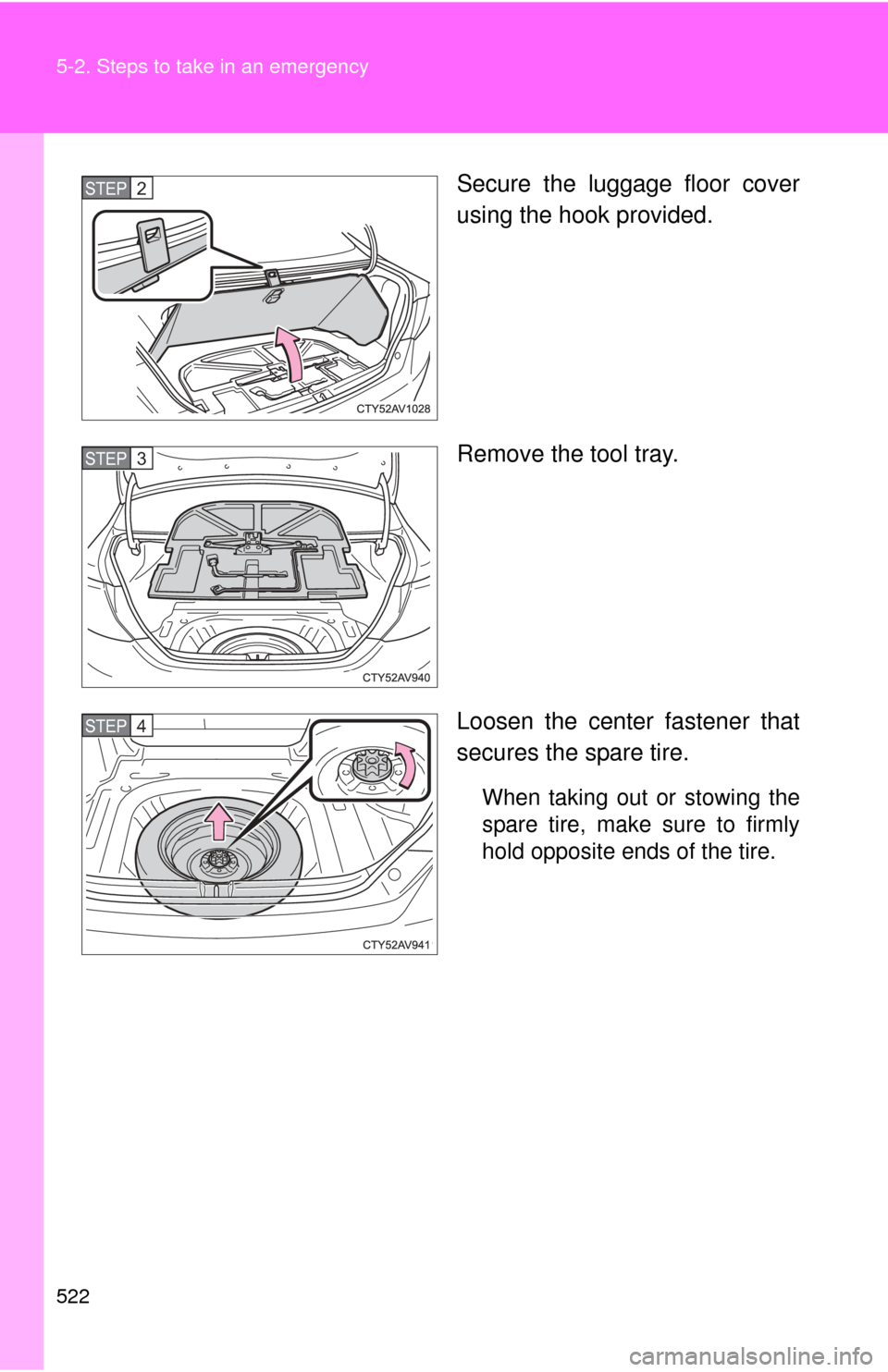
Secure the luggage floor cover
using the hook provided.
Remove the tool tray.
Loosen the center fastener that
secures the spare tire.
When taking out or stowing the
spare tire, make sure to firmly
hold opposite ends of the tire.
STEP2
STEP3
STEP4
Page 529 of 620

5
When trouble arises
529
5-2. Steps to take in an emergency
CAUTION
■Using the tire jack
Improper use of the tire jack may cause the vehicle to suddenly fall off
the jack, leading to death or serious injury.
●Do not use the tire jack for any pu
rpose other than replacing tires or
installing and removing tire chains.
●Only use the tire jack that comes wi th this vehicle for replacing a flat
tire.
Do not use it on other vehicles, and do not use other tire jacks for
replacing tires on this vehicle.
●Always check that the tire jack is securely set to the jack point.
●Do not put any part of your body under the vehicle while it is supported
by the jack.
●Do not start or run the engine while your vehicle is supported by the
jack.
●Do not raise the vehicle while someone is inside.
●When raising the vehicle, do not put an object on or under the jack.
●Do not raise the vehicle to a hei ght greater than that required to
replace the tire.
●Use a jack stand if it is necessary to get under the vehicle.
Take particular care when lowering the vehicle to ensure that no one
working on or near the vehicle may be injured.
Page 549 of 620
5
When trouble arises
549
5-2. Steps to take in an emergency
CAUTION
■
If the engine has to be turned off while driving
●Power assist for the brakes and steering wheel will be lost, making the
brake pedal harder to depress and the steering wheel heavier to turn.
Decelerate as much as possible before turning off the engine.
● Vehicles without a smart key system: Never attempt to remove the key, as
doing so will lock the steering wheel.
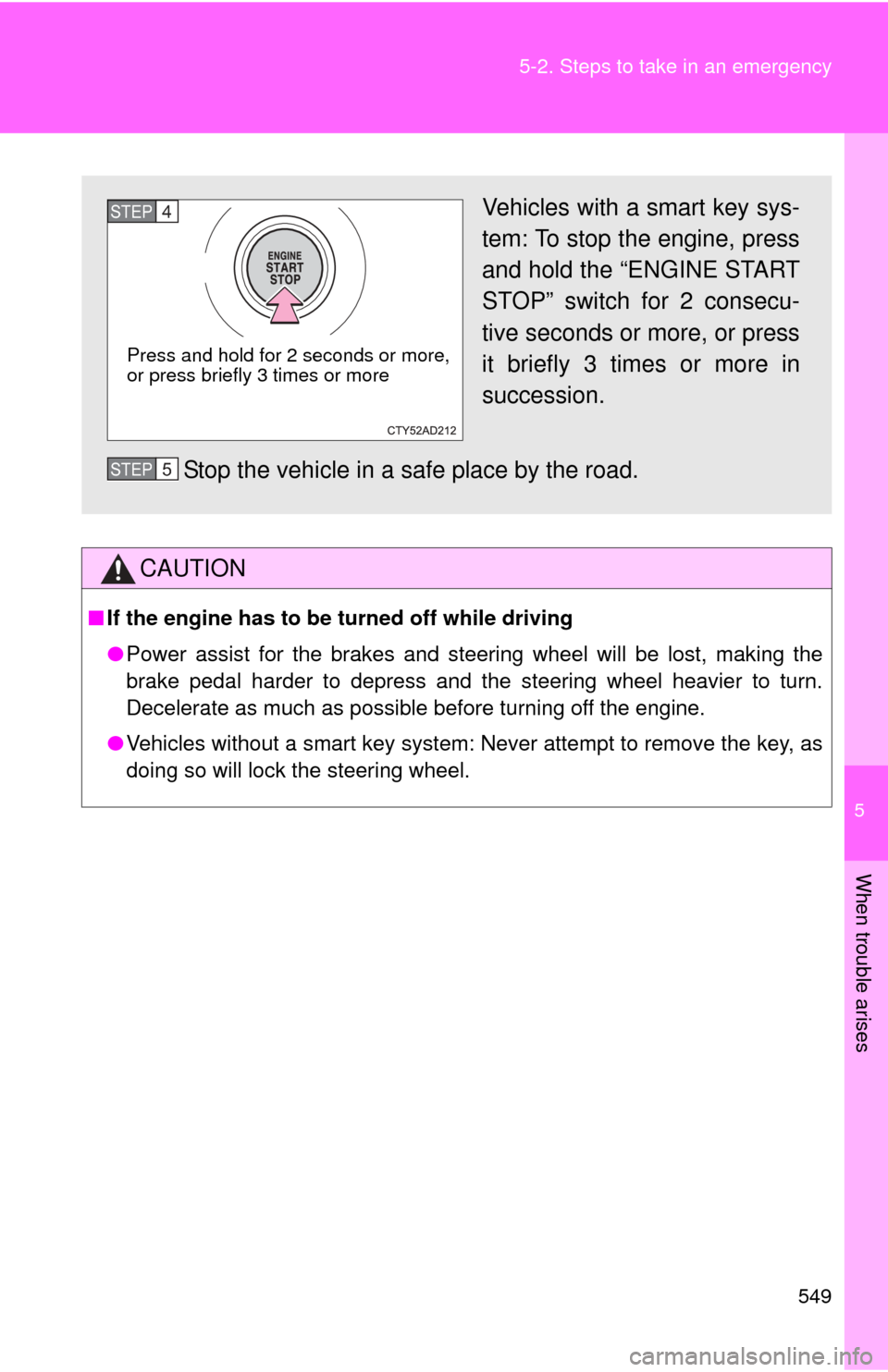
Vehicles with a smart key sys-
tem: To stop the engine, press
and hold the “ENGINE START
STOP” switch for 2 consecu-
tive seconds or more, or press
it briefly 3 times or more in
succession.
Stop the vehicle in a safe place by the road.STEP4
Press and hold for 2 seconds or more,
or press briefly 3 times or more
STEP5
Page 580 of 620
580 6-1. Specifications
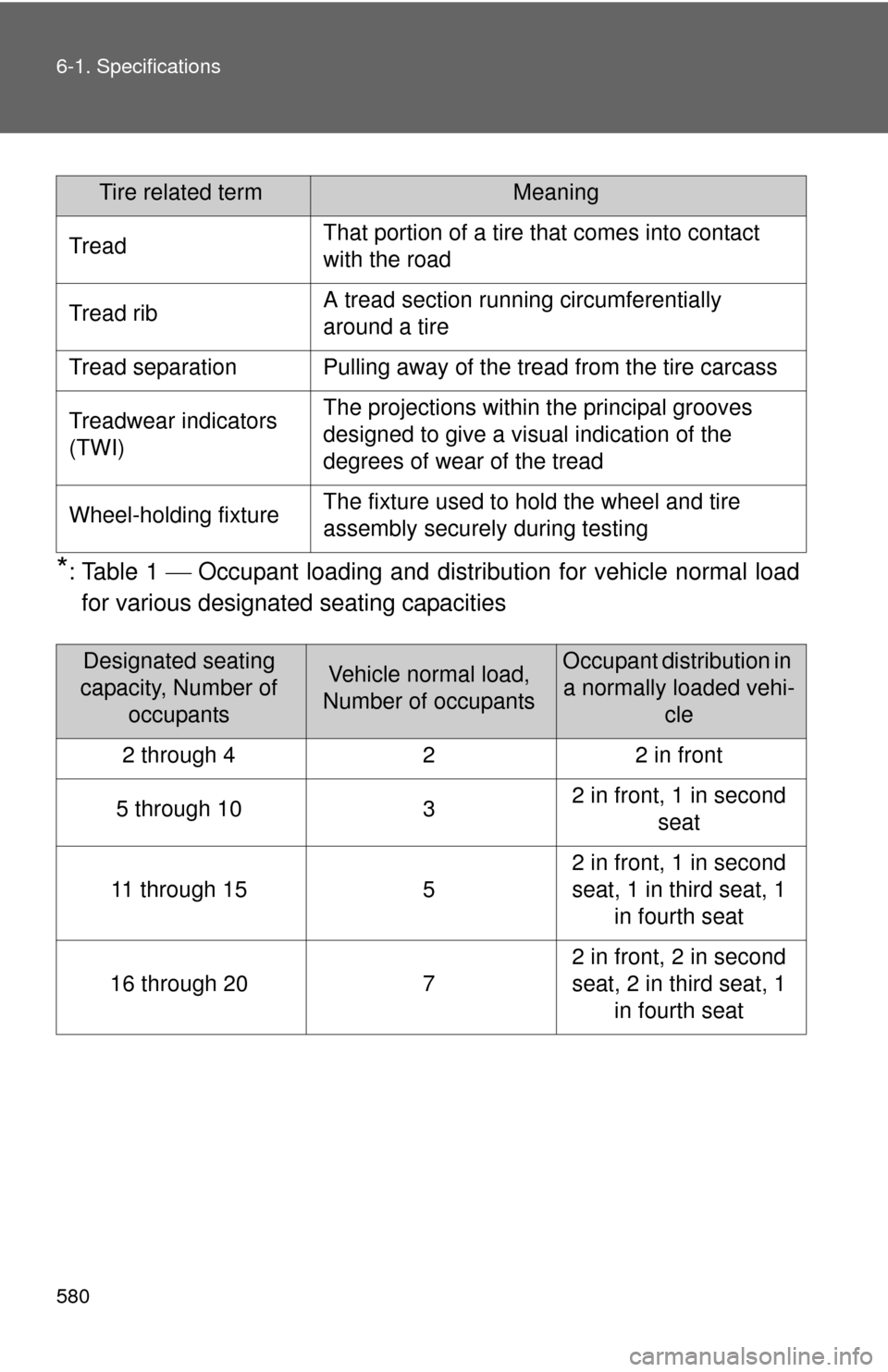
*:Table 1 Occupant loading and distribution for vehicle normal load
for various designated seating capacities
Tire related termMeaning
Tread That portion of a tire that comes into contact
with the road
Tread rib A tread section running circumferentially
around a tire
Tread separation Pulling away of the tread from the tire carcass
Treadwear indicators
(TWI) The projections within the principal grooves
designed to give a visual indication of the
degrees of wear of the tread
Wheel-holding fixture The fixture used to hold the wheel and tire
assembly securely
during testing
Designated seating
capacity, Number of occupantsVehicle normal load,
Number of occupantsOccupant distribution in a normally loaded vehi- cle
2 through 4 2 2 in front
5 through 10 3 2 in front, 1 in second
seat
11 through 15 5 2 in front, 1 in second
seat, 1 in third seat, 1
in fourth seat
16 through 20 7 2 in front, 2 in second
seat, 2 in third seat, 1
in fourth seat
Page 591 of 620
591
7
For owners
Seat belt instructions for Canadian owners (in French)
The following is a French explanation of seat belt instructions
extracted from the seat belt section in this manual.
See the seat belt section for more detailed seat belt instructions in
English.
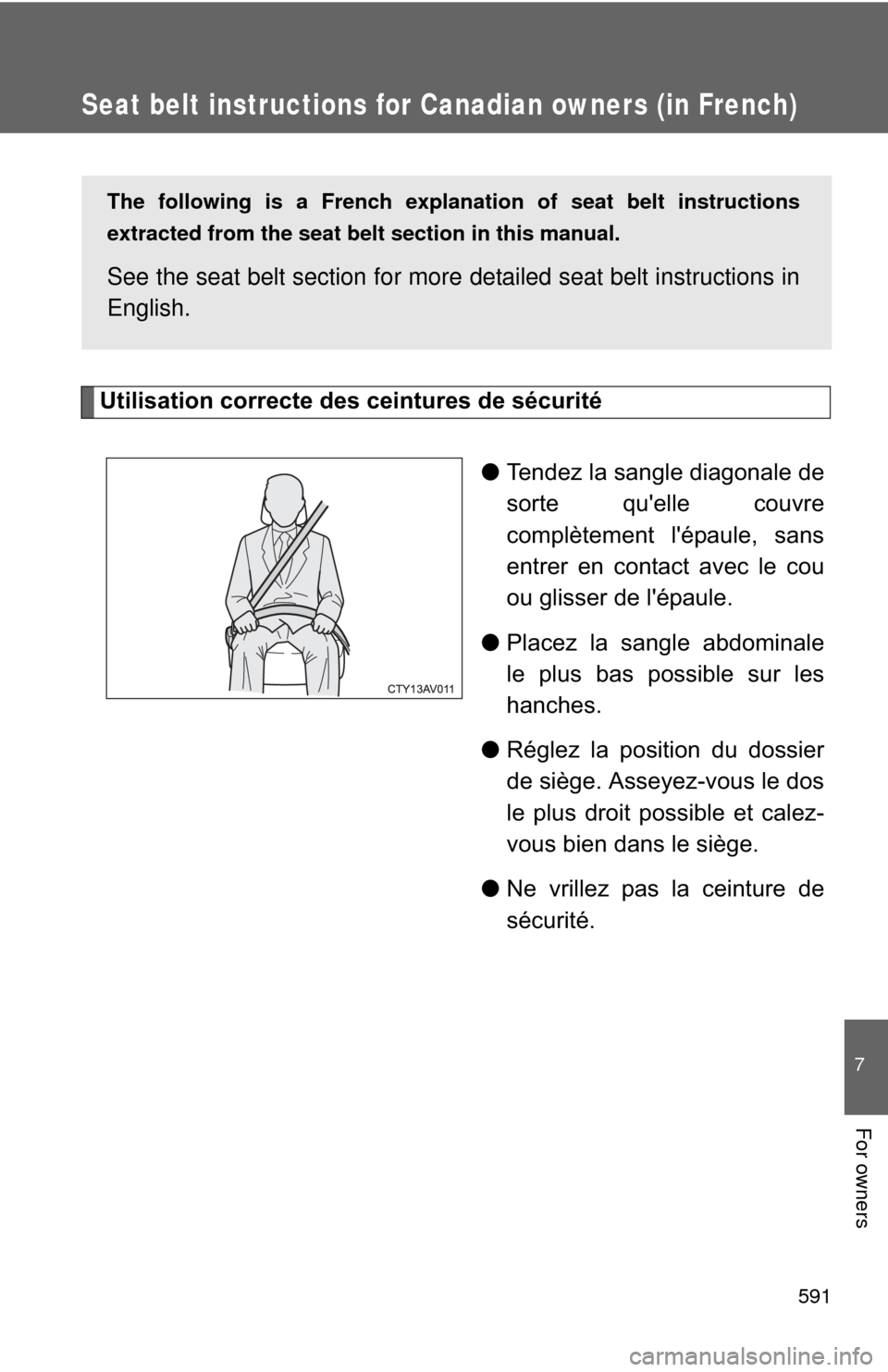
Utilisation correcte des ceintures de sécurité
●Tendez la sangle diagonale de
sorte qu'elle couvre
complètement l'épaule, sans
entrer en contact avec le cou
ou glisser de l'épaule.
● Placez la sangle abdominale
le plus bas possible sur les
hanches.
● Réglez la position du dossier
de siège. Asseyez-vous le dos
le plus droit possible et calez-
vous bien dans le siège.
● Ne vrillez pas la ceinture de
sécurité.
Page 592 of 620
592
Entretien et soin
■Ceintures de sécurité
Nettoyez avec un chiffon ou une éponge humectée d'eau savonneuse tiède.
Profitez de l'occasion pour vérifier régulièrement que les ceintures ne sont
pas effilochées, entaillées, ou ne paraissent pas exagérément usées.
■
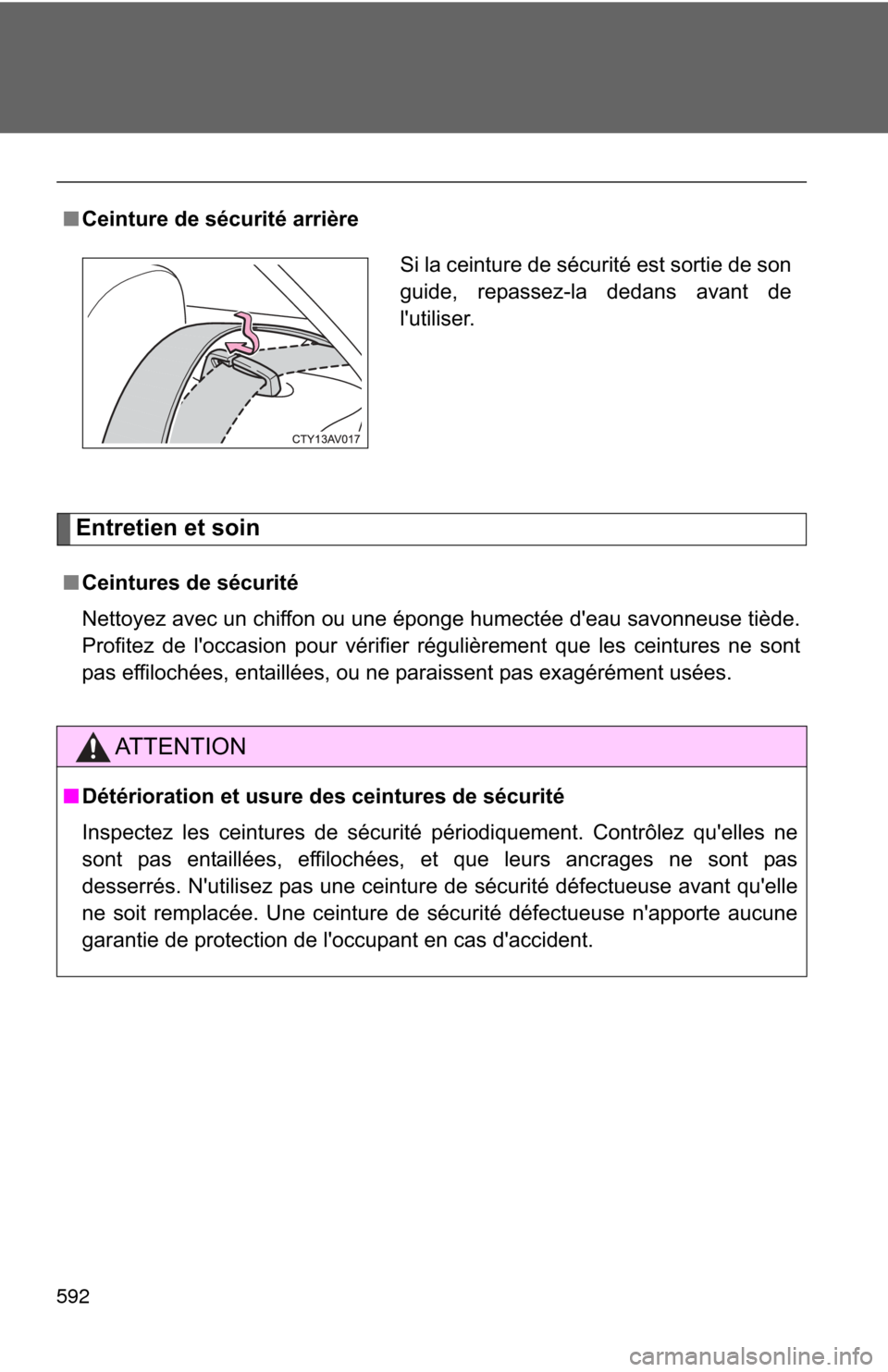
Ceinture de sécurité arrière
AT T E N T I O N
■Détérioration et usure des ceintures de sécurité
Inspectez les ceintures de sécurité périodiquement. Contrôlez qu'elles ne
sont pas entaillées, effilochées, et que leurs ancrages ne sont pas
desserrés. N'utilisez pas une ceinture de sécurité défectueuse avant qu'elle
ne soit remplacée. Une ceinture de sécurité défectueuse n'apporte aucune
garantie de protection de l'occupant en cas d'accident.
Si la ceinture de sécurité est sortie de son
guide, repassez-la dedans avant de
l'utiliser.