2014 SUBARU IMPREZA WRX fuel pressure
[x] Cancel search: fuel pressurePage 331 of 414
11-12Maintenance and service/Cooling system
Refer to“Fuses ”F 11-38 and “Fuse panel
located in the engine compartment ”F 12-
12.
If the fuse is not blown, have the cooling
system checked by your SUBARU dealer.
If frequent addition of coolant is neces-
sary, there may be a leak in the engine
cooling system. It is recommended that
the cooling system and connections be
checked for leaks, damage, or looseness.
& Engine coolant
! Checking the coolant level
WARNING
Never attempt to remove the radia-
tor cap until the engine has been
shut off and has cooled down
completely. Since the coolant is
under pressure, you may suffer
serious burns from a spray of boil-
ing hot coolant when the cap isremoved.
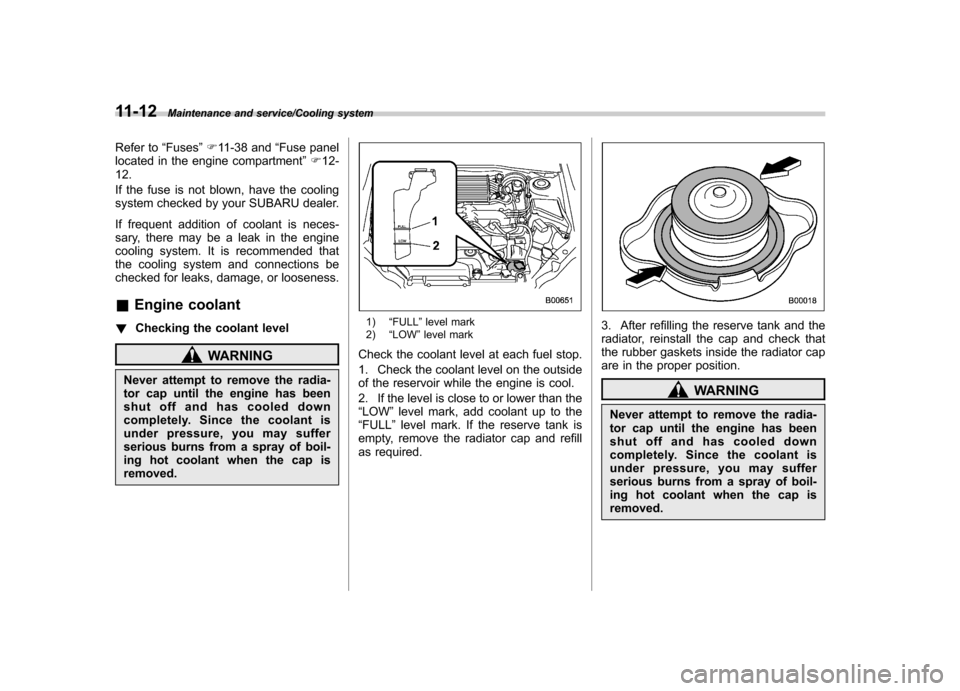
1) “FULL ”level mark
2) “LOW ”level mark
Check the coolant level at each fuel stop.
1. Check the coolant level on the outside
of the reservoir while the engine is cool.
2. If the level is close to or lower than the “ LOW ”level mark, add coolant up to the
“ FULL ”level mark. If the reserve tank is
empty, remove the radiator cap and refill
as required.3. After refilling the reserve tank and the
radiator, reinstall the cap and check that
the rubber gaskets inside the radiator cap
are in the proper position.
WARNING
Never attempt to remove the radia-
tor cap until the engine has been
shut off and has cooled down
completely. Since the coolant is
under pressure, you may suffer
serious burns from a spray of boil-
ing hot coolant when the cap isremoved.
Page 345 of 414
11-26Maintenance and service/Tires and wheels
rough surface, they can suffer damage
that cannot be seen with the naked eye.
This type of damage does not become
evident until time has passed. Try not
to drive over curbs, potholes or on
other rough surfaces. If doing so is
unavoidable, keep the vehicle’s speed
down to a walking pace or less, and
approach the curbs as squarely as
possible. Also, make sure the tires are
not pressed against the curb when you
park the vehicle.. If you feel unusual vibration while
driving or find it difficult to steer the
vehicle in a straight line, one of the
tires and/or wheels may be damaged.
Drive slowly to the nearest authorized
SUBARU dealer and have the vehicleinspected.
& Tire pressures and wear
Maintaining the correct tire pressures
helps to maximize the tires ’service lives
and is essential for good running perfor-
mance. Check and, if necessary, adjust
the pressure of each tire (including the
spare) at least once a month (for example,
during a fuel stop) and before any long
journey.
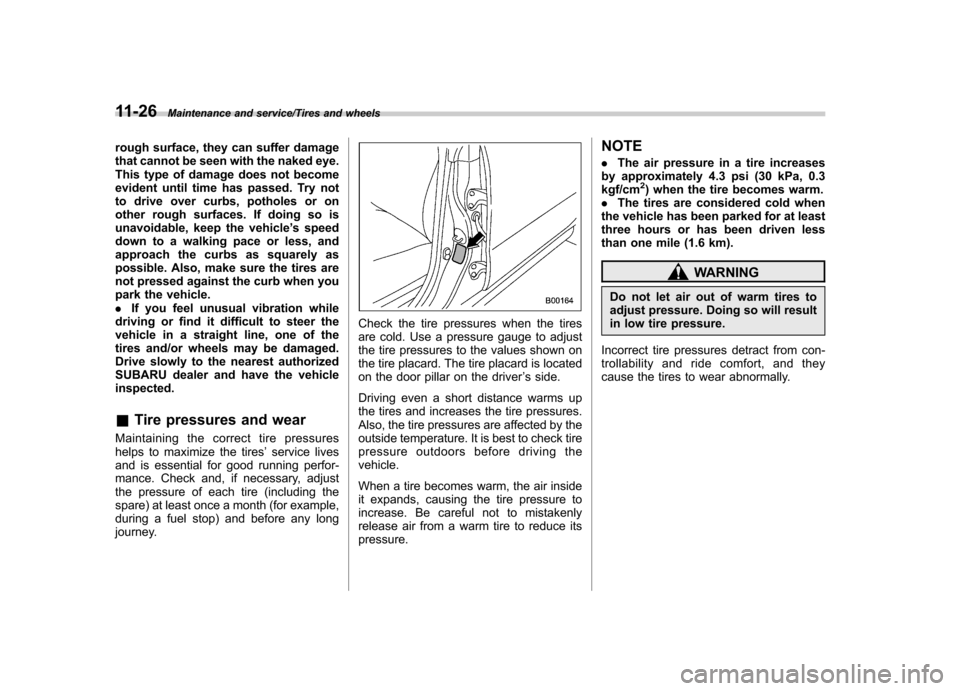
Check the tire pressures when the tires
are cold. Use a pressure gauge to adjust
the tire pressures to the values shown on
the tire placard. The tire placard is located
on the door pillar on the driver ’s side.
Driving even a short distance warms up
the tires and increases the tire pressures.
Also, the tire pressures are affected by the
outside temperature. It is best to check tire
pressure outdoors before driving thevehicle.
When a tire becomes warm, the air inside
it expands, causing the tire pressure to
increase. Be careful not to mistakenly
release air from a warm tire to reduce itspressure. NOTE .
The air pressure in a tire increases
by approximately 4.3 psi (30 kPa, 0.3 kgf/cm
2) when the tire becomes warm.
. The tires are considered cold when
the vehicle has been parked for at least
three hours or has been driven less
than one mile (1.6 km).
WARNING
Do not let air out of warm tires to
adjust pressure. Doing so will result
in low tire pressure.
Incorrect tire pressures detract from con-
trollability and ride comfort, and they
cause the tires to wear abnormally.
Page 346 of 414
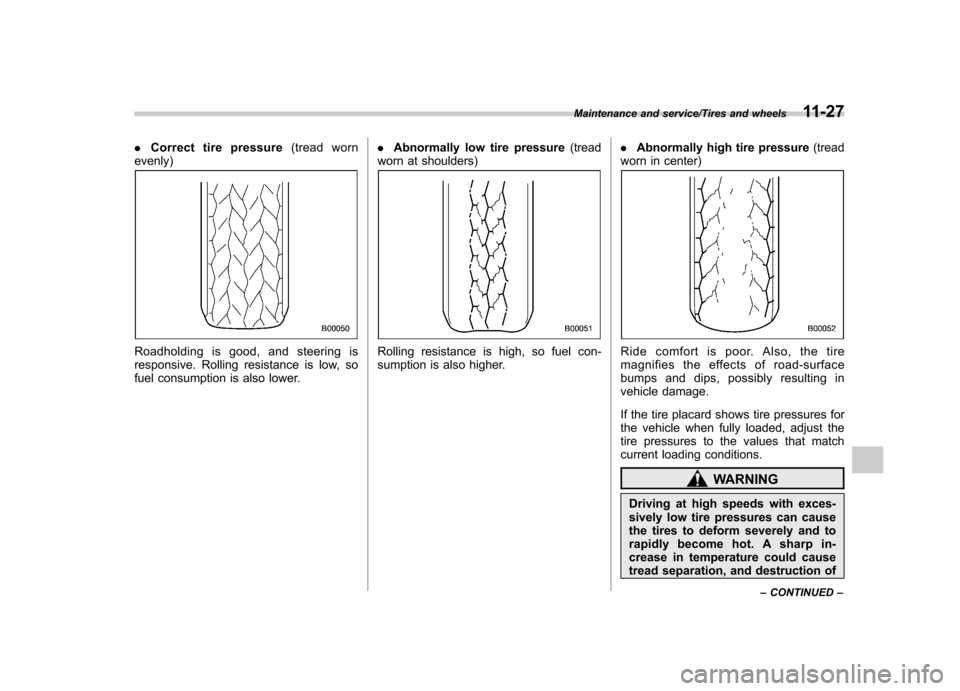
.Correct tire pressure (tread worn
evenly)
Roadholding is good, and steering is
responsive. Rolling resistance is low, so
fuel consumption is also lower. .
Abnormally low tire pressure (tread
worn at shoulders)Rolling resistance is high, so fuel con-
sumption is also higher. .
Abnormally high tire pressure (tread
worn in center)Ride comfort is poor. Also, the tire
magnifies the effects of road-surface
bumps and dips, possibly resulting in
vehicle damage.
If the tire placard shows tire pressures for
the vehicle when fully loaded, adjust the
tire pressures to the values that match
current loading conditions.
WARNING
Driving at high speeds with exces-
sively low tire pressures can cause
the tires to deform severely and to
rapidly become hot. A sharp in-
crease in temperature could cause
tread separation, and destruction of
Maintenance and service/Tires and wheels11-27
– CONTINUED –
Page 384 of 414
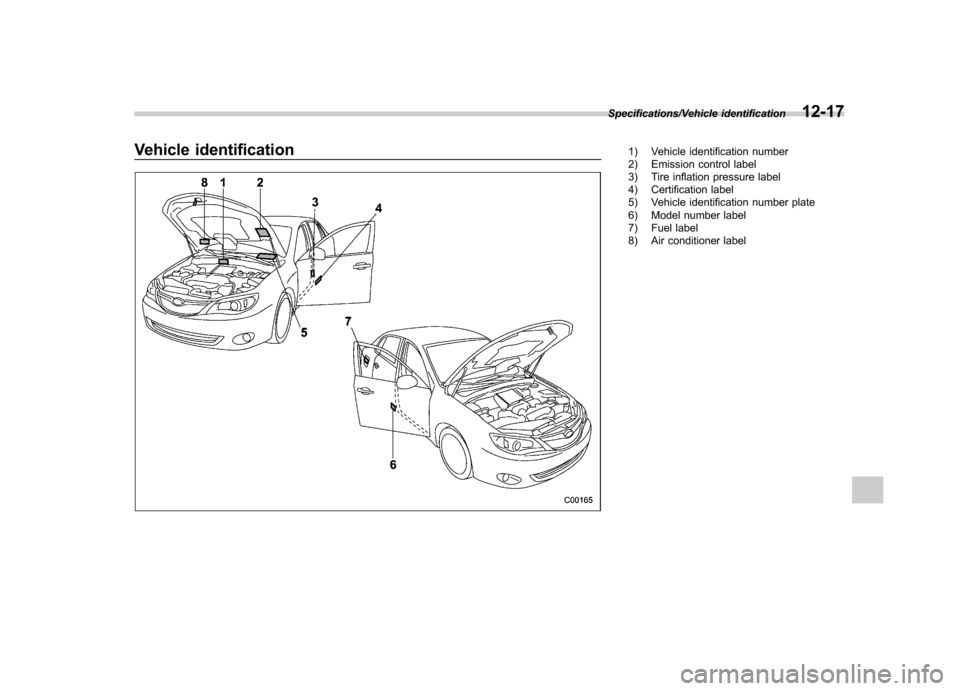
Vehicle identification1) Vehicle identification number
2) Emission control label
3) Tire inflation pressure label
4) Certification label
5) Vehicle identification number plate
6) Model number label
7) Fuel label
8) Air conditioner label
Specifications/Vehicle identification12-17
Page 390 of 414

crease in temperature could cause
tread separation, and failure of the
tire(s). Possible resulting loss of
vehicle control could lead to anaccident. !Measuring and adjusting air
pressure to achieve proper in-
flation
Check and, if necessary, adjust the
pressure of each tire (including the
spare) at least once a month and
before any long journey. Check the
tire pressures when the tires are
cold. Use a pressure gauge to
adjust the tire pressures to the
specific values. Driving even a
short distance warms up the tires
and increases the tire pressures.
Also, the tire pressures are affected
by the outside temperature. It is
best to check tire pressure out-
doors before driving the vehicle.
When a tire becomes warm, the air
inside it expands, causing the tire
pressure to increase. Be careful not
to mistakenly release air from a
warm tire to reduce its pressure. &
Glossary of tire terminology
. Accessory weight
The combined weight (in excess of
those standard items which may be
replaced) of automatic transmis-
sion, power steering, power brakes,
power windows, power seats, radio,
and heater, to the extent that these
items are available as factory-in-
stalled equipment (whether in-
stalled or not). . Bead
The part of the tire that is made of
steel wires, wrapped or reinforced
by ply cords and that is shaped to fit
the rim.. Bead separation
A breakdown of the bond between
components in the bead.. Bias ply tire
A pneumatic tire in which the ply
cords that extend to the beads are
laid at alternate angles substantially
less than 90 degrees to the center-
line of the tread. . Carcass
The tire structure, except tread and sidewall rubber which, when in-
flated, bears the load. .
Chunking
The breaking away of pieces of the
tread or sidewall.. Cold tire pressure
The pressure in a tire that has been
driven less than 1 mile or has been
standing for three hours or more.. Cord
The strands forming the plies in the tire. . Cord separation
The parting of cords from adjacent
rubber compounds.. Cracking
Any parting within the tread, side-
wall, or inner liner of the tire
extending to cord material. . Curb weight
The weight of a motor vehicle with
standard equipment including the
maximum capacity of fuel, oil and
coolant, and if so equipped, air
conditioning and additional weight
optional engine.
Consumer information and Reporting safety defects/Tire information13-5
– CONTINUED –
Page 408 of 414

Limited slip differential (LSD)....................................... 7-24
Loading your vehicle .................................................. 8-10
Low fuel warning light ................................................. 3-20
Low tire pressure warning light .................................... 3-16
Lower and tether anchorage ........................................ 1-29
LSD (Limited slip differential) ....................................... 7-24
Lubricants ................................................................. 12-5
M Maintenance Precautions ........................................................... 11-3
Schedule .............................................................. 11-3
Seatbelt ................................................................ 1-19
Tools ...................................................................... 9-3
Malfunction indicator light (check engine warning light) ... 3-15Manual Climate control system ............................................. 4-3
Transmission oil ............................................ 11-16, 12-6
Transmission-5 speeds ........................................... 7-16
Transmission-6 speeds ........................................... 7-14
Map light ........................................................... 6-3, 11-46
Meters and gauges ...................................................... 3-5
Mirror defogger .......................................................... 3-47
Mirrors ...................................................................... 3-38
Moonroof .................................................................. 2-27
N
New vehicle break-in driving .......................................... 8-2
O
Odometer/Trip meter .................................................... 3-7 Oil filter
..................................................................... 11-9
Oil level Engine .................................................................. 11-8
Manual transmission ............................................. 11-16
Rear differential gear ............................................ 11-17
Oil pressure warning light ............................................ 3-16
Outside
Mirror defogger ...................................................... 3-47
Mirrors .................................................................. 3-45
Temperature indicator .............................................. 3-27
Overheating engine .................................................... 9-12
PParking Brake .................................................................... 7-33
Brake stroke ........................................................ 11-23
Tips ...................................................................... 7-34
Periodic inspections ..................................................... 8-4
Petrol fuel ................................................................... 7-3
Power
Door locking switch .................................................. 2-6
Outlets ................................................................... 6-8
Outside mirrors .............................................. 3-45, 3-47
Steering ................................................................ 7-24
Steering fluid ................................................ 11-17, 12-7
Windows ............................................................... 2-20
Precautions against vehicle modification ................ 1-21, 1-57
Preparing to drive ........................................................ 7-8 Index
14-7
Page 411 of 414

14-10Index
Pressures and wear .............................................. 11-26
Replacement ........................................................ 11-29
Rotation ............................................................... 11-29
Size and pressure .................................................. 12-9
Types .................................................................. 11-24
Tire pressure monitoring system (TPMS). ...... 7-32, 9-8, 11-24
Warning light ......................................................... 3-16
Tires and wheels. ...................................................... 11-24
Tools .......................................................................... 9-3
Top tether anchorages ........................................ 1-29, 1-31
Towing ...................................................................... 9-12
All wheels on the ground ........................................ 9-15
Flat-bed truck ........................................................ 9-15
Hooks ................................................................... 9-13
Trailer Towing .................................................................. 8-13
Trip meter ................................................................... 3-7
Trunk lid ................................................................... 2-23
Release handle ..................................................... 2-24
Trunk light ................................................................ 11-47
Turn signal Indicator lights ....................................................... 3-24
Lever .................................................................... 3-31
U
Under-floor storage compartment ................................. 6-14
USB storage device operations .................................... 5-26
V
Valet mode ................................................................ 2-17
Vanity mirror ................................................................ 6-4 Vehicle
Capacity weight ...................................................... 8-10
Identification ........................................................ 12-17
Symbols .................................................................... 3
Vehicle Dynamics Control OFF indicator light .................................................. 3-21
OFF switch .................................................... 7-30, 7-31
Operation indicator light ................................... 3-20, 3-21
System .................................................................. 7-28
Warning light .......................................................... 3-20
Ventilator .................................................................... 4-2
W
Warning and indicator lights ......................................... 3-12
Warning light ABS...................................................................... 3-18
Brake system ......................................................... 3-19
Charge .................................................................. 3-16
CHECK ENGINE .................................................... 3-15
Door open ............................................................. 3-20
Driver ’s Control Center Differential ............................ 3-25
Hill start assist ....................................................... 3-20
Low fuel ................................................................ 3-20
Low tire pressure .................................................... 3-16
Oil pressure ........................................................... 3-16
Rear differential oil temperature ................................ 3-16
Seatbelt. ................................................................ 3-13
SRS airbag system ................................................. 3-14
Vehicle Dynamics Control ........................................ 3-20
Warranties ..................................................................... 1
Washing .................................................................... 10-2
Page 414 of 414

GAS STATION REFERENCE
& Fuel:
! Turbo models except STI
Use premium unleaded gasoline with an octane rating of 91
AKI (95 RON) or higher . If premium unleaded gasoline with an
octane rating of 91 AKI (95 RON) is not available, regular
unleaded gasoline with octane rating of 87 AKI (90 RON) or
higher may be temporarily used. For optimum engine perfor-
mance and driveability, it is required that you use premium
grade unleaded gasoline with an octane rating of 91 AKI (95
RON) or higher. ! STI
The engine is designed to operate at maximum performance using unleaded gasoline with an octane rating of 93 AKI (98
RON) or higher . If 93 AKI (98 RON) fuel is not readily available
in your area, unleaded gasoline with an octane rating of 91 AKI
(95 RON) may be used with no detriment to engine durability or
driveability. However, you may notice a slight decrease in
maximum engine performance while using 91 AKI (95 RON)
fuel. Use of 91 AKI (95 RON) fuel will not affect your warrantycoverage. &
Fuel octane rating:
This octane rating is the average of the Research Octane and
Motor Octane numbers and is commonly referred to as the Anti
Knock Index (AKI). Refer to “Fuel octane rating ”F 7-3.
& Fuel capacity:
16.9 US gal (64 liters, 14.1 Imp gal) & Engine oil:
Use only the following oils. . ILSAC GF-4 or GF-5, which can be identified with the ILSAC
certification mark (Starburst mark). or API classification SN or SM with the words “ENERGY
CONSERVING ”or “RESOURCE CONSERVING ”
For the complete viscosity requirements, refer to “Engine oil ”
F 12-5.
& Engine oil capacity:
Except STI models: 4.4 US qt (4.2 liters, 3.7 Imp qt)
STI models: 4.5 US qt (4.3 liters, 3.8 Imp qt)
The indicated oil quantity is only a guideline and is estimated
based on a case when the engine oil is changed with an oil
filter. After refilling the engine with oil, the oil level should be
checked using an oil level gauge. For more details about
maintenance and service, refer to “Engine oil ”F 11-8.
& Cold tire pressure:
Refer to “Tires ”F 12-9.