Page 424 of 488
424
6-1. Specifications
Fuel infor mation
■Fuel tank opening for unleaded gasoline
To help prevent incorrect fueling, your SUBARU has a fuel tank opening that
only accommodates the special nozzle on unleaded fuel pumps.
■If your engine knocks
●Consult your SUBARU dealer.
●You may occasionally notice light knocking for a short time while acceler-
ating or driving uphill. This is normal and there is no need for concern.
■Gasoline quality
In very few cases, driveability problems may be caused by the brand of gas-
oline you are using. If driveability problems persist, try changing the brand of
gasoline. If this does not correct the problem, consult your SUBARU dealer.
■Fuel octane rating
This octane rating is the average of the Research Octane and Motor Octane
numbers and is commonly referred to as the Anti Knock Index (AKI).
Using a gasoline with a lower octane rating can cause persistent and heavy
knocking, which can damage the engine. Do not be concerned if your vehi-
cle sometimes knocks lightly when you drive up a hill or when you acceler-
ate. Contact your SUBARU dealer if you use a fuel with the specified octane
rating and your vehicle knocks heavily or persistently.
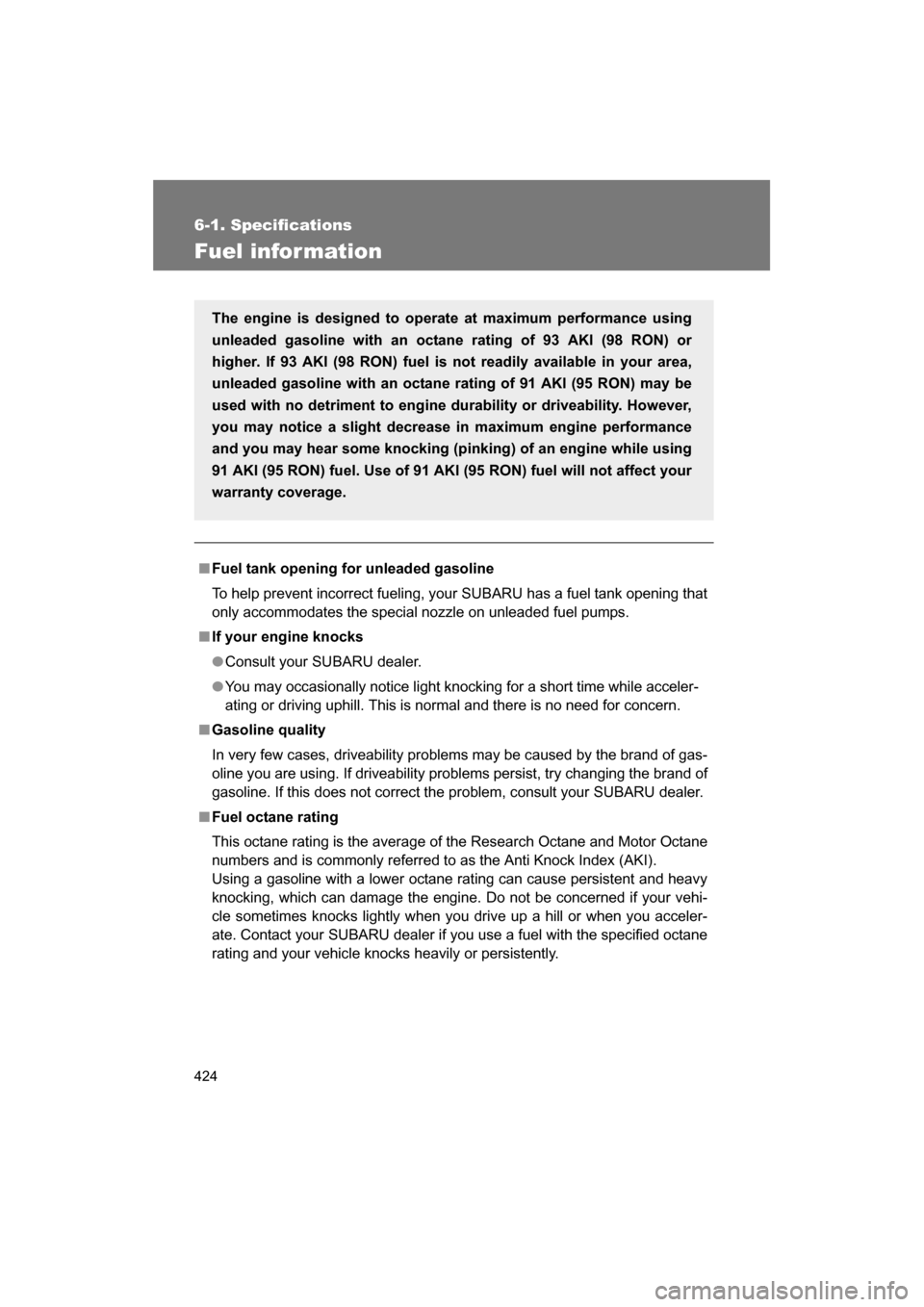
The engine is designed to operate at maximum performance using
unleaded gasoline with an octane rating of 93 AKI (98 RON) or
higher. If 93 AKI (98 RON) fuel is not readily available in your area,
unleaded gasoline with an octane rating of 91 AKI (95 RON) may be
used with no detriment to engine
durability or driveability. However,
you may notice a slight decrease in maximum engine performance
and you may hear some knocking (pinking) of an engine while using
91 AKI (95 RON) fuel. Use of 91 AKI ( 95 RON) fuel will not affect your
warranty coverage.
Page 436 of 488
436
6-1. Specifications
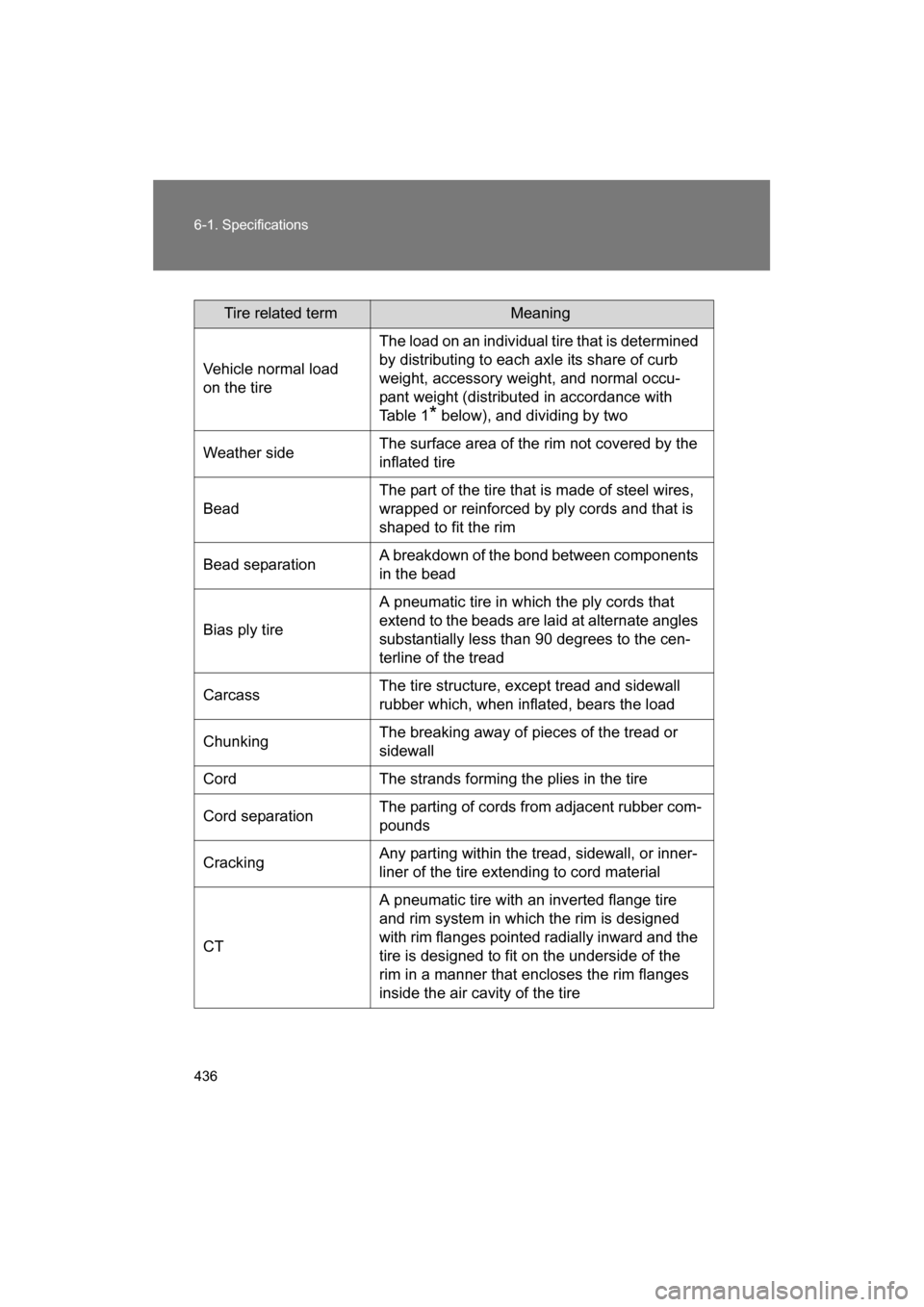
Tire related termMeaning
Vehicle normal load
on the tire The load on an individual tire that is determined
by distributing to each axle its share of curb
weight, accessory weight, and normal occu-
pant weight (distributed in accordance with
Table 1
* below), and dividing by two
Weather side The surface area of the rim not covered by the
inflated tire
Bead The part of the tire that is made of steel wires,
wrapped or reinforced by ply cords and that is
shaped to fit the rim
Bead separation A breakdown of the bond between components
in the bead
Bias ply tire A pneumatic tire in which the ply cords that
extend to the beads are laid at alternate angles
substantially less than 90 degrees to the cen-
terline of the tread
Carcass The tire structure, except tread and sidewall
rubber which, when inflated, bears the load
Chunking The breaking away of pieces of the tread or
sidewall
Cord The strands forming the plies in the tire
Cord separation The parting of cords from adjacent rubber com-
pounds
Cracking Any parting within the tread, sidewall, or inner-
liner of the tire extending to cord material
CT A pneumatic tire with an inverted flange tire
and rim system in which the rim is designed
with rim flanges pointed radially inward and the
tire is designed to fit on the underside of the
rim in a manner that encloses the rim flanges
inside the air cavity of the tire
Page 439 of 488
439
6-1. Specifications
6
Vehicle specifications
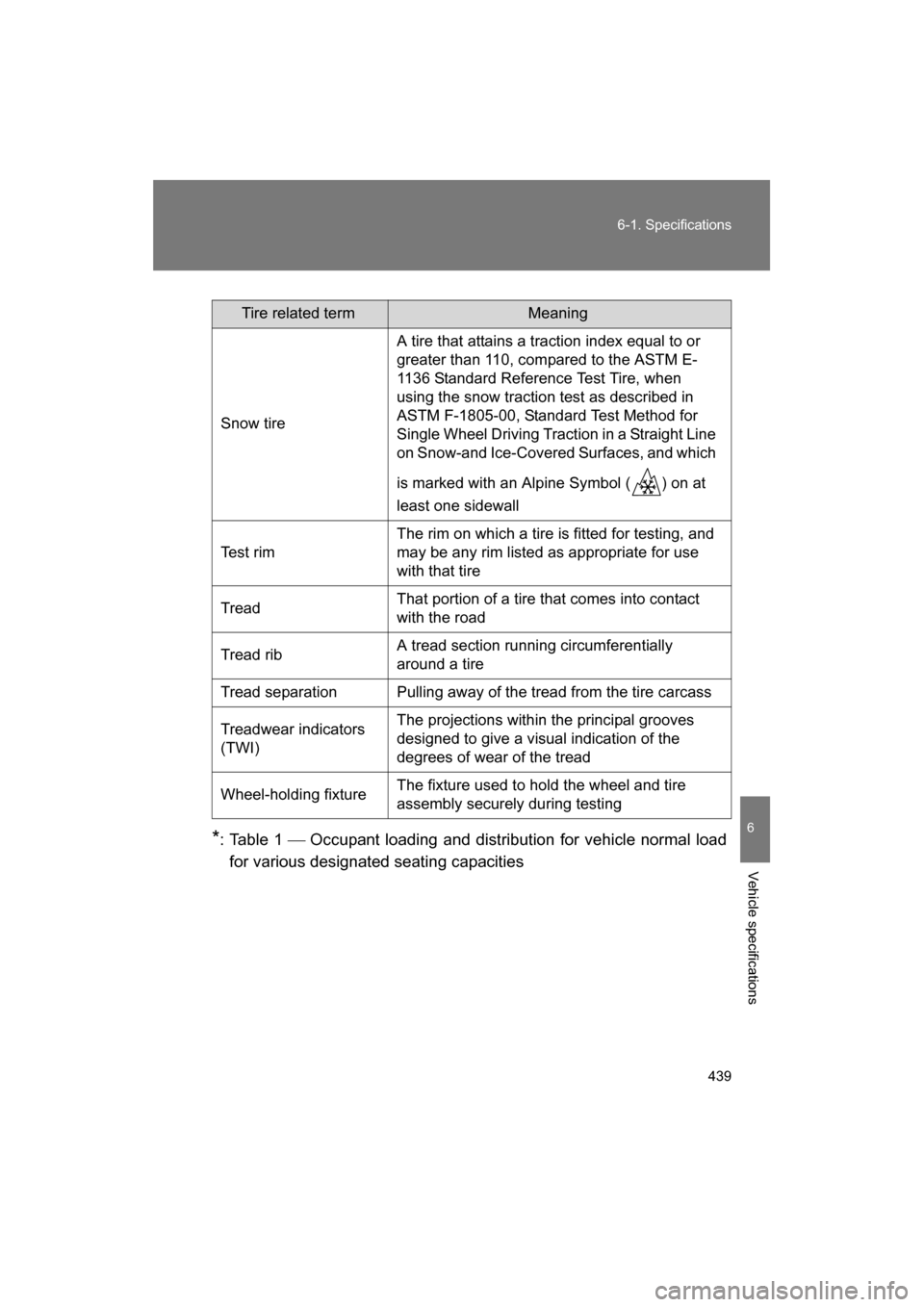
*:Table 1 Occupant loading and distribution for vehicle normal load
for various designated seating capacities
Tire related termMeaning
Snow tire A tire that attains a traction index equal to or
greater than 110, compared to the ASTM E-
1136 Standard Reference Test Tire, when
using the snow traction test as described in
ASTM F-1805-00, Standard Test Method for
Single Wheel Driving Traction in a Straight Line
on Snow-and Ice-Covered Surfaces, and which
is marked with an Alpine Symbol ( ) on at
least one sidewall
Te s t r i m The rim on which a tire is fitted for testing, and
may be any rim listed as appropriate for use
with that tire
Tread That portion of a tire that comes into contact
with the road
Tread rib A tread section running circumferentially
around a tire
Tread separation Pulling away of the tread from the tire carcass
Treadwear indicators
(TWI) The projections within the principal grooves
designed to give a visual indication of the
degrees of wear of the tread
Wheel-holding fixture The fixture used to hold the wheel and tire
assembly securely during testing