Page 253 of 488
253
3-1. Using the air conditioning system and defogger
3
Interior features
■The defoggers can be operated when
Vehicles without a keyless access with push button start system
The engine switch is in the “ON” position.
Vehicles with a keyless access with push button start system
The push-button ignition switch is in “ON” mode.
■The outside rear view mirror defoggers (vehicles with outside rear view
mirror defoggers)
Turning the rear window defogger on will turn the outside rear view mirror
defoggers on.
■When continuous operation is set (vehicles with an automatic air con-
ditioning system)
During continuous operation, the defogger stops operating for 2 minutes
after every 15 minutes of continual operation. Even during the 2 minutes that
operation stops, the operating light remains illuminated. The rear window
defogger will continue to operate in this cycle until it is turned off.
■Customization that can be configured at SUBARU dealer (vehicles with
an automatic air conditioning system)
The rear window defogger can be set to 15-minute operation or continuous
operation. (Customizable features →P. 441)
WARNING
■When the outside rear view mirror defoggers are on (vehicles with out-
side rear view mirror defoggers)
Do not touch the outside surface of the rear view mirrors, as they can
become very hot and burn you.
CAUTION
■To prevent battery discharge
Do not leave the rear window defogger on longer than necessary when the
engine is stopped.
Page 257 of 488
257
3
Interior features
3-4. Using the storage features
List of storage features
WARNING
■Items that should not be left in the storage spaces
Do not leave glasses, lighters or spray cans in the storage spaces, as this
may cause the following when cabin temperature becomes high:
●Glasses may be deformed by heat or cracked if they come into contact
with other stored items.
●Lighters or spray cans may explode. If they come into contact with other
stored items, the lighter may catch fire or the spray can may release gas,
causing a fire hazard.
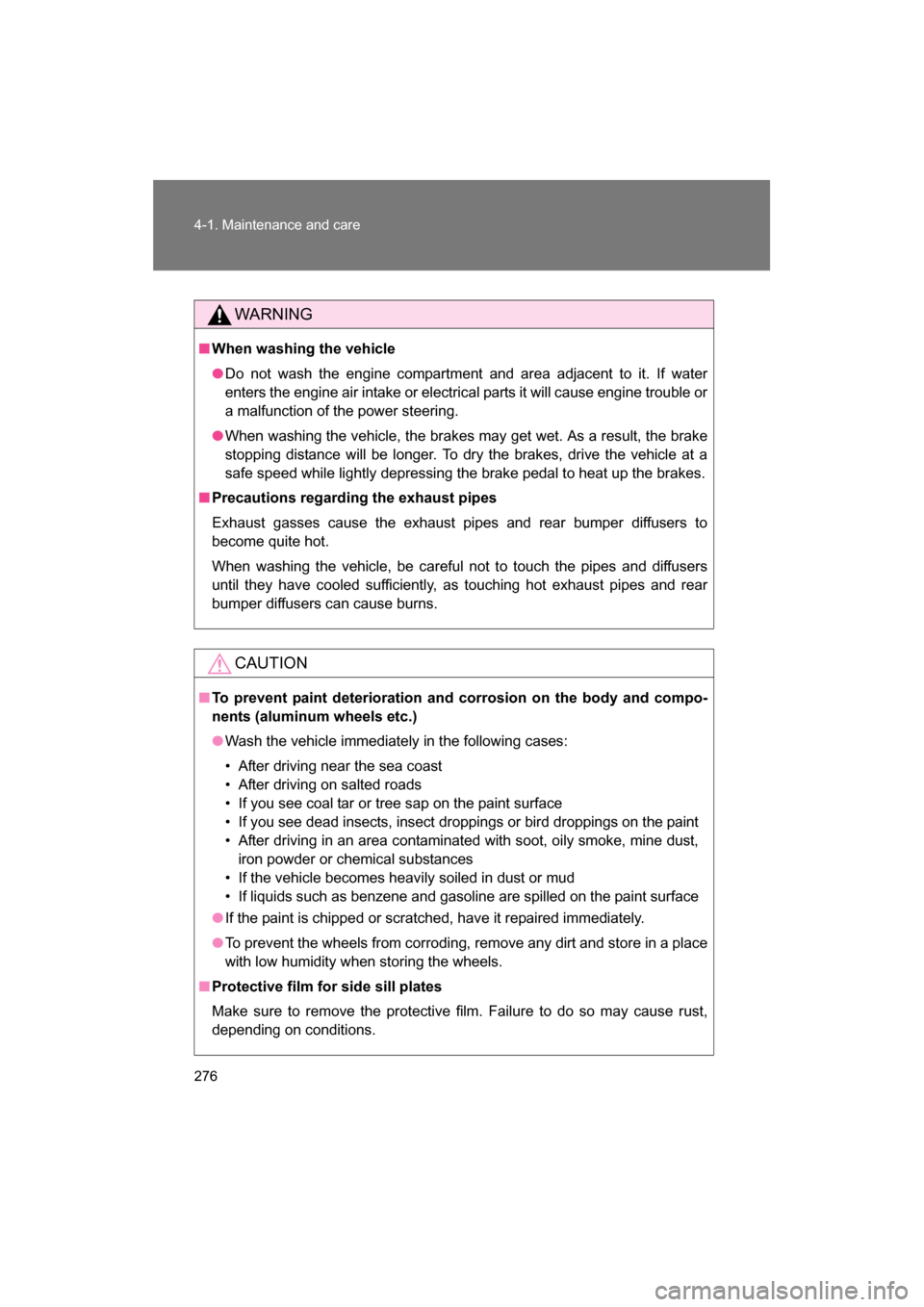
Glove box
Bottle holders
Cup holders/console tray
Page 276 of 488
276
4-1. Maintenance and care
WARNING
■When washing the vehicle
●Do not wash the engine compartment and area adjacent to it. If water
enters the engine air intake or electrical parts it will cause engine trouble or
a malfunction of the power steering.
●When washing the vehicle, the brakes may get wet. As a result, the brake
stopping distance will be longer. To dry the brakes, drive the vehicle at a
safe speed while lightly depressing the brake pedal to heat up the brakes.
■Precautions regarding the exhaust pipes
Exhaust gasses cause the exhaust pipes and rear bumper diffusers to
become quite hot.
When washing the vehicle, be careful not to touch the pipes and diffusers
until they have cooled sufficiently, as touching hot exhaust pipes and rear
bumper diffusers can cause burns.
CAUTION
■To prevent paint deterioration and corrosion on the body and compo-
nents (aluminum wheels etc.)
●Wash the vehicle immediately in the following cases:
Page 286 of 488
286
4-2. Maintenance
WARNING
■If your vehicle is not properly maintained
It could result in serious damage to the vehicle and possible serious injury or death.
■Warning in handling of battery
●Before beginning work on or near any battery, be sure to extinguish all cig-
arettes, matches, and lighters. Never expose a battery to an open flame or
electric sparks. Batteries give off a gas which is highly flammable and
explosive.
●For safety, in case an explosion does occur, wear eye protection or shield
your eyes when working near any battery. Never lean over a battery.
●Do not let battery fluid contact eyes, skin, fabrics, or paint because battery
fluid is a corrosive acid. If battery fluid gets on your skin or in your eyes,
immediately flush the area with water thoroughly. Seek medical help
immediately if acid has entered the eyes.
If battery fluid is accidentally swallowed, immediately drink a large amount
of milk or water, and seek medical attention immediately.
●To lessen the risk of sparks, remove rings, metal watchbands, and other
metal jewelry. Never allow metal tools to contact the positive battery termi-
nal and anything connected to it WHILE you are at the same time in con-
tact with any other metallic portion of the vehicle because a short circuit
will result.
●Keep everyone including children away from the battery.
●Charge the battery in a wellventilated area.
●Battery posts, terminals and related accessories contain lead and lead
compounds, chemicals known to the State of California to cause cancer
and reproductive harm. Batteries also contain other chemicals known to
the State of California to cause cancer. Wash hands after handling.
Page 303 of 488
303
4-3. Do-it-yourself maintenance
4
Maintenance and care
■Adding fluid
Make sure to check the fluid type and prepare the necessary items.
Fluid typeFMVSS No.116 fresh DOT 3 or DOT 4 brake fluid
ItemsClean funnel
■Brake fluid can absorb moisture from the air
Excess moisture in the fluid can cause a dangerous loss of braking effi-
ciency. Use only newly opened brake fluid.
WARNING
■When filling the reservoir
Take care because brake fluid can harm your hands or eyes and damage
painted surfaces.
If fluid gets in your eyes, flush your eyes with clean water immediately.
If you still experience discomfort, see a doctor.
CAUTION
■If the fluid level is low or high
It is normal for the brake fluid level to go down slightly as the brake pads
wear or when the fluid level in the accumulator is high.
If the reservoir needs frequent refilling, it may indicate a serious problem.
Page 307 of 488
307
4-3. Do-it-yourself maintenance
4
Maintenance and care
WARNING
■Chemicals in the battery
A battery contains poisonous and corrosive sulfuric acid and may produce
hydrogen gas which is flammable and explosive. To reduce the risk of death
or serious injury, take the following precautions while working on or near the
battery:
●Do not cause sparks by touching the battery terminals with tools.
●Do not smoke or light a match near the battery.
●Avoid contact with eyes, skin and clothes.
●Never inhale or swallow electrolyte.
●Wear protective safety glasses when working near the battery.
●Keep children away from the battery.
■Where to safely charge the battery
Always charge the battery in an open area. Do not charge the battery in a
garage or closed room where there is not sufficient ventilation.
■Emergency measures regarding electrolyte
●If electrolyte gets in your eyes
Flush your eyes with clean water for at least 15 minutes and get immedi-
ate medical attention. If possible, continue to apply water with a sponge or
cloth while traveling to the nearest medical facility.
●If electrolyte gets on your skin
Wash the affected area thoroughly. If you feel pain or burning, get medical
attention immediately.
●If electrolyte gets on your clothes
It can soak through clothing on to your skin. Immediately take off the cloth-
ing and follow the procedure above if necessary.
●If you accidentally swallow electrolyte
Drink a large quantity of water or milk. Get emergency medical attention
immediately.
Page 312 of 488
312
4-3. Do-it-yourself maintenance
Registering ID codes (vehicles with a tire pressure monitoring
system)
The tire pressure warning valve and transmitter is equipped with a
unique ID code. When replacing a tire pressure warning valve and
transmitter, it is necessary to register the ID code. Have the ID code
registered by your SUBARU dealer.
■When to replace your vehicle’s tires
Tires should be replaced if:
●You have tire damage such as cuts, splits, cracks deep enough to
expose the fabric or bulges indicating internal damage
●A tire goes flat repeatedly or cannot be properly repaired due to the
size or location of a cut or other damage
If you are not sure, consult with your SUBARU dealer.
■Replacing tires and wheels (vehicles with a tire pressure monitor-
ing system)
If the ID code of the tire pressure warning valve and transmitter is not
registered, the tire pressure monitoring system will not work properly.
After driving for about 20 minutes, the tire pressure warning light comes
on after blinking for 1 minute to indicate a system malfunction.
■Tire life
Any tire over 6 years old must be checked by a qualified technician even
if they have seldom or never been used or damage is not obvious.
■If the tread wears down below 0.16 in. (4 mm) on snow tires
The effectiveness of snow tires is lost.
■Low profile tires (vehicles with 17-inch tires)
Generally, low profile tires will wear more rapidly and tire grip perfor-
mance will be reduced on snowy and/or icy roads when compared to
standard tires. Be sure to use snow tires or tire chains on snowy and/or
icy roads and drive carefully at a speed appropriate for road and weather
conditions.
Page 336 of 488
336
4-3. Do-it-yourself maintenance
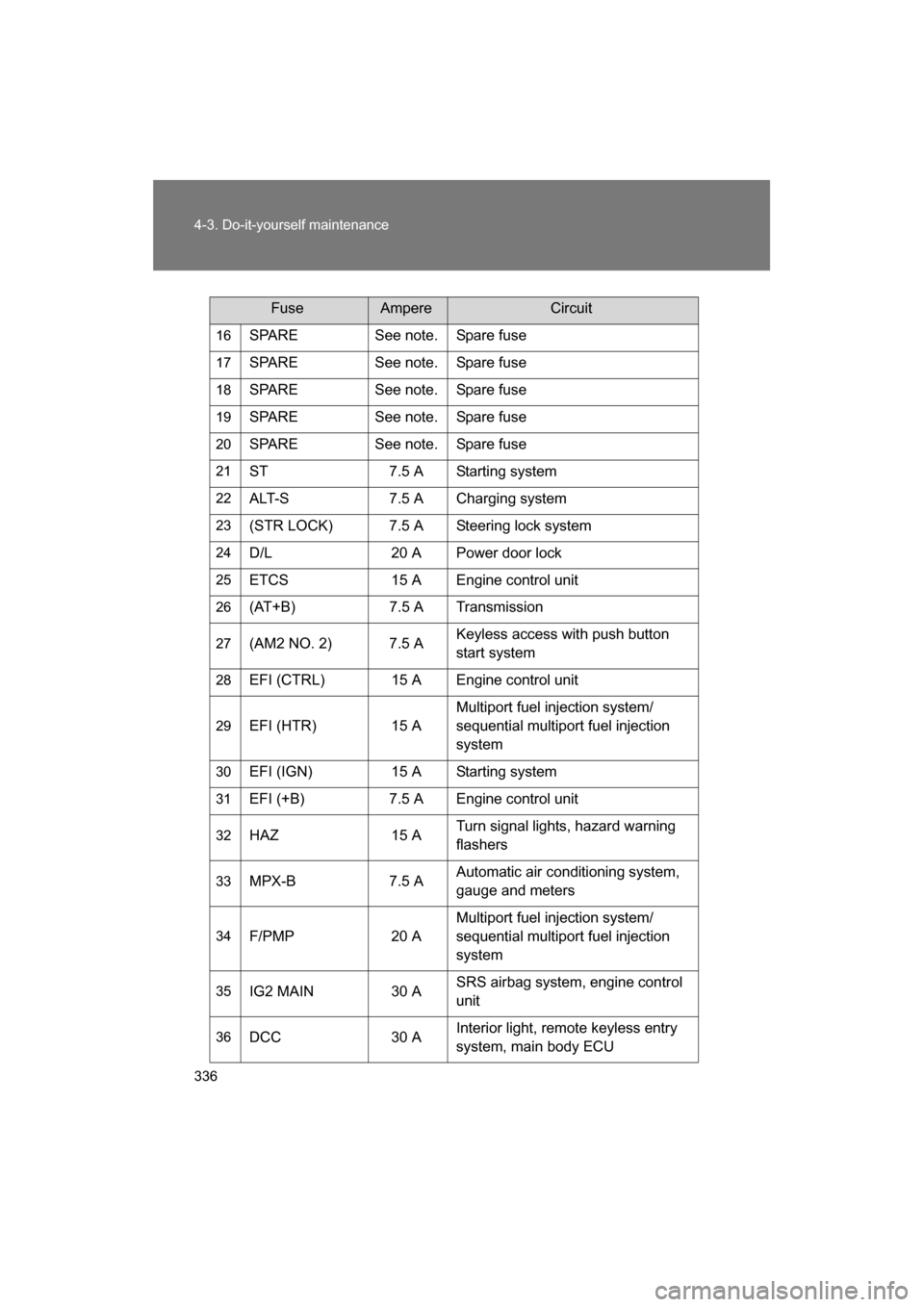
16SPARE See note. Spare fuse
17 SPARE See note. Spare fuse
18 SPARE See note. Spare fuse
19 SPARE See note. Spare fuse
20 SPARE See note. Spare fuse
21 ST 7.5 A Starting system
22 ALT-S 7.5 A Charging system
23 (STR LOCK) 7.5 A Steering lock system
24 D/L 20 A Power door lock
25 ETCS 15 A Engine control unit
26 (AT+B) 7.5 A Transmission
27 (AM2 NO. 2) 7.5 A Keyless access with push button
start system
28 EFI (CTRL) 15 A Engine control unit
29 EFI (HTR) 15 A Multiport fuel injection system/
sequential multiport fuel injection
system
30 EFI (IGN) 15 A Starting system
31 EFI (+B) 7.5 A Engine control unit
32 HAZ 15 A Turn signal lights, hazard warning
flashers
33 MPX-B 7.5 A Automatic air conditioning system, gauge and meters
34 F/PMP 20 A Multiport fuel injection system/
sequential multiport fuel injection
system
35 IG2 MAIN 30 A SRS airbag system, engine control
unit
36 DCC 30 A Interior light, remote keyless entry
system, main body ECU
FuseAmpereCircuit