2014 SMART FORTWO COUPE replacement
[x] Cancel search: replacementPage 180 of 222
Closing the rear soft top
If the rear soft top does not lock properly
after being closed, proceed as follows:
X Stop the vehicle in a safe location.
X Engage the parking brake.
X Make sure the key is in starter switch
position 1.
X Fold up the rear soft top completely.
The rear soft top stops in the unlocked
position.
X Within one minute, press and hold symbol
0055 on the retractable soft top switch
for 15 seconds twice.
The rear soft top closes the locking
hooks.
X Close the retractable soft top com-
pletely.
X Have the rear soft top checked at an
authorized electric drive smart center. Replacing transmitter battery
Notes
The remote control’s transmitter battery is
almost spent when the turn signals flash
rapidly nine times in a row when locking
the vehicle.
i If you do not replace the transmitter
battery, after about 100 more times you
will no longer be able to lock or unlock
the vehicle using the remote control.
X Replace the transmitter battery.
or
X Have the transmitter battery replaced at
an authorized electric drive smart
center. G
WARNING
Batteries contain poisonous and corrosive
substances. Therefore keep the batteries
out of reach of children.
If a battery is swallowed, seek medical help
immediately. Batteries contain materials that can harm
the environment if disposed of improperly.
Recycling of batteries is the preferred
method of disposal. Many states/provinces
require sellers of batteries to accept old
batteries for recycling. Replacing battery
Replacement battery: CR 2016 button cell
! Replace the remote control’s transmit-
ter battery every two years at the latest.
Otherwise there is a danger of leakage.
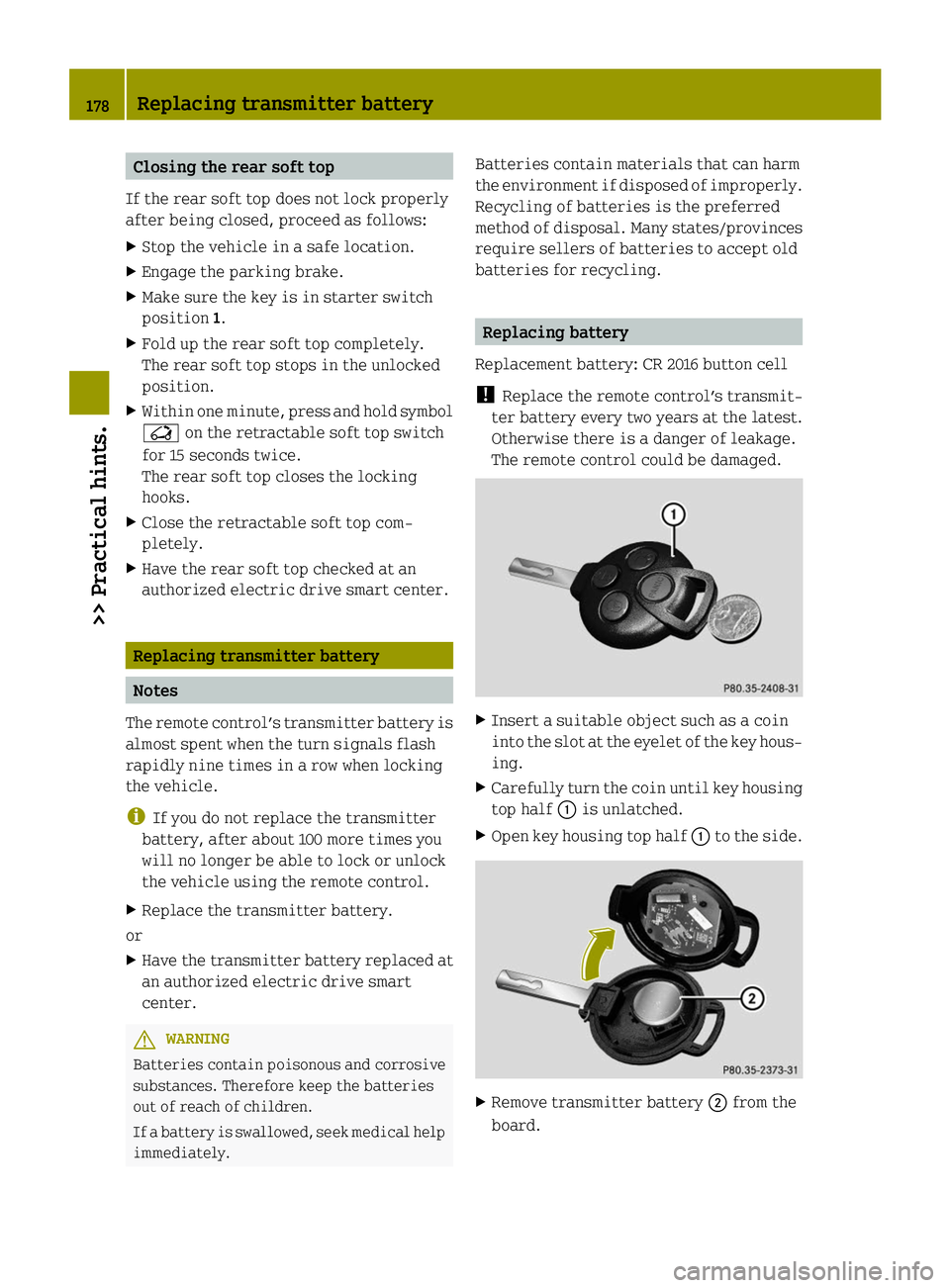
The remote control could be damaged. X
Insert a suitable object such as a coin
into the slot at the eyelet of the key hous-
ing.
X Carefully turn the coin until key housing
top half 0043is unlatched.
X Open key housing top half 0043to the side. X
Remove transmitter battery 0044from the
board. 178
Replacing transmitter battery>> Practical hints.
Page 181 of 222

!
Check the polarity when inserting the
new transmitter battery. You could oth-
erwise damage parts of the electrical
system. When inserting the batteries,
make sure they are clean and free of lint.
X Insert the new transmitter battery.
X Press both halves of the key housing
together again.
X Check the operation of the remote
control. Replacing bulbs
About replacing bulbs
Safe vehicle operation depends on proper
exterior lighting and signaling. It is
therefore essential that all bulbs and lamp
assemblies are in good working order at all
times.
Correct headlamp adjustment is extremely
important. Have headlamps checked and
readjusted at regular intervals and when a
bulb has been replaced. Contact an author-
ized electric drive smart center for head-
lamp adjustment. G
WARNING
Bulbs and bulb sockets can be very hot.
Allow the lamp to cool down before changing
a bulb. Otherwise you could be burned if you
touch them.
Keep bulbs out of the reach of children.
Halogen lamps contain pressurized gas. A
bulb can explode if you:
R touch or move it when hot
R drop the bulb
R scratch the bulb
Wear eye and hand protection.
i If the headlamps or front fog lamps* are
fogged up on the inside as a result of
high humidity, driving the vehicle a
distance with the lights on should clear
up the fogging. Notes on bulb replacement:
R
Only use bulbs of the same type and with
the specified watt rating.
R Switch the lights off before replacing a
bulb to prevent short circuits.
R Always use a clean lint-free cloth when
handling bulbs.
R Your hands should be dry and free of oil
and grease.
R Avoid touching the glass of the bulb with
bare fingers.
R If the newly installed bulb does not come
on, contact an authorized electric drive
smart center.
R Have the bulbs for the front fog lamps*
and the LED daytime running lamps*
replaced at an authorized electric drive
smart center. Replacing bulbs
179>> Practical hints.
* optional Z
Page 194 of 222

X
Drive to the nearest authorized electric
drive smart center, to have the damaged
tire replaced.
X Contact an authorized electric drive
smart center as soon as possible to
obtain a new filler hose and a new tire
sealant container.
X Bring used tire sealant materials to an
authorized electric drive smart center
for proper disposal.
X Replace your tire sealant container
every 4 years. Replacement containers
are available at any authorized electric
drive smart center. G
WARNING
After changing a tire, contact an author-
ized electric drive smart center to make
sure the bolts holding the wheel to the car
are tight enough. Otherwise, the wheels
could come off. Each bolt should be tight-
ened to a torque of 81 lb‑ft (110 Nm). Sealing a tire (Version 2)
X Take the tire repair kit from the
passenger footwell (Y page 160).X
Take electrical plug 0087and filler hose
0084 from the bottom of the electric air
pump housing.
X Engage the yellow plug of filler hose 0084
in the opening in yellow closure cap 0083.X
With the O-ring seals towards the elec-
tric air pump housing, insert yellow clo-
sure cap 0083into fixture 0044.
X Push tire sealant container 0043into fix-
ture 0044until both hooks of yellow closure
cap 0083engage. X
Unscrew the valve cap from tire valve
006B of the damaged tire.
X Screw the end of filler hose 0084onto tire
valve 006B.
X Insert electrical plug 0087into the aux-
iliary power outlet ( Ypage 110).
X Insert the key in the starter switch and
turn it to position 1.
i The vehicle’s 12‑volt battery is drained
by use of the electric air pump. You
should therefore keep the drive system
running while inflating the tire.
X Press ONon electric air pump switch 0085.
The electric air pump is switched on and
inflates the tire.
i First, the sealant is pumped into the
tire. The pressure may briefly increase
to a high value. This is normal and not an
indication of a malfunction. Do not
switch off the electric air pump.
X Let the electric air pump inflate the tire
for a maximum of ten minutes.
The pressure gauge must display at least
200 kpa (2.0 bar, 29 psi).
! Do not operate the electric air pump
longer than ten minutes without inter-
ruption. Otherwise it may overheat. 192
Flat tire>> Practical hints.
Page 196 of 222

placard located on the driver’s door
B‑pillar).
R
To increase the tire inflation pres-
sure: Switch on the electric air pump.
R To decrease the tire inflation pres-
sure: Press deflate button 006C. Recheck
the tire inflation pressure with the
electric air pump’s pressure gauge
006D.
X When the tire inflation pressure is cor-
rect, unscrew the end of filler hose 0085
from tire valve 006B.
X Screw the valve cap onto the tire valve. X
To detach tire sealant container 0043from
the electric air pump, press both
latches.
X Pull tire sealant container 0043out of fix-
ture 0044.
Filler hose 0085remains on tire sealant
container 0043.
X Place the tire repair kit securely in the
vehicle.
! The manufacturer is unable to guaran-
tee that all tire punctures can be
repaired with the tire repair kit, in par-
ticular cuts or perforations larger than
approximately 0.16 in (4 mm) or away from
the tire’s tread. The manufacturer is not
liable for damage sustained through
improper use of the tire repair kit. G
WARNING
Follow recommended tire inflation pres-
sures.
Do not underinflate tires. Underinflated
tires wear excessively and/or unevenly,
adversely affect handling and energy con-
sumption of the vehicle, and are more
likely to fail from being overheated.
Do not overinflate tires. Overinflated
tires can adversely affect handling and
ride comfort, wear unevenly, increase
stopping distance, and result in sudden
deflation (blowout) because they are more
likely to become punctured or damaged by
road debris, potholes etc.
Do not overload the tires by exceeding the
specified load limit as indicated on the
Tire and Loading Information placard on
the driver’s door B‑pillar. Overloading the
tires can overheat them, possibly causing
a blowout. Overloading the tires can also
result in handling or steering problems, or
brake failure.
X Drive to the nearest authorized electric
drive smart center, to have the damaged
tire replaced.
X Contact an authorized electric drive
smart center as soon as possible to
obtain a new filler hose and a new tire
sealant container.
X Bring used tire sealant materials to an
authorized electric drive smart center
for proper disposal.
X Replace your tire sealant container
every 4 years. Replacement containers
are available at any authorized electric
drive smart center. G
WARNING
After changing a tire, contact an author-
ized electric drive smart center to make
sure the bolts holding the wheel to the car
are tight enough. Otherwise, the wheels
could come off. Each bolt should be tight-
ened to a torque of 81 lb‑ft (110 Nm). 194
Flat tire>> Practical hints.
Page 214 of 222

Parts service
The “Technical data” section provides the
necessary technical data for your vehicle.
Genuine smart Parts are subjected to strin-
gent quality inspections. Each part has
been specifically developed, manufac-
tured or selected for and adapted to smart
vehicles.
Therefore, Genuine smart Parts should be
installed.
! The use of non-genuine smart parts and
accessories not authorized by smart
could damage the vehicle, which is not
covered by the smart Limited Warranty,
or could compromise the vehicle’s dura-
bility or safety. Warranty coverage
Your vehicle is covered under the terms of
the warranties printed in the smart USA
Warranty booklet (USA only) or the Warranty
booklet (Canada only).
Your authorized electric drive smart
center will exchange or repair any defec-
tive parts originally installed on the
vehicle in accordance with the terms of the
following warranties:
R smart USA Limited Warranty (USA only)
R New Vehicle Limited Warranty (Canada
only)
R Emission System Warranty
R Emission Performance Warranty
R Corrosion Warranty
R California, Connecticut, Maine, Massa-
chusetts, New York, Pennsylvania, Rhode
Island, and Vermont Emission Control
System Warranty
R smartmove Assistance (Canada only)
R State Warranty Enforcement Laws (Lemon
Laws, USA only)
Replacement parts and accessories are
covered by the smart Parts and Accessories warranties, copies of which are available
at any authorized electric drive smart
center. Loss of Warranty booklet
Should you lose your smart USA Warranty
booklet (USA only) or the Warranty booklet
(Canada only), have an authorized electric
drive smart center arrange for a replace-
ment. It will be mailed to you. Drive system and high-voltage system
electronics
Work on drive system and high-voltage
system electronics
G
WARNING
Always have maintenance work on drive sys-
tem and high-voltage system electronics
and components performed by a qualified
specialist, e.g. at an authorized electric
drive smart center. In particular, work rel-
evant to safety or on safety related systems
must be carried out at a qualified special-
ist workshop with expert knowledge of
electric drive vehicles.
! Always have maintenance work on drive
system and high-voltage system elec-
tronics and components, such as control
modules, sensors and connecting cables,
performed by a qualified specialist
workshop with the necessary expert
knowledge of electric drive vehicles and
the tools to carry out the work required,
e.g. at an authorized electric drive
smart center. Otherwise there is a danger
that vehicle components may wear more
rapidly, which may void the vehicle’s
warranty. 212
Drive system and high-voltage system electronics>> Technical data.
Page 220 of 222

Capacities
Components Capacity Coolants, lubricants, etc.
Coolant system approx. 6.9 US qt (6.5 l) Anticorrosion/Antifreeze meet-
ing specification MB 325.0
Air conditioning system 500 g
(17.6 oz) R134a refrigerant (never R 12)
120 g
(4.2 oz) PAG lubricant oil Daphne 1234
Windshield washer sys-
tem 4.0 US qt (3.8 l)
Windshield washer concentrate
13
(Y page 218)
Washer fluid mixing ratio
(Y page 218) Brake fluid
G
WARNING
During vehicle operation, the boiling
point of the brake fluid is continuously
reduced through the absorption of moisture
from the atmosphere. Under extremely
strenuous operating conditions, this mois-
ture content can lead to the formation of
bubbles in the system, thus reducing the
system’s efficiency.
Therefore, the brake fluid must be replaced
regularly. Refer to your vehicle’s Mainte-
nance Booklet for replacement interval.
Only brake fluid approved by smart is rec-
ommended. Any authorized electric drive
smart center will provide you with addi-
tional information. Windshield/rear window washer system
During all seasons:
X Use a windshield washer concentrate
labeled for summer and water for tem-
peratures above freezing point.
X Use a windshield washer concentrate
labeled for winter and water for temper-
atures below freezing point.
X Premix the windshield washer fluid in a
suitable container depending on the out-
side temperature and in accordance with
the manufacturer’s instructions 14
.
Washer fluid mixing ratio R
Temperature above 32¦ (0¥):
1 part windshield washer concentrate
labeled for summer to 100 parts water
R Temperature of 14¦ (-10¥):
1 part windshield washer concentrate
labeled for winter to 2 parts water
R Temperature of -4¦ (-20¥):
1 part windshield washer concentrate
labeled for winter to 1 part water
13 Use a windshield washer concentrate labeled for summer and water for temperatures above freezing
point or a windshield washer concentrate labeled for winter and water for temperatures below freezing
point.
14 Refer to the notes for use on the container. 218
Service fluids and capacities>> Technical data.
Page 221 of 222

G
WARNING
Windshield washer concentrate is highly
flammable. Fire, naked flames and smoking
are prohibited when windshield washer
concentrate is being handled. Coolants
The battery and drive system coolant is a
mixture of water and anticorrosion/anti-
freeze, which provides:
R Corrosion protection
R Freeze protection
R Boiling protection (by increasing the
boiling point)
The cooling system was filled at the factory
with a coolant providing freeze protection
to approximately -35¦ (-37¥) and cor-
rosion protection.
! Add premixed coolant solution only.
Adding water and MB 325.0 Anticorro-
sion/Antifreeze separately from each
other, could cause drive system damage
not covered by the smart Limited War-
ranty.
If the antifreeze mixture is effective to
-35¦ (-37¥), the boiling point of the
coolant in the pressurized cooling system
is reached at approximately 266¦
(130¥ ).
The coolant solution must be used year
round, even in countries which have high
temperatures to provide the necessary cor-
rosion protection and increase boil‑over
protection. Refer to Maintenance/ Service
Booklet for replacement interval.
Coolant system design and coolant used
determine the replacement interval. The
replacement interval published in the
Maintenance booklet is only applicable if
MB 325.0 Anticorrosion/Antifreeze solu-
tion or other smart approved products of
equal specification are used to renew the coolant concentration or bring it back up
to the proper level.
For information on other smart approved
products of equal specification, contact an
authorized electric drive smart center.
To provide important corrosion protec-
tion, the solution must be at least 50% anti-
corrosion/antifreeze (equivalent to freeze
protection to approximately -35¦
[-37¥]).
If you use a solution that is more than 55%
anticorrosion/antifreeze (freeze protec-
tion to approximately -49
¦[(-45 ¥]), the
drive system and battery temperature will
increase due to the lower heat transfer
capability of the solution. Therefore, do
not use more than this amount of anticor-
rosion/antifreeze.
If the coolant level is low, water and
MB 325.0 Anticorrosion/Antifreeze should
be used to bring it up to the proper level
(have cooling system checked for signs of
leakage). Please make sure the mixture is
in accordance with label instructions.
Always use anticorrosion/antifreeze that
has been approved by smart. For informa-
tion contact an authorized electric drive
smart center.
The water in the cooling system must meet
minimum requirements, which are usually
satisfied by normal drinking water.
If you are not sure about the water quality,
consult an authorized electric drive smart
center.
Capacities Cooling-system
capacity
All models approx. 6.9 US qt
(6.5 l)Service fluids and capacities
219>> Technical data. Z