2014 Seat Toledo wheel
[x] Cancel search: wheelPage 152 of 200
Advice
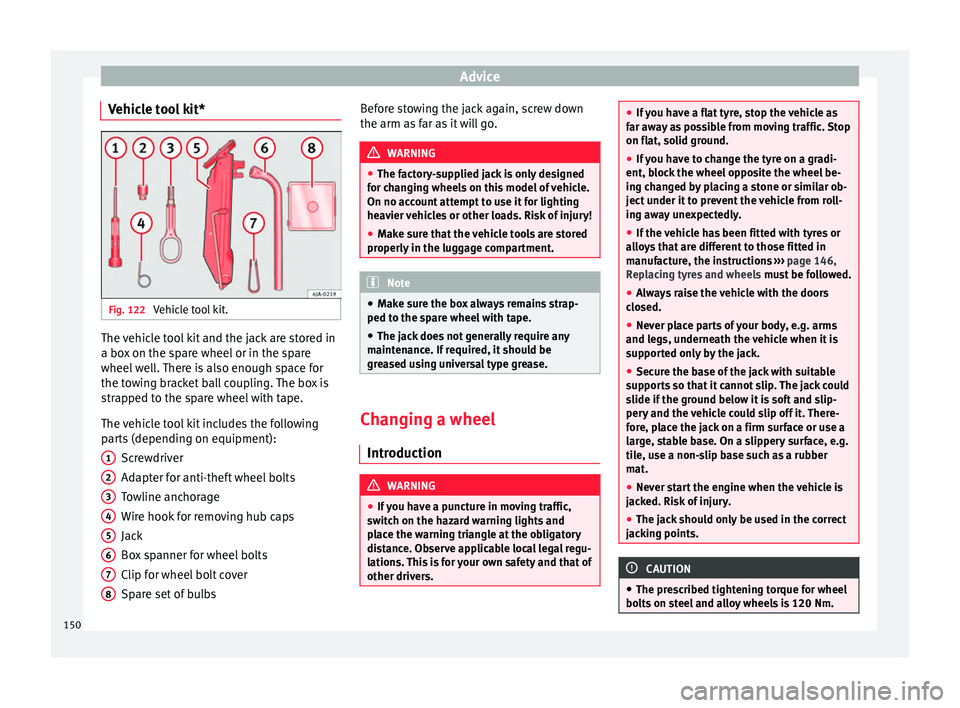
Vehicle tool kit* Fig. 122
Vehicle tool kit. The vehicle tool kit and the jack are stored in
a box on the spare wheel or in the spare
wheel well. There is also enough space for
the towing bracket ball coupling. The box is
strapped to the spare wheel with tape.
The vehicle tool kit includes the following
parts (depending on equipment):
Screwdriver
Adapter for anti-theft wheel bolts
Towline anchorage
Wire hook for removing hub caps
Jack
Box spanner for wheel bolts
Clip for wheel bolt cover
Spare set of bulbs
1 2
3
4
5
6
7
8 Before stowing the jack again, screw down
the arm as far as it will go.
WARNING
● The factory-supplied jack is only designed
for changing wheels on this model of vehicle.
On no account attempt to use it for lighting
heavier vehicles or other loads. Risk of injury!
● Make sure that the vehicle tools are stored
properly in the luggage compartment. Note
● Make sure the box always remains strap-
ped to the spare wheel with tape.
● The jack does not generally require any
maintenance. If required, it should be
greased using universal type grease. Changing a wheel
Introduction WARNING
● If you have a puncture in moving traffic,
switch on the hazard warning lights and
place the warning triangle at the obligatory
distance. Observe applicable local legal regu-
lations. This is for your own safety and that of
other drivers. ●
If you have a flat tyre, stop the vehicle as
far away as possible from moving traffic. Stop
on flat, solid ground.
● If you have to change the tyre on a gradi-
ent, block the wheel opposite the wheel be-
ing changed by placing a stone or similar ob-
ject under it to prevent the vehicle from roll-
ing away unexpectedly.
● If the vehicle has been fitted with tyres or
alloys that are different to those fitted in
manufacture, the instructions ››› page 146,
Replacing tyres and wheels must be followed.
● Always raise the vehicle with the doors
closed.
● Never place parts of your body, e.g. arms
and legs, underneath the vehicle when it is
supported only by the jack.
● Secure the base of the jack with suitable
supports so that it cannot slip. The jack could
slide if the ground below it is soft and slip-
pery and the vehicle could slip off it. There-
fore, place the jack on a firm surface or use a
large, stable base. On a slippery surface, e.g.
tile, use a non-slip base such as a rubber
mat.
● Never start the engine when the vehicle is
jacked. Risk of injury.
● The jack should only be used in the correct
jacking points. CAUTION
● The prescribed tightening torque for wheel
bolts on steel and alloy wheels is 120 Nm. 150
Page 153 of 200
Emergencies
●
If the anti-theft wheel bolt is overly tight-
ened, this could damage the bolt and the
adapter. Note
● The set of anti-theft wheel bolts or the
adapter are available from authorised SEAT
dealers.
● Please observe the relevant local legal reg-
ulations when changing the wheel. Preparation work
Some preparation is required before chang-
ing a wheel:
– If you have a flat tyre, stop the vehicle as
far away as possible from moving traffic.
The surface must be horizontal.
– All vehicle occupants should leave the ve-
hicle . Vehicle occupants should wait in a
s af
e place, e.g. behind the roadside crash
barrier) while the wheel is being changed.
– Switch off the ignition and engage neutral
or move the selector lever on the automatic
g
earbox to position P.
– Apply the handbrake firmly.
– If t
owing a trailer, unhitch it. –
Take the vehicle tool kit ››
› page 150 and
the spare wheel ››› page 150 out of the lug-
gage compartment.
Wheel trim Removing
– Place the hook from the vehicle tool kit on
the reinforced edge of the wheel trim.
– Insert the box spanner through the hook,
supporting it on the tyre and remove the
wheel trim.
Fitting – First press the wheel trim onto the wheel at
the cut out designed for the valve. Then
press the wheel trim on both sides in the
direction of the valve so that it fits correctly
in place around all the perimeter. CAUTION
● Press down by hand, do not hit the wheel
trim! Knocking it sharply, particularly at
points where the wheel trim has not yet been
inserted, could result in damage to the wheel
trim guiding and centring elements.
● Before fitting the trim on a steel wheel at-
tached with an anti-theft wheel bolt, make
sure the bolt is in the hole in the valve area
››› page 154, Anti-theft wheel bolts*. ●
Where trim is fitted at a later date, ensure
enough air inflow is guaranteed in order to
cool the brake system. Wheel bolt caps
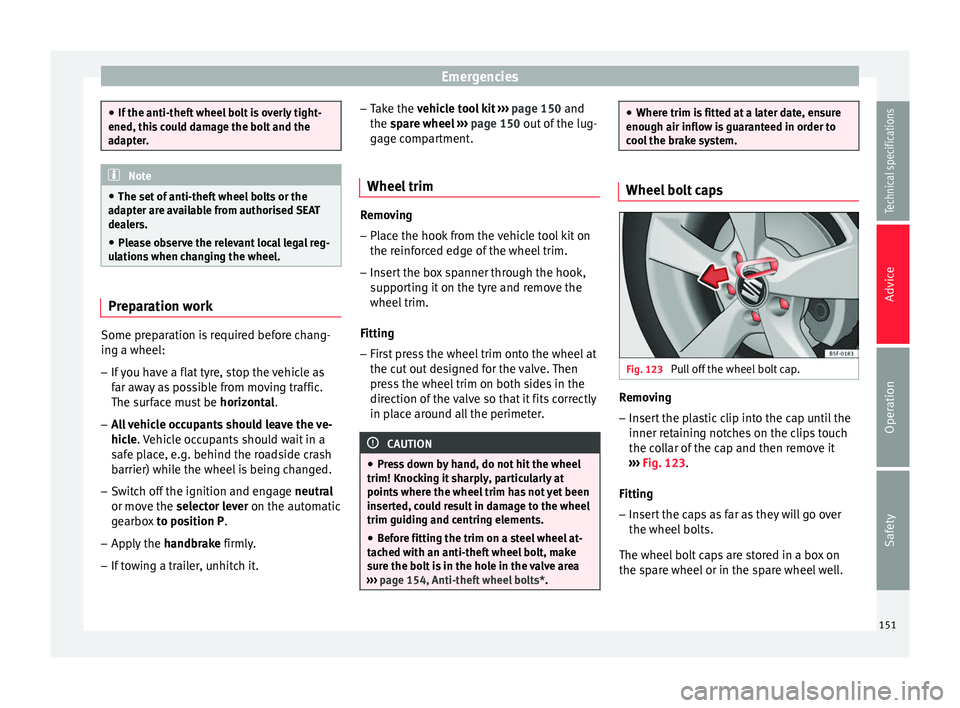
Fig. 123
Pull off the wheel bolt cap. Removing
– Insert the plastic clip into the cap until the
inner retaining notches on the clips touch
the collar of the cap and then remove it
››› Fig. 123 .
Fittin g
– In
sert the caps as far as they will go over
the wheel bolts.
The wheel bolt caps are stored in a box on
the spare wheel or in the spare wheel well.
151
Technical specifications
Advice
Operation
Safety
Page 154 of 200
Advice
Wheel bolts The wheel bolts
are m atched to the rims.
When installing different wheels, e.g. to fit
light alloy wheels or wheels with winter tyres,
it is important to use the correct wheel bolts
with the right length and correctly shaped
bolt heads. This is essential for a secure fit of
the wheels and for proper operation of the
brake system.
Changing a wheel If possible, change the wheel on a level sur-
face.
– Pull off the hub cap ›››
page 151 or the
wheel bolt covers ›››
page 151.
– First loosen the anti-theft wheel bolts and
then the other wheel bolts ›››
page 152.
– Raise the vehicle until the wheel to be
changed is no longer touching the ground
››› page 153 .
– Remo
ve the wheel bolts and place them on
a clean surface (cloth, paper, etc.).
– Take off the wheel.
– Lift the spare wheel into position and tight-
en the wheel bolts lightly.
– Lower the vehicle. –
Tighten the wheel bolts firmly in diagonal
sequence with the box spanner and then
the anti-theft wheel bolt ››› page 152.
– Replace the hub cap and/or the bolt cov-
ers. Note
● All bolts must be clean and turn easily.
● Never grease or oil the wheel bolts!
● Note the direction of rotation when putting
on a tyre with a directional tread pattern
››› page 144. After changing a wheel
Tasks that must be carried out after changing
a wheel:
– Place the wheel with the defective tyre in
the spare wheel well and secure it using a
special bolt ›››
page 146 .
– Put
the vehicle tools back in their storage
location.
– Check the tyre pressure of the newly fitted
s
pare wheel as soon as possible.
– Have the tightening torque of the wheel
bo
lts checked as soon as possible with a
torque wrench.
– Have the flat tyre replaced or ask an Official
Service about the possibility of repair. Note
● If you notice that the wheel bolts are rusty
and difficult to turn when changing a wheel,
they must be replaced before having the
tightening torque checked.
● Drive carefully and at moderate speeds un-
til the tightening torque of the wheel bolts
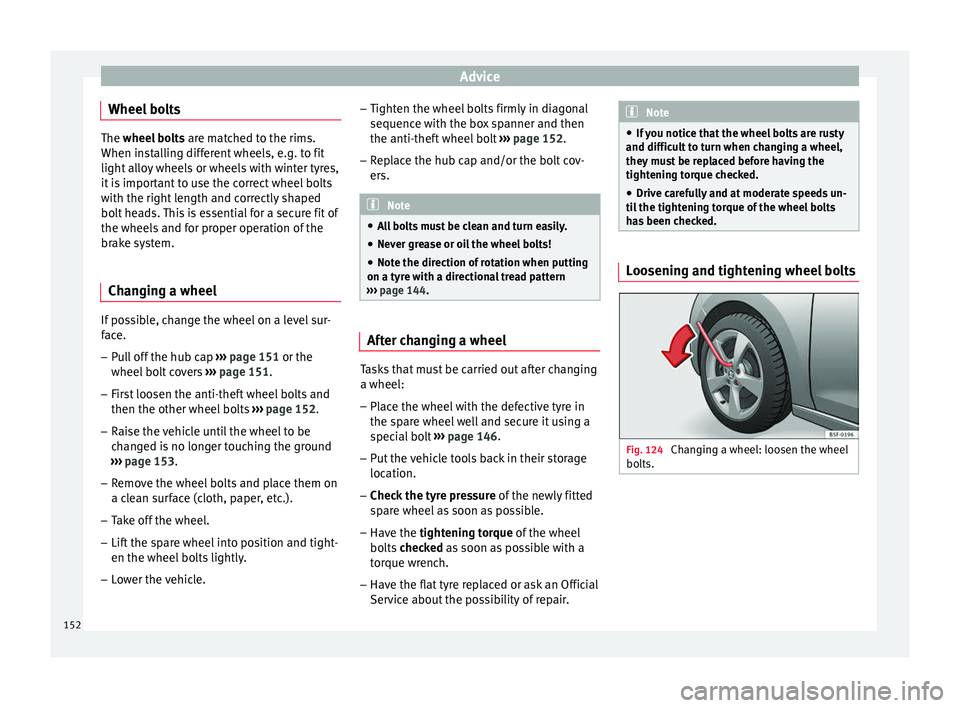
has been checked. Loosening and tightening wheel bolts
Fig. 124
Changing a wheel: loosen the wheel
bolts. 152
Page 155 of 200
Emergencies
Loosening wheel bolts – Fit the box spanner as far as it will go over
the wheel bolt 1)
.
– Grip the end of the box spanner and turn
the wheel bolt about one turn anti-clock-
w i
se ››› Fig. 124.
Tightening wheel bolts – Fit the box spanner as far as it will go over
the wheel bolt 1)
.
– Grip the box spanner as close to the end as
possible and tighten the bolt firmly by turn-
ing clockwise. WARNING
The wheel bolts should only be loosened
slightly (about one turn) before raising the
vehicle with the jack. Risk of accident! Note
If the wheel bolt is very tight, it may be pos-
sible to loosen it by pushing down the end of
the box spanner carefully with your foot. Hold
on to the vehicle for support and take care
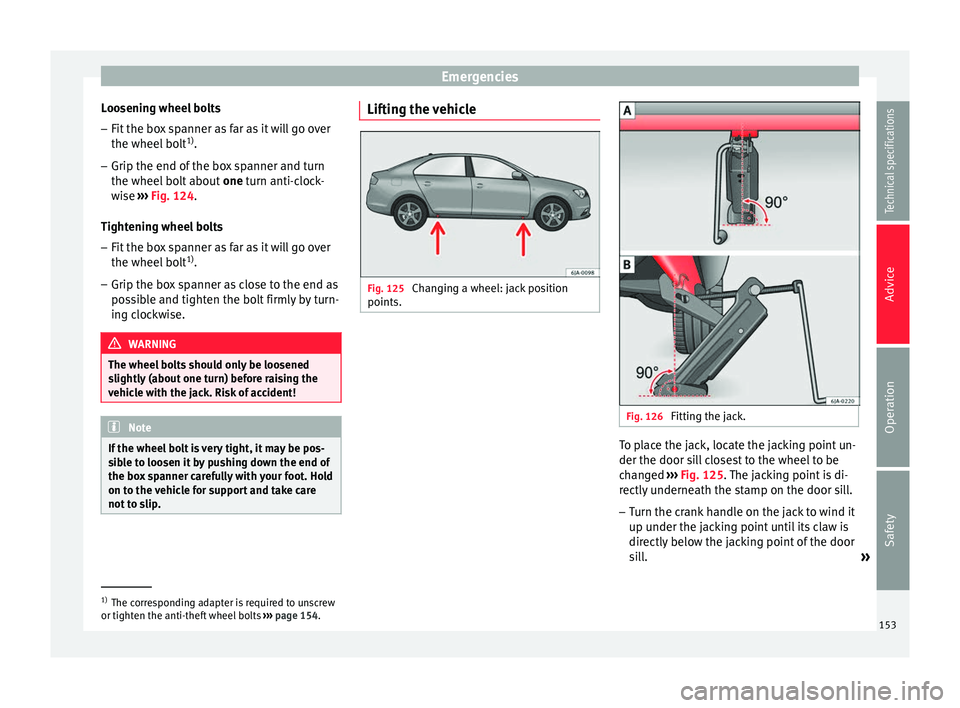
not to slip. Lifting the vehicle
Fig. 125
Changing a wheel: jack position
points. Fig. 126
Fitting the jack. To place the jack, locate the jacking point un-
der the door sill closest to the wheel to be
changed
››› Fig. 125 . The jacking point is di-
r ectly
underneath the stamp on the door sill.
– Turn the crank handle on the jack to wind it
up under the jacking point until its claw is
directly below the jacking point of the door
sill.
»1)
The corresponding adapter is required to unscrew
or tighten the anti-theft wheel bolts ››› page 154.
153
Technical specifications
Advice
Operation
Safety
Page 156 of 200
Advice
– Adjust the jack so that its claw surrounds
the jacking point on the door sill ››› Fig. 126
- B underneath the stamp on the door sill.
– Make sure that the base of the jack is en-
tirely supported on a flat surface and that it
is vertical ››› Fig. 126 to the point where the
c l
aw surrounds the jacking point on the
door sill.
– Continue to wind up the jack using the
crank handle until the defective wheel is
clear off the ground.
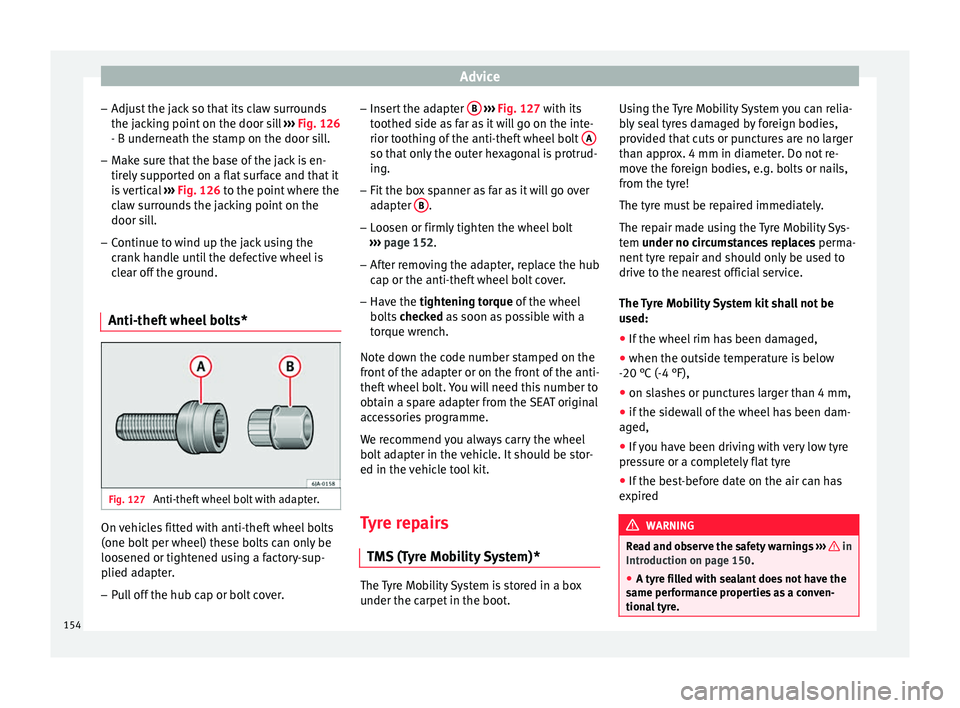
Anti-theft wheel bolts* Fig. 127
Anti-theft wheel bolt with adapter. On vehicles fitted with anti-theft wheel bolts
(one bolt per wheel) these bolts can only be
loosened or tightened using a factory-sup-
plied adapter.
– Pull off the hub cap or bolt cover. –
Insert the adapter B
››› Fig. 127 with its
t oothed s
ide as far as it will go on the inte-
rior toothing of the anti-theft wheel bolt A so that only the outer hexagonal is protrud-
ing.
– Fit the box spanner as far as it will go over
adapter B .
– Loosen or firmly tighten the wheel bolt
››› page 152 .
– Af t
er removing the adapter, replace the hub
cap or the anti-theft wheel bolt cover.
– Have the tightening torque of the wheel
bo
lts checked as soon as possible with a
tor
que wrench.
Note down the code number stamped on the
front of the adapter or on the front of the anti-
theft wheel bolt. You will need this number to
obtain a spare adapter from the SEAT original
accessories programme.
We recommend you always carry the wheel
bolt adapter in the vehicle. It should be stor-
ed in the vehicle tool kit.
Tyre repairs TMS (Tyre Mobility System)* The Tyre Mobility System is stored in a box
under the carpet in the boot.Using the Tyre Mobility System you can relia-
bly seal tyres damaged by foreign bodies,
provided that cuts or punctures are no larger
than approx. 4 mm in diameter. Do not re-
move the foreign bodies, e.g. bolts or nails,
from the tyre!
The tyre must be repaired immediately.
The repair made using the Tyre Mobility Sys-
tem
under no circumstances replaces
perm
a-
nent
tyre repair and should only be used to
drive to the nearest official service.
The Tyre Mobility System kit shall not be
used:
● If the wheel rim has been damaged,
● when the outside temperature is below
-20 °C (-4 °F),
● on slashes or punctures larger than 4 mm,
● if the sidewall of the wheel has been dam-
aged,
● If you have been driving with very low tyre
pressure or a completely flat tyre
● If the best-before date on the air can has
expired WARNING
Read and observe the safety warnings ››› in
Introduction on page 150.
● A ty r
e filled with sealant does not have the
same performance properties as a conven-
tional tyre. 154
Page 157 of 200
Emergencies
●
Do not drive faster than 80 km/h (50 mph).
● Avoid heavy acceleration, hard braking and
fast cornering.
● Check the tyre pressure after 10 minutes of
driving!
● The sealant is harmful to health and must
be immediately rinsed from affected skin. For the sake of the environment
Used or out-of-date sealant must be disposed
of in line with environmental protection regu-
lations. Note
● Observe the usage instructions provided by
the snow chain manufacturer.
● A new can of sealant can be acquired from
the selection of SEAT Original Accessories.
● Change the tyre repaired using the Tyre
Mobility System as soon as possible or ask
an official service about the possibility of re-
pairing it for you. Components of the Tyre Mobility
System*
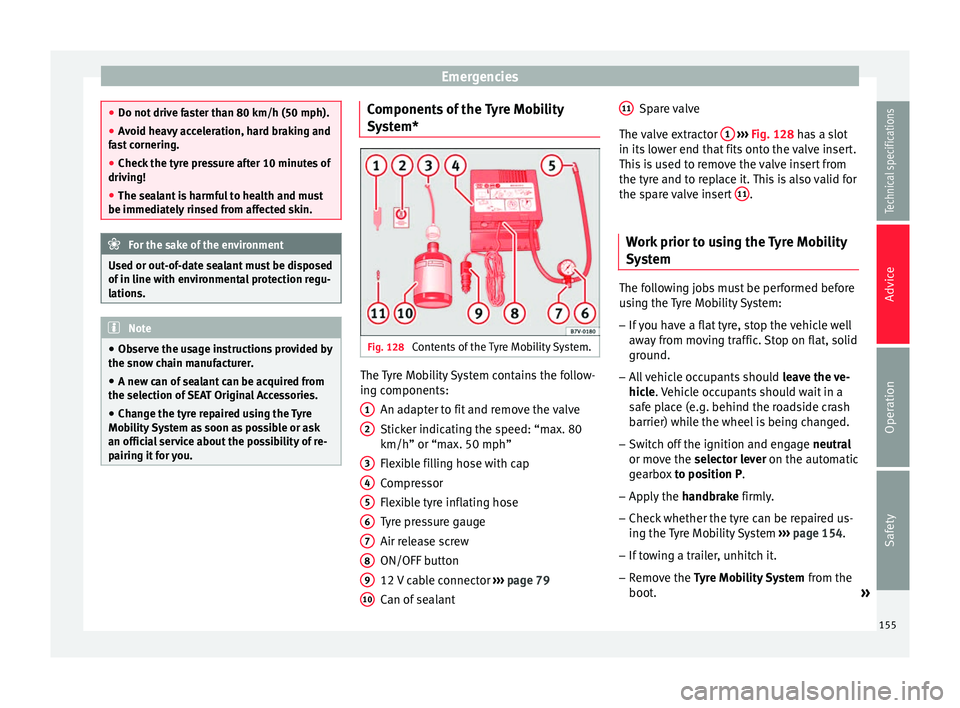
Fig. 128
Contents of the Tyre Mobility System. The Tyre Mobility System contains the follow-
ing components:
An adapter to fit and remove the valve
Sticker indicating the speed: “max. 80
km/h” or “max. 50 mph”
Flexible filling hose with cap
Compressor
Flexible tyre inflating hose
Tyre pressure gauge
Air release screw
ON/OFF button
12 V cable connector ››› page 79
Can of sealant
1 2
3
4
5
6
7
8
9
10 Spare valve
The valve extractor 1
››› Fig. 128 has a slot
in its lo
wer end that fits onto the valve insert.
This is used to remove the valve insert from
the tyre and to replace it. This is also valid for
the spare valve insert 11 .
Work prior to using the Tyre Mobility
System The following jobs must be performed before
using the Tyre Mobility System:
– If you have a flat tyre, stop the vehicle well
away from moving traffic. Stop on flat, solid
ground.
– All vehicle occupants should leave the ve-
hicle . Vehicle occupants should wait in a
s af
e place (e.g. behind the roadside crash
barrier) while the wheel is being changed.
– Switch off the ignition and engage neutral
or move the selector lever on the automatic
g
earbox to position P.
– Apply the handbrake firmly.
– Check
whether the tyre can be repaired us-
ing the Tyre Mobility System ›››
page 154.
– If towing a trailer, unhitch it.
– Remove the Tyre Mobility System from the
boot
. »
11
155
Technical specifications
Advice
Operation
Safety
Page 161 of 200

Emergencies
on battery). Failure to comply could result in
an explosion.
●
Never use jump leads when one of the bat-
teries is frozen. Danger of explosion! Even af-
ter the battery has thawed, battery acid could
leak and cause chemical burns. If a battery
freezes, it should be replaced.
● Keep sparks, flames and lighted cigarettes
away from batteries, danger of explosion.
Failure to comply could result in an explo-
sion.
● Observe the instructions provided by the
manufacturer of the jump leads.
● Do not connect the negative cable from the
other vehicle directly to the negative terminal
of the flat battery. The gas emitted from the
battery could be ignited by sparks. Danger of
explosion.
● Do not attach the negative cable from the
other vehicle to parts of the fuel system or to
the brake line.
● The non-insulated parts of the battery
clamps must not be allowed to touch. The
jump lead attached to the positive battery
terminal must not touch metal parts of the ve-
hicle, this can cause a short circuit.
● Position the leads in such a way that they
cannot come into contact with any moving
parts in the engine compartment.
● Do not lean on the batteries. This could re-
sult in chemical burns. Note
The vehicles must not touch each other, oth-
erwise electricity could flow as soon as the
positive terminals are connected. Towing the vehicle
Introduction Vehicles with manual gearbox can be towed
using a towbar or towrope. They can also be
towed with either the front or rear wheels lif-
ted off the road.
Vehicles with automatic gearbox can be tow-
ed using a towbar or towrope. They can also
be towed with the front wheels lifted off the
road. If the vehicle is towed with the rear
wheels lifted off the road the automatic gear-
box will be damaged!
It is safer to tow a vehicle with a
towbar. A
towrope should only be used if you do not
h av
e a towbar.
Follow the instructions below when towing a
vehicle:
Notes for the driver of the towing vehicle
– Engage the clutch very gently when starting
to move or on vehicles with automatic gear-
box press the accelerator carefully. –
On vehicles with a manual gearbox, the
towrope must be taut before driving off.
Maximum towing speed is 50 km/h (31
mph).
Note
s for the driver of the towed vehicle
– The ignition should be switched on so that
the steering wheel lock is not engaged and
the turn signals, horn and windscreen wip-
ers and washers can be used.
– Put the gear lever in neutral or move the se-
lector lever to position N (automatic gear-
bo
x).
The brake servo and power steering only
work when the engine is running. Considera-
bly more effort is required on the brake pedal
and steering wheel when the engine is
switched off.
Ensure the towrope remains taut at all times
when towing. CAUTION
● Do not tow-start the engine. Risk of engine
damage! In vehicles with a catalytic convert-
er, fuel that has not been burned could reach
the catalytic converter and catch fire in it.
This could damage and destroy the catalytic
converter. You may use the battery from an-
other vehicle to help you start your engine
››› page 158.
» 159
Technical specifications
Advice
Operation
Safety
Page 162 of 200

Advice
●
If, due to a fault, there is no oil in the gear-
box, the car may only be towed with the
driven wheels lifted clear of the road and
transported on a special vehicle transporter
or trailer.
● If normal towing is not possible or if the ve-
hicle is to be towed for further than 50 km,
the vehicle must be transported on a special
vehicle transporter or trailer.
● The towrope should be slightly elastic to
reduce the load on both vehicles during tow-
ing. It is advisable to use a towrope made of
synthetic fibre or similar material only.
● Do not pull too hard with the towing vehicle
and always take care to avoid jerking the tow-
rope. When towing on a loose surface there is
always a risk of overloading and damaging
the anchorage points.
● Attach the towrope or towbar only to the
towline anchorages or to the removable tow-
ing bracket ››› page 114, or ››› page 161. Note
● We recommend you use the towrope or tow-
bar available in the SEAT Original Accessories
programme from authorised SEAT dealers.
● Towing a vehicle requires a certain degree
of practical skill. Both drivers should be fa-
miliar with the technique required for towing.
Inexperienced drivers should not attempt to
tow away another vehicle or to have their ve-
hicle towed. ●
Note the legal regulations concerning tow-
ing, particularly those regarding the signal-
ling of the towed and towing vehicle.
● The towrope must not be twisted, as under
certain circumstances this could unscrew the
front towline anchorage. Towline anchorage
Fig. 131
Front bumper: towline anchorage
cover/fitting. Fitting and detaching the cover
– Press on the left of the cover as indicated
by the arrow ››› Fig. 131 .
– Pull on the cover to remove it from the front
bumper.
– To refit the cover after unscrewing the tow-
line anchorage, fit the cover and press
down on its right-hand side. The cover
must be securely engaged.
Fitting and detaching the towline anchorage
– Screw in the towline anchorage anti-clock-
wise by hand as far as it will go ››› Fig. 131
.
To tighten the towline anchorage, we recom-
mend using the box spanner, the towing eye
from another vehicle or a similar object that
can be inserted through the anchorage.
– Unscrew the towline anchorage by turning
it clockwise. CAUTION
The towline anchorage must be screwed in as
far as it will go. Otherwise there is a risk of
the screw connection shearing off during
towing or tow-starting! 160