2014 Seat Mii height
[x] Cancel search: heightPage 80 of 219
Operation
●
Avoid brusque manoeuvres and sudden
braking.
● Adjust your speed and driving style to visi-
bility, road, traffic and weather conditions. CAUTION
● Always remove the roof carrier system from
the roof before entering a car wash.
● The height of your vehicle is changed by
the installation of the roof carrier and the
load secured on it. Compare the vehicle
height with the passage height, for example
in underground car parks or for garage doors.
● The roof antenna and the range of the rear
lid should not be affected by the roof carrier
system or the load being transported.
● Take extra care not to let the hatch strike
the roof load when opening. For the sake of the environment
The vehicle uses more fuel when the roof car-
rier system is fitted. Securing the base supports and roof
carrier system
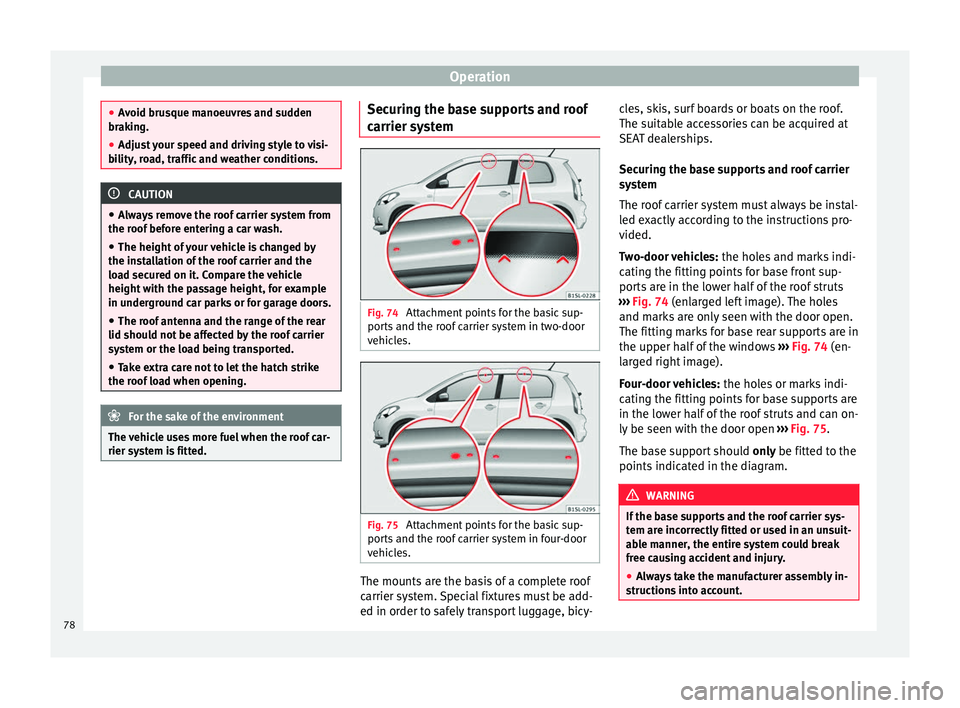
Fig. 74
Attachment points for the basic sup-
ports and the roof carrier system in two-door
vehicles. Fig. 75
Attachment points for the basic sup-
ports and the roof carrier system in four-door
vehicles. The mounts are the basis of a complete roof
carrier system. Special fixtures must be add-
ed in order to safely transport luggage, bicy-cles, skis, surf boards or boats on the roof.
The suitable accessories can be acquired at
SEAT dealerships.
Securing the base supports and roof carrier
system
The roof carrier system must always be instal-
led exactly according to the instructions pro-
vided.
Two-door vehicles:
the holes and marks indi-
cating the fitting points for base front sup-
ports are in the lower half of the roof struts
››› Fig. 74
(enlarged left image). The holes
and m ark
s are only seen with the door open.
The fitting marks for base rear supports are in
the upper half of the windows ››› Fig. 74
(en-
larged right image).
Four-door vehicles: the holes or marks indi-
cating the fitting points for base supports are
in the lower half of the roof struts and can on-
ly be seen with the door open ››› Fig. 75.
The ba
se support should only
be fitted to the
points indicated in the diagram. WARNING
If the base supports and the roof carrier sys-
tem are incorrectly fitted or used in an unsuit-
able manner, the entire system could break
free causing accident and injury.
● Always take the manufacturer assembly in-
structions into account. 78
Page 122 of 219

Advice
●
All repairs and modifications to the vehicle
should only be performed by a specialised
workshop. Repair and faults in the airbag system
When performing repairs and technical mod-
ifications, SEAT's directives must be ob-
served!
››› Modifications and repairs to the front bump-
er, doors, front seats, and repairs to the roof
or chassis should only be carried out in a
specialised workshop. These components
may contain parts or sensors belonging to
the airbag system.
If work is carried out on the airbag system or
parts have to be removed and fitted on the
system when performing other repair work,
parts of the airbag system may be damaged.
The consequence may be that, in the event of
an accident, the airbag inflates incorrectly or
does not inflate at all.
So that the effectiveness of the airbag is not
reduced and that removed parts do not cause
any injuries or environmental pollution, regu-
lations must be observed. These require-
ments are known to specialised workshops.
Modifications to the vehicle suspension may
affect the operation of the airbag system in
the event of collision. For example, if wheel
and tyre combinations not approved by SEAT are used, or if the vehicle height is lowered,
the suspension is stiffened or the suspension
springs, telescopic arms, dampers, etc., are
modified, the results received by the airbag
sensors and sent to the control unit may not
be accurate. For example, some modifica-
tions to the suspension could increase the
force measured by the sensors and result in
the triggering of the airbag systems in colli-
sions. Under normal conditions, the meas-
ured values would be lower and the airbag
would not have been triggered. Other modifi-
cations may reduce the forces measured by
the sensors and prevent the airbags from be-
ing triggered when they should.
WARNING
Repairs or modifications which are not per-
formed correctly may result in damage or er-
rors in the vehicle operation, affecting the ef-
fectiveness of the airbag systems. This could
result in serious or fatal accidents.
● All repairs and modifications to the vehicle
should only be performed by a specialised
workshop.
● Airbag modules must never be repaired: if
damaged, they must be replaced.
● Never fit recycled or reused airbag compo-
nents in your vehicle. WARNING
Modifications to the vehicle suspension, in-
cluding the use of unauthorised wheel and tyre combinations, may affect the perform-
ance of the airbags and increase the risk of
serious or fatal injury in the event of acci-
dent.
●
Never fit suspension components which are
not identical to the original parts in the vehi-
cle.
● Never use wheel and tyre combinations not
approved by SEAT. Retro-fitting of two-way radios
An exterior aerial is required for the use of
two-way radios in the vehicle.
The retro-fitting of electrical or electronic ap-
pliances in the vehicle is subject to their ap-
proval for use in your vehicle. Under certain
circumstances, this could mean that your ve-
hicle registration documents are no longer
valid.
SEAT has approved your vehicle for use with
two-way radios providing the following condi-
tions are observed:
● The exterior aerial must be mounted pro-
fessionally.
● The maximum transmitting power is 10
watts.
The optimal reach of the equipment is only
achieved with an external aerial.
120
Page 129 of 219

Care and maintenance
SEAT recommends the use of car washes
without brushes.
To remove traces of wax on windows and to
prevent wiper blades from scratching, please
observe the following ››› page 128, Cleaning
windows and exterior mirrors .
Washing the car by hand
When washing the car by hand, use plenty of
water to soften the dirt first, and rinse off as
well as possible.
Then clean the vehicle with a soft sponge,
glove or
brush using only slight pressure.
Start at the roof and work downwards. Spe-
cial car shampoo should only be used for
ver
y persistent dirt.
Rinse the sponge or glove thoroughly and of-
ten.
Wheels, sills and similar should be cleaned
last. Use a second sponge for this. WARNING
Sharp components on the vehicle may cause
injury.
● Protect arms and hands from sharp edges
when cleaning the vehicle undercarriage or
the interior of the wheel hubs. WARNING
After the vehicle has been washed, the brak-
ing effect will be reduced (and the braking
distance increased) due to moisture (and ice
in winter) on the brakes.
● “Dry the brakes and remove ice” by braking
carefully. Ensure that you are not endanger-
ing other road-users or breaking traffic regu-
lations in the process. CAUTION
● The temperature of the water must not ex-
ceed +60 °C (+140 °F).
● To avoid damage to the paintwork, do not
wash the vehicle in full sun.
● Do not use rough sponges or similar which
could damage the surface to clean away the
traces of insects.
● Never wipe the headlights with a dry cloth
or sponge, always moisten first. It is best to
use soapy water.
● Washing the vehicle in low temperatures:
When washing the vehicle with a hose, do
not direct water into the lock cylinders or the
gaps around the doors or roof. Locks and
seals could freeze! CAUTION
To prevent damage to the vehicle, please ob-
serve the following before entering an auto-
matic car wash: ●
Compare the distance between the vehicle
wheels and the distance between the guide-
rails of the car wash to prevent damage to the
wheels and tyres!
● Switch off the rain sensor before taking the
vehicle to an automatic car wash.
● Compare the height and width of your vehi-
cle with the available height and width when
entering and driving through the car wash.
● Fold in exterior mirrors Electrically retracta-
ble exterior mirrors must not be folded in or
out by hand. Always use the electrical power
control.
● To avoid damaging the bonnet paintwork,
rest the windscreen wipers on the windscreen
after drying the wiper blades. Do not let them
fall!
● Lock the rear lid to prevent it from opening
unexpectedly while inside the car wash. Washing the vehicle with high
pressure cleaning apparatus
When cleaning the vehicle with a high-pres-
sure cleaner, always follow the operating in-
structions for the equipment. Pay special at-
tention to the required pressure of the jet
and the
distance
between the jet and the ve-
hic
le ››› .
Keep a suitable distance from soft materials,
such as rubber hoses or insulating material, »
127
Technical specifications
Advice
Operation
Safety
Page 148 of 219

Advice
Fig. 106
C: Bonnet securing rod in the bon-
net. D: Bonnet supported by the bonnet se-
curing rod Opening the bonnet
● Before opening the bonnet, make sure that
the windscreen wiper arms are in place
against the windscreen ››› .
● Pull the release lever 1 in the direction of
the arrow ›››
Fig. 105
A. The bonnet is re- leased from the lock carrier by a spring mech-
anism
››› .
● Lift the bonnet up slightly while pressing
the release lever 2
B
in the direction of the
arr
ow to completely open the bonnet.
● Take out the bonnet support rod from its
clip in the direction of the arrow 3
C
and
p
lace it in the corresponding open position
4
D
(arrow).
C
losing the bonnet
● Slightly lift the bonnet ››› .
● Take out the bonnet support rod from the
opening catch 4
D
and insert it into its clip
3
C
in the opening catch.
● L
et the bonnet fall from a height of 30 cm
into its clip; Do not
apply pressure!
If the bonnet is not correctly closed, open it
once again and close it correctly.
The bonnet is correctly closed when it is flush
with the corresponding parts on the body-
work. WARNING
If the bonnet is not correctly closed, it could
suddenly open while driving leaving the driv-
er without visibility. This could result in a se-
rious accident.
● After closing the bonnet, always check that
it is properly secured by the locking mecha-
nism in the lock carrier piece. The bonnet must be flush with the surrounding body pan-
els.
●
While driving, if you notice that the bonnet
is not correctly closed then stop immediately
and close it correctly.
● Only open and close the bonnet when there
is nobody within its range. CAUTION
● To avoid damage to the bonnet and to the
windscreen wiper arms, only open it when
the windscreen wipers are in place against
the windscreen.
● Before driving, always lower the wiper
arms. Engine oil
Introduction WARNING
Incorrectly handling engine oil can cause in-
jury and serious burns.
● Always protect your eyes when handling
engine oil.
● Oil is toxic and must be kept out of the
reach of children.
● Engine oil should only be kept in its origi-
nal packaging; the same goes for used oil un-
til it is disposed of. 146
Page 169 of 219

Wheels and tyres
Tyre code Fig. 119
Universal code on tyres Radial
Rim diameter code
Load index & speed rating
DOT tyre identification number
Severe snow conditions
Tyre ply composition and materials used
Max. load rating
Treadwear, traction and temperature
grades
Max. permissible inflation pressure
Passenger car tyre
Nominal width of tyre in millimetres
Ratio of height to width (aspect ratio)
1 2
3
4
5
6
7
8
9
10
11
12Tyre code (example)Meaning
Make, logotypeManufacturer
Product nameName of tyre assigned by manufacturer.
P255 / 55 R 18Size:
PPassenger vehicle code.
255Nominal width between walls, in mm.
55Height/width ratio in %
RTyre type (R indicates "radial").
18Rim diameter in inches»
167
Technical specifications
Advice
Operation
Safety
Page 205 of 219

Technical features
DimensionsLongitude3,557 mm
Width1,641-1,645 mm
Height, unladen1,478-1,489 mm
Wheelbase2,420 mm
Turning circle diameter a)approx. 9.8 m
Front track widtha)1,412-1,428 mm
Rear track widtha)1,408-1,424 mm
Ground clearance with
maximum authorised load109 mm
a)
Depending on the dimensions of the wheel trims and tyres,
there may be variations. CAUTION
● Special care should be taken when parking
in areas with high kerbs or fixed barriers. Ob-
jects protruding from the ground may dam-
age the bumper or other parts of the vehicle
during manoeuvres.
● Special attention is required when driving
through entrances, over ramps, kerbs or oth-
er objects. The vehicle underbody, bumpers,
mudguards and running gear, and the engine
and exhaust system could be damaged as
you drive over these objects. Capacities
Fuel tank capacity
Petrol enginesAround 35.0 l
, of which approximately 4.0 are the reserve.
Natural gas en-
gineNatural gas: approx. 11 kg; of whichmax. 1.5 kg reserve
Petrol: approx. 10 l; of which approx. 5 l reserve 203Technical specifications
Advice
Operation
Safety