2014 Seat Ibiza ST bonnet
[x] Cancel search: bonnetPage 175 of 240

Checking and refilling levels
●
When working in the engine compartment,
always observe the safety warnings
››› page 166.
● When the en gine i
s warm or hot, the cool-
ing system is pressurised! Do not unscrew
the cap on the coolant expansion tank when
the engine is hot. This is a burn injury risk. CAUTION
● If you notice a change in the colour of the
liquid because it has been in use for a long
time, it is recommended to change it, as it
will have lost some of its properties and
could cause damage to the engine.
● If a lot of coolant fluid has been lost, wait
for the engine to cool. This avoids damaging
the engine. Large coolant losses are an indi-
cation of leaks in the cooling system. See a
specialised workshop immediately and have
the cooling system checked. Otherwise, there
is a risk of engine damage. Brake fluid
Checking the brake fluid level Read the additional information carefully
››› page 25
The position of the brake fluid reservoir is
shown in the corresponding engine compart- ment illustration
››› page 168 . The brake fluid
r e
servoir has a black and yellow cap.
The brake fluid level drops slightly when the
vehicle is being used as the brake pads are
automatically adjusted as they wear.
However, if the level goes down noticeably in
a short time, or drops below the “MIN” mark,
there may be a leak in the brake system. A
display on the instrument panel will warn you
if the brake fluid level is too low ››› page 57. WARNING
Before opening the bonnet to check the brake
fluid level, read and observe the warnings
››› page 166. Changing the brake fluid
The Maintenance Programme indicates brake
fluid change intervals.
We recommend that you have the brake fluid
changed by a Technical Service.
Before opening the bonnet, please read and
follow the warnings
››› in Safety instruc-
tions on working in the engine compartment
on page 166 in section “Safety notes for
w ork
ing in the engine compartment”.
In the course of time, brake fluid becomes
hygroscopic and absorbs water from the am-
bient air. If the water content in the brake flu- id is too high, the brake system could cor-
rode. This also considerably reduces the boil-
ing point of the brake fluid. Heavy use of the
brakes may then cause a vapour lock which
could impair the braking effect.
Be sure to always use the correct brake fluid.
Only use brake fluid that expressly meets the
VW 501 14 standard.
You can buy VW 501 14 standard brake fluid
in a SEAT dealership or a SEAT Official Serv-
ice. If none is available, use only high-quality
brake fluid that meets DIN ISO 4925 CLASS 4
standards, or USA Standards FMVSS 116 DOT
4.
Using any other kind of brake fluid or one
that is not of a high quality may affect opera-
tion of the brake system and reduce its effec-
tiveness. Never use a brake fluid if the con-
tainer does not state that it complies with VW
501 14, DIN ISO 4925 CLASS 4 standards, or
USA standards FMVSS 116 DOT 4.
WARNING
Brake fluid is poisonous. Old brake fluid im-
pairs the braking effect.
● Before opening the bonnet to check the
brake fluid level, read and observe the warn-
ings ››› page 166.
● Br ak
e fluid should be stored in the closed
original container in a safe place out of reach
of children. There is a toxic risk. » 173
Technical specifications
Advice
Operation
Safety
The essentials
Page 177 of 240

Checking and refilling levels
●
Fires, sparks, open flames and smoking are
prohibited. When handling cables and electri-
cal equipment, avoid causing sparks and
electrostatic charge. Never short the battery
terminals. High-energy sparks can cause in-
jury.
● A highly explosive mixture of gases is re-
leased when the battery is under charge. The
batteries should be charged in a well-ventila-
ted room only.
● Keep children away from acid and batteries.
● Before working on the electrical system,
you must switch off the engine, the ignition
and all electrical devices. The negative cable
on the battery must be disconnected. When a
light bulb is changed, you need only switch
off the light.
● Deactivate the anti-theft alarm by unlock-
ing the vehicle before you disconnect the bat-
tery! The alarm will otherwise be triggered.
● When disconnecting the battery from the
vehicle on-board network, disconnect first
the negative cable and then the positive ca-
ble.
● Switch off all electrical devices before re-
connecting the battery. Reconnect first the
positive cable and then the negative cable.
Never reverse the polarity of the connections.
This could cause an electrical fire.
● Never charge a frozen battery, or one which
has thawed. This could result in explosions
and chemical burns. Always replace a battery
which has frozen. A flat battery can also
freeze at temperatures close to 0 °C (+32 °F). ●
Ensure that the vent hose is always connec-
ted to the battery.
● Never use a defective battery. This could
cause an explosion. Replace a damaged bat-
tery immediately.
● For vehicles with the battery in the luggage
compartment: Check that the battery gas
ventilation hose is securely attached. CAUTION
● Never disconnect the battery if the ignition
is switched on or if the engine is running.
This could damage the electrical system or
electronic components.
● Do not expose the battery to direct sunlight
over a long period of time, as the intense ul-
traviolet radiation can damage the battery
housing.
● If the vehicle is left standing in cold condi-
tions for a long period, protect the battery
from “freezing”. If it freezes it will be dam-
aged. Checking the electrolyte level
The electrolyte level should be checked regu-
larly in high-mileage vehicles, in hot coun-
tries and in older batteries.
– Open the bonnet and open the battery cov-
er at the front ››› in Safety instructions
on working in the engine compartment on
page 166
›
›› in Warnings on handlingthe battery on page 174. For vehicles with
the battery under the spare wheel, open
the rear lid and lift the floor covering. The
battery is located next to the spare wheel.
– Check the colour display in the "magic eye"
on the top of the battery.
– If there are air bubbles in the window, tap
the window gently until they disperse.
The position of the battery is shown in the
corresponding engine compartment diagram
››› page 168 . The location of the battery in
the lug g
age compartment can be seen in
››› Fig. 152.
The “magic
eye” indicator, located on the top
of the battery changes colour, depending on
the charge state and electrolyte level of the
battery.
There are two different colours:
● Black: correct charge status.
● Transparent/clear yellow: the battery must
be replaced. Contact a specialised workshop.
Charging and changing the vehicle
battery The battery is maintenance-free and is
checked during the inspection service. All
work on the vehicle battery requires special-
ist knowledge.
»
175
Technical specifications
Advice
Operation
Safety
The essentials
Page 195 of 240

Emergencies
Changing the wiper blades Changing windscreen wiper blades Fig. 170
Wipers in service position Fig. 171
Changing the windscreen wiper
blade. Perfect wiper blade condition is essential for
clear vision. Damaged wiper blades should
be replaced immediately. To change the blades it is necessary to move
the wipers from the rest position into the
service position.
Do not change the windscreen wipers when
out of the service position, as it could cause
paint to flake off the bonnet due to friction
with the windscreen wiper arm.
Service position (for changing wiper blades)
–
Ensure that the wiper blades are not frozen.
– Turn the ignition on and off and then (with-
in approximately 9 seconds) push the
windscreen wiper lever down (short wipe).
The windscreen wipers will move to the
service position ››› Fig. 170 .
R emo
ving the wiper blade
– Lift the windscreen wiper arm.
– Press the securing tab down 1
››› Fig. 171 .
– Extr act
the wiper blade from the wiper arm.
Fitting the wiper blade – Insert the wiper blade onto the windscreen
wiper arm until it clicks into place.
– Place the windscreen wiper arms to their in-
itial position.
If the windscreen wipers scratch , they should
be replaced if they are damaged, or cleaned
if they are soiled. If this does not produce the desired results,
the setting angle of the windscreen wiper
arms might be incorrect. They should be
checked by a specialised workshop and cor-
rected if necessary.
WARNING
Do not drive unless you have good visibility
through all windows!
● Clean the windscreen wiper blades and all
windows regularly.
● The wiper blades should be changed once
or twice a year. CAUTION
● Damaged or dirty windscreen wipers could
scratch the windscreen.
● Never use fuel, nail varnish remover, paint
thinner or similar products to clean the win-
dows. This could damage the windscreen
wiper blades.
● Never move the windscreen wiper or wind-
screen wiper arm manually. This could cause
damage.
● To prevent damage to the bonnet and the
windscreen wiper arms, the latter should only
be lifted off the windscreen when in service
position. » 193
Technical specifications
Advice
Operation
Safety
The essentials
Page 196 of 240
Advice
Note
● The windscreen wiper arms can be moved
to the service position only when the bonnet
is properly closed.
● You can also use the service position, for
example, if you want to fix a cover over the
windscreen in the winter to keep it clear of
ice. Changing the rear wiper blade
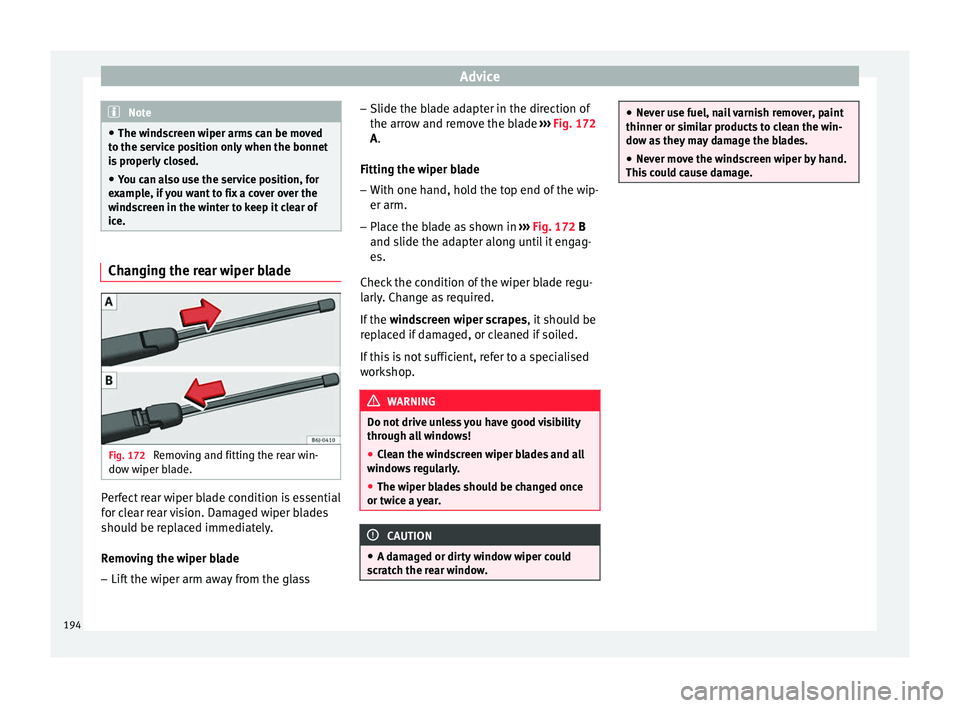
Fig. 172
Removing and fitting the rear win-
dow wiper blade. Perfect rear wiper blade condition is essential
for clear rear vision. Damaged wiper blades
should be replaced immediately.
Removing the wiper blade
– Lift the wiper arm away from the glass –
Slide the blade adapter in the direction of
the arrow and remove the blade ››› Fig. 172
A .
Fittin g the w
iper blade
– With one hand, hold the top end of the wip-
er arm.
– Place the blade as shown in ››› Fig. 172 B
and s
lide the adapter along until it engag-
es.
Check the condition of the wiper blade regu-
larly. Change as required.
If the windscreen wiper scrapes, it should be
replaced if damaged, or cleaned if soiled.
If this is not sufficient, refer to a specialised
workshop. WARNING
Do not drive unless you have good visibility
through all windows!
● Clean the windscreen wiper blades and all
windows regularly.
● The wiper blades should be changed once
or twice a year. CAUTION
● A damaged or dirty window wiper could
scratch the rear window. ●
Never use fuel, nail varnish remover, paint
thinner or similar products to clean the win-
dow as they may damage the blades.
● Never move the windscreen wiper by hand.
This could cause damage. 194
Page 200 of 240
Advice
However, the edges may continue to be mis-
ted.
● Please check at regular intervals that all
lighting (especially the exterior lighting) on
your vehicle is functioning properly. This is
not only in the interest of your own safety,
but also that of all other road users.
● Before changing a bulb, make sure you
have the correct new bulb.
● Do not touch the glass part of the bulb with
your bare hands, use a cloth or paper towel
instead. The residue left by the fingerprints
would vaporise as a result of the heat gener- ated by the bulb, they will be deposited on
the reflector and will impair its surface. Single headlight bulb change
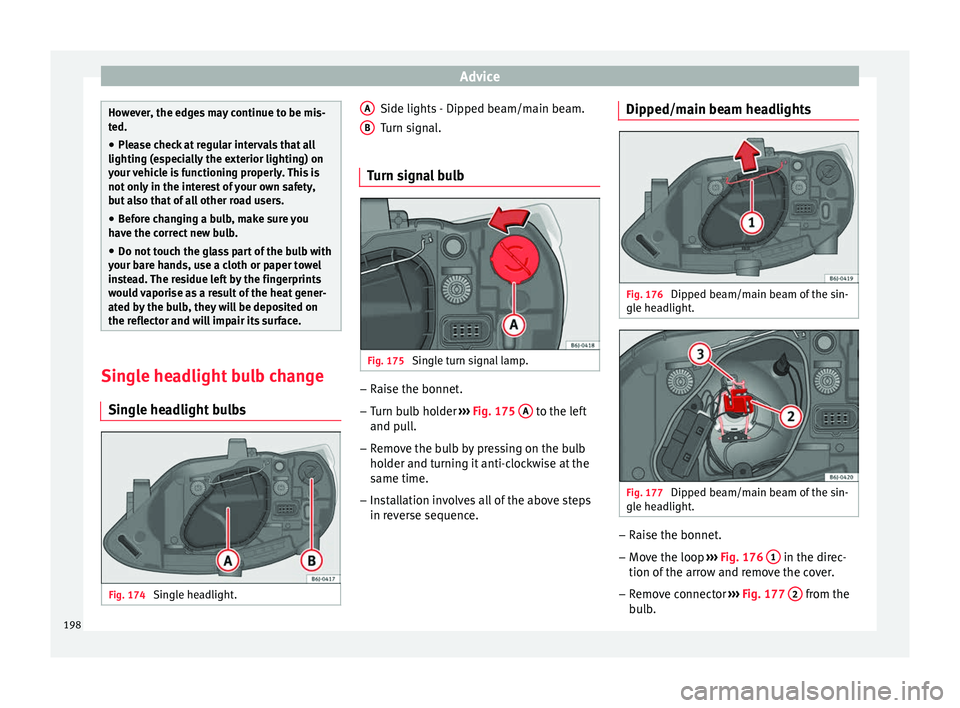
Single headlight bulbs Fig. 174
Single headlight. Side lights - Dipped beam/main beam.
Turn signal.
Turn signal bulb Fig. 175
Single turn signal lamp. –
Raise the bonnet.
– Turn bulb holder ››› Fig. 175 A to the left
and pull.
– Remove the bulb by pressing on the bulb
holder and turning it anti-clockwise at the
same time.
– Installation involves all of the above steps
in reverse sequence.
A B Dipped/main beam headlights
Fig. 176
Dipped beam/main beam of the sin-
gle headlight. Fig. 177
Dipped beam/main beam of the sin-
gle headlight. –
Raise the bonnet.
– Move the loop ››› Fig. 176 1 in the direc-
tion of the arrow and remove the cover.
– Remove connector ››› Fig. 177
2 from the
bulb.
198
Page 201 of 240

Fuses and bulbs
– Unclip the retainer spring ››› Fig. 177 3 pressing inwards to the right.
– Extract the bulb and fit the replacement so
that the lug on the base fits into the recess
on the reflector.
– Fit the connector.
– Fit the cover and close the strap. Make sure
that the gasket sits well on the casing cover
during the operation.
– Check whether the new bulb is working.
Side light Fig. 178
Side lights. –
Raise the bonnet.
– Move the loop ››› Fig. 176 1 in the direc-
tion of the arrow and remove the cover.
– Remove the bulb holder 4
››› Fig. 178 out-
w ar
ds. –
Replace the bulb by pulling it out and in-
serting the replacement.
– Installation is done in the reverse order.
Double headlight bulb change Double headlight bulbs Fig. 179
Double headlight. Side lights
Main beam headlights
Dipped beam headlights
Turn signal lights
A B
C
D Side light
Fig. 180
Side lights. Fig. 181
Side lights. –
Raise the bonnet.
– Move the loop 1 in the direction of the ar-
row and remove the cover ››› Fig. 180 .
– Remo
ve connector ››› Fig. 181 2 by pulling
outward. »
199
Technical specifications
Advice
Operation
Safety
The essentials
Page 202 of 240
Advice
– Remove the bulb by pulling it out and fit-
ting the new one.
– Installation involves all of the above steps
in reverse sequence.
– Fit the cover and close the strap. Make sure
that the gasket sits well on the casing cover
during the operation.
– Check whether the new bulb is working.
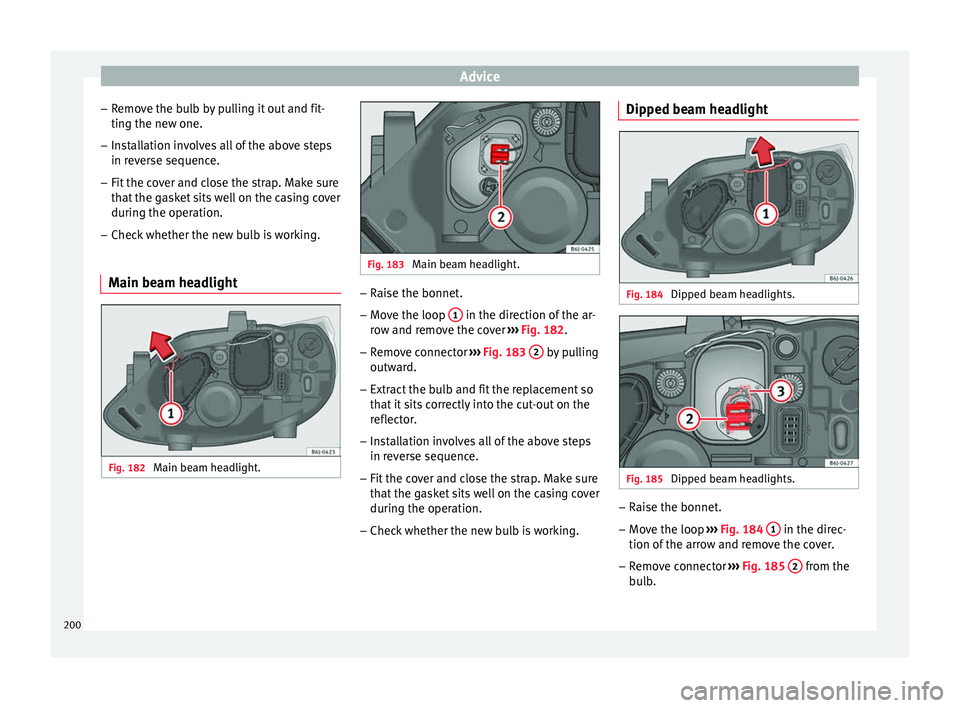
Main beam headlight Fig. 182
Main beam headlight. Fig. 183
Main beam headlight. –
Raise the bonnet.
– Move the loop 1 in the direction of the ar-
row and remove the cover ››› Fig. 182 .
– Remo
ve connector ››› Fig. 183 2 by pulling
outward.
– Extract the bulb and fit the replacement so
that it sits correctly into the cut-out on the
reflector.
– Installation involves all of the above steps
in reverse sequence.
– Fit the cover and close the strap. Make sure
that the gasket sits well on the casing cover
during the operation.
– Check whether the new bulb is working. Dipped beam headlight
Fig. 184
Dipped beam headlights. Fig. 185
Dipped beam headlights. –
Raise the bonnet.
– Move the loop ››› Fig. 184 1 in the direc-
tion of the arrow and remove the cover.
– Remove connector ››› Fig. 185 2 from the
bulb.
200
Page 203 of 240

Fuses and bulbs
– Unclip the retainer spring ››› Fig. 185 3 pressing inwards to the right.
– Extract the bulb and fit the replacement so
that the lug on the base fits into the recess
on the reflector.
– Fit the connector.
– Fit the cover and close the strap. Make sure
that the gasket sits well on the casing cover
during the operation.
– Check whether the new bulb is working.
Turn signal lamp Fig. 186
Turn signal light. –
Raise the bonnet.
– Turn bulb holder ››› Fig. 186 A to the left
and pull. –
Remove the bulb by pressing on the bulb
holder and turning it anti-clockwise at the
same time.
– Installation involves all of the above steps
in reverse sequence.
AFS headlight bulb change AFS headlight bulbs Fig. 187
AFS headlight bulbs. Turn signal lights
Xenon headlight (dipped beam/main
beam)
Changing the xenon bulb The procedure for changing the bulb is the
same on both sides of the vehicle.A B WARNING
This type of bulb should be changed at a spe-
cialised workshop. Turn signal bulb
Fig. 188
Turn signal light. –
Raise the bonnet.
– Turn bulb holder ››› Fig. 188 A to the left
and pull.
– Remove the bulb by pressing on the bulb
holder and turning it anti-clockwise at the
same time.
– Installation involves all of the above steps
in reverse sequence.
201Technical specifications
Advice
Operation
Safety
The essentials