2014 Seat Alhambra air conditioning
[x] Cancel search: air conditioningPage 200 of 381
198Driving
Start-Stop Function*
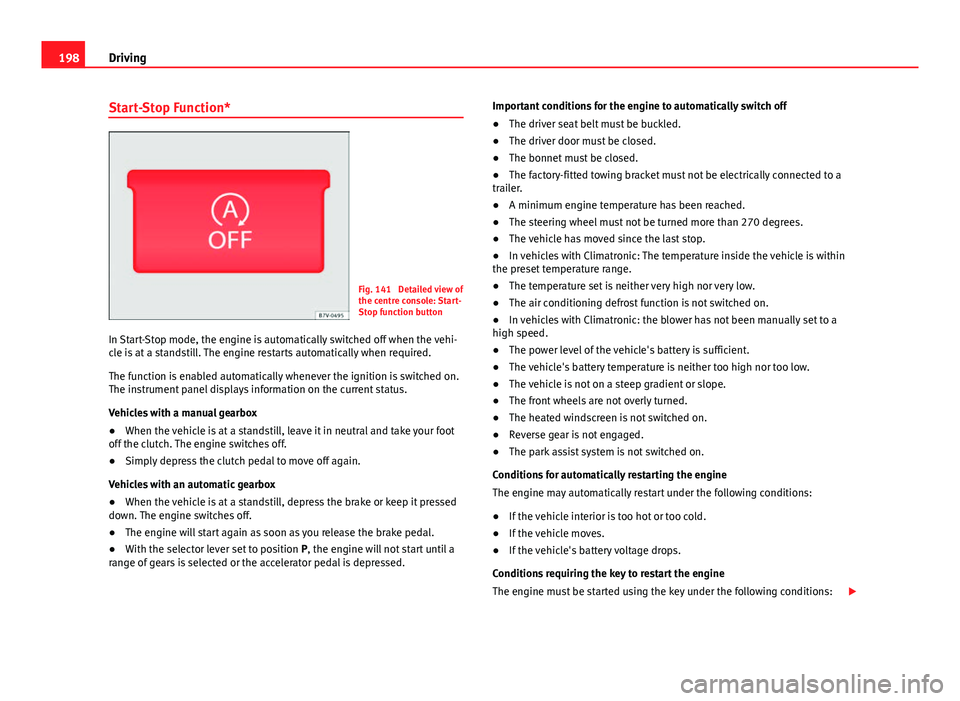
Fig. 141 Detailed view of
the centre console: Start-
Stop function button
In Start-Stop mode, the engine is automatically switched off when the vehi-
cle is at a standstill. The engine restarts automatically when required.
The function is enabled automatically whenever the ignition is switched on.
The instrument panel displays information on the current status.
Vehicles with a manual gearbox
● When the vehicle is at a standstill, leave it in neutral and take your foot
off the clutch. The engine switches off.
● Simply depress the clutch pedal to move off again.
Vehicles with an automatic gearbox
● When the vehicle is at a standstill, depress the brake or keep it pressed
down. The engine switches off.
● The engine will start again as soon as you release the brake pedal.
● With the selector lever set to position P, the engine will not start until a
range of gears is selected or the accelerator pedal is depressed. Important conditions for the engine to automatically switch off
●
The driver seat belt must be buckled.
● The driver door must be closed.
● The bonnet must be closed.
● The factory-fitted towing bracket must not be electrically connected to a
trailer.
● A minimum engine temperature has been reached.
● The steering wheel must not be turned more than 270 degrees.
● The vehicle has moved since the last stop.
● In vehicles with Climatronic: The temperature inside the vehicle is within
the preset temperature range.
● The temperature set is neither very high nor very low.
● The air conditioning defrost function is not switched on.
● In vehicles with Climatronic: the blower has not been manually set to a
high speed.
● The power level of the vehicle's battery is sufficient.
● The vehicle's battery temperature is neither too high nor too low.
● The vehicle is not on a steep gradient or slope.
● The front wheels are not overly turned.
● The heated windscreen is not switched on.
● Reverse gear is not engaged.
● The park assist system is not switched on.
Conditions for automatically restarting the engine
The engine may automatically restart under the following conditions:
● If the vehicle interior is too hot or too cold.
● If the vehicle moves.
● If the vehicle's battery voltage drops.
Conditions requiring the key to restart the engine
The engine must be started using the key under the following conditions:
Page 232 of 381

230Driving and the environment
Economic driving style
Changing gear early
General instructions: The highest gear is always the most economical gear.
As a guideline, for the majority of vehicles: At a speed of 30 km/h (19 mph),
drive in third gear, at 40 km/h (25 mph) in fourth gear and at 50 km/h
(30 mph) in fifth gear.
In addition, skipping gears when shifting up helps to save fuel, weather and
traffic conditions permitting.
Do not wait until the last moment before changing gear. Only use first gear
when you move off and change to second gear quickly. Avoid the kick-down
function in vehicles with automatic gearbox.
Vehicles with a gear display help to achieve an economical driving style as
the display indicates the best moment to change gear.
Let the vehicle roll
If you take your foot off the accelerator, the fuel supply is stopped and con-
sumption is reduced.
Allow the vehicle to roll without accelerating, for example when approach-
ing a red traffic light. However, if the vehicle is rolling too slowly or the dis-
tance is too long, the clutch pedal should be pressed to declutch. The en-
gine will then operate at idle speed.
If the vehicle is going to be at a standstill for a period of time, switch off the
engine; for example, while waiting at a level crossing. In vehicles which
have the Start-Stop function on, the engine switches off automatically when
the vehicle is not moving.
Think ahead and “flow” with the traffic
Frequent acceleration and braking considerably increase fuel consumption.
If you think ahead as you drive and keep a safe distance from the vehicle in
front, it is possible to slow down by simply lifting your foot off the accelera-
tor. This eliminates the need for constant braking and acceleration. Calm and steady driving
Constancy is more important than speed: The more you drive at a constant
speed, the lower the fuel consumption.
When driving on the motorway, it is more efficient to drive at a constant and
more moderate speed than to be continuously accelerating and braking. As
a general rule, you will reach your destination just as quickly when you drive
at a constant speed.
The cruise control function helps you to achieve a constant style of driving.
Moderate use of additional electrical appliances
It is important to travel in comfort, but convenience systems should be used
in an ecological manner.
Some equipment, when connected, increase fuel consumption considera-
bly, for example:
●
Air conditioning cooling system: If the air conditioning system is re-
quired to cool to significantly lower temperatures than the true outside tem-
perature, it will require a large quantity of energy from the engine. There-
fore, we recommend that the selected temperature for the vehicle is not too
different to the outside temperature. It is a good idea to open all the win-
dows of the car before starting your journey, and to drive a short distance
with all the windows open to allow the vehicle to cool down slightly. Only
then should you close all the windows and switch on the air conditioning.
Keep windows closed when travelling at high speeds. Driving with the win-
dows open increases fuel consumption.
● Switch off the seat heating when the seats have warmed up.
● Switch off the heated rear window and the windscreen heating when the
windows have demisted and are free of ice.
● Do not leave the auxiliary heater switched on when the vehicle is mov-
ing ⇒ page 165.
Page 363 of 381

Index
A
AbroadExtended stay abroad with your vehicle . . 259
Sale of vehicle . . . . . . . . . . . . . . . . . . . . . . 259
ABS See "Brake assist systems" . . . . . . . . . . . . 191
Accessories . . . . . . . . . . . . . . . . . . . . . . . . . . . . 261
Acoustic warnings Headlights . . . . . . . . . . . . . . . . . . . . . . . . . . 98
Adaptive headlights Dynamic . . . . . . . . . . . . . . . . . . . . . . . . . . . 100
AdBlue Control lamp . . . . . . . . . . . . . . . . . . . . . . . . 275
Information . . . . . . . . . . . . . . . . . . . . . . . . . 276
Minimum quantity for a refill . . . . . . . . . . . 276
Refilling . . . . . . . . . . . . . . . . . . . . . . . . . . . . 277
Specifications . . . . . . . . . . . . . . . . . . . . . . . 278
Tank filling capacity . . . . . . . . . . . . . . . . . . 276
Warning lamp . . . . . . . . . . . . . . . . . . . . . . . 275
Additional equipment . . . . . . . . . . . . . . . . . . . 262
Additional heater See "Auxiliary heater" . . . . . . . . . . . . . . . . 165
Adjusting passenger exterior mirror . . . . . . . . 113
Adjustment Correct sitting position . . . . . . . . . . . . . . . . 12
Electric front seat . . . . . . . . . . . . . . . . . . . . 116
Head restraints . . . . . . . . . . . . . . . . . . . . . . 124
Mechanical front seat . . . . . . . . . . . . . . . . 115
Rear seats . . . . . . . . . . . . . . . . . . . . . . . . . . 117 Seat with position memory . . . . . . . . . . . . 119
Steering wheel . . . . . . . . . . . . . . . . . . . . . . 171
Adjustments Folding the seat backrest of the front pas-senger seat . . . . . . . . . . . . . . . . . . . . . . . 122
Headlight range . . . . . . . . . . . . . . . . . . . . . 102
Aerial . . . . . . . . . . . . . . . . . . . . . . . . . . . . . . . . . 259
Aerial built into the window . . . . . . . . . . . . . . . 259
AFS . . . . . . . . . . . . . . . . . . . . . . . . . . . . . . . . . . 100
Airbag system . . . . . . . . . . . . . . . . . . . . . . . . 29, 31 Cleaning dash panel . . . . . . . . . . . . . . . . . 257
Control lamp . . . . . . . . . . . . . . . . . . . . . . . . . 31
Curtain airbags . . . . . . . . . . . . . . . . . . . . . . . 37
Deactivating the front passenger front air-bag . . . . . . . . . . . . . . . . . . . . . . . . . . . . . . . 35
Deactivating using the key switch . . . . . . . . 35
Description . . . . . . . . . . . . . . . . . . . . . . . . . . 31
Differences between front passenger front airbag systems . . . . . . . . . . . . . . . . . . . . . 34
Faults . . . . . . . . . . . . . . . . . . . . . . . . . . . . . 263
Front airbags . . . . . . . . . . . . . . . . . . . . . . . . 33
Function . . . . . . . . . . . . . . . . . . . . . . . . . . . . 31
Knee airbag . . . . . . . . . . . . . . . . . . . . . . . . . 38
Locking the vehicle after airbag deploy- ment . . . . . . . . . . . . . . . . . . . . . . . . . . . . . . 76
Repairs . . . . . . . . . . . . . . . . . . . . . . . . . . . . 263
Side airbags . . . . . . . . . . . . . . . . . . . . . . . . . 36
Use of child seats . . . . . . . . . . . . . . . . . . . . . 35
Vehicle care . . . . . . . . . . . . . . . . . . . . . . . . 257 Air conditioner . . . . . . . . . . . . . . . . . . . . . . . . . 157
Air recirculation mode . . . . . . . . . . . . . . . . 163
Air vents . . . . . . . . . . . . . . . . . . . . . . . . . . . 163
Climatronic . . . . . . . . . . . . . . . . . . . . . . . . . 159
Controls . . . . . . . . . . . . . . . . . . . . . . . . . . . . 159
Electronic manual air conditioning . . . . . . 159
Faults . . . . . . . . . . . . . . . . . . . . . . . . . . . . . 162
Indirect ventilation . . . . . . . . . . . . . . . . . . . 163
Things to note . . . . . . . . . . . . . . . . . . . . . . . 162
User instructions . . . . . . . . . . . . . . . . . . . . 162
Air conditioning see "Air conditioner" . . . . . . . . . . . . . . . . . 157
Air recirculation mode . . . . . . . . . . . . . . . . . . . 163
Air vents . . . . . . . . . . . . . . . . . . . . . . . . . . . . . . 163
Alarm system . . . . . . . . . . . . . . . . . . . . . . . . . . . 79
Alcantara . . . . . . . . . . . . . . . . . . . . . . . . . . . . . . 255
All-wheel drive Snow chains . . . . . . . . . . . . . . . . . . . . . . . . 305
Towing . . . . . . . . . . . . . . . . . . . . . . . . . . . . . 345
Winter tyres . . . . . . . . . . . . . . . . . . . . . . . . . 305
Alternator . . . . . . . . . . . . . . . . . . . . . . . . . . . . . 293
Ambient lighting . . . . . . . . . . . . . . . . . . . . . . . 103
Anodized surfaces . . . . . . . . . . . . . . . . . . . . . . 251
Anti-lock brake system (ABS) . . . . . . . . . . . . . 191
Anti-theft alarm . . . . . . . . . . . . . . . . . . . . . . . . . 79 Trailer . . . . . . . . . . . . . . . . . . . . . . . . . . . . . 240
Anti-theft alarm system Anti-tow system . . . . . . . . . . . . . . . . . . . . . . 80
False alarms . . . . . . . . . . . . . . . . . . . . . . . . . 80
Interior monitoring . . . . . . . . . . . . . . . . . . . . 80
361
Index