2014 Seat Alhambra mirror
[x] Cancel search: mirrorPage 104 of 381

102Lights and visibility
“Leaving home”Necessary operationsTo switch sys-
tem on:– Unlock the vehicle when the light switch is in position
and the photo sensor detects darkness.
To switch sys-
tem off:– Automatically, at the end of the delay period..
– When the vehicle is locked.
– When the light switch is turned to position .
– When the ignition is switched on.
Lighting around the exterior mirrors
The lighting around the exterior mirrors illuminates the door area on enter-
ing and leaving the vehicles. It comes on when the vehicle is unlocked,
when the vehicle door is opened and when the “Coming home” or “Leaving
home” function is switched on. If the equipment includes the light sensor,
the lighting around the exterior mirrors only comes when it is dark.
Note
● The time taken for the headlights to go off can be changed in the Lights
& Visibility menu and the function can be switched on or off ⇒ page 62.
● When the “Coming home” function is on, if the vehicle door is opened
there is no audible warning signal to advise that the light is still on. Headlight range control, instrument and switch lighting
Fig. 63 Next to the
steering wheel: instru-
ment and switch lighting
control
1
and headlight
range control 2
1 Instrument and switch lighting
When the headlights are switched on, the brightness of the instruments
and switch lighting can be regulated to suit your requirements by turning
the switch ⇒ Fig. 63 1
.
2
Headlight range control
The headlight range control ⇒ Fig. 63 2 is modified according to the value
of the headlight beam and the vehicle load status. This offers the driver op-
timum visibility and the headlights do not dazzle oncoming drivers ⇒
.
The headlights can only be adjusted when the dipped beam is switched on.
To reset, turn switch ⇒ Fig. 63 2
:
ValueVehicle load statusa)–Two front occupants, luggage compartment empty1All seats occupied, luggage compartment empty
Page 106 of 381

104Lights and visibility
Sun blind
Introduction
WARNING
Sun visors and sun blinds may reduce visibility when open.
● Always roll or fold sun blinds and visors away when not in use.
Sun visors
Fig. 64 Sun visor
Options for adjusting driver and front passenger sun visors:
● Lower by unfolding towards the windscreen.
● The sun visor can be pulled out of its mounting and turned towards the
door ⇒ Fig. 64 1
.
● Swing the sun visor towards the door, longitudinally backwards. Vanity mirror light
There may be a vanity mirror, with a cover, on the rear of the sun visor. When
the cover is opened
⇒ Fig. 64 2
a light comes on.
The lamp goes out when the vanity mirror cover is closed or the sun visor is
pushed back up.
Note
The light above the sun visor automatically switches off after a few minutes
in certain conditions. This prevents the battery from discharging.
Rear side window sun blinds
Fig. 65 On the rear
right-hand window: sun
blind
The sun blinds for the vehicle interior are fitted in the side panels of the
windows.
Page 113 of 381

111
Lights and visibility
WARNING
Never mix an unsuitable antifreeze or other similar additives with the
windscreen washer water. A greasy layer may be formed on the wind-
screen which will impair visibility.
● Use clean water with a window cleaner recommended by SEAT.
● If necessary, add a suitable antifreeze to the water in the reservoir.
CAUTION
● Do not mix cleaning products recommended by SEAT with other prod-
ucts. This could lead to flocculation and may block the windscreen washer
jets.
● When topping up service fluids, make absolutely certain that you fill the
fluids into the correct reservoirs. Using the wrong fluids could cause serious
malfunctions and engine damage!
Rear vision mirror
Introduction
Additional information and warnings:
● Personal convenience settings in the SEAT information system
⇒ page 62
● Seat memory
⇒ page 118
● Changing gear
⇒ page 176
● Braking, stopping and parking
⇒ page 185
WARNING
The automatic anti-dazzle rear vision mirror contains an electrolytic fluid
which may leak if the mirror is broken. This could cause irritation to the
skin, eyes and respiratory organs.
● The electrolytic fluid may cause irritation to the skin, eyes and respi-
ratory organs, particularly in individuals suffering from asthma or other
illnesses. Make sure that adequate quantities of fresh air enter and leave
the vehicle if it is not possible to open all the doors and windows.
● If the electrolytic fluid comes into contact with eyes or skin, wash the
area for at least 15 minutes with plenty of water, and seek medical ad-
vice.
● If the electrolytic fluid comes into contact with shoes or clothing,
wash the area for at least 15 minutes with plenty of water. Wash shoes
and clothing before wearing them again.
● If the electrolytic fluid is swallowed, wash your mouth with plenty of
water for at least 15 minutes. Do not try to provoke vomiting unless rec-
ommended by a Doctor. Seek medical advice immediately.
CAUTION
In the event that an automatic anti-dazzle rear vision mirror breaks, an elec-
trolyte fluid may leak. This liquid attacks plastic surfaces. Therefore, it
should be cleaned as fast as possible with a damp sponge or similar.
Safety FirstOperating instructionsPractical TipsTechnical Specifications
Page 114 of 381

112Lights and visibility
Rear vision mirror
Fig. 72 Manual anti-daz-
zle function for rear vi-
sion mirror
Fig. 73 Automatic anti-
dazzle function for rear
vision mirror
The driver should always adjust the rear vision mirror to permit adequate
visibility through the rear window. Manual anti-dazzle function for interior rear vision mirror
●
Basic position: point the lever at the bottom of the mirror forwards.
● Pull the lever to the back to select the anti-dazzle function ⇒ Fig. 72.
Automatic anti-dazzle function for interior mirror
Legend for the Fig. 73:
control lamp
Control
Light incidence sensor
This function can be activated and deactivated by pressing the rear vision
mirror switch ⇒ Fig. 73 2
. When it is activated, the warning lamp lights up
1.
When the ignition is on, the sensor 3
automatically moves the rear vision
mirror to the anti-dazzle position depending upon the incidence of the light
from behind.
The automatic anti-dazzle function is deactivated when reverse gear is en-
gaged or the interior or reading lights are on.
Note
If the incidence of the light on the sensor is obstructed or prevented, e.g. by
the sun blinds, the rear vision mirror with automatic anti-dazzle function will
not operate correctly.
1
23
Page 115 of 381

113
Lights and visibility
Exterior mirrors
Fig. 74 In the driver
door: exterior mirror con-
trols
Turn the knob to the required position:
Electric folding exterior mirrors ⇒ .
Switch on the exterior mirror heating This only heats up if the
ambient temperature is less than +20 °C (+68 °F).
Adjust the left-hand exterior mirror by turning the knob for-
wards, backwards, to the left or to the right.
Adjust the right-hand exterior mirror by turning the knob for-
wards, backwards, to the left or to the right.
Zero position. Exterior mirror unfolded, exterior mirror heating
off, adjustment of exterior mirror not possible.
Synchronised mirror adjustment
●In the Settings - Convenience menu, select whether or not the mirrors
should move in synchronisation ⇒ page 62.
● Turn the knob to position L. ●
Adjust the left-hand exterior mirror. The right exterior mirror will be ad-
justed at the same time (synchronised).
● If necessary the right exterior mirror adjustment may need correcting.
Turn the knob to position R.
Automatic anti-dazzle exterior mirror, driver side
The automatic anti-dazzle exterior mirror is controlled in the same way as
the automatic anti-dazzle rear vision mirror ⇒ page 112.
Store the reverse settings for the passenger exterior mirror
● Select the vehicle key in which the setting is to be stored.
● Use this key to unlock the vehicle.
● Connect the automatic parking brake.
● Switch the ignition on.
● Move the gear lever to neutral.
● In the menu Settings - Convenience activate the function Mirror adjust-
ment.
● Select reverse gear.
● Adjust the front passenger side exterior mirror so that you can see, for
example, the kerb area.
● The new position of the mirror will be stored automatically and allocated
to the vehicle key that was used to unlock the vehicle. For vehicles with seat
memory, please see ⇒ page 118.
Activating the passenger exterior mirror settings
● Turn the exterior mirror knob to position R.
● With the ignition switched on, select reverse gear.
● The stored position of the passenger exterior mirror for reverse gear is
deleted when driving forwards at 15 km/h (9 mph) or if the knob is turned
from position R to another position.
Safety FirstOperating instructionsPractical TipsTechnical Specifications
Page 116 of 381

114Lights and visibility
WARNING
Fold and unfold the exterior mirror, taking care to avoid injuries.
● Only fold or unfold the exterior mirror when there is no-one in the way
of the mirror.
● When moving the mirror, take care not to trap fingers between the
mirror and the mirror bracket.
WARNING
Failure to correctly estimate the distance of the vehicle behind could lead
to serious accident.
● Rear-view convex or aspheric mirrors increase the field of vision, how-
ever objects appear smaller and further away in the mirrors.
● The use of these mirrors to estimate the distance to the next vehicle
when changing lane is imprecise and could result in serious accident.
● If possible, use the rear vision mirror to estimate distances to vehi-
cles behind you or in other circumstances.
● Make sure that the rear visibility is adequate.
CAUTION
● Before entering a car wash, always ensure that the exterior mirrors are
correctly folded in.
● Electrically-folding exterior mirrors should not be folded and unfolded
mechanically as this may damage the electrical operation.
For the sake of the environment
The exterior mirror heating should be switched off when it is no longer nee-
ded. Otherwise, it is an unnecessary fuel waste.
Note
● The exterior mirror heating initially heats up with a high power, after two
minutes the heat will depend upon the ambient temperature.
● In the event of faults, the electric exterior mirrors can be adjusted man-
ually by pressing the edge of the mirror surface.
Page 117 of 381
115
Seats and storage
Seats and storage Seat adjustment
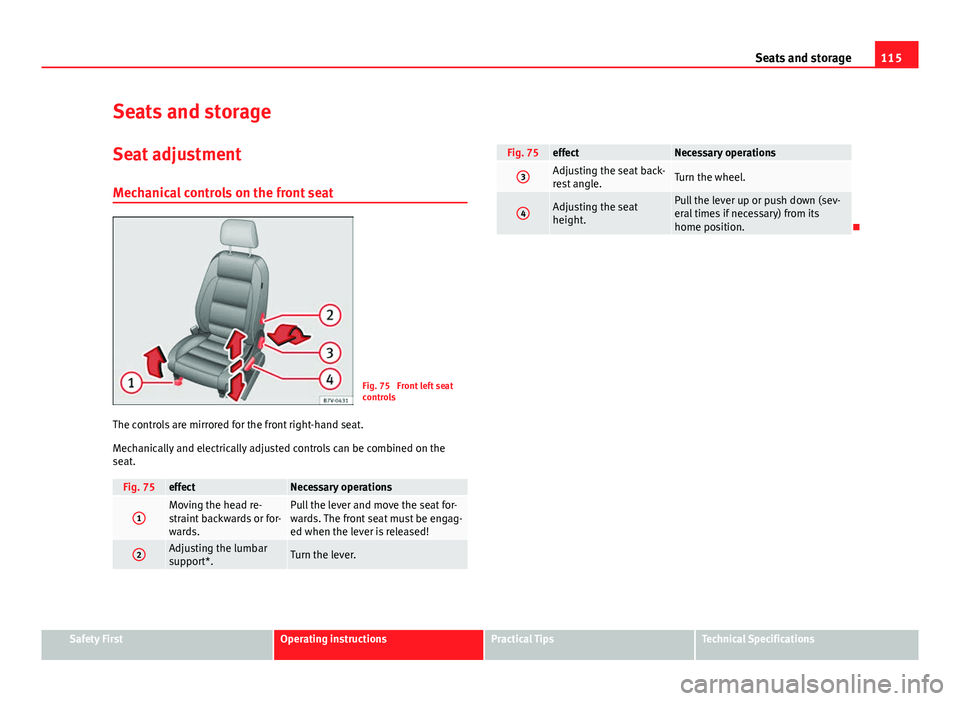
Mechanical controls on the front seat
Fig. 75 Front left seat
controls
The controls are mirrored for the front right-hand seat.
Mechanically and electrically adjusted controls can be combined on the
seat.
Fig. 75effectNecessary operations
1Moving the head re-
straint backwards or for-
wards.Pull the lever and move the seat for-
wards. The front seat must be engag-
ed when the lever is released!
2Adjusting the lumbar
support*.Turn the lever.
Fig. 75effectNecessary operations
3Adjusting the seat back-
rest angle.Turn the wheel.
4Adjusting the seat
height.Pull the lever up or push down (sev-
eral times if necessary) from its
home position.
Safety FirstOperating instructionsPractical TipsTechnical Specifications
Page 118 of 381

116Seats and storage
Electrical controls on the front seat*
Fig. 76 Adjusting the
front left seat forwards or
backwards, the height,
the seat angle and the
front seat backrest
Fig. 77 Adjusting the
lumbar support
The controls are mirrored for the front right-hand seat.
Mechanically and electrically adjusted controls can be combined on the
seat.
Fig. 76 Press the control in the direction of the arrow:
A1Move the seat backwards or forwards.2 and 3Raise or lower the seat.2 or 3Adjust the seat angle.
BForwards or
backwards.Adjust the seat backrest angle.
Fig. 77 Press the corresponding area of the switch:1 or 2Adjust the curve of the lumbar support.3 or 4Adjust the height of the lumbar support.
WARNING
Using the front electric seats in a careless or uncontrolled manner may
lead to severe injuries.
● The front seats can also be electrically adjusted when the ignition is
switched off. Never leave children or disabled people alone in the vehicle.
● In the event of an emergency, stop electrical adjustment by pressing
any button.
CAUTION
So as not the damage the electrical components of the front seats, do not
kneel on the seats or apply specific pressure to one point of the seat or seat
backrest.
Note
● It may not be possible to electrically adjust the seat if the vehicle battery
is very low.
● Seat adjustment is stopped when the engine is started.