2014 PEUGEOT PARTNER fuel
[x] Cancel search: fuelPage 92 of 244
90
Partner-2-VU_en_Chap05_Securite_ed02-2014
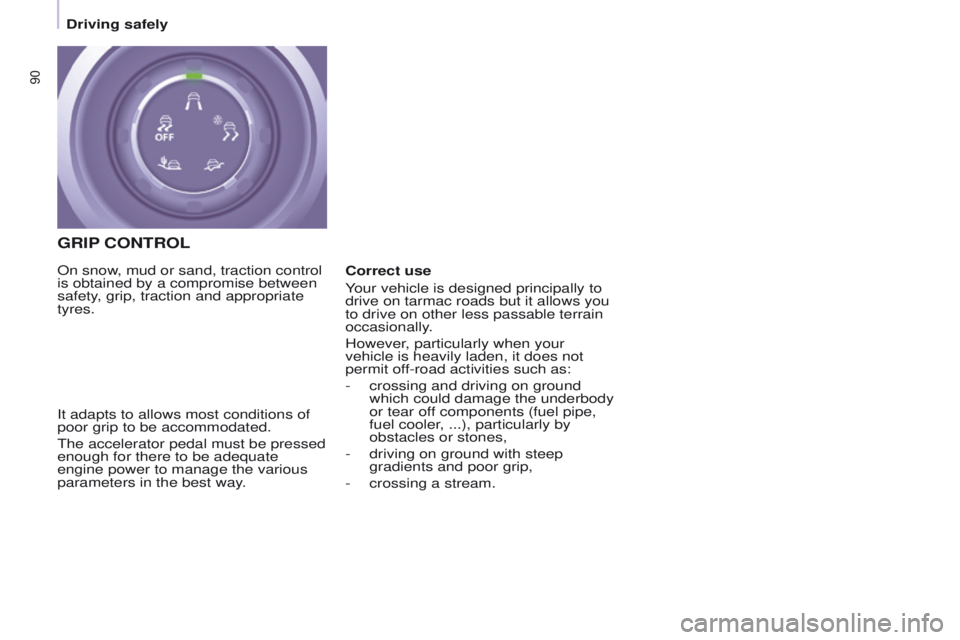
GRIP CONTROL
It adapts to allows most conditions of
poor grip to be accommodated.
The accelerator pedal must be pressed
enough for there to be adequate
engine power to manage the various
parameters in the best way. On snow, mud or sand, traction control
is obtained by a compromise between
safety, grip, traction and appropriate
tyres. Correct use
Your vehicle is designed principally to
drive on tarmac roads but it allows you
to drive on other less passable terrain
occasionally.
However, particularly when your
vehicle is heavily laden, it does not
permit off-road activities such as:
-
crossing and driving on ground
which could damage the underbody
or tear of
f components (fuel pipe,
fuel cooler, ...), particularly by
obstacles or stones,
-
driving on ground with steep
gradients and poor grip,
-
crossing a stream.
Driving safely
Page 121 of 244

11 9
Partner-2-VU_en_Chap07_Verification_ed02-2014
FILLING WITH FUEL
Low fuel level
Filling
The fuel tank must be filled with the
engine off.
-
Open the fuel filler flap.
-
Insert the key
, then turn it a quarter
turn.
-
Remove the cap and hook it onto
the clip located on the inside of the
flap.
When fillin
g with fuel, with the fuel
filler flap open, ensure that no one
attempts to open the sliding side
door.
When the minimum fuel tank
level is reached, this warning
lamp comes on.
You then have approximately 8 litres
of fuel remaining. Fill up without delay
to avoid running out of fuel.
Never risk driving until you run out of
fuel as this may damage the emissions
control and injection systems.Fuel used for petrol engines
A label affixed to the inside of the flap
reminds you of the type of fuel to be
used.
You must fill with at least 5 litres of fuel
for it to be registered by the fuel gauge.
When the fuel filler cap is opened,
there may be a slight air suction noise.
This vacuum is entirely normal and is
due to the sealing of the fuel circuit.
When filling the fuel tank, do not
continue after the 3
rd cut-off of the
nozzle. This could cause malfunctions.
The capacity of the fuel tank is
approximately 60 litres.
-
After fillin
g the fuel tank, lock the
cap and close the flap. The petrol engines are compatible
with E10 bio-petrol (containing
10
% ethanol), conforming to European
standards EN 228 and EN 15376.
E85 type fuels (containing up to
85 % ethanol) are reserved exclusively
for vehicles marketed for the use of
this type of fuel (BioFlex vehicles). The
quality of the ethanol must comply with
European standard EN 15293.
CHECKS
7
Fuel
Page 122 of 244
DIESEL
120
Partner-2-VU_en_Chap07_Verification_ed02-2014
FUEL CUT-OFF
In a serious collision, a mechanism
automatically prevents fuel from
reaching the engine.The flashing of this warning
lamp is accompanied by a
message in the screen.
Check that there is no odour or
leakage of fuel outside the vehicle and
re-establish the fuel supply:
-
switch of
f the ignition
(STOP
position),
-
remove the key
,
-
put the key back in the ignition,
-
switch on the ignition and start.
DIESEL PRIMING PUMP
If you should run out of fuel, it is
necessary to prime the fuel circuit:
-
fill the fuel tank with at least five
litres of Diesel,
-
squeeze and release the manual
priming pump, under the bonnet
under the protective cover
,
-
operate the starter until the engine
starts. Refer to chapter 7: "Under the
bonnet" section.
Fuel used for Diesel engines
The Diesel engines are compatible with
biofuels which conform to current and
future European standards (Diesel fuel
which complies with standard EN 590
mixed with a biofuel which complies
with standard EN 14214) available at
the pumps (containing up to 7 % Fatty
Acid Methyl Ester).
The B30 biofuel can be used in certain
Diesel engines; however, this use
is subject to strict application of the
special servicing conditions indicated
in the warranty and maintenance
record. Contact a PEUGEOT dealer or
a qualified workshop.
The use of any other type of (bio)
fuel (vegetable or animal oils, pure
or diluted, domestic fuel...) is strictly
prohibited (risk of damage to the
engine and fuel system).
Fuel
Page 123 of 244
121
Partner-2-VU_en_Chap07_Verification_ed02-2014
ADBLUE®ADDITIVE AND SCR
SYSTEM
FOR
B
LUE HD I D IESEL
ENGINES
To assure respect for the environment
and conformity with the new Euro 6
emissions standard, without adversely
affecting the performance or fuel
consumption of Diesel engines,
PEUGEOT has taken the decision
to equip its vehicles with an effective
system that associates SCR (Selective
Catalytic Reduction) with a particle
filter (FAP) for the treatment of exhaust
gases.
Presentation of the SCR system
Using an additive called AdBlue®
containing urea, a catalytic converter
turns up to 85% of nitrous oxides
(NOx) into nitrogen and water, which
are harmless to health and the
environment.
The AdBlue
® additive is held in a
special tank located under the boot
at the rear of the vehicle. It has a
capacity of 17 litres: this provides a
driving range of about 12 500 miles
(20
000
km), after which an alert
is triggered warning you when the
reserve remaining is enough for just
1
500 miles (2 400 km).
During each scheduled service of
your vehicle by a PEUGEOT dealer
or a qualified workshop, the AdBlue
®
additive tank is refilled in order to allow
normal operation of the SCR system.
If the estimated mileage between two
services is greater than 12 500 miles
(20 000 km), we recommend that you
go to a PEUGEOT dealer or a qualified
workshop to have the necessary top-
up carried out. Once the AdBlue
® tank is empty,
a system required by regulations
prevents starting of the engine.
If the SCR
is faulty, the level of
emissions from your vehicle will no
longer meet the Euro 6 standard: you
vehicle becomes polluting.
In the event of a confirmed fault with
the SCR system, you must go to
a PEUGEOT dealer or a qualified
workshop as soon as possible: after
a running distance of 650 miles
(1
100 km), a system will be triggered
automatically to prevent engine
starting.
CHECKS
7
AdBlue® additive
Page 128 of 244
126
Partner-2-VU_en_Chap07_Verification_ed02-2014
Topping-up the AdBlue® additive
Filling the AdBlue® tank is an operation
included in every routine service on
your vehicle by a PEUGEOT dealer or
a qualified workshop.
Nevertheless, given the capacity
of the tank, it may be necessary to
top-up the additive between services,
more particularly if an alert (warning
lamps and a message) signals the
requirement.
You can got to a PEUGEOT dealer or a
qualified workshop.
If you envisage topping-up yourself,
please read the following warnings
carefully. Precautions in use
The AdBlue® additive is an urea-based
solution. This liquid is non-flammable,
colourless and odourless (kept in a
cool area).
In the event of contact with the skin,
wash the affected area with soap and
water. In the event of contact with the
eyes, wash (irrigate) the eyes with
large amounts of water or with an eye
wash solution for at least 15 minutes.
If a burning sensation or irritation
persists, get medical attention.
If swallowed, immediately wash out the
mouth with clean water and then drink
plenty of water.
In certain conditions (high ambient
temperature, for example), the risk
of release of ammonia cannot be
excluded: do not inhale the product.
Ammonia vapour has en irritant effect
on mucous membranes (eyes, nose
and throat).
Keep AdBlue
® out of the reach of
children, in its original bottle.
Never transfer AdBlue
® to another
container: it would loose its purity. Use only AdBlue
® additive that meets
the ISO 22241 standard.
Never dilute the additive with
water.
Never pour the additive into the Diesel
fuel tank.
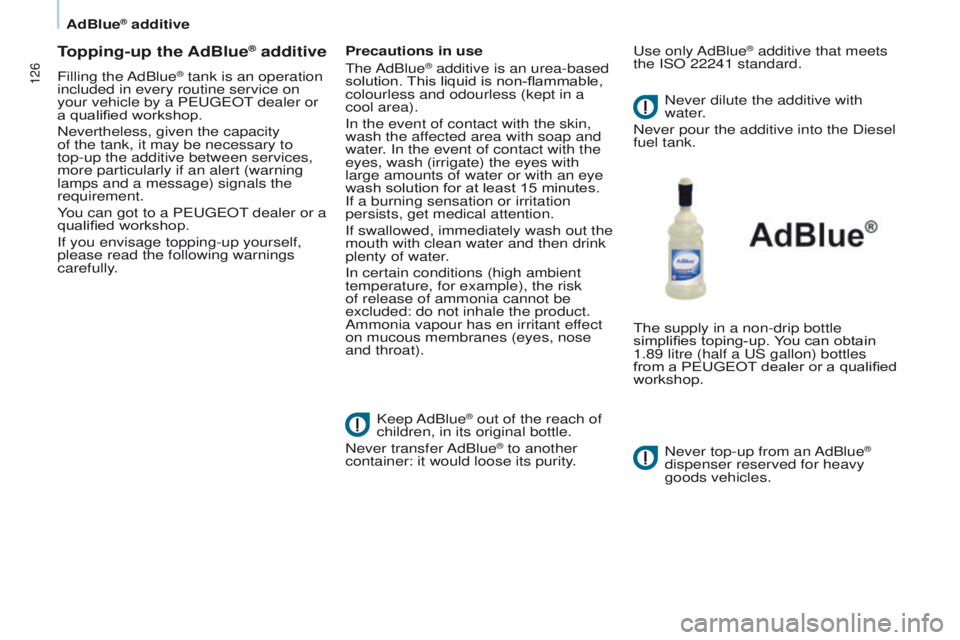
The supply in a non-drip bottle
simplifies toping-up. You can obtain
1.89 litre (half a US gallon) bottles
from a PEUGEOT
dealer or a qualified
workshop.
Never top-up from an AdBlue
®
dispenser reserved for heavy
goods vehicles.
AdBlue® additive
Page 129 of 244
127
Partner-2-VU_en_Chap07_Verification_ed02-2014
Recommendations on storage
AdBlue® freezes at about -11°C
and deteriorates above 25°C. It is
recommended that bottles be stored in
a cool area and protected from direct
sunlight.
Under these conditions, the additive
can be kept for at least a year.
If the additive has frozen, can be used
once it has completely thawed out.
Never store bottles of AdBlue
® in
your vehicle. Procedure
Before topping-up, ensure that the
vehicle is parked on a flat and level
surface.
In wintry conditions, ensure that the
temperature of the vehicle is above
-11°C. Otherwise, by freezing, the
AdBlue
® cannot be poured into its tank.
Park your vehicle in a warmer area for
a few hours to allow the top-up to be
carried out.
F
Switch of
f the ignition and remove
the key.
-
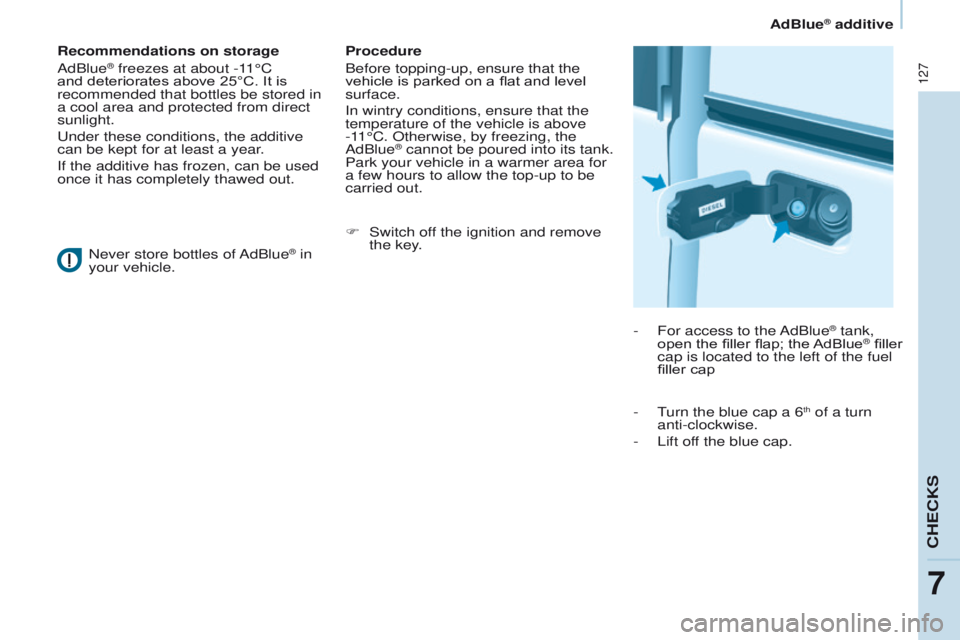
For access to the
AdBlue
® tank,
open the filler flap; the AdBlue® filler
cap is located to the left of the fuel
filler cap
-
T
urn the blue cap a 6
th of a turn
anti-clockwise.
-
Lift of
f the blue cap.
CHECKS
7
AdBlue® additive
Page 157 of 244

155
Partner-2-VU_en_Chap09_Caract-technique_ed02-2014
WEIGHTS AND TOWED LOADS
The weights and towable loads for your
vehicle can be found on the vehicle's
registration certificate.
These values, expressed in kg, are
laos present on the manufacturer's
plate or label.The recommended nose weight is
the downward force on the towball
(removable with or without tools).
In each country, it is imperative that
the towed loads authorised by local
legislation are complied with. To find
out your vehicle's towing capacities
and its gross train weight, consult a
PEUGEOT dealer.
The kerb weight is equal to the weight
without load + driver (75 kg) + fuel tank
filled to 90%.
The GTW and towed load values
indicated are valid up to a maximum
altitude of 1000 metres. The value of
the towed load mentioned must be
reduced by 10 % for each additional
1000 metres.
With load transfer, the braked trailer
weight can be increased, on condition
that the equivalent of this load is
removed from the vehicle so that the
GTW is not exceeded. High ambient temperatures
may result in a reduction in the
performance of the vehicle in
order to protect the engine. When the
ambient temperature is higher than
37
°C, limit the towed weight.
Refer to chapter 9, "Identification
markings" section.
ENGINE CHARACTERISTICS
The engine characteristics (capacity,
maximum power, maximum power
speed, fuel, CO
2 emissions...) for your
vehicle are given in the registration
document.
These characteristics correspond
to the values type-approved
on a test bed, under conditions
defined in European legislation
(Directive
1999/99/EC).
For more information, refer to the
manufacturer's website or sales
brochure for the model. Contact
a PEUGEOT dealer or a qualified
workshop. GVW: gross vehicle weight, the
maximum authorised weight.
GTW: gross train weight, the maximum
weight for vehicle plus trailer.
Towing with a lightly loaded
vehicle can adversely affect road
holding.
Towing a trailer increases braking
distances.
When towing, the maximum permitted
speed is reduced (comply with the
legislation in force in the country).
TECHNICAL DATA
9
Weights
Page 205 of 244

11
10.47
Partner-2-VU_en_Chap10b_RT6-2-8_ed02-2014
TRIP COMPUTER
Trip computer
Press the MODE button several
times in succession until the trip
computer is displayed.
Range: displays the distance which can travelled with the
remaining fuel detected in the tank, basd on the average
consumption over the last few miles (kilometres).
This displayed value may vary significantly following a change in
the vehicle speed or the relief of the route.
When the range falls below 20 miles (30 km), dashes are
displayed. After filling with at least 10 litres of fuel, the range is
recalculated and is displayed when it exceeds 60 miles (100 km).
If, whilst driving, dashes are displayed continuously in place of the
digits, contact a PEUGEOT dealer.
Current fuel consumption:
only calculated and displayed above
20 mph (30 km/h).
Average fuel consumption: this is the average fuel consumption
since the last trip computer zero reset.
Distance travelled: calculated since the last trip computer zero
reset.
Distance remaining to the destination:
calculated with reference
to the final destination, entered by the user. If guidance is
activated, the navigation system calculates it as a current value.
Average speed: this is the average speed calculated since the last
trip computer zero reset (ignition on).
Each press of the button at the end of the wiper stalk displays the
different trip computer information in succession, according to the
screen.
A few definitions
- The "vehicle" tab:
The range, the current fuel
consumption and the distance
remaining.
-
The "1" (trip 1) tab with:
The average speed, the average
fuel consumption and the
distance travelled calculated
over route "1".
-
The "2" (trip 2) tab with the same
functions for a second route.