Page 66 of 352
64
Access
Fuel tank Capacity of the tank: approximately 72 litres (or 55 litres according to version).
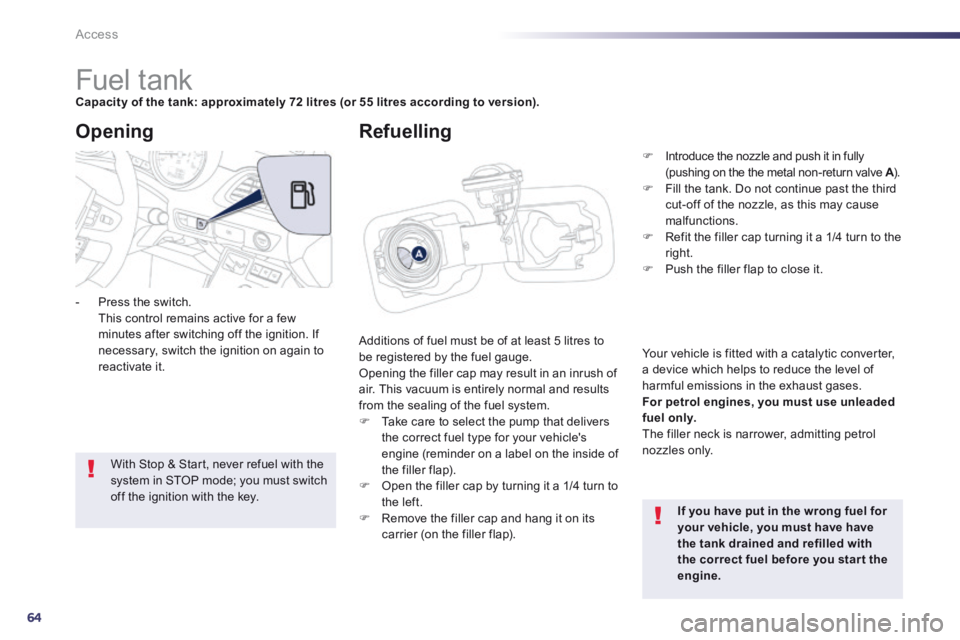
Additions of fuel must be of at least 5 litres to be registered by the fuel gauge. Opening the filler cap may result in an inrush of air. This vacuum is entirely normal and results from the sealing of the fuel system. Take care to select the pump that delivers
the correct fuel type for your vehicle's engine (reminder on a label on the inside of the filler flap). Open the filler cap by turning it a 1/4 turn to the left. Remove the filler cap and hang it on its carrier (on the filler flap).
Opening
If you have put in the wrong fuel for your vehicle, you must have have the tank drained and refilled with the correct fuel before you star t the engine.
With Stop & Start, never refuel with the system in STOP mode; you must switch off the ignition with the key.
- Press the switch. This control remains active for a few minutes after switching off the ignition. If necessary, switch the ignition on again to reactivate it.
Refuelling
Introduce the nozzle and push it in fully (pushing on the the metal non-return valve A ). A ). A Fill the tank. Do not continue past the third cut-off of the nozzle, as this may cause malfunctions.
Refit the filler cap turning it a 1/4 turn to the right. Push the filler flap to close it.
Your vehicle is fitted with a catalytic converter, a device which helps to reduce the level of harmful emissions in the exhaust gases. For petrol engines, you must use unleaded fuel only. The filler neck is narrower, admitting petrol nozzles only.
Page 67 of 352
2
65
Access
Low fuel level
When the low fuel level in the tank is reached, this warning lamp comes on in the instrument panel, accompanied by an audible warning and a message in the instrument panel screen. When it first comes on, around 7 litres of fuel remain in the tank. You must refuel as soon as possible to avoid running out.
Fuel supply cut-off
Your vehicle is equipped with a safety device which cuts off the fuel supply in the event of a collision.
It is still possible to use a fuel can to fill the tank but this must be done slowly. In order to ensure a good flow of fuel, do not place the nozzle of the fuel can in direct contact with the flap of the misfuel prevention device.
Diesel misfuel prevention
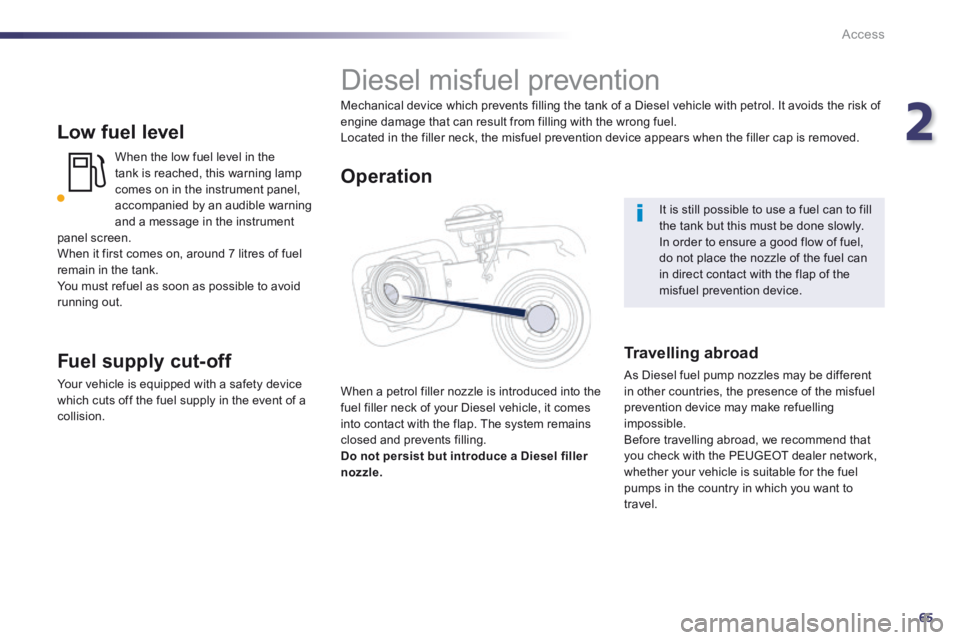
Mechanical device which prevents filling the tank of a Diesel vehicle with petrol. It avoids the risk of engine damage that can result from filling with the wrong fuel. Located in the filler neck, the misfuel prevention device appears when the filler cap is removed.
When a petrol filler nozzle is introduced into the fuel filler neck of your Diesel vehicle, it comes into contact with the flap. The system remains
closed and prevents filling. Do not persist but introduce a Diesel filler nozzle.
Operation
Travelling abroad
As Diesel fuel pump nozzles may be different in other countries, the presence of the misfuel prevention device may make refuelling impossible. Before travelling abroad, we recommend that you check with the PEUGEOT dealer network, whether your vehicle is suitable for the fuel pumps in the country in which you want to travel.
Page 68 of 352
66
DIESEL
Access
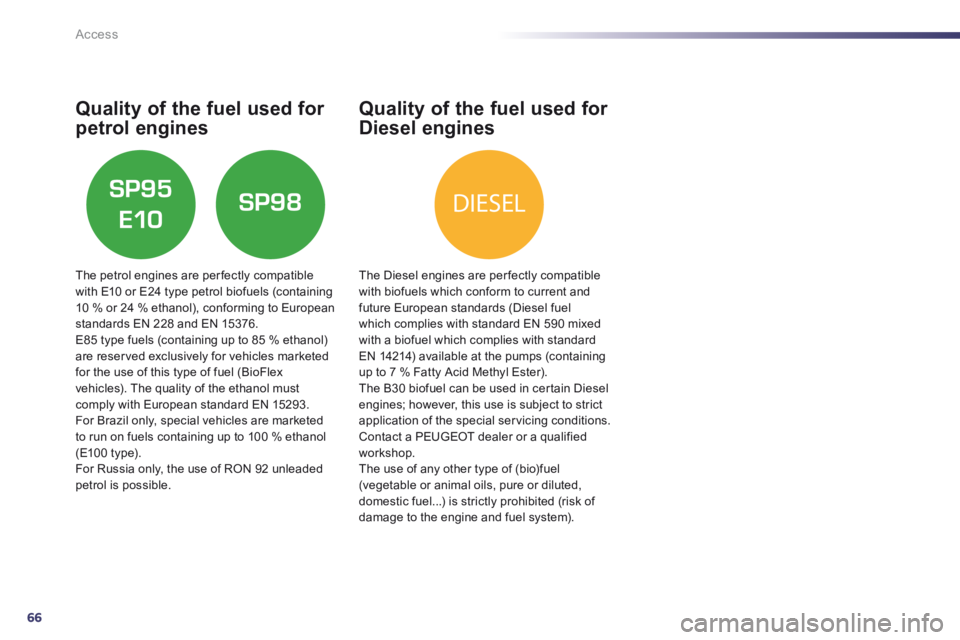
Quality of the fuel used for
petrol engines
The petrol engines are per fectly compatible with E10 or E24 type petrol biofuels (containing 10 % or 24 % ethanol), conforming to European standards EN 228 and EN 15376. E85 type fuels (containing up to 85 % ethanol) are reserved exclusively for vehicles marketed for the use of this type of fuel (BioFlex vehicles). The quality of the ethanol must comply with European standard EN 15293. For Brazil only, special vehicles are marketed
to run on fuels containing up to 100 % ethanol (E100 type). For Russia only, the use of RON 92 unleaded petrol is possible.
Quality of the fuel used for
Diesel engines
The Diesel engines are per fectly compatible with biofuels which conform to current and future European standards (Diesel fuel which complies with standard EN 590 mixed with a biofuel which complies with standard EN 14214) available at the pumps (containing up to 7 % Fatty Acid Methyl Ester). The B30 biofuel can be used in certain Diesel engines; however, this use is subject to strict application of the special servicing conditions.
Contact a PEUGEOT dealer or a qualified workshop. The use of any other type of (bio)fuel (vegetable or animal oils, pure or diluted, domestic fuel...) is strictly prohibited (risk of damage to the engine and fuel system).
Page 221 of 352
9
219
Checks
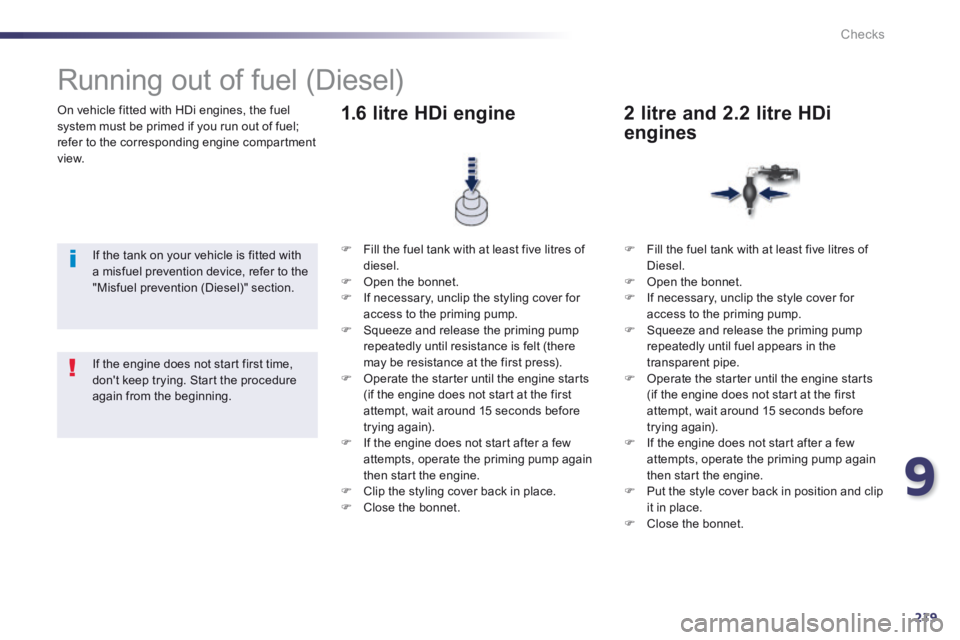
On vehicle fitted with HDi engines, the fuel system must be primed if you run out of fuel; refer to the corresponding engine compartment view.
Running out of fuel (Diesel)
If the tank on your vehicle is fitted with a misfuel prevention device, refer to the "Misfuel prevention (Diesel)" section.
Fill the fuel tank with at least five litres of diesel. Open the bonnet. If necessary, unclip the styling cover for access to the priming pump. Squeeze and release the priming pump repeatedly until resistance is felt (there may be resistance at the first press). Operate the starter until the engine starts (if the engine does not start at the first attempt, wait around 15 seconds before trying again). If the engine does not start after a few attempts, operate the priming pump again then start the engine. Clip the styling cover back in place. Close the bonnet.
1.6 litre HDi engine
Fill the fuel tank with at least five litres of Diesel. Open the bonnet. If necessary, unclip the style cover for access to the priming pump. Squeeze and release the priming pump repeatedly until fuel appears in the transparent pipe. Operate the starter until the engine starts (if the engine does not start at the first attempt, wait around 15 seconds before trying again). If the engine does not start after a few attempts, operate the priming pump again then start the engine. Put the style cover back in position and clip it in place. Close the bonnet.
2 litre and 2.2 litre HDi
engines
If the engine does not start first time, don't keep trying. Start the procedure again from the beginning.
Page 224 of 352
222
Checks
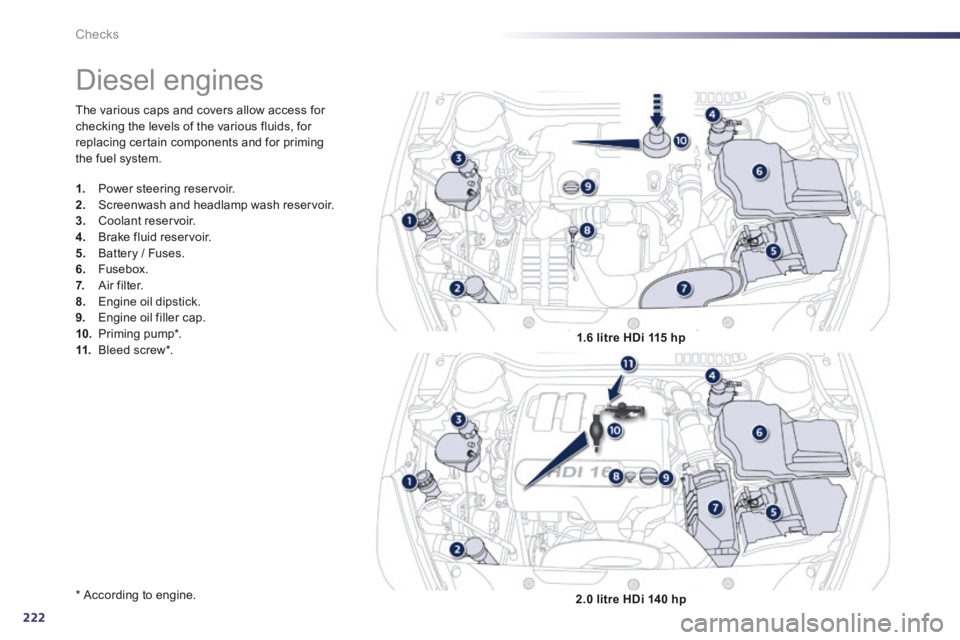
The various caps and covers allow access for checking the levels of the various fluids, for replacing certain components and for priming the fuel system.
* According to engine.
Diesel engines
1. Power steering reservoir. 2. Screenwash and headlamp wash reservoir. 3. Coolant reservoir.
4. Brake fluid reservoir. 5. Battery / Fuses. 6. Fusebox. 7. Air filter. 8. Engine oil dipstick. 9. Engine oil filler cap. 10. Priming pump * . 11. Bleed screw * . 1.6 litre HDi 115 hp
2.0 litre HDi 140 hp
Page 225 of 352
9
223
Checks
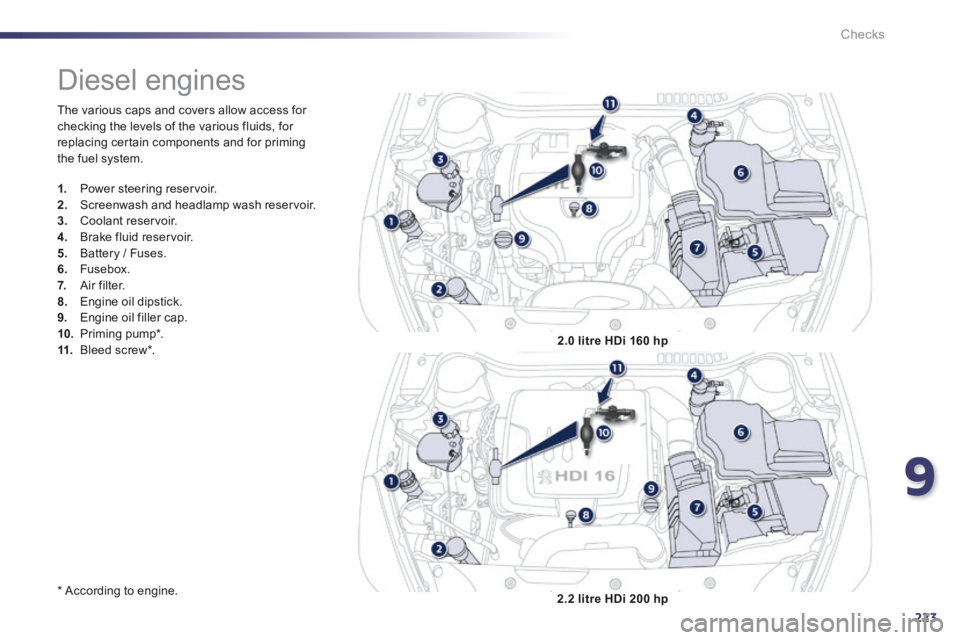
The various caps and covers allow access for checking the levels of the various fluids, for replacing certain components and for priming the fuel system.
* According to engine.
Diesel engines
1. Power steering reservoir. 2. Screenwash and headlamp wash reservoir. 3. Coolant reservoir.
4. Brake fluid reservoir. 5. Battery / Fuses. 6. Fusebox. 7. Air filter. 8. Engine oil dipstick. 9. Engine oil filler cap. 10. Priming pump * . 11. Bleed screw * . 2.0 litre HDi 160 hp
2.2 litre HDi 200 hp