2014 Peugeot 508 ABS
[x] Cancel search: ABSPage 31 of 352
1
29
Monitoring
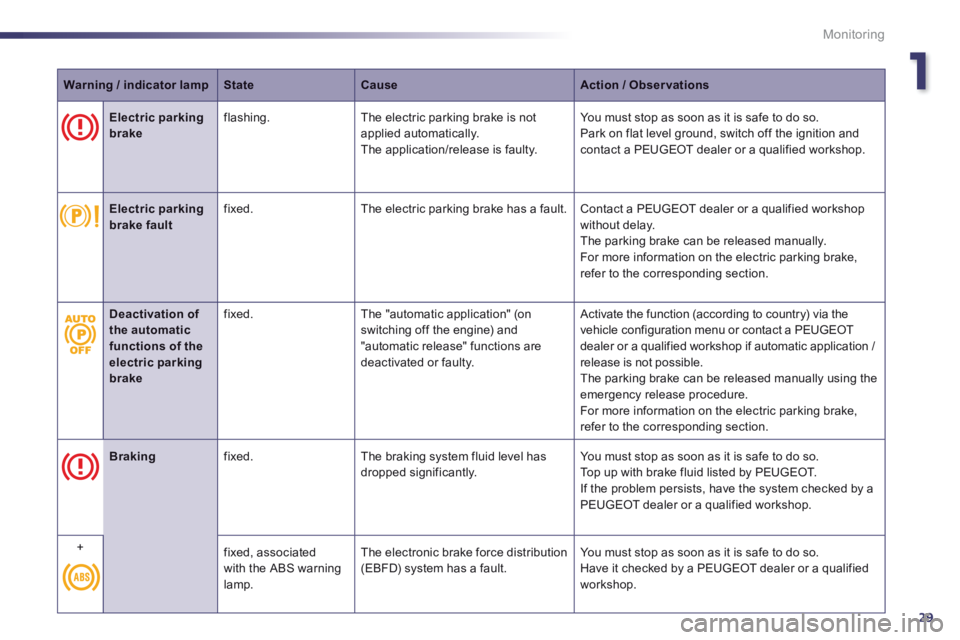
Warning / indicator lampStateCauseAction / Observations
Electric parking brake flashing. The electric parking brake is not applied automatically. The application/release is faulty.
You must stop as soon as it is safe to do so. Park on flat level ground, switch off the ignition and contact a PEUGEOT dealer or a qualified workshop.
Electric parking
brake fault
fixed. The electric parking brake has a fault. Contact a PEUGEOT dealer or a qualified workshop
without delay. The parking brake can be released manually. For more information on the electric parking brake, refer to the corresponding section.
Braking fixed. The braking system fluid level has dropped significantly. You must stop as soon as it is safe to do so. Top up with brake fluid listed by PEUGEOT. If the problem persists, have the system checked by a PEUGEOT dealer or a qualified workshop.
+ fixed, associated with the ABS warning
lamp.
The electronic brake force distribution (EBFD) system has a fault. You must stop as soon as it is safe to do so. Have it checked by a PEUGEOT dealer or a qualified
workshop.
Deactivation of the automatic functions of the electric parking brake
fixed. The "automatic application" (on switching off the engine) and "automatic release" functions are deactivated or faulty.
Activate the function (according to country) via the vehicle configuration menu or contact a PEUGEOT dealer or a qualified workshop if automatic application / release is not possible. The parking brake can be released manually using the emergency release procedure. For more information on the electric parking brake, refer to the corresponding section.
Page 32 of 352
30
Monitoring
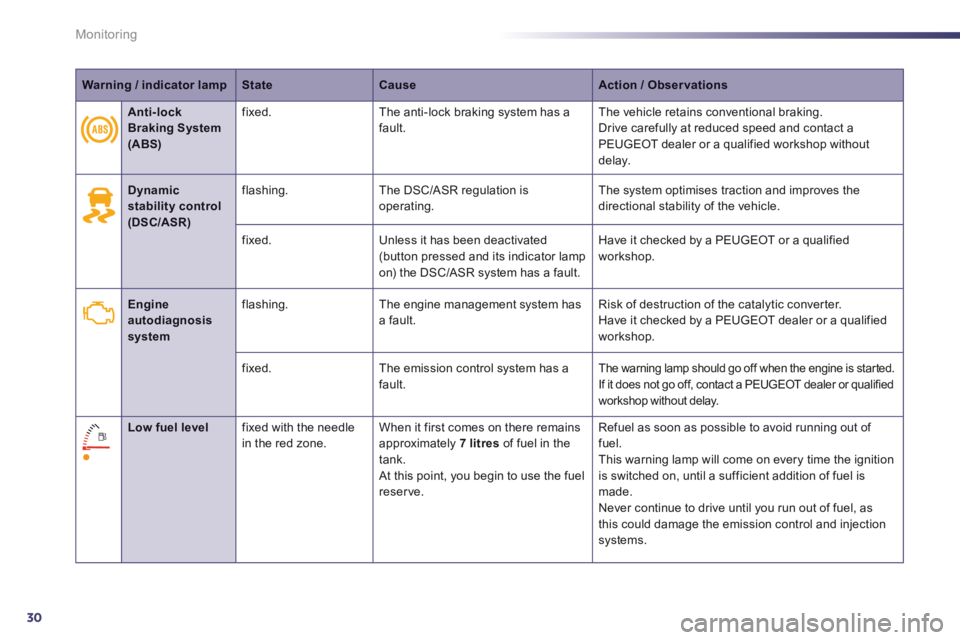
Warning / indicator lampStateCauseAction / Observations
Dynamic stability control (DSC/ASR)
flashing. The DSC/ASR regulation is operating. The system optimises traction and improves the directional stability of the vehicle.
fixed. Unless it has been deactivated (button pressed and its indicator lamp on) the DSC/ASR system has a fault.
Have it checked by a PEUGEOT or a qualified workshop.
Engine autodiagnosis system
flashing. The engine management system has a fault. Risk of destruction of the catalytic converter. Have it checked by a PEUGEOT dealer or a qualified workshop.
fixed. The emission control system has a fault. The warning lamp should go off when the engine is started. If it does not go off, contact a PEUGEOT dealer or qualified workshop without delay.
Low fuel level fixed with the needle in the red zone. When it first comes on there remains approximately 7 litres of fuel in the tank. At this point, you begin to use the fuel reserve.
Refuel as soon as possible to avoid running out of fuel. This warning lamp will come on every time the ignition is switched on, until a sufficient addition of fuel is made. Never continue to drive until you run out of fuel, as this could damage the emission control and injection systems.
Anti-lock Braking System (ABS)
fixed. The anti-lock braking system has a fault. The vehicle retains conventional braking. Drive carefully at reduced speed and contact a PEUGEOT dealer or a qualified workshop without d e l ay.
Page 40 of 352
38
Monitoring
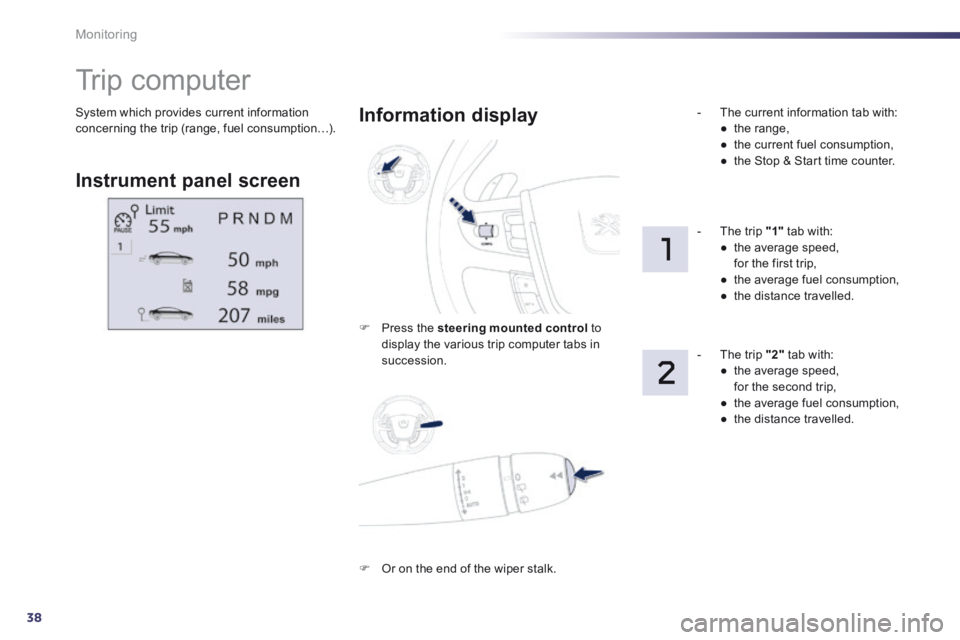
System which provides current information concerning the trip (range, fuel consumption…).
Trip computer
Instrument panel screen
Information display
Press the steering mounted control to display the various trip computer tabs in succession.
- The current information tab with: ● t h e r a n g e , ● the current fuel consumption, ● the Stop & Start time counter.
- The trip "1" tab with: ● the average speed, for the first trip, ● the average fuel consumption, ● t h e d i s t a n c e t r a v e l l e d .
- The trip "2" tab with: ● the average speed, for the second trip, ● the average fuel consumption, ● t h e d i s t a n c e t r a v e l l e d .
Or on the end of the wiper stalk.
Page 56 of 352
54
Access
Locking the vehicle
with exterior perimeter
monitoring only
Deactivate the interior volumetric and anti-lift monitoring to avoid unwanted triggering of the alarm in certain cases such as: - leaving a window partially open, - washing your vehicle, - changing a wheel, - having your vehicle towed, - transportation by sea.
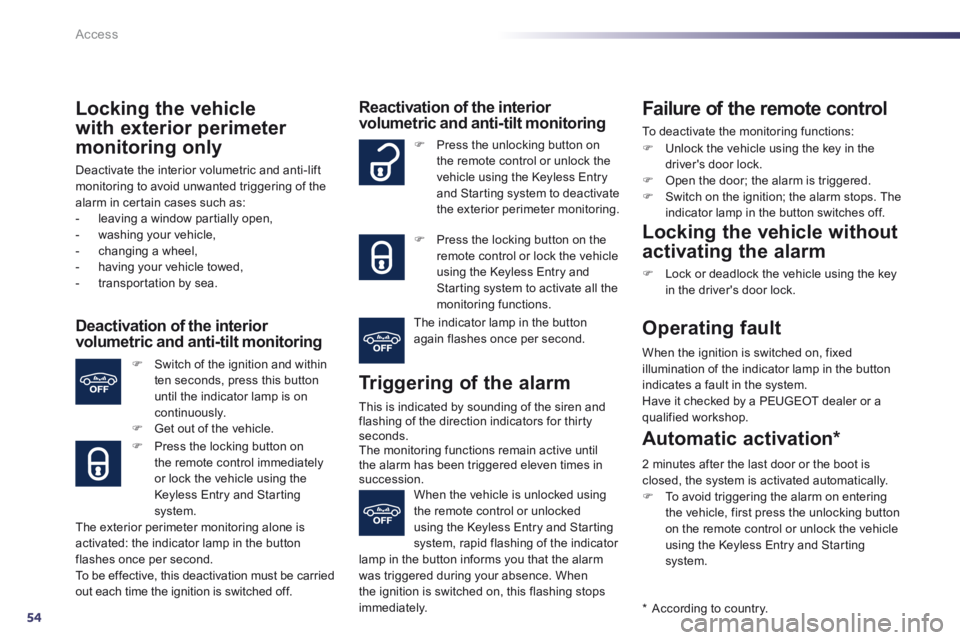
Deactivation of the interior volumetric and anti-tilt monitoring
Switch of the ignition and within ten seconds, press this button until the indicator lamp is on continuously. Get out of the vehicle.
Press the locking button on the remote control immediately or lock the vehicle using the Keyless Entry and Starting system.
The exterior perimeter monitoring alone is activated: the indicator lamp in the button flashes once per second. To be effective, this deactivation must be carried out each time the ignition is switched off.
Reactivation of the interior volumetric and anti-tilt monitoring
Triggering of the alarm
This is indicated by sounding of the siren and flashing of the direction indicators for thirty seconds. The monitoring functions remain active until the alarm has been triggered eleven times in succession.
Press the unlocking button on the remote control or unlock the vehicle using the Keyless Entry and Starting system to deactivate the exterior perimeter monitoring.
Press the locking button on the remote control or lock the vehicle using the Keyless Entry and Starting system to activate all the monitoring functions.
The indicator lamp in the button again flashes once per second.
When the vehicle is unlocked using the remote control or unlocked using the Keyless Entry and Starting system, rapid flashing of the indicator lamp in the button informs you that the alarm was triggered during your absence. When the ignition is switched on, this flashing stops immediately.
Failure of the remote control
To deactivate the monitoring functions:
Unlock the vehicle using the key in the driver's door lock. Open the door; the alarm is triggered. Switch on the ignition; the alarm stops. The indicator lamp in the button switches off.
Locking the vehicle without
activating the alarm
Lock or deadlock the vehicle using the key in the driver's door lock.
Operating fault
When the ignition is switched on, fixed illumination of the indicator lamp in the button indicates a fault in the system. Have it checked by a PEUGEOT dealer or a qualified workshop.
* According to country.
Automatic activation *
2 minutes after the last door or the boot is closed, the system is activated automatically. To avoid triggering the alarm on entering the vehicle, first press the unlocking button on the remote control or unlock the vehicle
using the Keyless Entry and Starting system.
Page 161 of 352
6
159
Child safety
The incorrect installation of a child seat in a vehicle compromises the child's protection in the event of an accident. Remember to fasten the seat belts or the child seat harnesses keeping the slack relative to the child's body to a minimum, even for short journeys. When installing a child seat using the seat belt, ensure that the seat belt is tightened correctly on the child seat and that it secures the child seat firmly on the seat of your vehicle. If your passenger seat is adjustable, move it for wards if necessary. For optimum installation of the "forwards-facing" child seat, ensure that the back of the child seat is in contact with the back of the vehicle's seat and that the head restraint does not cause any discomfort. If the head restraint has to be removed,
ensure that it is stored or attached securely to prevent it from being thrown around the vehicle in the event of sharp braking.
Advice on child seats
As a safety precaution, do not leave: - a child or children alone and unsupervised in a vehicle, - a child or an animal in a vehicle which is exposed to the sun, with the windows closed, - the keys within reach of children inside the vehicle. To prevent accidental opening of the doors and rear windows, use the "Child lock". Take care not to open the rear windows by more than one third. To protect young children from the rays of the sun, fit side blinds on the rear windows.
Children under the age of 10 must not travel in the "for wards-facing" position on the front passenger seat, unless the rear seats are already occupied by other children, cannot be used or are absent. Deactivate the passenger airbag when a "rear wards-facing" child seat is installed on the front seat. Otherwise, the child would risk being seriously injured or killed if the airbag were to inflate.
Installing a booster seat
The chest part of the seat belt must be positioned on the child's shoulder without touching the neck. Ensure that the lap part of the seat belt passes correctly over the child's thighs. PEUGEOT recommends the use of a booster seat which has a back, fitted with a seat belt guide at shoulder level.
Page 167 of 352
7
165
Safety
Direction indicators
Lower the lighting control stalk fully when moving to the left. Raise the lighting control stalk fully when moving to the right.
"Motorway" function
Move the stalk briefly upwards or downwards, without going beyond the point of resistance; the corresponding direction indicators will flash 3 times.
If you forget to cancel the
direction indicators for more than twenty seconds, the volume of the audible signal will increase if the speed is above 40 mph (60 km/h).
Hazard warning lamps
Press the button, the direction indicators flash. They can operate with the ignition off.
Automatic operation of
hazard warning lamps
When braking in an emergency, depending on the rate of deceleration, as well as when the ABS regulation is invoked or in the event of an impact, the hazard warning lamps come on automatically. They switch off automatically the first time you accelerate. You can also switch them off by pressing the button.
Page 171 of 352
7
169
Safety
Electronic Stability Programme (ESC: Electronic Stability Control) incorporating the following systems: - the anti-lock braking system (ABS) and the electronic brake force distribution (EBFD), - the emergency braking assistance, - the anti-slip regulation (ASR) or traction control, - the dynamic stability control (DSC).
Electronic stability programme (ESC)
Definitions
Anti-lock braking system (ABS) and electronic brake force distribution (EBFD)
This system improves the stability and manoeuvrability of your vehicle when braking and provides improved control in corners, in particular on poor or slippery road sur faces. The ABS prevents wheel lock in the event of emergency braking. The electronic brake force distribution system manages the braking pressure wheel by wheel.
Emergency braking assistance
In an emergency, this system enables you to reach the optimum braking pressure more quickly and therefore reduce the stopping distance. It is triggered according to the speed at which the brake pedal is pressed. This is felt by a reduction in the resistance of the pedal and an increase in the effectiveness of the braking.
Anti-slip regulation (ASR)
The ASR system (also known as Traction Control) optimises traction in order to avoid wheel slip by acting on the brakes of the driving wheels and on the engine. It also improves the directional stability of the vehicle on acceleration.
Dynamic stability control (DSC)
If there is a difference between the path followed by the vehicle and that required by the driver, the DSC monitors each wheel and automatically acts on the brake of one or more wheels and on the engine to return the vehicle to the required path, within the limits of the laws of physics.
Page 172 of 352
170
Safety
Snow driving assistance
(Intelligent Traction Control)
Your vehicle has a system to help driving on snow: Intelligent Traction Control. This automatic system continuously checks for situations of difficult sur face adhesion that could make it difficult to move off or make progress on deep fresh snow or compacted snow. In these situations, Intelligent Traction Control limits the amount of wheel slip to provide the best traction and trajectory control. In extremely severe conditions (deep snow, mud…), it can be useful to temporarily deactivate the wheel anti-slip regulationsystem to allow a degree of wheel spin and so recover grip. It is recommended that the system be reactivated as soon as possible. Snow tyres are strongly recommended on sur faces offering low levels of adhesion.
Operation
Anti-lock braking system (ABS) and electronic brake force distribution (EBFD)
In emergency braking, press very firmly without releasing the pressure.
When changing wheels (tyres and rims), make sure that these are approved for your vehicle. Normal operation of the ABS may make itself felt by slight vibrations of the brake pedal.
When this warning lamp comes on, accompanied by an audible signal and a message, it indicates that there is a fault with the ABS, which could cause loss of control of the vehicle when braking.
When this warning lamp comes on, coupled with the STOP warning lamp, accompanied by an audible signal and a message, it indicates that there is a fault with the electronic brake force distribution (EBFD), which could cause loss of control of the vehicle when braking. You must stop as soon as it is safe to do so. In both cases, contact a PEUGEOT dealer or a qualified workshop.