2014 PEUGEOT 5008 brake light
[x] Cancel search: brake lightPage 54 of 404
Multifunction screens
52
"SETUP" menu (PEUGEOT Connect PEUGEOT Connect PEUGEOT
Media Navigation (NG4 3D))
Press the "SETUP" menu for access to the "SETUP" menu . It allows you to adjust settings for the following functions: - "Languages and voice functions" - "Date and time", - "Display screen", - "Units", - "System parameters".
Languages (PEUGEOT Connect Navigation (RT6))
This menu allows you to select the language used by the display.
Languages and voice functions (PEUGEOT Connect Media Navigation (NG4 3D))
This menu allows you to: - select the language used by the display, - select the settings for voice recognition (on/off, instructions on use, personal voice training...), - adjust the volume of the voice synthesiser.
Date and time
Press "SETUP". Select "Display configuration" and confirm. Select "Adjust date and time" and confirm. Select "Synchronise minutes with GPS" for the adjustment of minutes to be done automatically by satellite reception. Select the setting to modify. Conform by pressing "OK", then adjust the setting and confirm again. Adjust the settings one by one.
Select "OK" in the screen then confirm to save the settings.
Display
This menu allows you to set the brightness of the screen, the screen colour scheme and the colour of the map (day/night or auto mode).
Units
This menu allows you to select the units: temperature (°C or °F) and fuel consumption (km/l, l/100 or mpg).
System parameters
This menu allows you to restore the factory configuration, display the software version and activate scrolling text.
For safety reasons, configuration of the multifunction screen by the driver must
only be done when stationary.
* According to country.
Vehicle parameters (PEUGEOTConnect Navigation (RT6))
This menu allows you to activate or deactivate certain driving and comfort equipment * : - wiper linked with reverse gear (refer to the "Visibility" section), - selective unlocking (refer to the "Access" section), - guide-me-home and welcome lighting (refer to the " Visibility" section), - interior mood lighting (refer to the "Visibility" section), - directional headlamps (refer to the "Visibility" section), - automatic or manual parking brake (refer to the "Driving" section), - ...
Press the "SETUP" button for access to the "SETUP" menu. This allows you to select from the following functions: - "Languages", - "Date and time", - "Display", - " Vehicle parameters", - "Units", - "System".
"SETUP" menu (PEUGEOT Connect Navigation (RT6)) PEUGEOT Connect Navigation (RT6)) PEUGEOT
Page 158 of 404
Safety
156
Operation
When this warning lamp comes on, accompanied by an audible signal and a message, it indicates that there is a fault with the ABS, which could cause loss of control of the vehicle when braking.
When this warning lamp comes on, coupled with the STOP warning lamp, accompanied by an audible signal and a message, it indicates that there is a fault with the electronic brake force distribution (EBFD), which could cause loss of control of the vehicle when braking.
You must stop as soon as it is safe to do so. In both cases, contact a PEUGEOT dealer or a qualified workshop.
Anti-lock braking system (ABS) and electronic brake force distribution (EBFD)
In emergency braking, press ver y firmly without releasing the pressure.
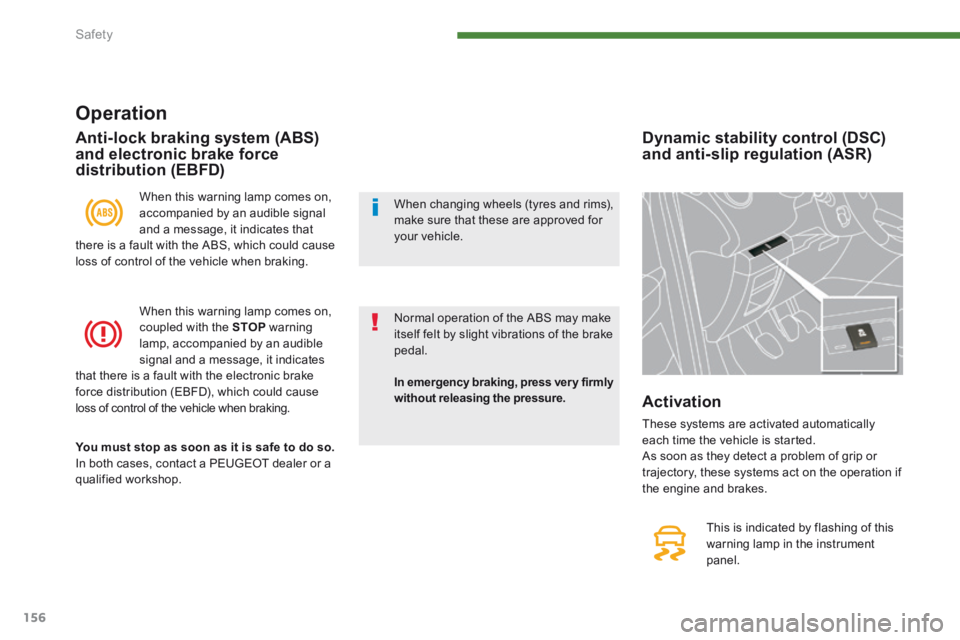
Dynamic stability control (DSC) and anti-slip regulation (ASR)
This is indicated by flashing of this
warning lamp in the instrument panel.
Activation
These systems are activated automatically each time the vehicle is started. As soon as they detect a problem of grip or trajectory, these systems act on the operation if the engine and brakes.
Normal operation of the ABS may make itself felt by slight vibrations of the brake pedal.
When changing wheels (tyres and rims), make sure that these are approved for your vehicle.
Page 196 of 404
Driving
194
Stopping the vehicle
Before switching off the engine, you can engage position P or N to place the gearbox in neutral. In both cases, apply the parking brake to immobilise the vehicle, unless it is programmed to automatic mode.
Operating fault
When the ignition is on, the lighting of this warning lamp, accompanied by an audible signal and a message in the multifunction screen, indicates a gearbox malfunction. In this case, the gearbox switches to back-up mode and is locked in 3rd gear. You may feel a substantial knock when changing from Pto R and from N to R . This will not cause any damage to the gearbox. Do not exceed 60 mph (100 km/h), local speed restrictions permitting. Have it checked by a PEUGEOT dealer or a qualified workshop. This warning lamp may also come on if a door is opened.
Invalid value during manual operation
This symbol is displayed if a gear is not engaged correctly (selector between two positions).
You risk damaging the gearbox: - if you press the accelerator and brake pedals at the same time, - if you force the lever from position Pto another position when the battery is flat. To reduce fuel consumption when stationary for long periods with the engine running (traffic jam...), position the gear lever at N and apply the parking brake, unless it is programmed in automatic mode.
If the lever is not in position P , when the P , when the Pdriver's door is opened or approximately 45 seconds after the ignition is switched off, there is an audible signal and a message appears.
Return the lever to position P ; the audible signal stops and the message disappears.
Page 197 of 404
9
Driving195
Stop & Start
Operation
Going into engine STOP mode
The "ECO" warning lamp comes on in the instrument panel and the engine goes into standby:
- with an electronic gearbox , at speeds below 4 mph (6 km/h), press the brake pedal or put the gear lever in position N .
If your vehicle is fitted with the system, a time counter calculates the sum of the periods in STOP mode during a journey. It rests itself to zero every time the ignition is switched on with the key.
Special cases: STOP mode not available
STOP mode is not invoked when: - the driver's door is open, - the driver's seat belt is not fastened, - the vehicle has not exceeded 6 mph (10 km/h) since the last engine start using
the key, - the electric parking brake is applied or being applied, - the engine is needed to maintain a comfortable temperature in the passenger compartment, - demisting is active, - some special conditions (battery charge, engine temperature, braking assistance, ambient temperature...) where the engine is needed to assure control of a system.
In this case, the "ECO" warning lamp flashes for a few seconds then goes off.
This operation is perfectly normal.
Never refuel with the engine in STOP mode; you must switch off the ignition with the key.
For your comfort, during parking maoeuvres, STOP mode is not available for a few seconds after coming out of reverse gear. STOP mode does not affect the functionality of the vehicle, such as for example, braking, power steering...
The Stop & Start system puts the engine temporarily into standby - STOP mode - during stops in the traffic (red lights, traffic jams, or other...). The engine restarts automatically - START mode - as soon as you want to move off. The restart takes place instantly, quickly and silently. Per fect for urban use, the Stop & Start system reduces fuel consumption and exhaust emissions as well as the noise level when stationary.
Page 214 of 404
Checks
212
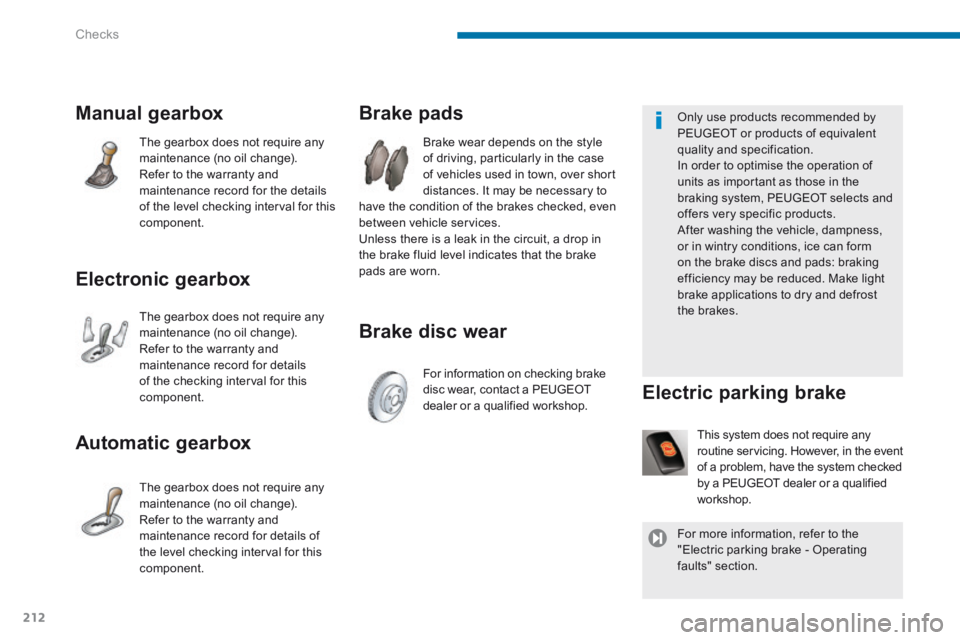
Brake disc wear
Brake pads
Brake wear depends on the style of driving, particularly in the case of vehicles used in town, over short distances. It may be necessary to have the condition of the brakes checked, even between vehicle services. Unless there is a leak in the circuit, a drop in the brake fluid level indicates that the brake pads are worn.
For information on checking brake disc wear, contact a PEUGEOT dealer or a qualified workshop.
Manual gearbox
The gearbox does not require any maintenance (no oil change). Refer to the warranty and maintenance record for the details of the level checking interval for this component.
Electronic gearbox
The gearbox does not require any maintenance (no oil change). Refer to the warranty and maintenance record for details of the checking interval for this component.
Automatic gearbox
The gearbox does not require any maintenance (no oil change). Refer to the warranty and maintenance record for details of the level checking interval for this component.
This system does not require any routine servicing. However, in the event of a problem, have the system checked by a PEUGEOT dealer or a qualified workshop.
Electric parking brake
Only use products recommended by PEUGEOT or products of equivalent quality and specification. In order to optimise the operation of units as important as those in the braking system, PEUGEOT selects and offers very specific products. After washing the vehicle, dampness, or in wintry conditions, ice can form on the brake discs and pads: braking efficiency may be reduced. Make light brake applications to dry and defrost the brakes.
For more information, refer to the "Electric parking brake - Operating faults" section.
Page 253 of 404
11
Practical information251
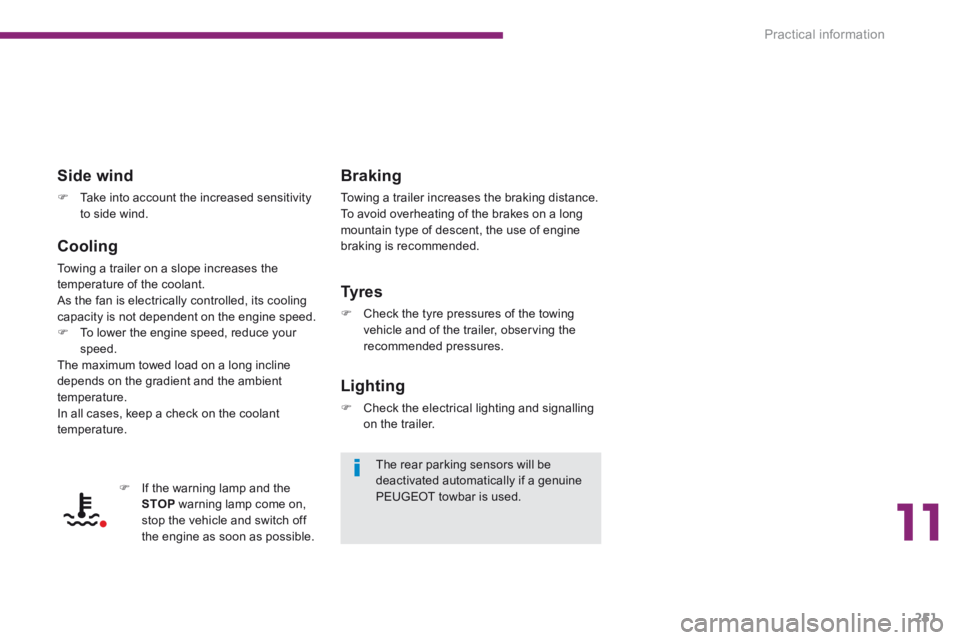
Braking
Towing a trailer increases the braking distance. To avoid overheating of the brakes on a long mountain type of descent, the use of engine braking is recommended.
Ty r e s
Check the tyre pressures of the towing vehicle and of the trailer, observing the recommended pressures.
Lighting
Check the electrical lighting and signalling on the trailer.
If the warning lamp and the STOP warning lamp come on, stop the vehicle and switch off the engine as soon as possible.
Side wind
Take into account the increased sensitivity to side wind.
Cooling
Towing a trailer on a slope increases the temperature of the coolant. As the fan is electrically controlled, its cooling capacity is not dependent on the engine speed. To lower the engine speed, reduce your speed. The maximum towed load on a long incline depends on the gradient and the ambient temperature. In all cases, keep a check on the coolant temperature.
The rear parking sensors will be deactivated automatically if a genuine PEUGEOT towbar is used.
Page 259 of 404
12
Technical data257
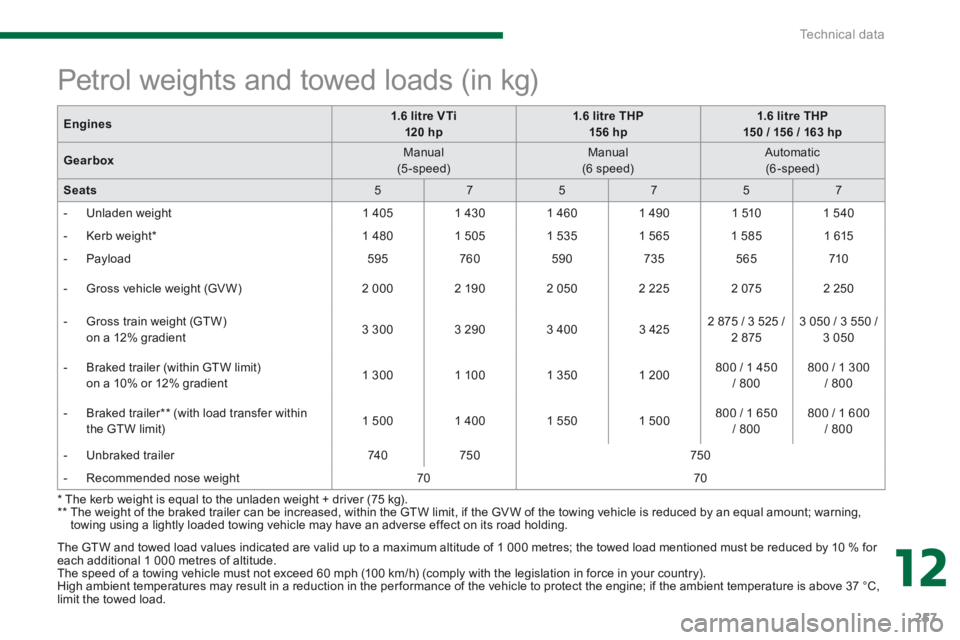
The GTW and towed load values indicated are valid up to a maximum altitude of 1 000 metres; the towed load mentioned must be reduced by 10 % for each additional 1 000 metres of altitude. The speed of a towing vehicle must not exceed 60 mph (100 km/h) (comply with the legislation in force in your country). High ambient temperatures may result in a reduction in the per formance of the vehicle to protect the engine; if the ambient temperature is above 37 °C, limit the towed load.
Engines1.6 litre VTi 120 hp1.6 litre THP 15 6 hp1.6 litre THP 150 / 156 / 163 hp
Gearbox Manual (5-speed) Manual (6 speed) Automatic (6-speed)
Seats 5 7 5 7 5 7
- Unladen weight 1 4 0 5 1 4 3 0 1 4 6 0 1 4 9 0 1 5 1 0 1 5 4 0
- Kerb weight * 1 4 8 0 1 5 0 5 1 5 3 5 1 5 6 5 1 5 8 5 1 6 1 5
- Payload 5 9 5 7 6 0 5 9 0 7 3 5 5 6 5 7 1 0
- Gross vehicle weight (GV W) 2 0 0 0 2 1 9 0 2 0 5 0 2 2 2 5 2 0 7 5 2 2 5 0
- Gross train weight (GTW) on a 12% gradient 3 3 0 0 3 2 9 0 3 4 0 0 3 4 2 5 2 875 / 3 525 / 2 875 3 050 / 3 550 / 3 050
- Braked trailer (within GTW limit) on a 10% or 12% gradient 1 3 0 0 1 1 0 0 1 3 5 0 1 2 0 0 800 / 1 450 / 800 800 / 1 300 / 800
- Braked trailer ** (with load transfer within the GTW limit) 1 5 0 0 1 4 0 0 1 5 5 0 1 5 0 0 800 / 1 650 / 800 800 / 1 600 / 800
- Unbraked trailer 7 4 0 7 5 0 7 5 0
- Recommended nose weight 7 0 7 0
* The kerb weight is equal to the unladen weight + driver (75 kg). ** The weight of the braked trailer can be increased, within the GTW limit, if the GV W of the towing vehicle is reduced by an equal amount; warning, towing using a lightly loaded towing vehicle may have an adverse effect on its road holding.
Petrol weights and towed loads (in kg)
Page 261 of 404
12
Technical data259
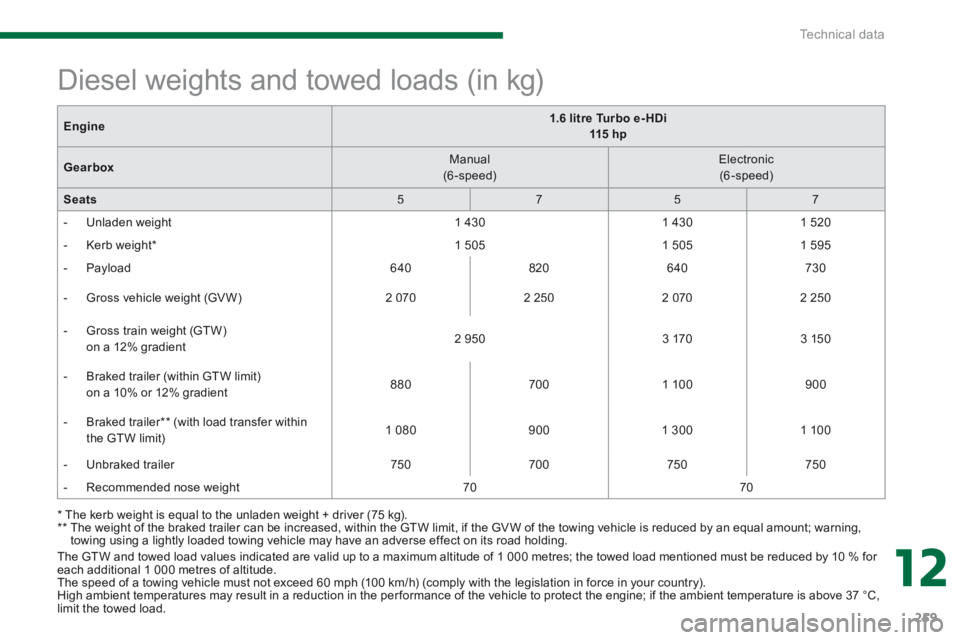
The GTW and towed load values indicated are valid up to a maximum altitude of 1 000 metres; the towed load mentioned must be reduced by 10 % for each additional 1 000 metres of altitude. The speed of a towing vehicle must not exceed 60 mph (100 km/h) (comply with the legislation in force in your country). High ambient temperatures may result in a reduction in the per formance of the vehicle to protect the engine; if the ambient temperature is above 37 °C, limit the towed load.
* The kerb weight is equal to the unladen weight + driver (75 kg). ** The weight of the braked trailer can be increased, within the GTW limit, if the GV W of the towing vehicle is reduced by an equal amount; warning, towing using a lightly loaded towing vehicle may have an adverse effect on its road holding.
Diesel weights and towed loads (in kg)
Engine1.6 litre Turbo e- HDi 115 h p
Gearbox Manual (6-speed) Electronic (6-speed)
Seats 5 7 5 7
- Unladen weight 1 4 3 0 1 4 3 0 1 5 2 0
- Kerb weight * 1 5 0 5 1 5 0 5 1 5 9 5
- Payload 6 4 0 8 2 0 6 4 0 7 3 0
- Gross vehicle weight (GV W) 2 0 7 0 2 2 5 0 2 0 7 0 2 2 5 0
- Gross train weight (GTW) on a 12% gradient 2 9 5 0 3 1 7 0 3 1 5 0
- Braked trailer (within GTW limit) on a 10% or 12% gradient 880 7 0 0 1 1 0 0 9 0 0
- Braked trailer ** (with load transfer within the GTW limit) 1 0 8 0 9 0 0 1 3 0 0 1 1 0 0
- Unbraked trailer 7 5 0 7 0 0 7 5 0 7 5 0
- Recommended nose weight 7 0 7 0