2014 Peugeot 3008 Hybrid 4 sensor
[x] Cancel search: sensorPage 77 of 378

3
Comfort75
The air conditioning system does not contain chlorine and does not present any danger to the ozone layer.
Recommendations for ventilation and air conditioning
In order for these systems to be fully effective, follow the operation and maintenance guidelines below:
If the interior temperature remains very high after the vehicle has been parked in the sun for a considerable time, first ventilate the passenger compartment for a few minutes.
Place the air flow control at a sufficient level to provide an adequate renewal of air in the passenger compartment.
To obtain an even air distribution, take care not to obstruct the exterior air intake grilles located at the base of the windscreen, the nozzles, the vents and the air outlets, as well as the air extractor located in the boot.
Use in preference the intake of exterior air as prolonged use of the air recirculation may cause misting of the windows and side windows.
Do not cover the sunshine sensor, located on the dashboard; this is used for regulation of the automatic air conditioning system.
Operate the air conditioning system for 5 to 10 minutes, once or twice a month to keep it in good working order.
Ensure that the passenger compartment filter is in good condition and have the filter elements replaced regularly (refer to the "Checks" section).
We recommend the use of a combined passenger compartment filter. Thanks to its second special active filter, it contributes to the purification of the air breathed by the occupants and the cleanliness of the passenger compartment (reduction of allergic symptoms, bad odours and greasy deposits).
The air conditioning uses power from the engine while operating. This results in an increase in the vehicle's fuel consumption.
When towing at or near maximum capacity or on steep slopes in high ambient temperatures, switching off the air conditioning saves engine power and so improves towing capacity.
Condensation created by the air conditioning results in a discharge of water under the vehicle when stationary, which is per fectly normal.
To ensure correct operation of the air conditioning system, you are also advised to have it checked regularly.
If the system does not produce cold air, do not use it and contact a PEUGEOT dealer or a qualified workshop.
Page 91 of 378

3
Comfort89
Adjustment
Adjust the mirror so that the glass is directed correctly in the "day" position.
Manual day/night model
Day / night position
Pull the lever to change to the "night" anti-dazzle position. Push the lever to change to the normal "day" position.
Rear view mirror
Adjustable mirror providing a central rearward view. Equipped with an anti-dazzle system, which darkens the mirror glass and reduces the nuisance to the driver caused by the sun, headlamps from other vehicles...
Automatic day/night model
By means of a sensor, which measures the light from the rear of the vehicle, this system automatically and progressively changes between the day and night uses.
As a safety measure, the mirrors should be adjusted to reduce the "blind spot". In order to ensure optimum visibility during your manoeuvres, the mirror lightens automatically when reverse gear is engaged.
Page 115 of 378

5
Visibility113
Manual guide-me-home
lighting
The temporary illumination of the dipped beam headlamps after the vehicle's ignition has been switched off makes the driver's exit easier when the light is poor.
Switching on
With the ignition off, "flash" the headlamps using the lighting stalk. A further "headlamp flash" switches the function off.
Switching off
The manual guide-me-home lighting switches off automatically after a set time.
Programming
The lighting duration is selected via the vehicle configuration
menu.
Exterior welcome lighting
The remote switching on of the lighting makes your approach to the vehicle easier in poor light. It is activated according to the level of light detected by the sunshine sensor.
Switching on
Press the open padlock on the remote control.
Switching off
The dipped beam headlamps and the sidelamps come on; your vehicle is also unlocked.
The exterior welcome lighting switches off automatically after a set time, when the ignition is switched on or on locking the vehicle.
The duration of the welcome lighting is associated with and identical to that of the automatic guide-me-home lighting.
Page 116 of 378
Visibility
114
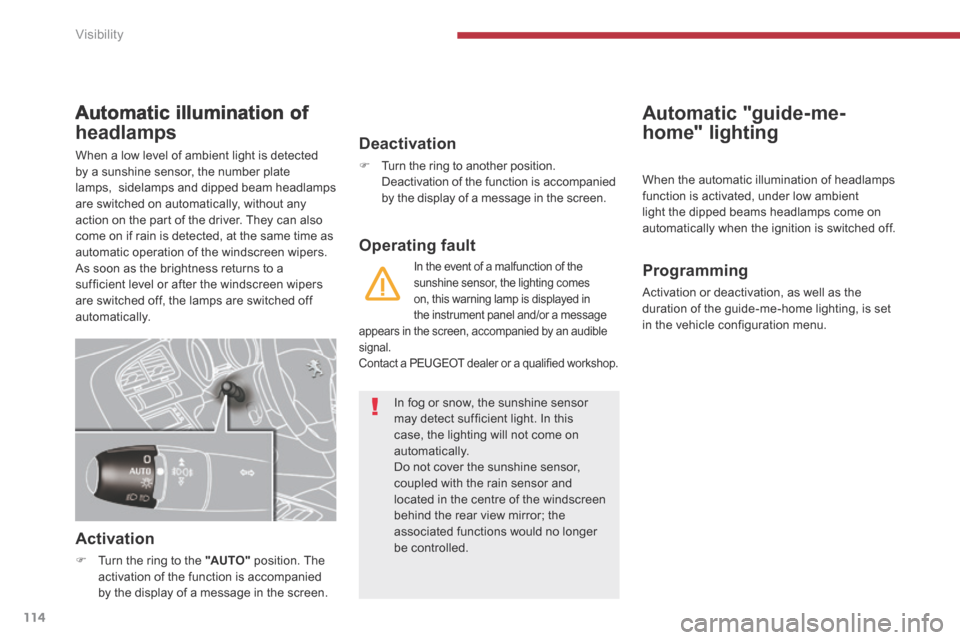
Automatic illumination of
headlamps
When a low level of ambient light is detected by a sunshine sensor, the number plate lamps, sidelamps and dipped beam headlamps are switched on automatically, without any action on the part of the driver. They can also come on if rain is detected, at the same time as automatic operation of the windscreen wipers. As soon as the brightness returns to a sufficient level or after the windscreen wipers are switched off, the lamps are switched off automatically.
Activation
Turn the ring to the "AUTO" position. The activation of the function is accompanied by the display of a message in the screen.
Deactivation
Turn the ring to another position. Deactivation of the function is accompanied by the display of a message in the screen.
When the automatic illumination of headlamps function is activated, under low ambient light the dipped beams headlamps come on automatically when the ignition is switched off.
Operating fault
In the event of a malfunction of the sunshine sensor, the lighting comes on, this warning lamp is displayed in the instrument panel and/or a message appears in the screen, accompanied by an audible signal. Contact a PEUGEOT dealer or a qualified workshop.
Automatic "guide-me-
home" lighting
Programming
Activation or deactivation, as well as the duration of the guide-me-home lighting, is set in the vehicle configuration menu.
In fog or snow, the sunshine sensor may detect sufficient light. In this
case, the lighting will not come on automatically. Do not cover the sunshine sensor, coupled with the rain sensor and located in the centre of the windscreen behind the rear view mirror; the associated functions would no longer be controlled.
Page 121 of 378

5
Visibility119
Automatic rain sensitive
windscreen wipers
The windscreen wipers operate automatically, without any action on the part of the driver, if rain is detected (sensor behind the rear view mirror), adapting their speed to the intensity of the rainfall.
Activation
This is controlled manually by the driver by pushing the stalk downwards to the "AUTO"position. It is accompanied by a message in the screen.
Switching off
This is controlled manually by the driver by moving the stalk upwards then returning it to position "0" . It is accompanied by a message in the screen.
Operating fault
If an automatic wiping malfunction occurs, the wipers will operate in intermittent mode. Have it checked by a PEUGEOT dealer or a qualified workshop.
Do not cover the rain sensor, linked with the sunshine sensor and located in the centre of the windscreen behind the rear view mirror. Switch off the automatic rain sensitive wipers when using an automatic car wash. In winter, to avoid damaging the wiper blades, it is advisable to wait until the
windscreen is completely clear of ice before activating the automatic rain sensitive wipers.
The automatic rain sensitive wipers must be reactivated if the ignition has been off for more than one minute, by pushing the stalk downwards.
Page 154 of 378

Safety
152
Tyre under-infl ation detection
System which automatically checks the pressures of the tyres while driving. The system continuously monitors the pressures of the four tyres, as soon as the vehicle is moving. A pressure sensor is located in the valve of a each tyres (except the spare wheel). The system triggers an alert if a drop in pressure is detected in one or more tyres.
The tyre under-inflation detection system is an aid to driving which does not replace the need for the driver to be vigilant or to drive responsibly.
This system does not avoid the need to check the tyre pressures regularly (including the spare wheel) and before a long journey. Driving with under-inflated tyres adversely affects road holding, extends braking distances and causes premature tyre wear, particularly under arduous conditions (vehicle loaded, high speed, long journey).
The tyre pressures for your vehicle can be found on the tyre pressure label (see the "Identification markings" section). The tyre pressures must be checked when the tyres cold (vehicle stopped for 1 hour or after driving for less then 6 miles (10 km) at moderate speed). Other wise, add 0.3 bar to the values indicated on the label.
Driving with under-inflated tyres increases fuel consumption.
Page 155 of 378

8
Safety153
Under-inflation alert
The alert is given by the fixed illumination of this warning lamp, accompanied by an audible signal, and depending on equipment, the display of a message.
In the event of a problem on one of the tyres, the symbol or the message appears, according to equipment, to identify it.
Reduce speed, avoid sudden steering movements or harsh brake applications. Stop as soon as it is safe to do so. In the event of a puncture, use the temporary puncture repair kit or the spare wheel (according to equipment), or if you have a compressor, the one in the temporary puncture repair kit for example, check the four tyre pressures when cold, or if it is not possible to check the tyre pressures at the time, drive carefully at reduced speed.
The loss of pressure detected does not always lead to visible deformation of the tyre. Do not rely on just a visual check.
The alert is maintained until the tyre or tyres concerned is reinflated, repaired or replaced. The spare wheel (space-saver type or a steel rim) does not have a sensor.
This alert is also displayed when one or more wheels is not fitted with a sensor (for example, a space-saver or steel spare wheel).
Operating fault
The flashing and then fixed illumination of the under-inflation warning lamp accompanied by the illumination of the "service" warning lamp indicates a fault with the system.
Go to a PEUGEOT dealer or a qualified workshop to have the system checked or, following the repair of a puncture, to have the original wheel, equipped with a sensor, refitted.
In this case, monitoring of the tyre pressures is not assured.
Page 185 of 378

9
183
Driving
Visual and audible front and rear parking sensors
The parking sensors are switched on : - by engaging reverse gear, - at a speed below 6 mph (10 km/h) in forward gear. This is accompanied by an audible signal and display of the vehicle in the multifunction screen.
The proximity information is indicated by: - an audible signal which becomes more rapid as the vehicle approaches the obstacle, - a graphic in the multifunction screen, with blocks which move closer to the vehicle. The obstacle is located in relation to the emission of the audible signal by the speakers; front or rear and right or left. When the distance between the vehicle and the obstacle is less than approximately thirty centimetres, the audible signal becomes continuous and/or the "Danger" symbol appears, depending on the multifunction screen version.
System consisting of four proximity sensors, installed in the front and/or rear bumper. It detects any obstacle (person, vehicle, tree, barrier...) located behind the vehicle, however, it will not be able to detect obstacles located immediately below the bumper.
An object, such as a stake, a roadworks cone or any other similar object may be detected at the start of the manoeuvre but may no longer be detected when the vehicle moves nearer to it.