Page 146 of 245

144Driving and operating
■ The adaptive programme tailorsgearshifting to the driving
conditions, e.g. greater load or
gradients.
■ When Sport mode is engaged, shift
times are reduced and the
transmission shifts at higher engine speeds (unless cruise control is
on). Sport mode 3 148.
Winter programme T
Activate the Winter programme if you
have problems starting off on a
slippery road surface.
Activation
Press the T button. The transmission
switches to automatic mode. The
vehicle starts off in 2nd gear. Sport
mode is deactivated.
Deactivation
The Winter programme is switched off by:
■ pressing the T button again
■ turning off the ignition,
■ switching to manual mode (when switched back to automatic mode,
the Winter programme is again
active)
■ when clutch temperature is too highKickdown
If the accelerator pedal is pressed
past the pressure point, the
transmission shifts to a lower gear depending on engine speed.
During kickdown no manual gear
shifting is possible.
Fault
To prevent damage to the manual
transmission automated, the clutch is
engaged automatically at high clutch
temperatures.
Page 147 of 245

Driving and operating145
A illuminates in the event of a fault.
Continued driving is possible. Manual
mode cannot be used for shifting.
If F appears in the transmission
display, continued driving is not
possible.
Have the cause of the fault remedied
by a workshop.
Interruption of power
supply
The clutch is not disengaged if there is an interruption of the power supply
when a gear is engaged. The vehicle
cannot move.
If the battery is discharged, start the
vehicle using jump leads 3 200.
If the cause of the fault is not a
discharged battery, seek the
assistance of a workshop.
If the vehicle must be moved out of the flow of traffic, disengage the
clutch as follows (for vehicles with 5-
speed manual transmission
automated only):
1. Apply parking brake and switch off
ignition.
2. Open the bonnet 3 161.
3. Clean the transmission around the cap so that no dirt can get intothe opening when the cap is
removed.
4. Rotate cap to slacken and remove
by lifting upwards.
5. Using a flat-head screwdriver, turn the adjusting screw under the
cap clockwise until clear
resistance can be felt. The clutch
has now been disengaged.
6. Refit cleaned cap. The cap must be in full contact with the housing.
On vehicles with 6-speed manual
transmission automated, the clutch cannot be released; if the vehicle
must be moved, raise the vehicle at
the front to tow.Caution
Do not turn beyond the resistance since this could damage the
transmission.
Page 150 of 245

148Driving and operating9Warning
Do not let this special safety
feature tempt you into taking risks
when driving.
Adapt speed to the road
conditions.
Control indicator v 3 99.
Deactivation
ESP® Plus
can be deactivated when
Sport mode is engaged for high-
performance driving:
Hold the SPORT button depressed
for about 4 seconds. Control indicator v illuminates. ESPoff also appears in
the service display.9 Warning
Do not deactivate ESP® Plus
if a
run-flat tyre has lost pressure.
ESP® Plus
is reactivated by pressing
the SPORT button. ESPon appears in
the service display. ESP® Plus
is also
reactivated the next time the ignition is switched on.
Sport mode 3 148.
Interactive driving system Interactive driving system (IDS Plus
)
combines the electronic stability
program (ESP® Plus
) with the antilock
brake system (ABS) and continuous damping control (CDC) to improve
driving dynamics and vehicle safety.
Sport mode
Suspension and steering become
more direct and provide better
contact with the road surface. The
engine reacts more quickly to
accelerator pedal movements.
Automatic gear changing is also more
responsive.
Control indicator IDS+ 3 100.
Activation
Press SPORT button.
Control indicator 1 3 98.
Page 151 of 245

Driving and operating149
Winter programme activation not
possible.
Deactivation
Briefly press the SPORT button.
Sport mode is deactivated the next
time the ignition is switched on or if
the Winter programme is activated.
Continuous damping
control Continuous damping control (CDC)
changes suspension with damping
adaptation of each shock absorber to the current driving situation and road
conditions.
When Sport mode is engaged, the
damping control is adapted to a
sportier driving style.
Control indicator IDS+ 3 100.Automatic level control
The rear level of the vehicle is
automatically adjusted to the load
conditions while driving. Suspension
and ground clearance are increased,
which improves driving conditions.
The automatic level control is
activated after the vehicle has been
driven for some distance, depending
on the vehicle loading and the road conditions.
Do not use full payload in the event of
a fault. Have the cause of the fault
remedied by a workshop.Cruise control
The cruise control can store and
maintain speeds of approx.
30 to 200 km/h. Deviations from the
stored speeds may occur when
driving uphill or downhill.
For safety reasons the cruise control
cannot be activated until the foot
brake has been operated once.
Do not use the cruise control if it is not
advisable to maintain a constant
speed.
Page 152 of 245

150Driving and operating
With automatic transmission or
manual transmission automated, only
activate cruise control in automatic
mode.
Control indicator m 3 102.
Activation
Briefly press the m button: the current
speed is stored and maintained.
Vehicle speed can be increased by
depressing the accelerator pedal.
When the accelerator pedal is
released, the previously stored speed is resumed.
The speed is saved until the ignition
is switched off.
To resume the saved speed, briefly
press the g button at a speed above
30 km/h.
Increase speed
With cruise control active, hold down
button m or briefly press it repeatedly:
speed is increased continuously or in small increments.
When button m is released the
current speed is stored and
maintained.Reduce speed
With cruise control active, hold down button g or briefly press it repeatedly:
speed is reduced continuously or in
small increments.
When button g is released the current
speed is stored and maintained.
Deactivation
Briefly press the § button: cruise
control is deactivated.
Automatic deactivation: ■ Vehicle speed below approx. 30 km/h
■ The brake pedal is depressed
■ The clutch pedal is depressed
■ Selector lever in N.Object detection
systems
Parking assist
The parking assist makes parking
easier by measuring the distance between the vehicle and obstacles. It
is the driver, however, who bears full
responsibility for parking.
The system consists of four ultrasonic parking sensors in each of the front
and rear bumpers.
Control indicator r 3 98.
Page 154 of 245
152Driving and operatingCaution
Use of fuel that does not comply toEN 228 or E DIN 51626-1 or
equivalent can lead to deposits or
engine damage and may affect
your warranty.
Caution
Use of fuel with too low an octane
rating could lead to uncontrolled combustion and engine damage.
Fuel for diesel engines
Only use diesel fuel that complies
with EN 590.
In countries outside the European
Union use Euro-Diesel fuel with a
sulfur concentration below 50 ppm.
Caution
Use of fuel that does not comply to EN 590 or similar can lead to
engine powerloss, increased wear
or engine damage and may affect
your warranty.
Do not use marine diesel oils, heating
oils, Aquazole and similar diesel-
water emulsions. Diesel fuels must
not be diluted with fuels for petrol
engines.
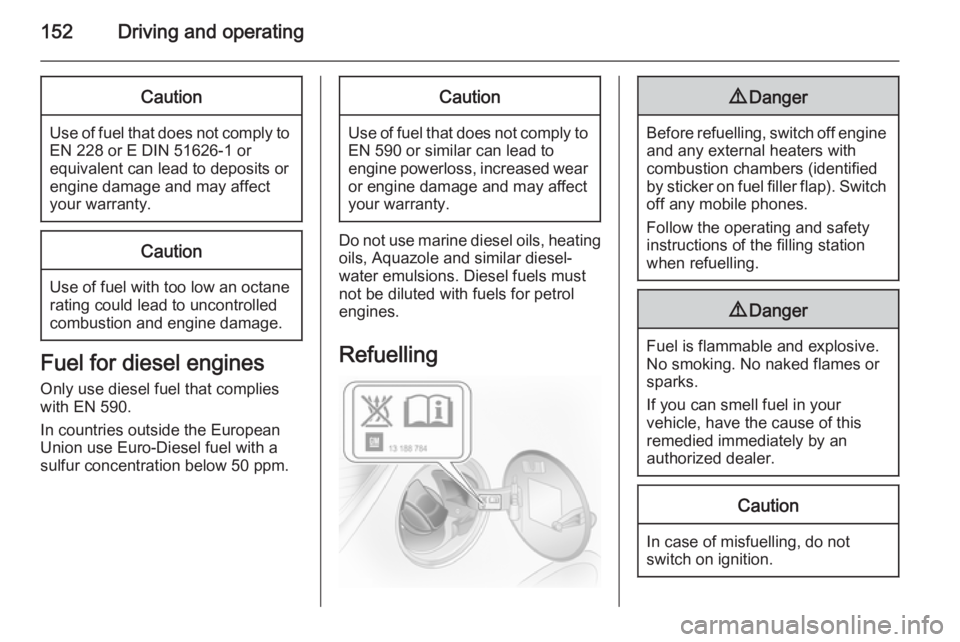
Refuelling
9 Danger
Before refuelling, switch off engine
and any external heaters with
combustion chambers (identified
by sticker on fuel filler flap). Switch off any mobile phones.
Follow the operating and safety
instructions of the filling station
when refuelling.
9 Danger
Fuel is flammable and explosive.
No smoking. No naked flames or
sparks.
If you can smell fuel in your
vehicle, have the cause of this
remedied immediately by an
authorized dealer.
Caution
In case of misfuelling, do not
switch on ignition.
Page 162 of 245
160Vehicle care
■ Open bonnet, close all doors andlock the vehicle.
■ Disconnect the clamp from the negative terminal of the vehicle
battery. Be aware that all systems
are non-operational, e.g. the anti-
theft alarm system.
Putting back into operation The following must be done if the
vehicle is put back into operation:
■ Connect the clamp to the negative terminal of the vehicle battery.
Activate the electronics of the
power windows.
■ Check tyre pressure.
■ Fill up the washer fluid reservoir.
■ Check the engine oil level.
■ Check the coolant level.
■ Fit the number plate if necessary.End-of-life vehicle
recovery
Information about end-of-life vehicle
recovery centres and the recycling of
end-of-life vehicles is available on our website. Only entrust this work to an
authorised recycling centre.Vehicle checks
Performing work9 Warning
Only perform engine compartment
checks when the ignition is off.
The cooling fan may start
operating even if the ignition is off.
Page 163 of 245

Vehicle care1619Danger
The ignition system and Xenon
headlights use extremely high
voltage. Do not touch.
The caps for topping up the engine oil, the coolant, the washing fluid and theoil dipstick handle are yellow for ease
of identification.
Bonnet
Opening
Pull the release lever and return it to
its original position.
Lift the safety catch upwards and
open the bonnet.
Air intake 3 131.
Secure the bonnet support.
Closing Before closing the bonnet, press the
support into the holder.
Lower the bonnet and allow it to drop into the catch. Check that the bonnet
is engaged.
Engine oil
Check the engine oil level manuallyon a regular basis to prevent damage
to the engine. Ensure that the correct specification of oil is used.
Recommended fluids and lubricants
3 208.
Check with the vehicle on a level
surface. The engine must be at
operating temperature and switched
off for at least 5 minutes.
Pull out the dipstick, wipe it clean, insert it to the stop on the handle, pull
it out and read the engine oil level.
Insert the dipstick to the stop on the
handle and make half a turn.
