2014 NISSAN VERSA NOTE Transmission
[x] Cancel search: TransmissionPage 304 of 372
When driving in areas using road salt or other
corrosive materials, check lubrication frequently.
Lights*Clean the headlights on a regular basis.
Make sure that the headlights, stop lights, tail
lights, turn signal lights, and other lights are all
operating properly and installed securely. Also
check headlight aim.
Road wheel nuts (lug nuts)* When checking
the tires, make sure no wheel nuts are missing,
and check for any loose wheel nuts. Tighten if
necessary.
Tire rotation* Tires should be rotated every
7,500 miles (12,000 km).
Tires* Check the pressure with a gauge often
and always prior to long distance trips. If neces-
sary, adjust the pressure in all tires, including the
spare, to the pressure specified. Check carefully
for damage, cuts or excessive wear.
Tire Pressure Monitoring System (TPMS)
transmitter components (if so equipped)
Replace the TPMS transmitter grommet seal,
valve core and cap when the tires are replaced
due to wear or age.
Wheel alignment and balance If the vehicle
should pull to either side while driving on a
straight and level road, or if you detect uneven or
abnormal tire wear, there may be a need for wheel alignment. If the steering wheel or seat vibrates at
normal highway speeds, wheel balancing may be
needed.
● For additional information regarding tires,
refer to “Important Tire Safety Information”
(US) or “Tire Safety Information” (Canada) in
the Warranty Information Booklet.
Windshield Clean the windshield on a regular
basis. Check the windshield at least every six
months for cracks or other damage. Have a dam-
aged windshield repaired by a qualified repair
facility.
Windshield wiper blades* Check for cracks or
wear if they do not wipe properly.
Inside the vehicle
The maintenance items listed here should be
checked on a regular basis, such as when per-
forming periodic maintenance, cleaning the ve-
hicle, etc.
Additional information on the following
items with an “*” is found in this section.
Accelerator pedal Check the pedal for smooth
operation and make sure the pedal does not bind
or require uneven effort. Keep the floor mat away
from the pedal.
Brake pedal Check the pedal for smooth opera-
tion. If the brake pedal suddenly goes down fur- ther than normal, the pedal feels spongy or the
vehicle seems to take longer to stop, see a
NISSAN dealer immediately. Keep the floor mat
away from the pedal.
Brakes
Check that the brakes do not pull the
vehicle to one side when applied.
Continuously Variable Transmission (CVT)
P (Park) position mechanism (if so
equipped) On a fairly steep hill check that the
vehicle is held securely with the shift lever in the P
(Park) position without applying any brakes.
Parking brake Check the parking brake opera-
tion regularly. The vehicle should be securely held
on a fairly steep hill with only the parking brake
applied. If the parking brake needs adjustment,
see a NISSAN dealer.
Seats Check seat position controls such as seat
adjusters, seat back recliner, etc. to ensure they
operate smoothly and all latches lock securely in
every position. Check that the head
restraints/headrests move up and down
smoothly and the locks hold securely in all
latched positions.
Seat belts Check that all parts of the seat belt
system (for example, buckles, anchors, adjusters
and retractors) operate properly and smoothly,
and are installed securely. Check the belt web-
bing for cuts, fraying, wear or damage.
Maintenance and do-it-yourself8-3
Page 306 of 372
When performing any inspection or maintenance
work on your vehicle, always take care to prevent
serious accidental injury to yourself or damage to
the vehicle. The following are general precau-
tions which should be closely observed.
WARNING
●Park the vehicle on a level surface, ap-
ply the parking brake securely and
block the wheels to prevent the vehicle
from moving. For manual transmission
models, move the shift lever to N (Neu-
tral) . For CVT models, move the shift
lever to P (Park) .
●
Be sure the ignition switch is placed in the
OFF or LOCK position when performing
any parts replacement or repairs.
● Your vehicle is equipped with an auto-
matic engine cooling fan. It may come
on at any time without warning, even if
the ignition switch is placed in the OFF
position and the engine is not running.
To avoid injury, always disconnect the
negative battery cable before working
near the fan.
● If you must work with the engine run-
ning, keep your hands, clothing, hair
and tools away from moving fans, belts
and any other moving parts. ●
It is advisable to secure or remove any
loose clothing and remove any jewelry,
such as rings, watches, etc. before
working on your vehicle.
● Always wear eye protection whenever
you work on your vehicle.
● If you must run the engine in an en-
closed space such as a garage, be sure
there is proper ventilation for exhaust
gases to escape.
● Never get under the vehicle while it is
supported only by a jack. If it is neces-
sary to work under the vehicle, support
it with safety stands.
● Keep smoking materials, flame and
sparks away from the fuel tank and
battery.
● The fuel filter or fuel lines should be
serviced by a NISSAN dealer because
the fuel lines are under high pressure
even when the engine is off.
CAUTION
● Do not work under the hood while the
engine is hot. Turn the engine off and
wait until it cools down. ●
Avoid contact with used engine oil and
coolant. Improperly disposed engine
oil, engine coolant and/or other vehicle
fluids can damage the environment. Al-
ways conform to local regulations for
disposal of vehicle fluid.
● Never leave the engine or the transmis-
sion related component harness con-
nector disconnected while the ignition
switch is in the ON position.
● Never connect or disconnect the battery
or any transistorized component while
the ignition switch is in the ON position.
This “Maintenance and do-it-yourself” section
gives instructions regarding only those items
which are relatively easy for an owner to perform.
A genuine NISSAN service manual is also avail-
able. See “Owner’s Manual/Service Manual or-
der information” in the “Technical and consumer
information” section of this manual.
You should be aware that incomplete or improper
servicing may result in operating difficulties or
excessive emissions, and could affect warranty
coverage. If in doubt about any servicing,
have it done by a NISSAN dealer.
MAINTENANCE PRECAUTIONS
Maintenance and do-it-yourself8-5
Page 307 of 372
HR16DE engine
1. Drive belt location
2. Engine oil filler cap
3. Air cleaner
4. Brake and clutch (*1) fluid reservoir
5. Fusible link
6. Battery
7. Engine coolant reservoir
8. Radiator cap
9. Engine oil dipstick
10. Windshield-washer fluid reservoir
*1 For Manual Transmission (M/T) model
LDI2377
ENGINE COMPARTMENT CHECK
LOCATIONS
8-6Maintenance and do-it-yourself
Page 308 of 372
The engine cooling system is filled at the factory
with a pre-diluted mixture of 50% Genuine
NISSAN Long Life Antifreeze/Coolant (blue) and
50% water to provide year-round anti-freeze and
coolant protection. The antifreeze solution con-
tains rust and corrosion inhibitors. Additional en-
gine cooling system additives are not necessary.
WARNING
●Never remove the radiator or coolant
reservoir cap when the engine is hot.
Wait until the engine and radiator cool
down. Serious burns could be caused
by high pressure fluid escaping from
the radiator. See precautions in “If your
vehicle overheats” found in the “In case
of emergency” section of this manual.
● The radiator is equipped with a pres-
sure type radiator cap. To prevent en-
gine damage, use only a genuine
NISSAN radiator cap.
CAUTION
● Never use any cooling system additives
such as radiator sealer. Additives may
clog the cooling system and cause dam-
age to the engine, transmission and/or
cooling system.
● When adding or replacing coolant, be
sure to use only Genuine NISSAN Long
Life Antifreeze/Coolant (blue) or
equivalent. Genuine NISSAN Long Life
Antifreeze/Coolant (blue) is pre-diluted
to provide antifreeze protection to -34°
F (-37° C) . If additional freeze protection
is needed due to weather where you
operate your vehicle, add Genuine
NISSAN Long Life Antifreeze/Coolant
(blue) concentrate following the direc-
tions on the container. If an equivalent
coolant other than Genuine NISSAN
Long Life Antifreeze/Coolant (blue) is
used, follow the coolant manufacturer’s
instructions to maintain minimum anti-
freeze protection to -34° F (-37° C) . The
use of other types of coolant solutions
other than Genuine NISSAN Long Life
Antifreeze/Coolant (blue) or equivalent
may damage the engine cooling
system. ●
The life expectancy of the factory-fill
coolant is 105,000 miles (168,000 km) or
7 years. Mixing any other type of cool-
ant other than Genuine NISSAN Long
Life Antifreeze/Coolant (blue) , includ-
ing Genuine NISSAN Long Life
Antifreeze/Coolant (green) , or the use
of non-distilled water will reduce the
life expectancy of the factory-fill cool-
ant. Refer to the NISSAN Service and
Maintenance Guide for more details.
ENGINE COOLING SYSTEM
Maintenance and do-it-yourself8-7
Page 312 of 372
CAUTION
Be careful not to burn yourself. The engine
oil may be hot.5. Wipe the engine oil filter sealing surface with a clean rag.
CAUTION
Be sure to remove any old gasket material
remaining on the sealing surface of the
engine. Failure to do so could lead to
engine damage.
6. Coat the gasket on the new filter with clean engine oil.
7. Screw on the oil filter until a slight resistance is felt, then tighten an additional 2/3 turn.
8. Start the engine and check for leakage around the oil filter. Correct as required.
9. Turn the engine off and wait more than 10 minutes. Check the oil level. Add engine
oil if necessary.
CAUTION
●Use only Genuine NISSAN CVT Fluid
NS-3. Do not mix with other fluids.
● Using transmission fluid other than
Genuine NISSAN CVT Fluid NS-3 will
damage the CVT, which is not covered
by the warranty.
When checking or replacement of CVT fluid is
required, we recommend your NISSAN dealer for
servicing. For further brake and clutch fluid specification
information, refer to “Recommended
fluids/lubricants and capacities” in the “Technical
and consumer information” section of this
manual.
WARNING
●
Use only new fluid from a sealed con-
tainer. Old, inferior or contaminated
fluid may damage the brake and clutch
(if so equipped) systems. The use of
improper fluids can damage the brake
and clutch system and affect the vehi-
cle’s stopping ability.
● Clean the filler cap before removing.
● Brake and clutch fluid is poisonous and
should be stored carefully in marked
containers out of reach of children.
CAUTION
Do not spill the fluid on any painted sur-
faces. This will damage the paint. If fluid is
spilled, immediately wash the surface with
water.
CONTINUOUSLY VARIABLE
TRANSMISSION (CVT) FLUID (if so
equipped) BRAKE AND CLUTCH (if so equipped)
FLUID
Maintenance and do-it-yourself8-11
Page 343 of 372
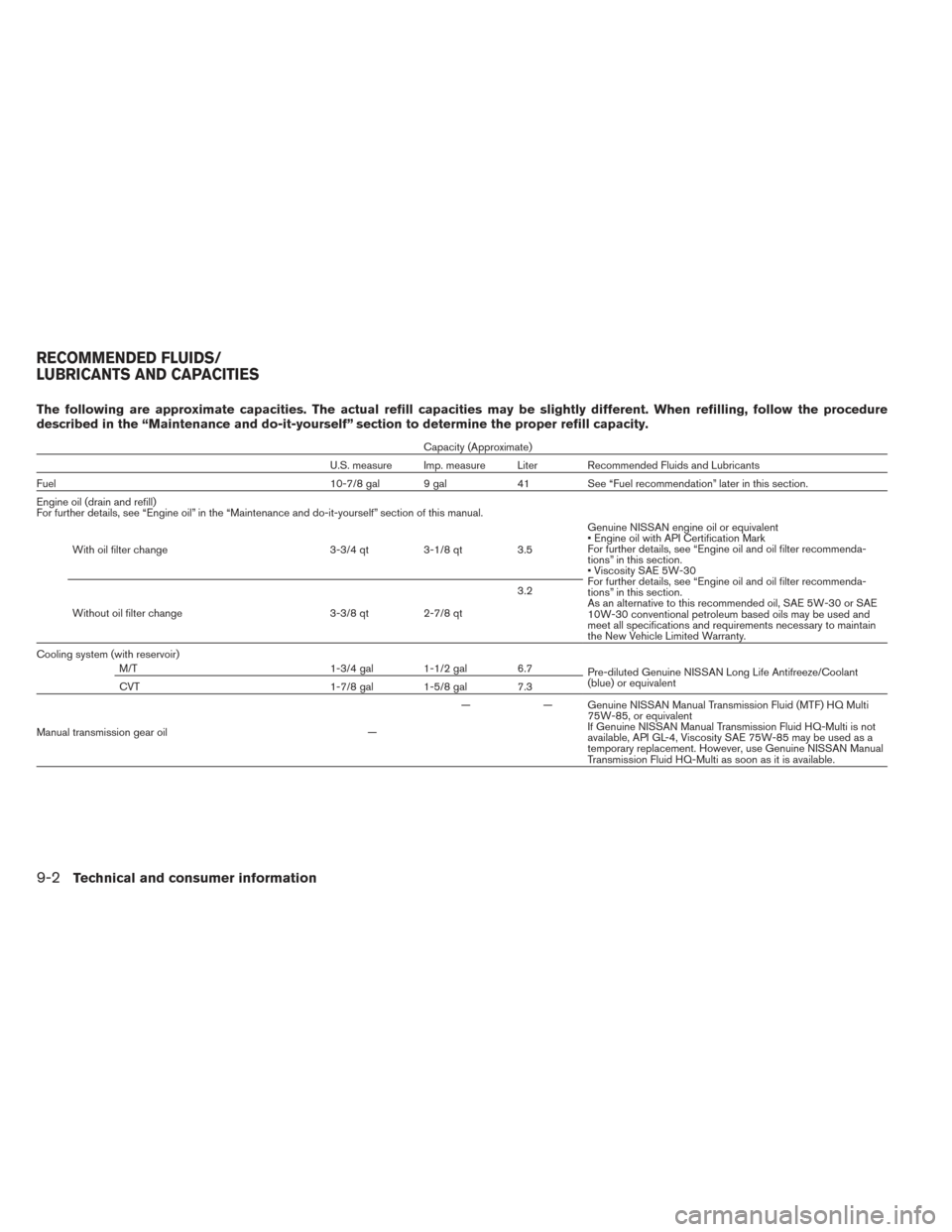
The following are approximate capacities. The actual refill capacities may be slightly different. When refilling, follow the procedure
described in the “Maintenance and do-it-yourself” section to determine the proper refill capacity.
Capacity (Approximate)
U.S. measure Imp. measure Liter Recommended Fluids and Lubricants
Fuel 10-7/8 gal 9 gal 41 See “Fuel recommendation” later in this section.
Engine oil (drain and refill)
For further details, see “Engine oil” in the “Maintenance and do-it-yourself” section of this manual.
With oil filter change 3-3/4 qt 3-1/8 qt 3.5 Genuine NISSAN engine oil or equivalent
• Engine oil with API Certification Mark
For further details, see “Engine oil and oil filter recommenda-
tions” in this section.
• Viscosity SAE 5W-30
For further details, see “Engine oil and oil filter recommenda-
tions” in this section.
As an alternative to this recommended oil, SAE 5W-30 or SAE
10W-30 conventional petroleum based oils may be used and
meet all specifications and requirements necessary to maintain
the New Vehicle Limited Warranty.
Without oil filter change 3-3/8 qt 2-7/8 qt 3.2
Cooling system (with reservoir) M/T 1-3/4 gal 1-1/2 gal 6.7
Pre-diluted Genuine NISSAN Long Life Antifreeze/Coolant
(blue) or equivalent
CVT 1-7/8 gal 1-5/8 gal 7.3
Manual transmission gear oil ——
— Genuine NISSAN Manual Transmission Fluid (MTF) HQ Multi
75W-85, or equivalent
If Genuine NISSAN Manual Transmission Fluid HQ-Multi is not
available, API GL-4, Viscosity SAE 75W-85 may be used as a
temporary replacement. However, use Genuine NISSAN Manual
Transmission Fluid HQ-Multi as soon as it is available.
RECOMMENDED FLUIDS/
LUBRICANTS AND CAPACITIES
9-2Technical and consumer information
Page 344 of 372
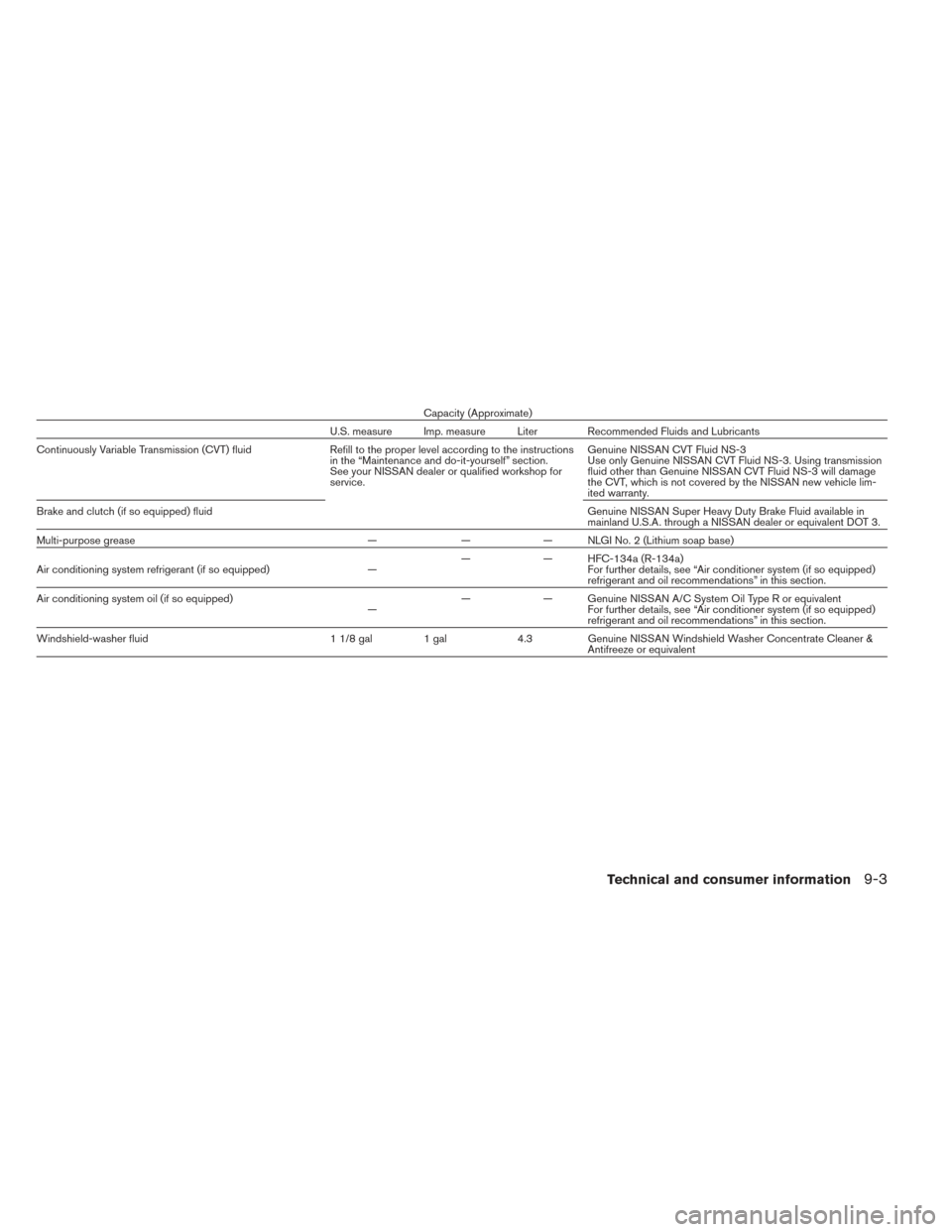
Capacity (Approximate)
U.S. measure Imp. measure Liter Recommended Fluids and Lubricants
Continuously Variable Transmission (CVT) fluid Refill to the proper level according to the instructions in the “Maintenance and do-it-yourself” section.
See your NISSAN dealer or qualified workshop for
service.Genuine NISSAN CVT Fluid NS-3
Use only Genuine NISSAN CVT Fluid NS-3. Using transmission
fluid other than Genuine NISSAN CVT Fluid NS-3 will damage
the CVT, which is not covered by the NISSAN new vehicle lim-
ited warranty.
Brake and clutch (if so equipped) fluid Genuine NISSAN Super Heavy Duty Brake Fluid available in
mainland U.S.A. through a NISSAN dealer or equivalent DOT 3.
Multi-purpose grease ——— NLGI No. 2 (Lithium soap base)
Air conditioning system refrigerant (if so equipped) ——
— HFC-134a (R-134a)
For further details, see “Air conditioner system (if so equipped)
refrigerant and oil recommendations” in this section.
Air conditioning system oil (if so equipped) ——
— Genuine NISSAN A/C System Oil Type R or equivalent
For further details, see “Air conditioner system (if so equipped)
refrigerant and oil recommendations” in this section.
Windshield-washer fluid 1 1/8 gal 1 gal4.3Genuine NISSAN Windshield Washer Concentrate Cleaner &
Antifreeze or equivalent
Technical and consumer information9-3
Page 358 of 372
Do not tow a trailer with your vehicle.
FLAT TOWING
Towing your vehicle with all four wheels on the
ground is sometimes called flat towing. This
method is sometimes used when towing a vehicle
behind a recreational vehicle, such as a motor
home.
CAUTION
●Failure to follow these guidelines can
result in severe transmission damage.
● Whenever flat towing your vehicle, al-
ways tow forward, never backward.
● DO NOT tow any continuously variable
transmission vehicle with all four
wheels on the ground (flat towing) . Do-
ing so WILL DAMAGE internal transmis-
sion parts due to lack of transmission
lubrication.
● For emergency towing procedures refer
to “Towing recommended by NISSAN”
in the “In case of emergency” section of
this manual.
Manual Transmission (if so equipped)
● Always tow with the manual transmission in
Neutral.
● After towing 500 miles (805 km) , start and
idle the engine with the transmission in Neu-
tral for two minutes. Failure to idle the engine
after every 500 miles (805 km) of towing
may cause damage to internal transmission
parts.
Continuously Variable Transmission (if
so equipped)
To tow a vehicle equipped with a continuously
variable transmission, an appropriate vehicle
dolly MUST be placed under the towed vehicle’s
drive wheels. Alwaysfollow the dolly manufac-
turer’s recommendations when using their prod-
uct. DOT (Department of Transportation) Quality
Grades: All passenger car tires must conform to
federal safety requirements in addition to these
grades.
Quality grades can be found where applicable on
the tire sidewall between tread shoulder and
maximum section width. For example:
Treadwear 200 Traction AA Temperature A
Treadwear
The treadwear grade is a comparative rating
based on the wear rate of the tire when tested
under controlled conditions on a specified gov-
ernment test course. For example, a tire graded
150 would wear one and one-half (1 1/2) times
as well on the government course as a tire graded
100. The relative performance of tires depends
upon the actual conditions of their use, however,
and may depart significantly from the norm due to
variations in driving habits, service practices and
differences in road characteristics and climate.
Traction AA, A, B and C
The traction grades, from highest to lowest, are
AA, A, B, and C. Those grades represent the
tire’s ability to stop on wet pavement as mea-
sured under controlled conditions on specified
government test surfaces of asphalt and con-
crete. A tire marked C may have poor traction
performance.
TOWING A TRAILER
UNIFORM TIRE QUALITY GRADING
Technical and consumer information9-17