2014 NISSAN SENTRA passenger window
[x] Cancel search: passenger windowPage 176 of 388
NOTE:● Odors from inside and outside the vehicle
can build up in the air conditioner unit. Odor
can enter the passenger compartment
through the vents.
● When parking, set the heater and air condi-
tioner controls to turn off air recirculation to
allow fresh air into the passenger compart-
ment. This should help reduce odors inside
the vehicle.
AUTOMATIC OPERATION
Heating (A/C OFF)
The air conditioner does not activate. When you
need to heat only, use this mode.
1. Press the A/C button. (A/C OFF will be displayed and A/C indicator will turn off.)
2. Use the temperature control buttons to set the desired temperature.
● The temperature of the passenger compart-
ment will be maintained automatically. Air
flow distribution and fan speed are also con-
trolled automatically.
● Do not set the temperature lower than the
outside air temperature or the system may
not work properly.
● Not recommended if windows fog up.
Dehumidified defrosting or defogging
1. Press thefront defroster button on.
(The indicator light on the button will remain
in Off.)
2. Use the temperature control buttons to set the desired temperature.
● To quickly remove ice from the outside of the
windows, use the fan speed control dial to
set the fan speed to maximum.
● As soon as possible after the windshield is
clean, press the AUTO button to return to
the automatic mode.
● When the
front defroster button is
pressed, the air conditioner will automati-
cally be turned on at outside temperatures
above 36°F (2°C) (The indicator light may
not illuminate) . The air recirculate mode au-
tomatically turns off, allowing outside air to
be drawn into the passenger compartment
to further improve the defogging perfor-
mance.
Cooling and/or dehumidified heating
(AUTO)
This mode may be used all year round as the
system automatically works to keep a constant temperature. Air flow distribution and fan speed
are also controlled automatically.
1. Press the AUTO button on. (The indicator on the button will illuminate and AUTO will be
displayed.)
2. Use the temperature control buttons to set the desired temperature.
● Adjust the temperature display to about
75°F (24°C) for normal operation.
● The temperature of the passenger compart-
ment will be maintained automatically. Air
flow distribution and fan speed are also con-
trolled automatically.
● A visible mist may be seen coming from the
vents in hot, humid conditions as the air is
cooled rapidly. This does not indicate a mal-
function.
3. You can individually set driver’s and front passenger’s side temperature using each
set of temperature control buttons. When
the DUAL button or passenger’s side tem-
perature control buttons are pressed, the
DUAL indicator will come on. To turn off the
passenger’s side temperature control, press
the DUAL button.
Monitor, climate, audio, phone and voice recognition systems4-25
Page 177 of 388
MANUAL OPERATION
Fan speed control
Press the fan control buttonsto manually
control the fan speed.
Press the AUTO button to return to automatic
control of the fan speed.
Air recirculation
Press theair recirculation button to recir-
culate interior air inside the vehicle. The
indicator light on the button will come on.
The air recirculation cannot be activated when
the air conditioner is in the
front defrosting
mode or the
front defrosting and foot out-
let mode.
Fresh air intake
Press thefresh air intake button to draw
outside air into the passenger compartment.
The
indicator light on the button will come
on.
Automatic intake air control
In the AUTO mode, the intake air will be con-
trolled automatically. To manually control the in-
take air, press the
air recirculation button.
To return to the automatic control mode, press and hold the
air recirculation button or
press and hold the
fresh air intake button
for about 2 seconds. The indicator lights (both air
recirculation and fresh air intake buttons) will
flash twice, and then the intake air will be con-
trolled automatically.
Air flow control
Pressing the MODE button manually controls air
flow and selects the air outlet:
— Air flows from center and side
vents.
— Air flows from center and sidevents and foot outlets.
— Air flows mainly from foot outlets.
— Air flows from defroster and footoutlets.
To turn system off
Press the OFF button.
Rear window and outside mirror (if so
equipped) defroster switch
For more information about the rear window and
outside mirror (if so equipped) defroster switch,
see “Rear window and outside mirror (if so
equipped) defroster switch” in the “Instruments
and controls” section of this manual.
OPERATING TIPS
●When the engine coolant temperature and
outside air temperature are low, the air flow
from the foot outlets may not operate for a
maximum of 150 seconds. However, this is
not a malfunction. After the coolant tempera-
ture warms up, air flow from the foot outlets
will operate normally.
4-26Monitor, climate, audio, phone and voice recognition systems
Page 259 of 388
WARNING
●Do not leave children or adults who
would normally require the assistance
of others alone in your vehicle. Pets
should also not be left alone. They
could accidentally injure themselves or
others through inadvertent operation of
the vehicle. Also, on hot, sunny days,
temperatures in a closed vehicle could
quickly become high enough to cause
severe or possibly fatal injuries to
people or animals.
● Closely supervise children when they
are around cars to prevent them from
playing and becoming locked in the
trunk where they could be seriously in-
jured. Keep the car locked, with the rear
seatback and trunk lid securely latched
when not in use, and prevent children’s
access to car keys.
EXHAUST GAS (carbon monoxide)
WARNING
● Do not breathe exhaust gases; they
contain colorless and odorless carbon
monoxide. Carbon monoxide is danger-
ous. It can cause unconsciousness or
death. ●
If you suspect that exhaust fumes are
entering the vehicle, drive with all win-
dows fully open, and have the vehicle
inspected immediately.
● Do not run the engine in closed spaces
such as a garage.
● Do not park the vehicle with the engine
running for any extended length of time.
● Keep the rear vent windows, lift gates,
doors and trunk lids (if so equipped)
closed while driving, otherwise exhaust
gases could be drawn into the passen-
ger compartment. If you must drive with
one of these open, follow these
precautions:
1. Open all the windows.
2. Set the
air recirculation but-
ton to off and the fan control dial to
high to circulate the air.
● If electrical wiring or other cable con-
nections must pass to a trailer through
the seal on the trunk lid or the body,
follow the manufacturer’s recommen-
dation to prevent carbon monoxide en-
try into the vehicle. ●
The exhaust system and body should be
inspected by a qualified mechanic
whenever:
a. The vehicle is raised for service.
b. You suspect that exhaust fumes are entering into the passenger
compartment.
c. You notice a change in the sound of the exhaust system.
d. You have had an accident involving damage to the exhaust system, un-
derbody, or rear of the vehicle.
THREE-WAY CATALYST
The three-way catalyst is an emission control
device installed in the exhaust system. Exhaust
gases in the three-way catalyst are burned at
high temperatures to help reduce pollutants.
WARNING
●The exhaust gas and the exhaust sys-
tem are very hot. Keep people, animals
or flammable materials away from the
exhaust system components.
PRECAUTIONS WHEN STARTING
AND DRIVING
5-2Starting and driving
Page 270 of 388
3. Touch the ignition switch with the IntelligentKey as illustrated. (A chime will sound.)
After step 3 is performed, when the ignition
switch is pushed without depressing the
brake pedal, the ignition switch position will
change to ACC.
4. Push the ignition switch while depressing the brake pedal within 10 seconds after the
chime sounds. The engine will start.
NOTE: ● When the ignition switch is pushed to the
ACC or ON position or the engine is started
by the above procedure, the Intelligent Key
battery discharge indicator appears in the
vehicle information display even when the
Intelligent Key is inside the vehicle. This is
not a malfunction. To turn off the Intelligent
Key battery discharge indicator, touch the
ignition switch with the Intelligent Key again.
● If the Intelligent Key battery discharge indi-
cator appears, replace the battery as soon
as possible. See “Battery Replacement” in
the “Maintenance and do-it-yourself” sec-
tion.NISSAN VEHICLE IMMOBILIZER
SYSTEM
The NISSAN Vehicle Immobilizer system will not
allow the engine to start without the use of the
registered key.
If the engine fails to start using a registered key
(for example, when interference is caused by
another registered key, an automated toll road
device or automatic payment device on the key
ring) , restart the engine using the following pro-
cedure:
1. Leave the ignition switch in the ON position for approximately 5 seconds.
2. Place the ignition switch in the OFF or LOCK position, and wait approximately
10 seconds.
3. Repeat steps 1 and 2.
4. Restart the engine while holding the device (which may have caused the interference)
separate from the registered key.
If the no start condition re-occurs, NISSAN rec-
ommends placing the registered key on a sepa-
rate key ring to avoid interference from other
devices. ●
Make sure the area around the vehicle is
clear.
● Check fluid levels such as engine oil, cool-
ant, brake and clutch fluid(if so equipped) ,
and windshield-washer fluid as frequently as
possible, or at least whenever you refuel.
● Check that all windows and lights are clean.
● Visually inspect tires for their appearance
and condition. Also check tires for proper
inflation.
● Lock all doors.
● Position seat and adjust head
restraints/headrests.
● Adjust inside and outside mirrors.
● Fasten seat belts and ask all passengers to
do likewise.
● Check the operation of warning lights when
the ignition switch is placed in the ON posi-
tion. See “Warning/indicator lights and au-
dible reminders” in the “Instruments and
controls” section of this manual.
BEFORE STARTING THE ENGINE
Starting and driving5-13
Page 383 of 388
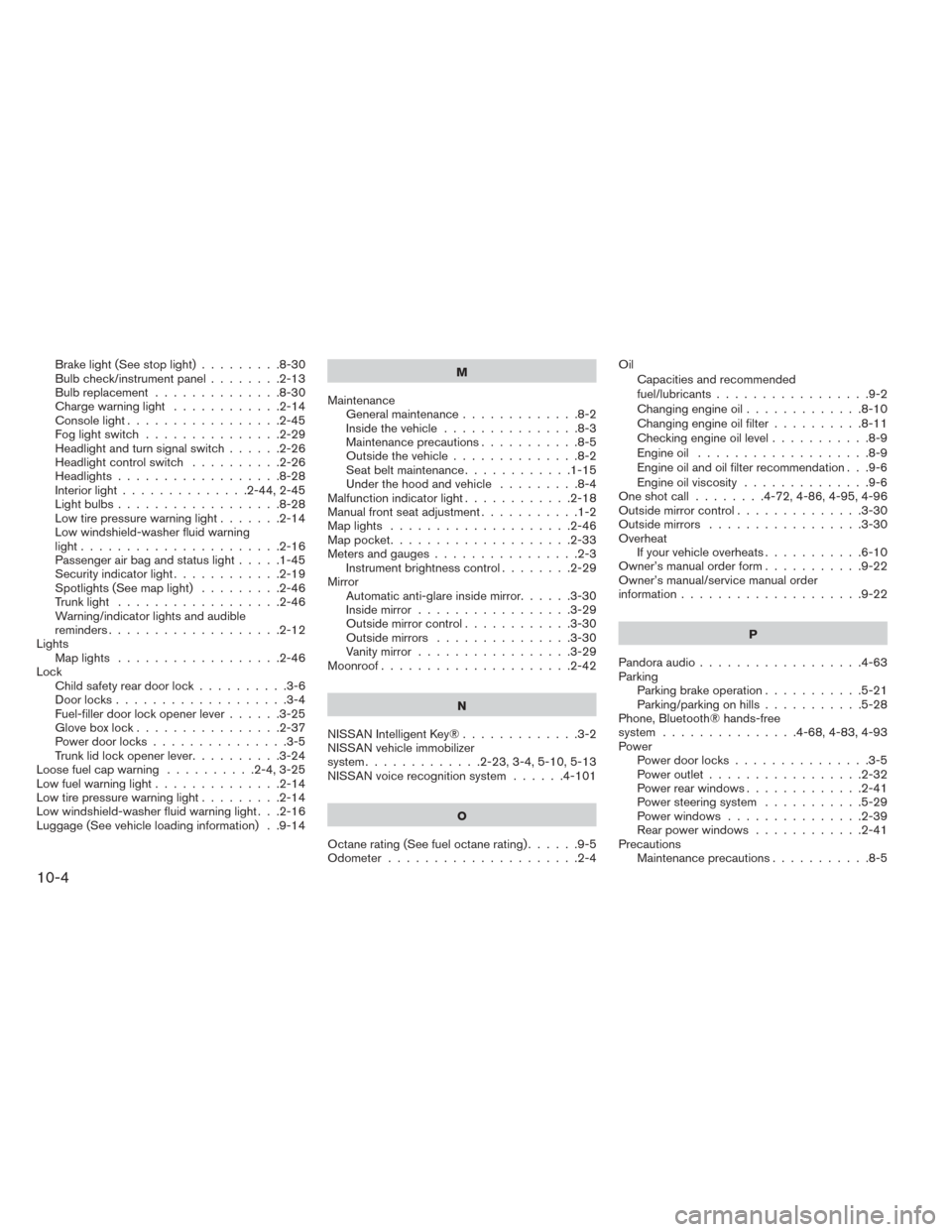
Brakelight(Seestoplight).........8-30
Bulb check/instrument panel........2-13
Bulb replacement ..............8-30
Chargewarninglight ............2-14
Console light .................2-45
Foglightswitch ...............2-29
Headlight and turn signal switch ......2-26
Headlightcontrolswitch ..........2-26
Headlights..................8-28
Interiorlight..............2-44,2-45
Lightbulbs..................8-28
Low tire pressure warning light .......2-14
Low windshield-washer fluid warning
light......................2-16
Passenger air bag and status light .....1-45
Security indicator light ............2-19
Spotlights (See map light) .........2-46
Trunklight ..................2-46
Warning/indicator lights and audible
reminders ...................2-12
Lights Maplights ..................2-46
Lock Child safety rear door lock ..........3-6
Door locks ...................3-4
Fuel-filler door lock opener lever ......3-25
Gloveboxlock................2-37
Power door locks ...............3-5
Trunk lid lock opener lever ..........3-24
Loose fuel cap warning ..........2-4,3-25
Lowfuelwarninglight..............2-14
Low tire pressure warning light .........2-14
Low windshield-washer fluid warning light . . .2-16
Luggage (See vehicle loading information) . .9-14 M
Maintenance Generalmaintenance.............8-2
Insidethevehicle...............8-3
Maintenance precautions ...........8-5
Outside the vehicle ..............8-2
Seatbeltmaintenance............1-15
Underthehoodandvehicle .........8-4
Malfunction indicator light ............2-18
Manual front seat adjustment ...........1-2
Maplights ....................2-46
Map pocket ....................2-33
Meters and gauges ................2-3
Instrument brightness control ........2-29
Mirror Automatic anti-glare inside mirror ......3-30
Inside mirror .................3-29
Outside mirror control ............3-30
Outside mirrors ...............3-30
Vanity mirror .................3-29
Moonroof .....................2-42
N
NISSAN Intelligent Key® .............3-2
NISSAN vehicle immobilizer
system .............2-23,3-4,5-10,5-13
NISSAN voice recognition system ......4-101
O
Octane rating (See fuel octane rating) ......9-5
Odometer .....................2-4 Oil
Capacities and recommended
fuel/lubricants .................9-2
Changing engine oil .............8-10
Changing engine oil filter ..........8-11
Checking engine oil level ...........8-9
Engine oil ...................8-9
Engine oil and oil filter recommendation . . .9-6
Engine oil viscosity ..............9-6
Oneshotcall........4-72,4-86,4-95,4-96
Outside mirror control ..............3-30
Outside mirrors .................3-30
Overheat If your vehicle overheats ...........6-10
Owner’s manual order form ...........9-22
Owner’s
manual/service manual order
information ....................9-22
P
Pandora audio ..................4-63
Parking Parking brake operation ...........5-21
Parking/parking on hills ...........5-28
Phone, Bluetooth® hands-free
system ...............4-68,4-83,4-93
Power Power door locks ...............3-5
Power outlet .................2-32
Power rear windows .............2-41
Power steering system ...........5-29
Power windows ...............2-39
Rear power windows ............2-41
Precautions Maintenanceprecautions...........8-5
10-4
Page 385 of 388
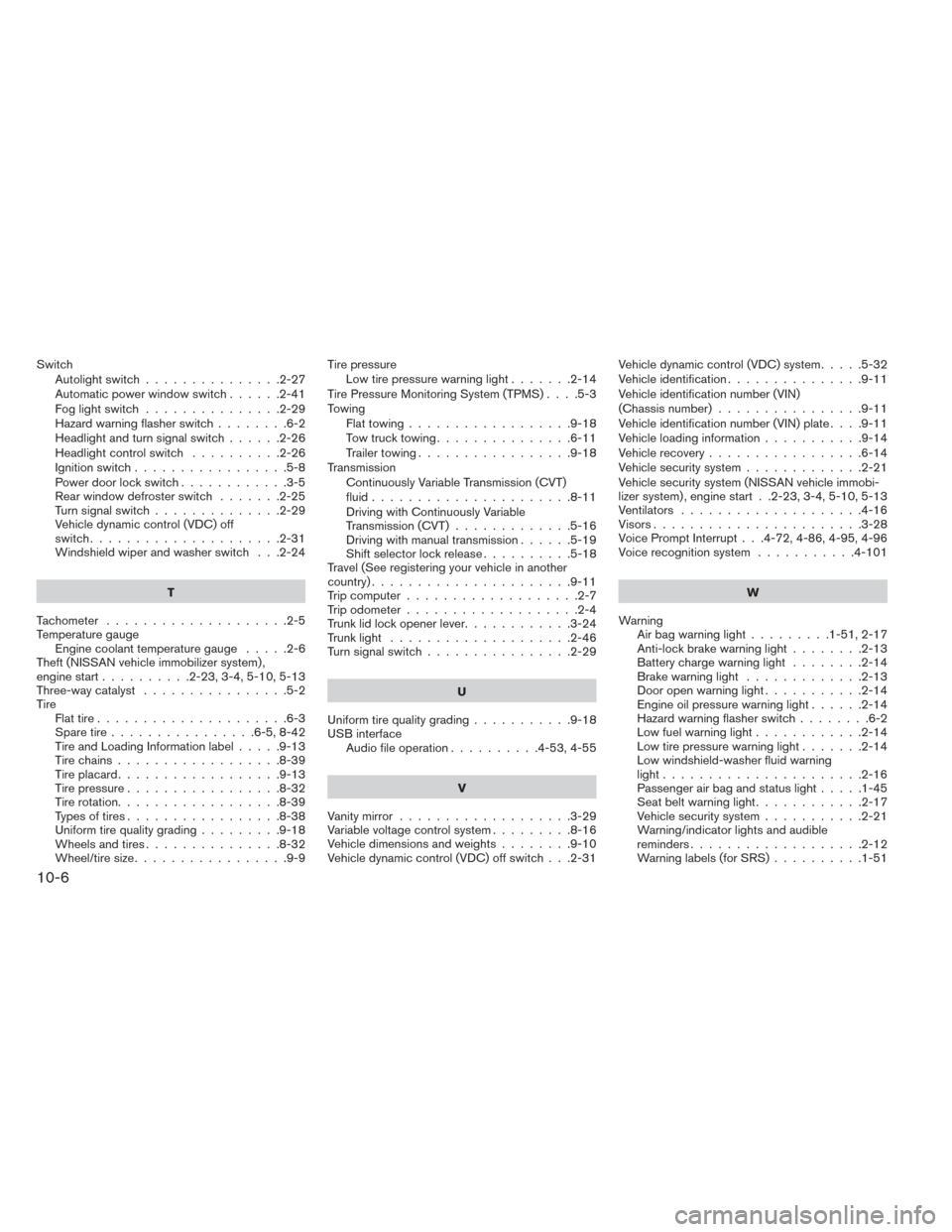
SwitchAutolightswitch...............2-27
Automatic power window switch ......2-41
Foglightswitch ...............2-29
Hazard warning flasher switch ........6-2
Headlight and turn signal switch ......2-26
Headlightcontrolswitch ..........2-26
Ignition switch .................5-8
Power door lock switch ............3-5
Rear window defroster switch .......2-25
Turnsignalswitch..............2-29
Vehicle dynamic control (VDC) off
switch.....................2-31
Windshield wiper and washer switch . . .2-24
T
Tachometer ....................2-5
Temperature gauge Engine coolant temperature gauge .....2-6
Theft (NISSAN vehicle immobilizer system) ,
engine start ..........2-23,3-4,5-10,5-13
Three-way catalyst ................5-2
Tire Flat tire .....................6-3
Spare tire ................6-5,8-42
Tire and Loading Information label .....9-13
Tire chains ..................8-39
Tireplacard..................9-13
Tirepressure.................8-32
Tire rotation..................8-39
Types of tires .................8-38
Uniform tire quality grading .........9-18
Wheels and tires ...............8-32
Wheel/tire size .................9-9 Tire pressure
Low tire pressure warning light .......2-14
Tire Pressure Monitoring System (TPMS) ....5-3
Towing Flattowing..................9-18
Towtrucktowing...............6-11
Trailer towing .................9-18
Transmission Continuously Variable Transmission (CVT)
fluid......................8-11
Driving with Continuously Variable
Transmission (CVT) .............5-16
Driving with manual transmission ......5-19
Shiftselectorlockrelease..........5-18
Travel (See registering your vehicle in another
country) ......................9-11
Trip computer ...................2-7
Trip odometer ...................2-4
Trunk lid lock opener lever ............3-24
Trunklight ....................2-46
Turn signal switch ................2-29
U
Uniform tire quality grading ...........9-18
USB interface Audio file operation ..........4-53,4-55
V
Vanity mirror ...................3-29
Variable voltage control system .........8-16
Vehicle dimensions and weights ........9-10
Vehicle dynamic control (VDC) off switch . . .2-31 Vehicle dynamic control (VDC) system
.....5-32
Vehicle identification ...............9-11
Vehicle identification number (VIN)
(Chassis number) ................9-11
Vehicle identification number (VIN) plate ....9-11
Vehicleloadinginformation...........9-14
Vehicle recovery .................6-14
Vehicle security system .............2-21
Vehicle security system (NISSAN vehicle immobi-
lizer system) , engine start . .2-23, 3-4, 5-10, 5-13
Ventilators ....................4-16
Visors.......................3-28
Voice Prompt Interrupt . . .4-72, 4-86, 4-95, 4-96
Voice recognition system ...........4-101
W
Warning Airbagwarninglight.........1-51,
2-17
Anti-lock brake warning light ........2-13
Battery charge warning light ........2-14
Brake warning light .............2-13
Door open warning light ...........2-14
Engine oil pressure warning light ......2-14
Hazard warning flasher switch ........6-2
Low fuel warning light ............2-14
Low tire pressure warning light .......2-14
Low windshield-washer fluid warning
light......................2-16
Passenger air bag and status light .....1-45
Seatbeltwarninglight............2-17
Vehicle security system ...........2-21
Warning/indicator lights and audible
reminders...................2-12
Warning labels (for SRS) ..........1-51
10-6
Page 386 of 388
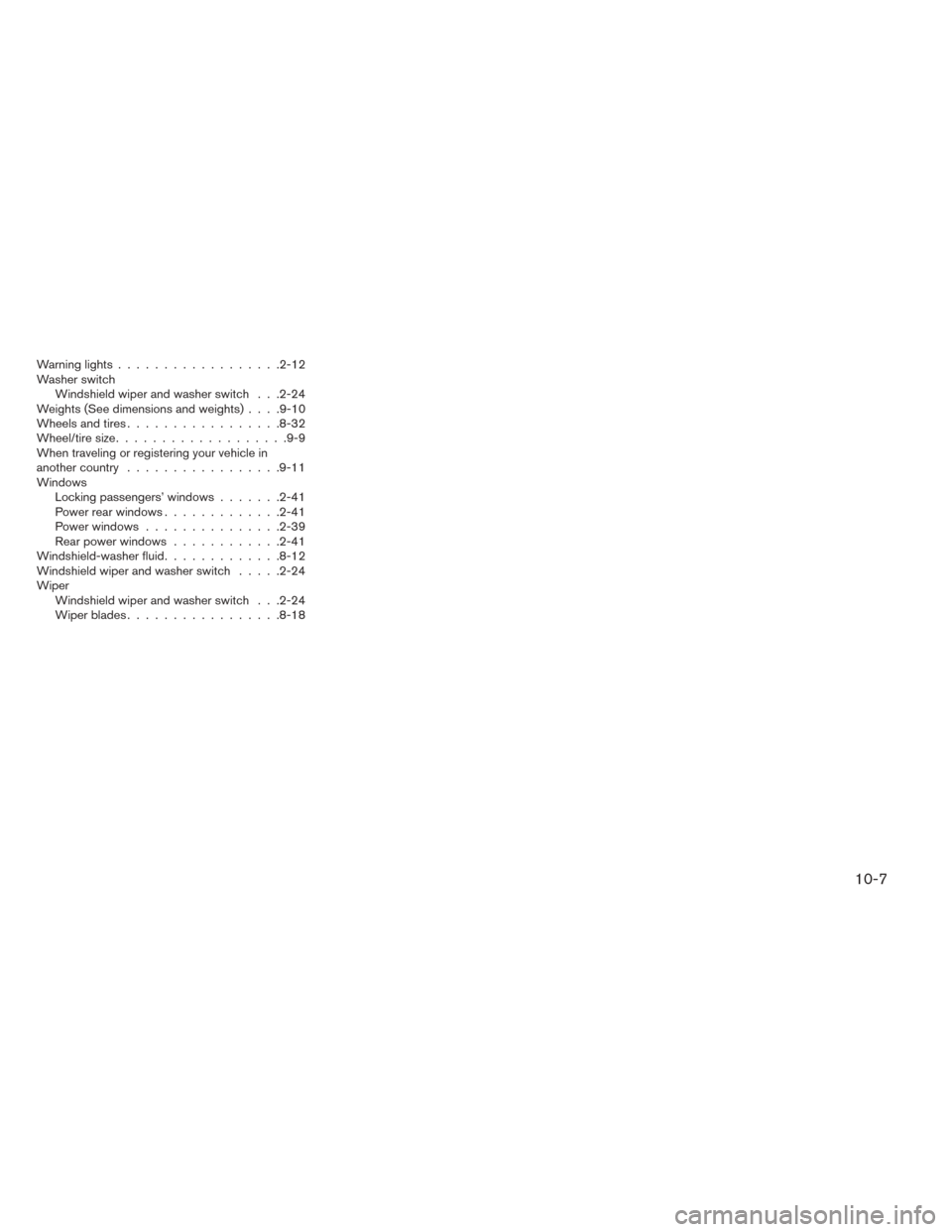
Warninglights..................2-12
Washer switchWindshield wiper and washer switch . . .2-24
Weights(Seedimensionsandweights)....9-10
Wheels and tires .................8-32
Wheel/tire size ...................9-9
When traveling or registering your vehicle in
another country .................9-11
Windows Locking passengers’ windows .......2-41
Power rear windows .............2-41
Power windows ...............2-39
Rear power windows ............2-41
Windshield-washer fluid .............8-12
Windshield wiper and washer switch .....2-24
Wiper Windshield wiper and washer switch . . .2-24
Wiper blades .................8-18
10-7