2014 NISSAN ROGUE roof
[x] Cancel search: roofPage 219 of 442
Reception conditions will constantly change be-
cause of vehicle movement. Buildings, terrain,
signal distance and interference from other ve-
hicles can work against ideal reception. De-
scribed below are some of the factors that can
affect your radio reception.
Some cellular phones or other devices may
cause interference or a buzzing noise to come
from the audio system speakers. Storing the de-
vice in a different location may reduce or elimi-
nate the noise.
FM RADIO RECEPTION
Range: FM range is normally limited to 25 – 30 mi
(40 – 48 km) , with monaural (single channel) FM
having slightly more range than stereo FM. Exter-
nal influences may sometimes interfere with FM
station reception even if the FM station is within
25 mi (40 km) . The strength of the FM signal is
directly related to the distance between the
transmitter and receiver. FM signals follow a line-
of-sight path, exhibiting many of the same char-
acteristics as light. For example, they will reflect
off objects.
Fade and drift: As your vehicle moves away from
a station transmitter, the signals will tend to fade
and/or drift.Static and flutter: During signal interference from
buildings, large hills or due to antenna position
(usually in conjunction with increased distance
from the station transmitter) , static or flutter can
be heard. This can be reduced by adjusting the
treble control to reduce treble response.
Multipath reception: Because of the reflective
characteristics of FM signals, direct and reflected
signals reach the receiver at the same time. The
signals may cancel each other, resulting in mo-
mentary flutter or loss of sound.
AM RADIO RECEPTION
AM signals, because of their low frequency, can
bend around objects and skip along the ground.
In addition, the signals can be bounced off the
ionosphere and bent back to earth. Because of
these characteristics, AM signals are also sub-
ject to interference as they travel from transmitter
to receiver.
Fading: Occurs while the vehicle is passing
through freeway underpasses or in areas with
many tall buildings. It can also occur for several
seconds during ionospheric turbulence even in
areas where no obstacles exist.
Static: Caused by thunderstorms, electrical
power lines, electric signs and even traffic lights.
SATELLITE RADIO RECEPTION (if so
equipped)
When the satellite radio is used for the first time
or the battery has been replaced, the satellite
radio may not work properly. This is not a mal-
function. Wait more than 10 minutes with satellite
radio ON and the vehicle outside of any metal or
large building for satellite radio to receive all of
the necessary data.
No satellite radio reception is available and “NO
SAT” is displayed when the SAT band option is
selected unless optional satellite receiver and
antenna are installed and a SiriusXM® Satellite
Radio service subscription is active. Satellite ra-
dio is not available in Alaska, Hawaii and Guam.
Satellite radio performance may be affected if
cargo carried on the roof blocks the satellite radio
signal.
If possible, do not put cargo over the satellite
antenna.
A build up of ice on the satellite radio antenna can
affect satellite radio performance. Remove the
ice to restore satellite radio reception.
4-38Monitor, climate, audio, phone and voice recognition systems
Page 287 of 442
WARNING
●Do not leave children or adults who
would normally require the assistance
of others alone in your vehicle. Pets
should also not be left alone. They
could accidentally injure themselves or
others through inadvertent operation of
the vehicle. Also, on hot, sunny days,
temperatures in a closed vehicle could
quickly become high enough to cause
severe or possibly fatal injuries to
people or animals.
● Properly secure all cargo with ropes or
straps to help prevent it from sliding or
shifting. Do not place cargo higher than
the seatbacks. In a sudden stop or col-
lision, unsecured cargo could cause
personal injury.
● To avoid raising the center of gravity
excessively, do not exceed the rated
capacity of the roof rack (if so equipped)
and evenly distribute the load.
EXHAUST GAS (carbon monoxide)
WARNING
● Do not breathe exhaust gases; they
contain colorless and odorless carbon
monoxide. Carbon monoxide is danger-
ous. It can cause unconsciousness or
death.
● If you suspect that exhaust fumes are
entering the vehicle, drive with all win-
dows fully open, and have the vehicle
inspected immediately.
● Do not run the engine in closed spaces
such as a garage.
● Do not park the vehicle with the engine
running for any extended length of time.
● Keep the rear vent windows, liftgates,
doors and trunk lids (if so equipped)
closed while driving, otherwise exhaust
gases could be drawn into the passen-
ger compartment. If you must drive with
one of these open, follow these
precautions:
1. Open all the windows.
2. Set the
air recirculation but-
ton to off and the fan control dial to
high to circulate the air. ●
If electrical wiring or other cable con-
nections must pass to a trailer through
the seal on the lift gate or the body,
follow the manufacturer’s recommen-
dation to prevent carbon monoxide en-
try into the vehicle.
● The exhaust system and body should be
inspected by a qualified mechanic
whenever:
a. The vehicle is raised for service.
b. You suspect that exhaust fumes are entering into the passenger
compartment.
c. You notice a change in the sound of the exhaust system.
d. You have had an accident involving damage to the exhaust system, un-
derbody, or rear of the vehicle.
THREE-WAY CATALYST
The three-way catalyst is an emission control
device installed in the exhaust system. Exhaust
gases in the three-way catalyst are burned at
high temperatures to help reduce pollutants.
PRECAUTIONS WHEN STARTING
AND DRIVING
5-2Starting and driving
Page 294 of 442
●Unsecured cargo can be thrown around
when driving over rough terrain. Prop-
erly secure all cargo so it will not be
thrown forward and cause injury to you
or your passengers.
● To avoid raising the center of gravity
excessively, do not exceed the rated
capacity of the roof rack (if so equipped)
and evenly distribute the load.
● Secure heavy loads in the cargo area as
far forward and as low as possible. Do
not equip the vehicle with tires larger
than specified in this manual. This could
cause your vehicle to roll over.
● Do not grip the inside or spokes of the
steering wheel when driving off-road.
The steering wheel could move sud-
denly and injure your hands. Instead
drive with your fingers and thumbs on
the outside of the rim.
● Before operating the vehicle, ensure
that the driver and all passengers have
their seat belts fastened.
● Always drive with the floor mats in place
as the floor may become hot. ●
Lower your speed when encountering
strong crosswinds. With a higher center
of gravity, your NISSAN is more affected
by strong side winds. Slower speeds
ensure better vehicle control.
● Do not drive beyond the performance
capability of the tires, even with AWD
engaged.
● For AWD equipped vehicles, do not at-
tempt to raise two wheels off the
ground and shift the transmission to
any drive or reverse position with the
engine running. Doing so may result in
drivetrain damage or unexpected ve-
hicle movement which could result in
serious vehicle damage or personal
injury. ●
Do not attempt to test a AWD equipped
vehicle on a 2-wheel dynamometer
(such as the dynamometers used by
some states for emissions testing) , or
similar equipment even if the other two
wheels are raised off the ground. Make
sure you inform test facility personnel
that your vehicle is equipped with AWD
before it is placed on a dynamometer.
Using the wrong test equipment may
result in drivetrain damage or unex-
pected vehicle movement which could
result in serious vehicle damage or per-
sonal injury.
● When a wheel is off the ground due to
an unlevel surface, do not spin the
wheel excessively.
● Accelerating quickly, sharp steering
maneuvers or sudden braking may
cause loss of control.
● If at all possible, avoid sharp turning
maneuvers, particularly at high speeds.
Your NISSAN vehicle has a higher cen-
ter of gravity than a passenger car. The
vehicle is not designed for cornering at
the same speeds as passenger cars.
Starting and driving5-9
Page 410 of 442
WHEELS AND TIRES
Wheel typeSize
Steel 17 x 7J
Aluminum 17 x 7J
18x7J
Tire size
Non Run Flat 225/65RF17
225/60R18
Run Flat 225/65R17
Spare tire
Spare Wheel - Steel T155/90D17
Spare Wheel - Steel T145/90D16
Spare Wheel - Aluminum T145/90D16
DIMENSIONS AND WEIGHTS
Overall length (without front license
plate bracket)in (mm) 182.8 (4,643)
Overall length (with front license plate
bracket) in (mm)
183.3 (4,655)
Overall width in (mm)72 (1,830)
Overall height without roof rack in (mm)66.8 (1,696)
with roof rack in (mm)67.5 (1714)
Front and Rear Track in (mm)62.8 (1,595)
Wheelbase in (mm)106.5 (2,706)
Gross vehicle weight rating lb (kg) See the “F.M.V.S.S./C.M.V.
S.S. certification label” on thecenter pillar between the
driver’s side front and rear doors.
Gross axle weight rating
Front lb (kg)
Rear lb (kg)
Technical and consumer information9-9
Page 437 of 442
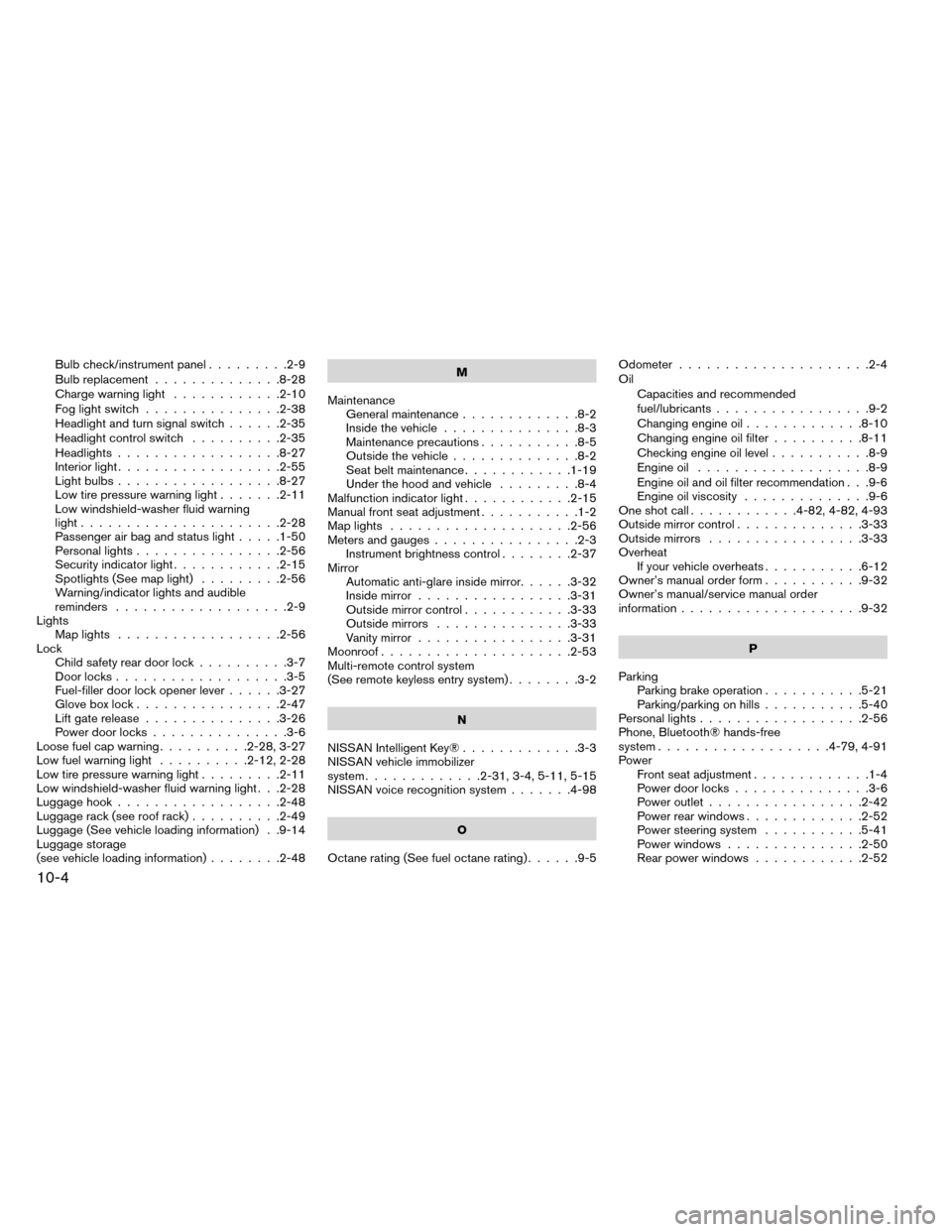
Bulb check/instrument panel.........2-9
Bulb replacement ..............8-28
Charge warning light ............2-10
Foglightswitch ...............2-38
Headlight and turn signal switch ......2-35
Headlight control switch ..........2-35
Headlights ..................8-27
Interiorlight..................2-55
Lightbulbs..................8-27
Low tire pressure warning light .......2-11
Low windshield-washer fluid warning
light......................2-28
Passenger air bag and status light .....1-50
Personal lights ................2-56
Security indicator light ............2-15
Spotlights(Seemaplight) .........2-56
Warning/indicator lights and audible
reminders ...................2-9
Lights Maplights ..................2-56
Lock Child safety rear door lock ..........3-7
Door locks ...................3-5
Fuel-filler door lock opener lever ......3-27
Gloveboxlock................2-47
Lift gate release ...............3-26
Power door locks ...............3-6
Loose fuel cap warning ..........2-28,3-27
Lowfuelwarninglight ..........2-12,2-28
Low tire pressure warning light .........2-11
Low windshield-washer fluid warning light . . .2-28
Luggage hook ..................2-48
Luggage rack (see roof rack) ..........2-49
Luggage (See vehicle loading information) . .9-14
Luggage storage
(see vehicle loading information) ........2-48 M
Maintenance General maintenance .............8-2
Inside the vehicle ...............8-3
Maintenance precautions ...........8-5
Outside the vehicle ..............8-2
Seat belt maintenance ............1-19
Under the hood and vehicle .........8-4
Malfunctionindicatorlight............2-15
Manual front seat adjustment ...........1-2
Maplights ....................2-56
Meters and gauges ................2-3
Instrument brightness control ........2-37
Mirror Automatic anti-glare inside mirror ......3-32
Inside mirror .................3-31
Outside mirror control ............3-33
Outside mirrors ...............3-33
Vanity mirror .................3-31
Moonroof .....................2-53
Multi-remote control system
(See remote keyless entry system) ........3-2
N
NISSAN Intelligent Key® .............3-3
NISSAN vehicle immobilizer
system .............2-31,3-4,5-11,5-15
NISSAN voice recognition system .......4-98
O
Octanerating(Seefueloctanerating)......9-5 Odometer
.....................2-4
Oil Capacities and recommended
fuel/lubricants .................9-2
Changing engine oil .............8-10
Changing engine oil filter ..........8-11
Checking engine oil level ...........8-9
Engine oil ...................8-9
Engine
oil and oil filter recommendation . . .9-6
Engine oil viscosity ..............9-6
One shot call ............4-82,4-82,4-93
Outside mirror control ..............3-33
Outside mirrors .................3-33
Overheat If your vehicle overheats ...........6-12
Owner’s manual order form ...........9-32
Owner’s manual/service manual order
information....................9-32
P
Parking Parking brake operation ...........5-21
Parking/parking on hills ...........5-40
Personal lights ..................2-56
Phone, Bluetooth® hands-free
system ...................4-79,4-91
Power Front seat adjustment .............1-4
Power door locks ...............3-6
Power outlet .................2-42
Power rear windows .............2-52
Power steering system ...........5-41
Power windows ...............2-50
Rear power windows ............2-52
10-4
Page 438 of 442
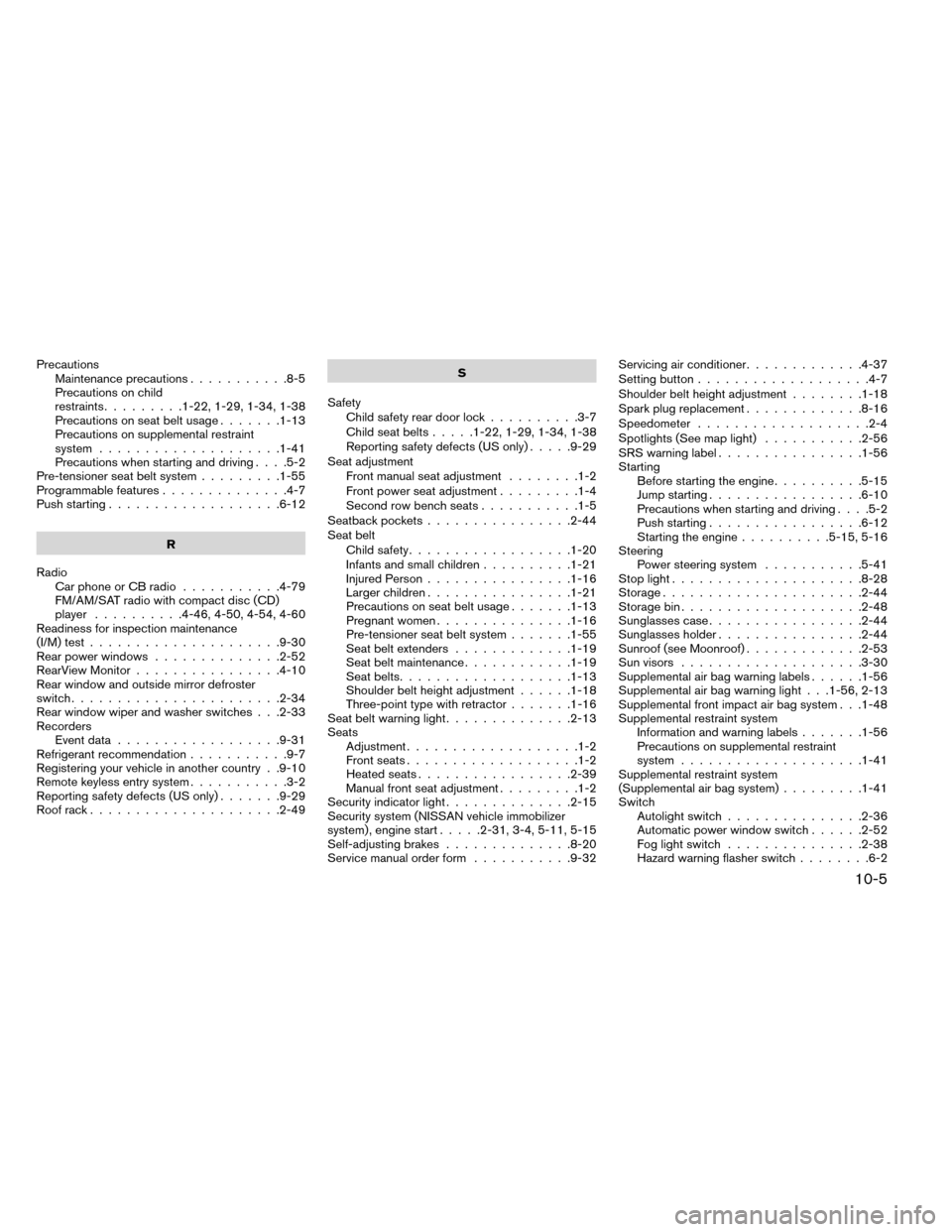
PrecautionsMaintenance precautions ...........8-5
Precautions on child
restraints.........1-22,1-29,1-34,1-38
Precautions on seat belt usage .......1-13
Precautions on supplemental restraint
system ....................1-41
Precautions when starting and driving ....5-2
Pre-tensioner seat belt system .........1-55
Programmable features ..............4-7
Push starting ...................6-12
R
Radio Car phone or CB radio ...........4-79
FM/AM/SAT radio with compact disc (CD)
player ..........4-46,4-50,4-54,4-60
Readiness for inspection maintenance
(I/M) test .....................9-30
Rear power windows ..............2-52
RearView Monitor ................4-10
Rear window and outside mirror defroster
switch.......................2-34
Rear window wiper and washer switches . . .2-33
Recorders Event data ..................9-31
Refrigerant recommendation ...........9-7
Registering your vehicle in another country . .9-10
Remote keyless entry system ...........3-2
Reporting safety defects (US only) .......9-29
Roof rack .....................2-49 S
Safety Child safety rear door lock ..........3-7
Child seat belts .....1-22,1-29,1-34,1-38
Reporting safety defects (US only) .....9-29
Seat adjustment Front manual seat adjustment ........1-2
Front power seat adjustment .........1-4
Second row bench seats ...........1-5
Seatback pockets ................2-44
Seat belt Childsafety..................1-20
Infants and small children ..........1-21
InjuredPerson................1-16
Largerchildren................1-21
Precautions on seat belt usage .......1-13
Pregnant women ...............1-16
Pre-tensioner seat belt system .......1-55
Seat belt extenders .............1-19
Seat belt maintenance ............1-19
Seat belts ...................1-13
Shoulder belt height adjustment ......1-18
Three-pointtypewithretractor.......1-16
Seat belt warning light ..............2-13
Seats Adjustment ...................1-2
Front seats ...................1-2
Heated seats .................2-39
Manual front seat adjustment .........1-2
Security indicator light ..............2-15
Security system (NISSAN vehicle immobilizer
system) , engine start .....2-31,3-4,5-11,5-15
Self-adjusting brakes ..............8-20
Service manual order form ...........9-32Servicing air conditioner
.............4-37
Setting button ...................4-7
Shoulder belt height adjustment ........1-18
Spark plug replacement .............8-16
Speedometer ...................2-4
S
potlights(Seemaplight) ...........2-56
SRS warning label ................1-56
Starting Before starting the engine ..........5-15
Jump starting .................6-10
Precautions when starting and driving ....5-2
Push starting .................6-12
Starting the engine ..........5-15,5-16
Steering Power steering system ...........5-41
Stoplight.....................8-28
Storage......................2-44
Storagebin....................2-48
Sunglasses case .................2-44
Sunglasses holder ................2-44
Sunroof (see Moonroof) .............2-53
Sunvisors ....................3-30
Supplemental air bag warning labels ......1-56
Supplemental air bag warning light . . .1-56, 2-13
Supplemental front impact air bag system . . .1-48
Supplemental restraint system Information and warning labels .......1-56
Precautions on supplemental restraint
system ....................1-41
Supplemental restraint system
(Supplemental air bag system) .........1-41
Switch Autolightswitch...............2-36
Automatic power window switch ......2-52
Foglightswitch ...............2-38
Hazard warning flasher switch ........6-2
10-5