2014 NISSAN ROGUE run flat
[x] Cancel search: run flatPage 344 of 442
3. Place the sub-woofer in the upper right cor-ner of the trunk, leaning against the 2nd row
passenger side seat.
4. Remove the spare tire.
5. Once the flat tire is exchanged with the spare tire, store the flat tire where the spare
was located.
6. Place the sub-woofer inside the flat tire.
7. Turn the bolt clockwise to tighten.
LCE2110
LCE2106
In case of emergency6-7
Page 350 of 442
6. After the engine cools down, check the cool-ant level in the engine coolant reservoir tank
with the engine running. Add coolant to the
engine coolant reservoir tank if necessary.
Have your vehicle repaired at a NISSAN
dealer. When towing your vehicle, all State (Provincial in
Canada) and local regulations for towing must be
followed. Incorrect towing equipment could dam-
age your vehicle. Towing instructions are avail-
able from a NISSAN dealer. Local service opera-
tors are generally familiar with the applicable laws
and procedures for towing. To assure proper
towing and to prevent accidental damage to your
vehicle, NISSAN recommends having a service
operator tow your vehicle. It is advisable to have
the service operator carefully read the following
precautions:
WARNING
●
Never ride in a vehicle that is being
towed.
● Never get under your vehicle after it has
been lifted by a tow truck.
CAUTION
● When towing, make sure that the trans-
mission, axles, steering system and
powertrain are in working condition. If
any of these conditions apply, dollies or
a flatbed tow truck must be used.
● Always attach safety chains before
towing. For additional information about towing your ve-
hicle behind a recreational vehicle (RV) , refer to
“Flat towing” in the “Technical and Consumer
Information” section of this manual.
TOWING RECOMMENDED BY
NISSAN
TOWING YOUR VEHICLE
In case of emergency6-13
Page 397 of 442
Summer tires
NISSAN specifies summer tires on some models
to provide superior performance on dry roads.
Summer tire performance is substantially re-
duced in snow and ice. Summer tires do not have
the tire traction rating “M&S” on the tire sidewall.
If you plan to operate your vehicle in snowy or icy
conditions, NISSAN recommends the use of
SNOW tires or ALL SEASON tires on all four
wheels.
Snow tires
If snow tires are needed, it is necessary to select
tires equivalent in size and load rating to the
original equipment tires. If you do not, it can
adversely affect the safety and handling of your
vehicle.
Generally, snow tires have lower speed ratings
than factory equipped tires and may not match
the potential maximum vehicle speed. Never ex-
ceed the maximum speed rating of the tire.
If you install snow tires, they must be the same
size, brand, construction and tread pattern on all
four wheels.
For additional traction on icy roads, studded tires
may be used. However, some U.S. states and
Canadian provinces prohibit their use. Check
local, state and provincial laws before installingstudded tires. Skid and traction capabilities of
studded snow tires on wet or dry surfaces may be
poorer than that of non-studded snow tires.
Run–Flat Tires (if so equipped)
Your vehicle is equipped with run-flat tires and is
not equipped with a spare tire, or a jack and tool
kit. The jack and tool kit may be purchased at the
dealer. Please consult your NISSAN dealer for
additional details. You can continue driving to a
safe location even if the run-flat tires are punc-
tured. Always use run-flat tires of the specified
size on all four wheels. Mixing tire sizes or con-
struction may reduce vehicle handling stability. If
necessary, contact your NISSAN dealer for as-
sistance.
Frequently check the tire pressure and adjust
pressure of each tire properly. The tire pressure
can be also checked in the vehicle information
display.
It can be difficult to tell if a run-flat tire is under-
inflated or flat. Check the tire pressures as de-
scribed in this section. If the tire becomes under-
inflated while driving, the low tire pressure
warning light will illuminate. If the tire becomes
flat while driving, the low tire pressure warning
light and the “Tire Pressure Low Add Air” warning
will appear.
Low tire pressure:
If the vehicle is being driven with low tire pres-
sure, the low tire pressure warning light will illu-
minate.
Flat tire:
If the vehicle is being driven with one or more flat
tires, the low tire pressure warning light will illumi-
nate continuously and a chime will sound for
10 seconds. A “Tire Pressure Low Add Air” warn-
ing also appears in the vehicle information display.
The chime will only sound at the first indication of
a flat tire and the warning light will illuminate
continuously. When the flat tire warning is acti-
vated, have the system reset and the tire checked
and replaced if necessary by your NISSAN
dealer. Even if the tire is inflated to the specified
COLD tire pressure, the warning light will con-
tinue to illuminate until the system is reset by your
NISSAN dealer.
If the low tire pressure warning light illuminates
continuously and the “Tire Pressure Low Add Air”
warning appears in the vehicle information display:
●
Do not exceed 50 MPH (80 km/h).
● Increase your following distance to allow for
increased stopping distances.
● Avoid sudden maneuvers, hard cornering
and hard braking.
8-38Maintenance and do-it-yourself
Page 398 of 442
WARNING
●Although you can continue driving with
a punctured run-flat tire, remember that
vehicle handling stability is reduced,
which could lead to an accident and
personal injury. Also, driving a long dis-
tance at high speeds may damage the
tire.
● Do not drive at speeds above 50 MPH
(80 km/h) and do not drive more than
approximately 93 miles (150 km) with a
punctured run-flat tire. The actual dis-
tance the vehicle can be driven on a flat
tire depends on outside temperature,
vehicle load, read conditions and other
factors.
● Drive safely at reduced speeds. Avoid
hard cornering or braking, which may
cause you to lose control of the vehicle.
● If you detect any unusual sounds or
vibrations while driving with a punc-
tured run-flat tire, pull off the road to a
safe location and stop the vehicle as
soon as possible. The tire may be seri-
ously damaged and need to be
replaced.
CAUTION
● Never install tire chains on a punctured
run-flat tire, as this could damage your
vehicle.
● Avoid driving over any projection or pot-
hole, as the clearance between the ve-
hicle and the ground is smaller than
normal.
● Do not enter an automated car wash
with a punctured run-flat tire.
● Have the punctured tire inspected by a
NISSAN dealer or other authorized re-
pair shop. Replace the tire as soon as
possible if the tire is seriously
damaged.
● Always use tires of the same type, size,
brand, construction (bias, bias-belted
or radial) , and tread pattern on all four
wheels. Failure to do so may result in a
circumference difference between tires
on the front and rear axles which will
cause excessive tire wear and may dam-
age the transmission, transfer case and
differential gears (AWD models) .
● ONLY use spare tires specified for the
AWD model. If excessive tire wear is found, it is recom-
mended that all four tires be replaced with
tires of the same size, brand, construction
and tread pattern. The tire pressure and
wheel alignment should also be checked
and corrected as necessary. Contact a
NISSAN dealer.
TIRE CHAINS
Use of tire chains may be prohibited according to
location. Check the local laws before installing
tire chains. When installing tire chains, make sure
they are the proper size for the tires on your
vehicle and are installed according to the chain
manufacturer’s suggestions.
Use only SAE
class “S” chains. Class “S” chains are used on
vehicles with restricted tire to vehicle clearance.
Vehicles that can use Class “S” chains are de-
signed to meet the minimum clearances between
the tire and the closest vehicle suspension or
body component required to accommodate the
use of a winter traction device (tire chains or
cables) . The minimum clearances are determined
using the factory equipped tire size. Other types
may damage your vehicle. Use chain tensioners
when recommended by the tire chain manufac-
turer to ensure a tight fit. Loose end links of the
tire chain must be secured or removed to prevent
the possibility of whipping action damage to the
fenders or underbody. If possible, avoid fully load-
Maintenance and do-it-yourself8-39
Page 410 of 442
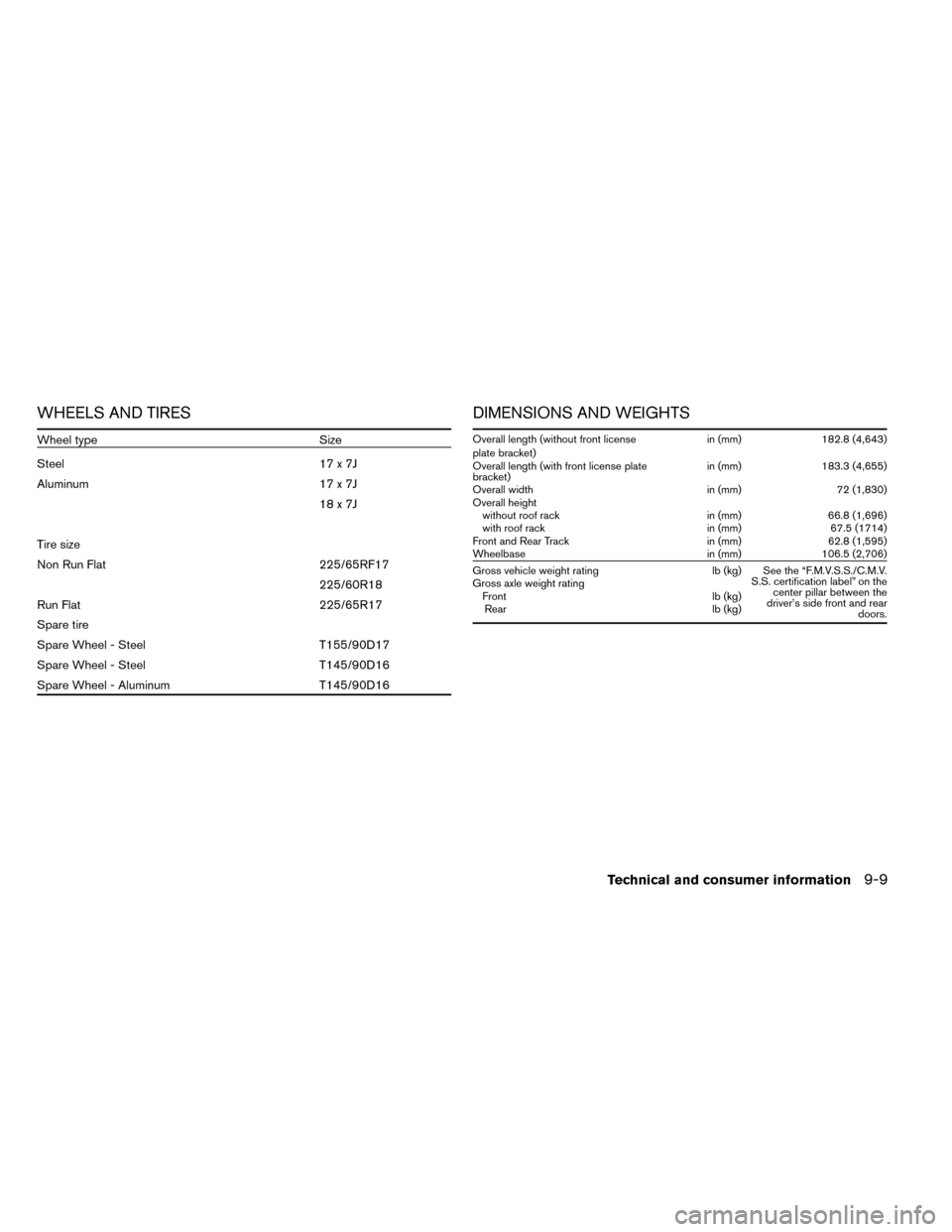
WHEELS AND TIRES
Wheel typeSize
Steel 17 x 7J
Aluminum 17 x 7J
18x7J
Tire size
Non Run Flat 225/65RF17
225/60R18
Run Flat 225/65R17
Spare tire
Spare Wheel - Steel T155/90D17
Spare Wheel - Steel T145/90D16
Spare Wheel - Aluminum T145/90D16
DIMENSIONS AND WEIGHTS
Overall length (without front license
plate bracket)in (mm) 182.8 (4,643)
Overall length (with front license plate
bracket) in (mm)
183.3 (4,655)
Overall width in (mm)72 (1,830)
Overall height without roof rack in (mm)66.8 (1,696)
with roof rack in (mm)67.5 (1714)
Front and Rear Track in (mm)62.8 (1,595)
Wheelbase in (mm)106.5 (2,706)
Gross vehicle weight rating lb (kg) See the “F.M.V.S.S./C.M.V.
S.S. certification label” on thecenter pillar between the
driver’s side front and rear doors.
Gross axle weight rating
Front lb (kg)
Rear lb (kg)
Technical and consumer information9-9
Page 435 of 442
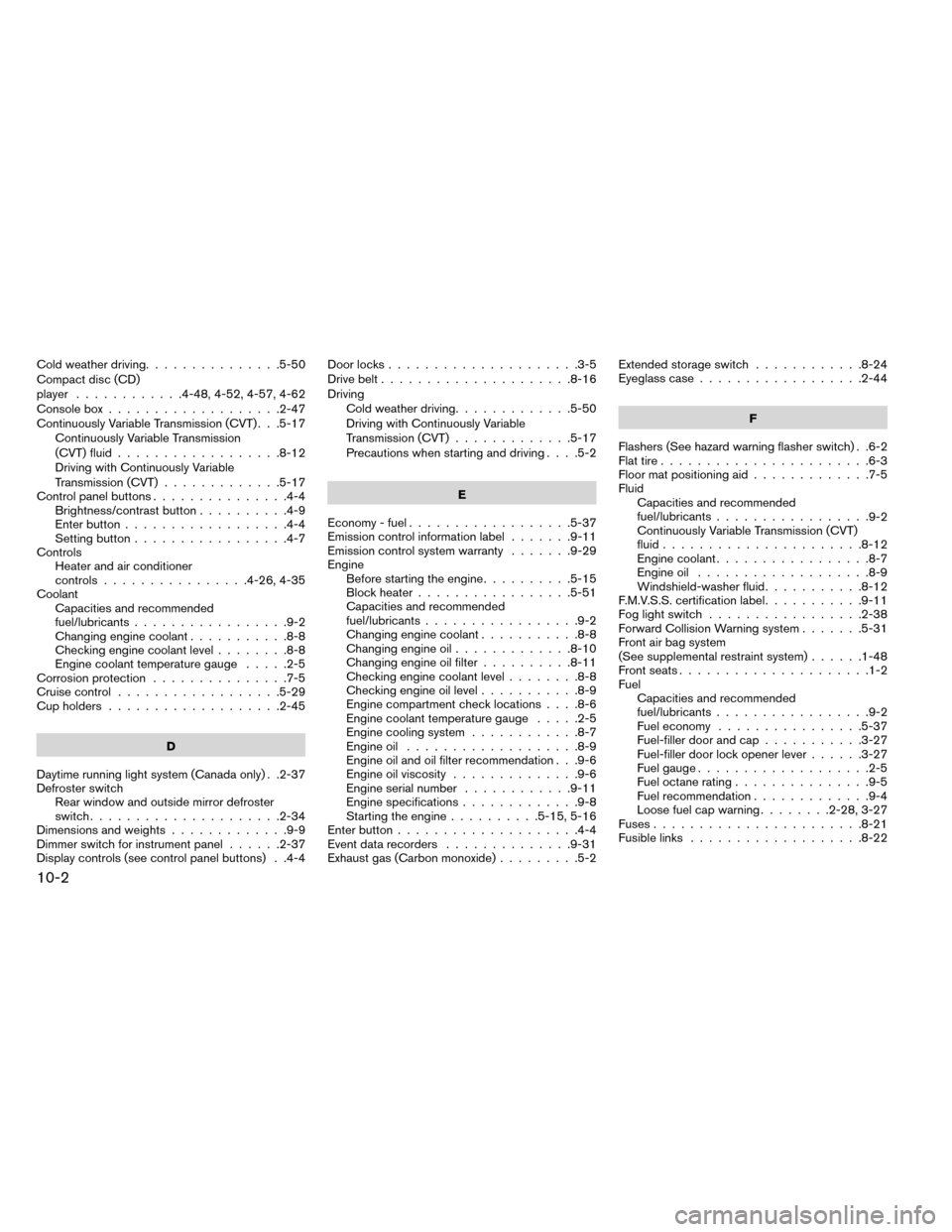
Cold weather driving...............5-50
Compact disc (CD)
player ............4-48,4-52,4-57,4-62
Console box ...................2-47
Continuously Variable Transmission (CVT) . . .5-17 Continuously Variable Transmission
(CVT) fluid ..................8-12
Driving with Continuously Variable
Transmission (CVT) .............5-17
Control panel buttons ...............4-4
Brightness/contrast button ..........4-9
Enterbutton..................4-4
Setting button .................4-7
Controls Heater and air conditioner
controls................4-26,4-35
Coolant Capacities and recommended
fuel/lubricants .................9-2
Changing engine coolant ...........8-8
Checking engine coolant level ........8-8
Engine coolant temperature gauge .....2-5
Corrosionprotection ...............7-5
Cruisecontrol..................5-29
Cupholders...................2-45
D
Daytime running light system (Canada only) . .2-37
Defroster switch Rear window and outside mirror defroster
switch.....................2-34
Dimensions and weights .............9-9
Dimmer switch for instrument panel ......2-37
Display controls (see control panel buttons) . .4-4 Door locks
.....................3-5
Drivebelt.....................8-16
Driving Cold weather driving .............5-50
Driving with Continuously Variable
Transmission (CVT) .............5-17
Precautions when starting and driving ....5-2
E
Economy - fuel ..................5-37
Emission control information label .......9-11
Emission control system warranty .......9-29
Engine Before starting the engine ..........5-15
Block heater .................5-51
Capacities and recommended
fuel/lubricants .................9-2
Changing engine coolant ...........8-8
Changing engine oil .............8-10
Changing engine oil filter ..........8-11
Checking engine coolant level ........8-8
Checking engine oil level ...........8-9
Engine compartment check locations ....8-6
Engine coolant temperature gauge .....2-5
Engine cooling system ............8-7
Engine oil ...................8-9
Engine oil and oil filter recommendation . . .9-6
Engine oil viscosity ..............9-6
Engine serial number ............9-11
Engine specifications .............9-8
Starting the engine ..........5-15,5-16
Enterbutton....................4-4
Event data recorders ..............9-31
Exhaust gas (Carbon monoxide) .........5-2Extended storage switch
............8-24
Eyeglass case ..................2-44
F
Flashers (See hazard warning flasher switch) . .6-2
Flat tire .......................6-3
Floormatpositioningaid.............7-5
Fluid Capacities and recommended
fuel/lubricants .................
9-2
Continuously Variable Transmission (CVT)
fluid......................8-12
Engine coolant .................8-7
Engine oil ...................8-9
Windshield-washer fluid ...........8-12
F.M.V.S.S. certification label ...........9-11
Foglightswitch .................2-38
Forward Collision Warning system .......5-31
Front air bag system
(See supplemental restraint system) ......1-48
Front seats .....................1-2
Fuel Capacities and recommended
fuel/lubricants .................9-2
Fuel economy ................5-37
Fuel-filler door and cap ...........3-27
Fuel-filler door lock opener lever ......3-27
Fuel gauge ...................2-5
Fuel octane rating ...............9-5
Fuel recommendation .............9-4
Loose fuel cap warning ........2-28,3-27
Fuses .......................8-21
Fusible links ...................8-22
10-2