Page 35 of 492
●Adjustable head restraints/headrests have
multiple notches along the stalk to lock them
in a desired adjustment position.
● The non-adjustable head
restraints/headrests have single locking
notches to secure them to the seat frame.
● Proper Adjustment:
– For the adjustable type, align the head restraint/headrest so the center of your
ear is approximately level with the center
of the head restraint/headrest.
– If your ear position is still higher than the recommended alignment, place the head
restraint/headrest at the highest position.
● If the head restraint/headrest has been re-
moved, ensure that it is reinstalled and
locked in place before riding in that desig-
nated seating position
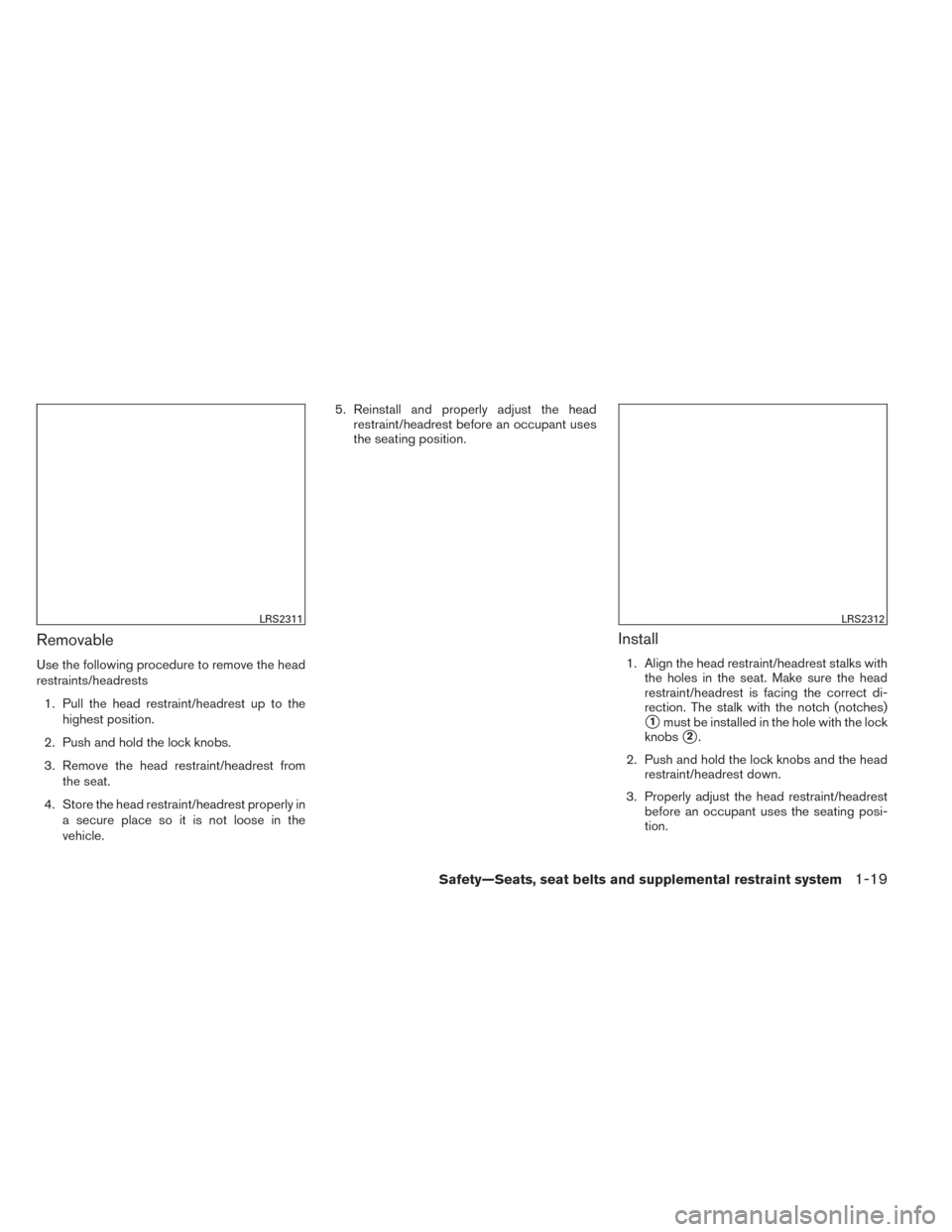
Adjustable head restraint/headrest
components
1. Removable head restraint/headrest
2. Multiple notches
3. Lock knobs
4. Stalks
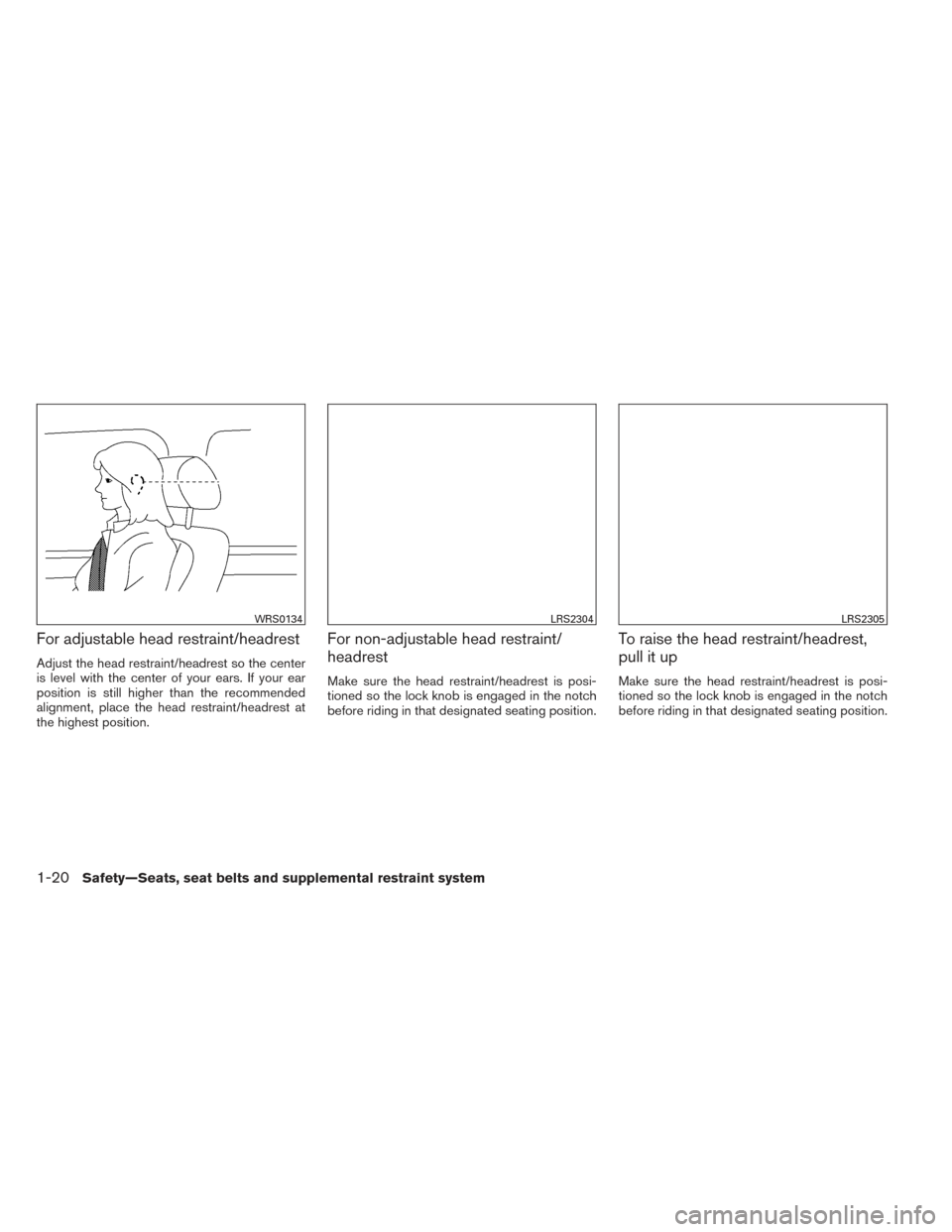
Non-adjustable head restraint/
headrest components
1. Removable head restraint/headrest
2. Single Notch
3. Lock knobs
4. Stalks
LRS2310LRS2315
1-18Safety—Seats, seat belts and supplemental restraint system
Page 36 of 492
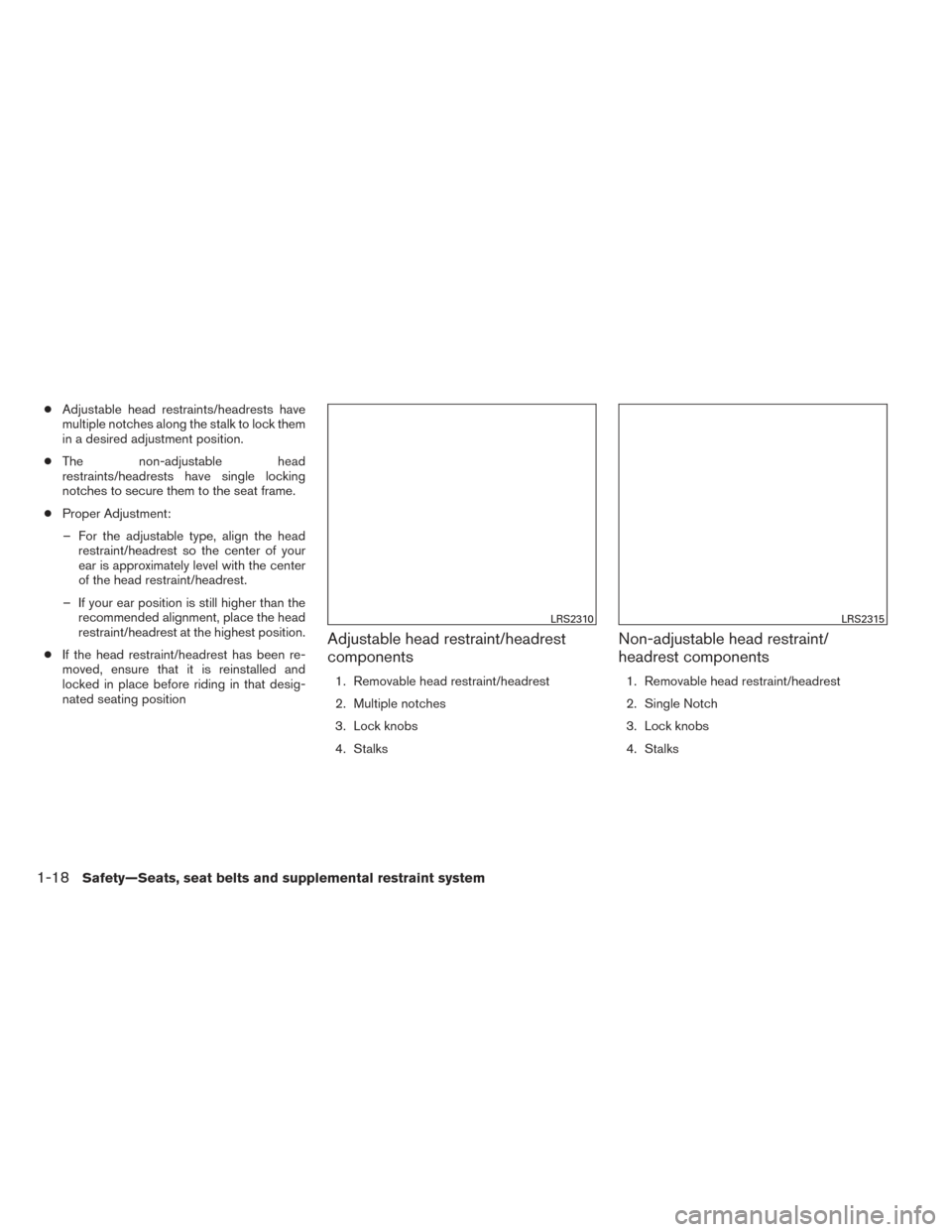
Removable
Use the following procedure to remove the head
restraints/headrests1. Pull the head restraint/headrest up to the highest position.
2. Push and hold the lock knobs.
3. Remove the head restraint/headrest from the seat.
4. Store the head restraint/headrest properly in a secure place so it is not loose in the
vehicle. 5. Reinstall and properly adjust the head
restraint/headrest before an occupant uses
the seating position.
Install
1. Align the head restraint/headrest stalks withthe holes in the seat. Make sure the head
restraint/headrest is facing the correct di-
rection. The stalk with the notch (notches)
�1must be installed in the hole with the lock
knobs
�2.
2. Push and hold the lock knobs and the head restraint/headrest down.
3. Properly adjust the head restraint/headrest before an occupant uses the seating posi-
tion.
LRS2311LRS2312
Safety—Seats, seat belts and supplemental restraint system1-19
Page 37 of 492
For adjustable head restraint/headrest
Adjust the head restraint/headrest so the center
is level with the center of your ears. If your ear
position is still higher than the recommended
alignment, place the head restraint/headrest at
the highest position.
For non-adjustable head restraint/
headrest
Make sure the head restraint/headrest is posi-
tioned so the lock knob is engaged in the notch
before riding in that designated seating position.
To raise the head restraint/headrest,
pull it up
Make sure the head restraint/headrest is posi-
tioned so the lock knob is engaged in the notch
before riding in that designated seating position.
WRS0134LRS2304LRS2305
1-20Safety—Seats, seat belts and supplemental restraint system
Page 38 of 492
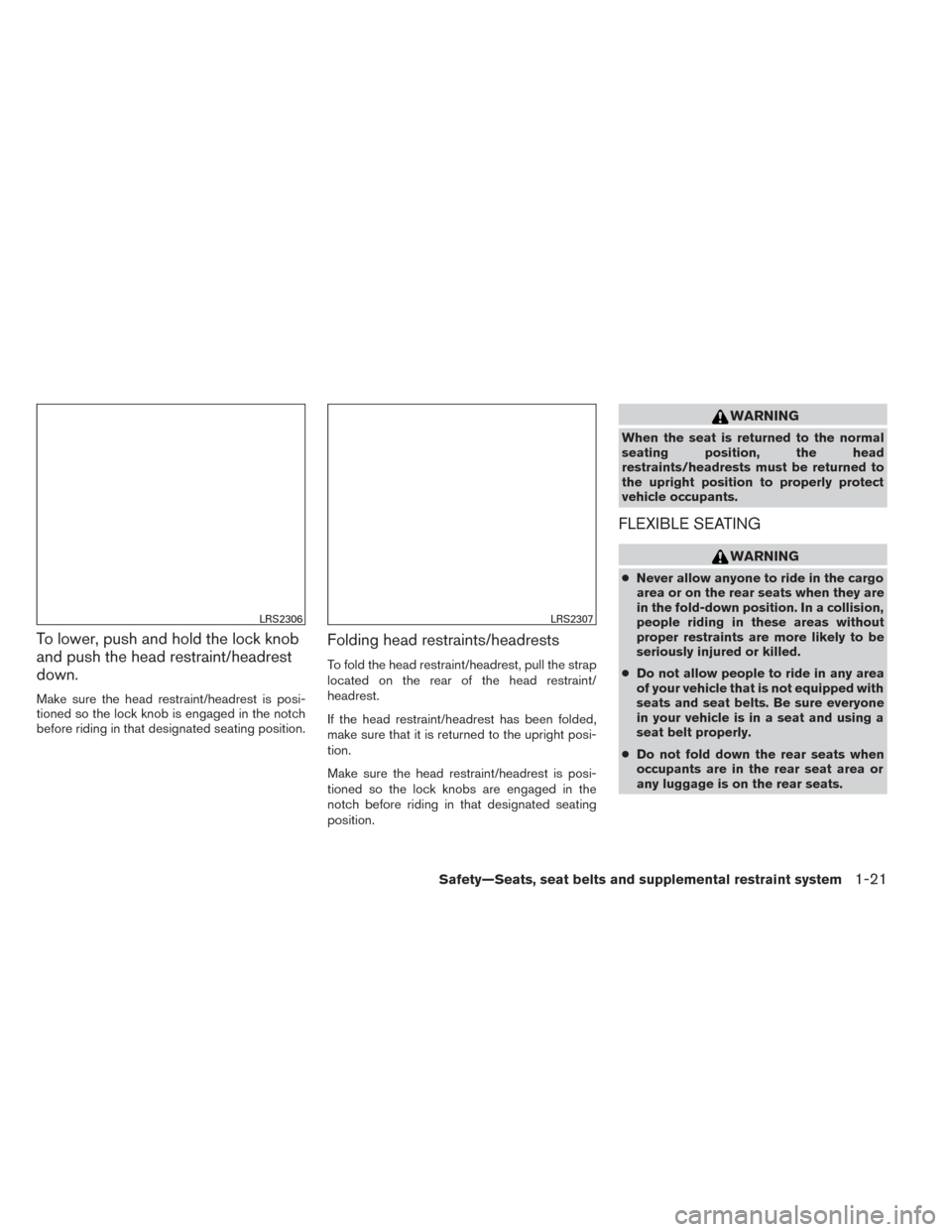
To lower, push and hold the lock knob
and push the head restraint/headrest
down.
Make sure the head restraint/headrest is posi-
tioned so the lock knob is engaged in the notch
before riding in that designated seating position.
Folding head restraints/headrests
To fold the head restraint/headrest, pull the strap
located on the rear of the head restraint/
headrest.
If the head restraint/headrest has been folded,
make sure that it is returned to the upright posi-
tion.
Make sure the head restraint/headrest is posi-
tioned so the lock knobs are engaged in the
notch before riding in that designated seating
position.
WARNING
When the seat is returned to the normal
seating position, the head
restraints/headrests must be returned to
the upright position to properly protect
vehicle occupants.
FLEXIBLE SEATING
WARNING
●Never allow anyone to ride in the cargo
area or on the rear seats when they are
in the fold-down position. In a collision,
people riding in these areas without
proper restraints are more likely to be
seriously injured or killed.
● Do not allow people to ride in any area
of your vehicle that is not equipped with
seats and seat belts. Be sure everyone
in your vehicle is in a seat and using a
seat belt properly.
● Do not fold down the rear seats when
occupants are in the rear seat area or
any luggage is on the rear seats.
LRS2306LRS2307
Safety—Seats, seat belts and supplemental restraint system1-21
Page 39 of 492
●Head restraints/headrests should be
adjusted properly as they may provide
significant protection against injury in
an accident. Always replace and adjust
them properly if they have been re-
moved for any reason.
● If the head restraints/headrests are re-
moved for any reason, they should be
securely stored to prevent them from
causing injury to passengers or damage
to the vehicle in case of sudden braking
or an accident
● When returning the seatbacks to the
upright position, be certain they are
completely secured in the latched posi-
tion. If they are not completely secured,
passengers may be injured in an acci-
dent or sudden stop.
● Properly secure all cargo to help pre-
vent it from sliding or shifting. Do not
place cargo higher than the seatbacks.
In a sudden stop or collision, unsecured
cargo could cause personal injury.
Folding the 2nd row bench seat
To fold the 2nd row bench seat flat for maximum
cargo hauling:
1. Make sure that the head restraints/ headrests are lowered. For maximum cargo
hauling, remove the center head
restraints/headrests. To remove the head
restraints/headrests, push and hold the lock
knob while moving the head restraints/
headrests in an upward direction. Store the
head restraints/headrests properly so it is
not loose in the vehicle. 2. Stow the 2nd row seat belts in the seat belt
hooks found on the sides of the vehicle.
3. Lift up on the recline lever on the side of the outboard seats to fold the seatbacks flat.
4. To return the 2nd row bench seats to a seating position, push up on the seatback
until it latches in place.
LRS2144
1-22Safety—Seats, seat belts and supplemental restraint system
Page 44 of 492
PREGNANT WOMEN
NISSAN recommends that pregnant women use
seat belts. The seat belt should be worn snug and
always position the lap belt as low as possible
around the hips, not the waist. Place the shoulder
belt over your shoulder and across your chest.
Never run the lap/shoulder belt over your ab-
dominal area. Contact your doctor for specific
recommendations.
INJURED PERSONS
NISSAN recommends that injured persons use
seat belts. Check with your doctor for specific
recommendations.
THREE-POINT TYPE SEAT BELT
WITH RETRACTOR
WARNING
●Every person who drives or rides in this
vehicle should use a seat belt at all
times. ●
Do not ride in a moving vehicle when
the seatback is reclined. This can be
dangerous. The shoulder belt will not
be against your body. In an accident,
you could be thrown into it and receive
neck or other serious injuries. You
could also slide under the lap belt and
receive serious internal injuries.
● For the most effective protection when
the vehicle is in motion, the seat should
be upright. Always sit well back in the
seat with both feet on the floor and
adjust the seat belt properly.
● Do not allow children to play with the
seat belts. Most seating positions are
equipped with Automatic Locking Re-
tractor (ALR) mode seat belts. If the
seat belt becomes wrapped around a
child’s neck with the ALR mode acti-
vated, the child can be seriously injured
or killed if the seat belt retracts and
becomes tight. This can occur even if
the vehicle is parked. Unbuckle the seat
belt to release the child. If the seat belt
cannot be unbuckled or is already un-
buckled, release the child by cutting the
seat belt with a suitable tool (such as a
knife or scissors) to release the seat
belt.
Fastening the seat belts
1. Adjust the seat. See “Seats” earlier in this section.
Front seat shown
LRS2148
Safety—Seats, seat belts and supplemental restraint system1-27
Page 45 of 492
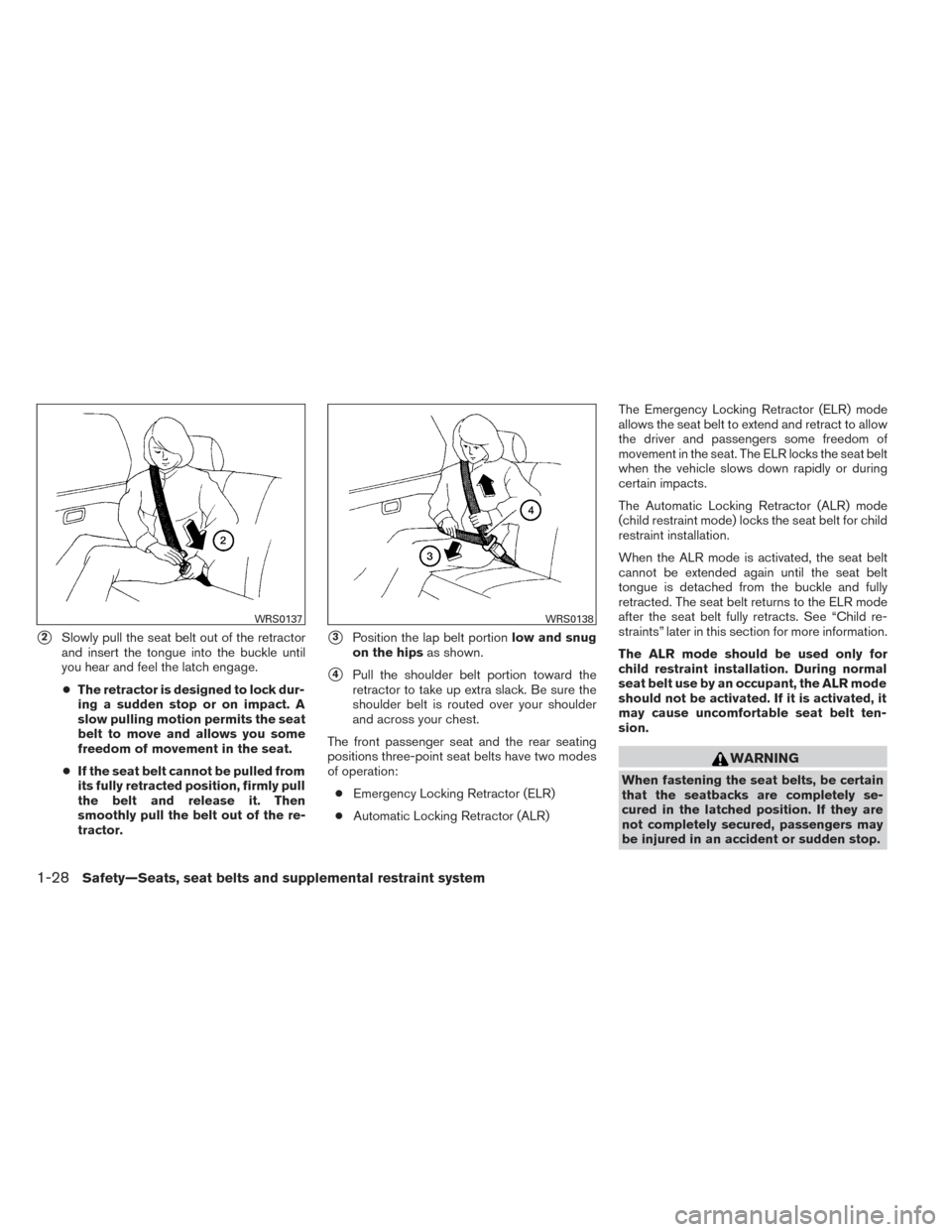
�2Slowly pull the seat belt out of the retractor
and insert the tongue into the buckle until
you hear and feel the latch engage.
● The retractor is designed to lock dur-
ing a sudden stop or on impact. A
slow pulling motion permits the seat
belt to move and allows you some
freedom of movement in the seat.
● If the seat belt cannot be pulled from
its fully retracted position, firmly pull
the belt and release it. Then
smoothly pull the belt out of the re-
tractor.�3Position the lap belt portion low and snug
on the hips as shown.
�4Pull the shoulder belt portion toward the
retractor to take up extra slack. Be sure the
shoulder belt is routed over your shoulder
and across your chest.
The front passenger seat and the rear seating
positions three-point seat belts have two modes
of operation: ● Emergency Locking Retractor (ELR)
● Automatic Locking Retractor (ALR) The Emergency Locking Retractor (ELR) mode
allows the seat belt to extend and retract to allow
the driver and passengers some freedom of
movement in the seat. The ELR locks the seat belt
when the vehicle slows down rapidly or during
certain impacts.
The Automatic Locking Retractor (ALR) mode
(child restraint mode) locks the seat belt for child
restraint installation.
When the ALR mode is activated, the seat belt
cannot be extended again until the seat belt
tongue is detached from the buckle and fully
retracted. The seat belt returns to the ELR mode
after the seat belt fully retracts. See “Child re-
straints” later in this section for more information.
The ALR mode should be used only for
child restraint installation. During normal
seat belt use by an occupant, the ALR mode
should not be activated. If it is activated, it
may cause uncomfortable seat belt ten-
sion.
WARNING
When fastening the seat belts, be certain
that the seatbacks are completely se-
cured in the latched position. If they are
not completely secured, passengers may
be injured in an accident or sudden stop.
WRS0137WRS0138
1-28Safety—Seats, seat belts and supplemental restraint system
Page 46 of 492
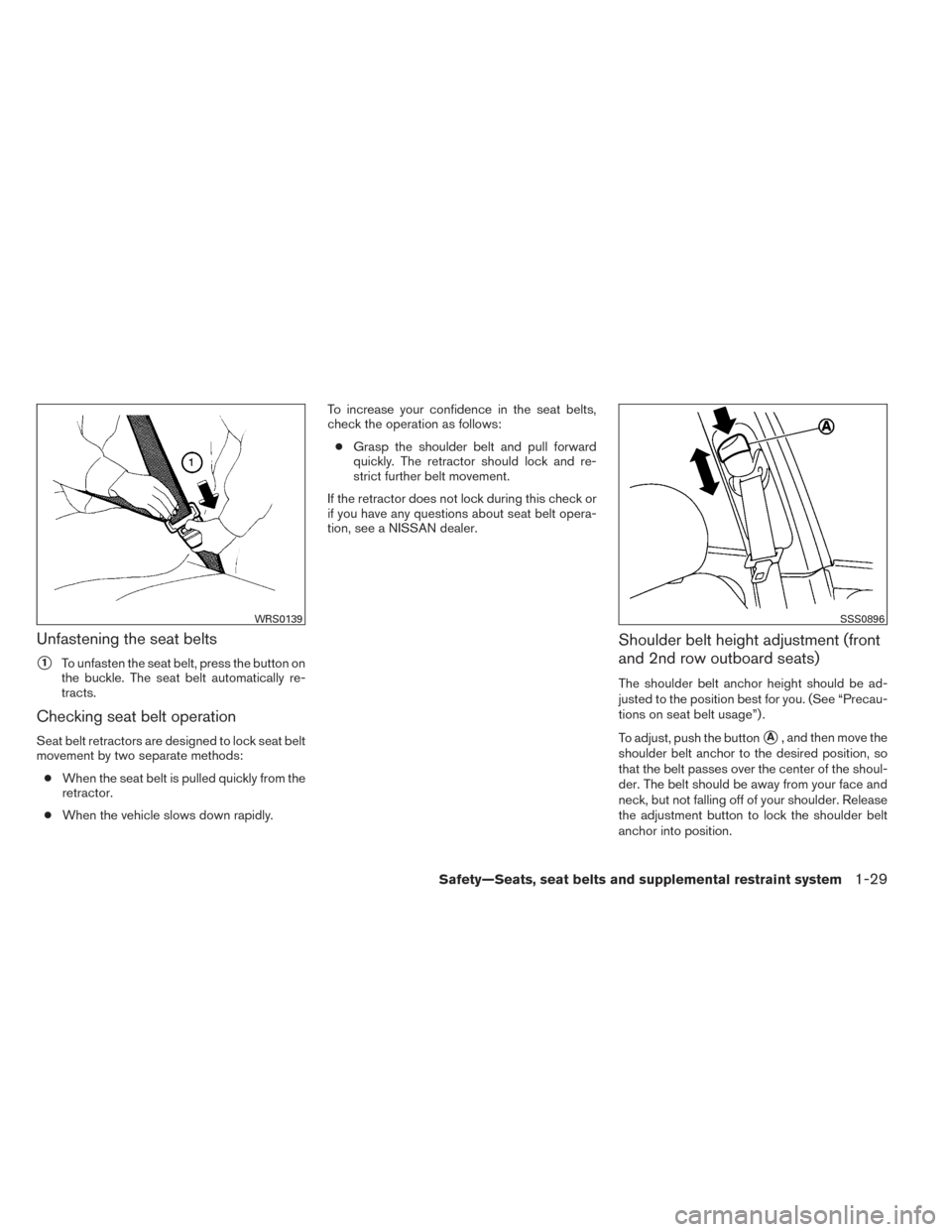
Unfastening the seat belts
�1To unfasten the seat belt, press the button on
the buckle. The seat belt automatically re-
tracts.
Checking seat belt operation
Seat belt retractors are designed to lock seat belt
movement by two separate methods:
● When the seat belt is pulled quickly from the
retractor.
● When the vehicle slows down rapidly. To increase your confidence in the seat belts,
check the operation as follows:
● Grasp the shoulder belt and pull forward
quickly. The retractor should lock and re-
strict further belt movement.
If the retractor does not lock during this check or
if you have any questions about seat belt opera-
tion, see a NISSAN dealer.
Shoulder belt height adjustment (front
and 2nd row outboard seats)
The shoulder belt anchor height should be ad-
justed to the position best for you. (See “Precau-
tions on seat belt usage”) .
To adjust, push the button
�A, and then move the
shoulder belt anchor to the desired position, so
that the belt passes over the center of the shoul-
der. The belt should be away from your face and
neck, but not falling off of your shoulder. Release
the adjustment button to lock the shoulder belt
anchor into position.
WRS0139SSS0896
Safety—Seats, seat belts and supplemental restraint system1-29