2014 NISSAN MAXIMA maintenance
[x] Cancel search: maintenancePage 401 of 432
Your engine was filled with a high-quality engine
oil when it was built. You do not have to change
the oil before the first recommended change
interval. Oil and filter change intervals depend
upon how you use your vehicle.
Operation under the following conditions may
require more frequent oil and filter changes:● repeated short distance driving at cold out-
side temperatures
● driving in dusty conditions
● extensive idling
● towing a trailer
● stop and go commuting
Refer to the “NISSAN Service and Maintenance
Guide” for the maintenance schedule.
AIR CONDITIONER SYSTEM
REFRIGERANT AND OIL
RECOMMENDATIONS
The air conditioner system in your NISSAN
vehicle must be charged with the refriger-
ant HFC-134a (R-134a) and NISSAN A/C
system oil Type S or the exact equivalents.
CAUTION
The use of any other refrigerant or oil will
cause severe damage to the air condition-
ing system and will require the replace-
ment of all air conditioner system
components.
The refrigerant HFC-134a (R-134a) in your
NISSAN vehicle does not harm the earth’s ozone
layer. Although this refrigerant does not affect the
earth’s atmosphere, certain government regula-
tions require the recovery and recycling of any
refrigerant during automotive air conditioner sys-
tem service. A NISSAN dealer has the trained
technicians and equipment needed to recover
and recycle your air conditioner system refriger-
ant.
Contact a NISSAN dealer when servicing your air
conditioner system.
9-6Technical and consumer information
Page 417 of 432
●When backing up, hold the bottom of the
steering wheel with one hand. Move your
hand in the direction in which you want the
trailer to go. Make small corrections and
back up slowly. If possible, have someone
guide you when you are backing up.
Always block the wheels on both vehicle and
trailer when parking. Parking on a slope is not
recommended; however, if you must do so:
CAUTION
If you move the shift selector to the P
(Park) position before blocking the
wheels and applying the parking brake,
transmission damage could occur.
1. Apply and hold the brake pedal.
2. Have someone place blocks on the downhill side of the vehicle and trailer wheels.
3. After the wheel blocks are in place, slowly release the brake pedal until the blocks ab-
sorb the vehicle load.
4. Apply the parking brake.
5. Shift the transmission into P (Park) .
6. Turn off the engine.
To drive away: 1. Start the vehicle. 2. Apply and hold the brake pedal.
3. Shift the transmission into gear.
4. Release the parking brake.
5. Drive slowly until the vehicle and trailer are
clear from the blocks.
6. Apply and hold the brake pedal.
7. Have someone retrieve and store the blocks. ● While going downhill, the weight of the
trailer pushing on the tow vehicle may de-
crease overall stability. Therefore, to main-
tain adequate control, reduce your speed
and use the manual shift mode (M5) . Avoid
long or repeated use of the brakes when
descending a hill, as this reduces their effec-
tiveness and could cause overheating. Shift-
ing the manual shift mode to M5 (5th) pro-
vides “engine braking” and reduces the need
to brake as frequently.
● If the engine coolant temperature rises to a
high temperature, refer to “If your vehicle
overheats” in the “In case of emergency”
section of this owner’s manual.
● Trailer towing requires more fuel than normal
circumstances.
● Avoid towing a trailer for your vehicle’s first
500 miles (805 km) . ●
For the first 500 miles (805 km) that you do
tow, do not drive over 50 MPH (80 km/h).
● Have your vehicle serviced more often than
at intervals specified in the recommended
Maintenance Schedule in the “NISSAN Ser-
vice and Maintenance Guide”.
● When making a turn, your trailer wheels will
be closer to the inside of the turn than your
vehicle wheels. To compensate for this,
make a larger than normal turning radius
during the turn.
● Crosswinds and rough roads will adversely
affect vehicle/trailer handling, possibly caus-
ing vehicle sway. When being passed by
larger vehicles, be prepared for possible
changes in crosswinds that could affect ve-
hicle handling.
Do the following if the trailer begins to sway: 1. Take your foot off the accelerator pedal to allow the vehicle to coast and steer as
straight ahead as the road conditions allow.
This combination will help stabilize the ve-
hicle.
– Do not correct trailer sway by steering or applying the brakes.
9-22Technical and consumer information
Page 421 of 432
Due to legal requirements in some states and
Canadian Provinces, your vehicle may be re-
quired to be in what is called the “ready condi-
tion” for an Inspection/Maintenance (I/M) test of
the emission control system.
The vehicle is set to the “ready condition” when it
is driven through certain driving patterns. Usually,
the ready condition can be obtained by ordinary
usage of the vehicle.
If a powertrain system component is repaired or
the battery is disconnected, the vehicle may be
reset to a “not ready” condition. Before taking the
I/M test, check the vehicle’s
inspection/maintenance test readiness condi-
tion. Place the ignition switch in the ON position
without starting the engine. If the Malfunction
Indicator Light (MIL) comes on steady for 20 sec-
onds and then blinks for 10 seconds , the I/M test
condition is “not ready”. If the MIL does not blink
after 20 seconds, the I/M test condition is
“ready”. Contact a NISSAN dealer to set the
“ready condition” or to prepare the vehicle for
testing.This vehicle is equipped with an Event Data Re-
corder (EDR) . The main purpose of an EDR is to
record, in certain crash or near crash-like situa-
tions, such as an air bag deployment or hitting a
road obstacle, data that will assist in understand-
ing how a vehicle’s systems performed. The EDR
is designed to record data related to vehicle
dynamics and safety systems for a short period of
time, typically 30 seconds or less. The EDR in this
vehicle is designed to record such data as:
● How various systems in your vehicle were
operating;
● Whether or not the driver and passenger
safety belts were buckled/fastened;
● How far (if at all) the driver was depressing
the accelerator and/or brake pedal; and,
● How fast the vehicle was traveling.
● Sounds are not recorded. These data can help provide a better understand-
ing of the circumstances in which crashes and
injuries occur. NOTE: EDR data are recorded by
your vehicle only if a nontrivial crash situation
occurs; no data are recorded by the EDR under
normal driving conditions and no personal data
(e.g. name, gender, age and crash location) are
recorded. However, other parties, such as law
enforcement, could combine the EDR data with
the type of personally identifying data routinely
acquired during a crash investigation.
To read data recorded by an EDR, special equip-
ment is required and access to the vehicle or the
EDR is needed. In addition to the vehicle manu-
facturer and NISSAN dealer, other parties, such
as law enforcement, that have the special equip-
ment, can read the information if they have ac-
cess to the vehicle or the EDR. EDR data will only
be accessed with the consent of the vehicle
owner or lessee or as otherwise required or per-
mitted by law.
READINESS FOR INSPECTION/
MAINTENANCE (I/M) TEST
EVENT DATA RECORDERS (EDR)
9-26Technical and consumer information
Page 426 of 432
FuelCapacities and recommended
fuel/lubricants .................9-2
Fuel economy ................5-22
Fuel-filler door and cap ...........3-21
Fuel gauge ...................2-7
Fueloctanerating...............9-4
Loosefuelcapwarning........2-25,3-21
Fuses.......................8-22
Fusiblelinks ...................8-24
G
Garage door opener, HomeLink® Universal
Transceiver....................2-54
Gascap .....................3-21
Gauge Engine coolant temperature gauge .....2-6
Fuel gauge ...................2-7
Odometer ...................2-5
Speedometer .................2-5
Tachometer ..................2-6
Trip odometer .................2-5
Generalmaintenance...............8-2
Glovebox.....................2-42
Gloveboxlock..................2-42
Grocery hooks ..................2-43
H
Hands-free phone system,
Bluetooth® ...............4-92,4-106
Hazard warning flasher switch ..........6-2
Headlightandturnsignalswitch........2-30 Headlight control switch
............2-31
Headlights ....................8-27
Head restraints Active Head Restraint .........1-8,1-15
Heated seats ...............2-35,2-37
Heated steering wheel .............2-37
Heater Heater and air conditioner
controls................4-30,4-34
Heater operation ...........4-31,4-35
HomeLink® Universal Transceiver .......2-54
Hood release ...................3-18
Horn .......................2-35
I
Ignition Switch Push-Button Ignition Switch .........5-7
Image viewer ...................4-19
Immobilizer system .........2-27,3-3,5-10
Important vehicle information label .......9-10
In-cabin microfilter ................8-19
Increasing fuel economy .............5-22
Indicator lights and audible reminders
(See warning/indicator lights and audible
reminders)....................2-10
Inside automatic anti-glare mirror ........3-26
Instrument brightness control ..........2-34
Instrument panel ...............0-6,2-3
Instrument panel dimmer switch ........2-34
Intelligent Key system Key operating range ..............3-8
Key operation ................3-10
Mechanicalkey ................3-3
Remote keyless entry operation .......3-13Troubleshooting guide
............3-16
Warning signals ...............3-16
Interiorlight....................2-51
Interior trunk lid release .............3-20
iPod® Player ...............4-79,4-82
ISOFIX child restraints .............1-27
J
Jump starting ...................6-8
K
Keyfob battery replacement ...........8-26
Keyless entry With Intelligent Key system
(See Intelligent Key system) .........3-13
Keys, For Intelligent Key system .........
3-2
L
Labels Air conditioner specification label .....9-11
C.M.V.S.S. certification label ........9-10
Emission control information label .....9-10
Engine serial number ............9-10
F.M.V.S.S. certification label .........9-10
Tire and Loading Information label .....9-11
Vehicle identification number (VIN) plate . .9-9
Warning labels (for SRS) ..........1-57
LATCH (Lower Anchors and Tethers for CHildren)
System ......................1-27
10-3
Page 427 of 432
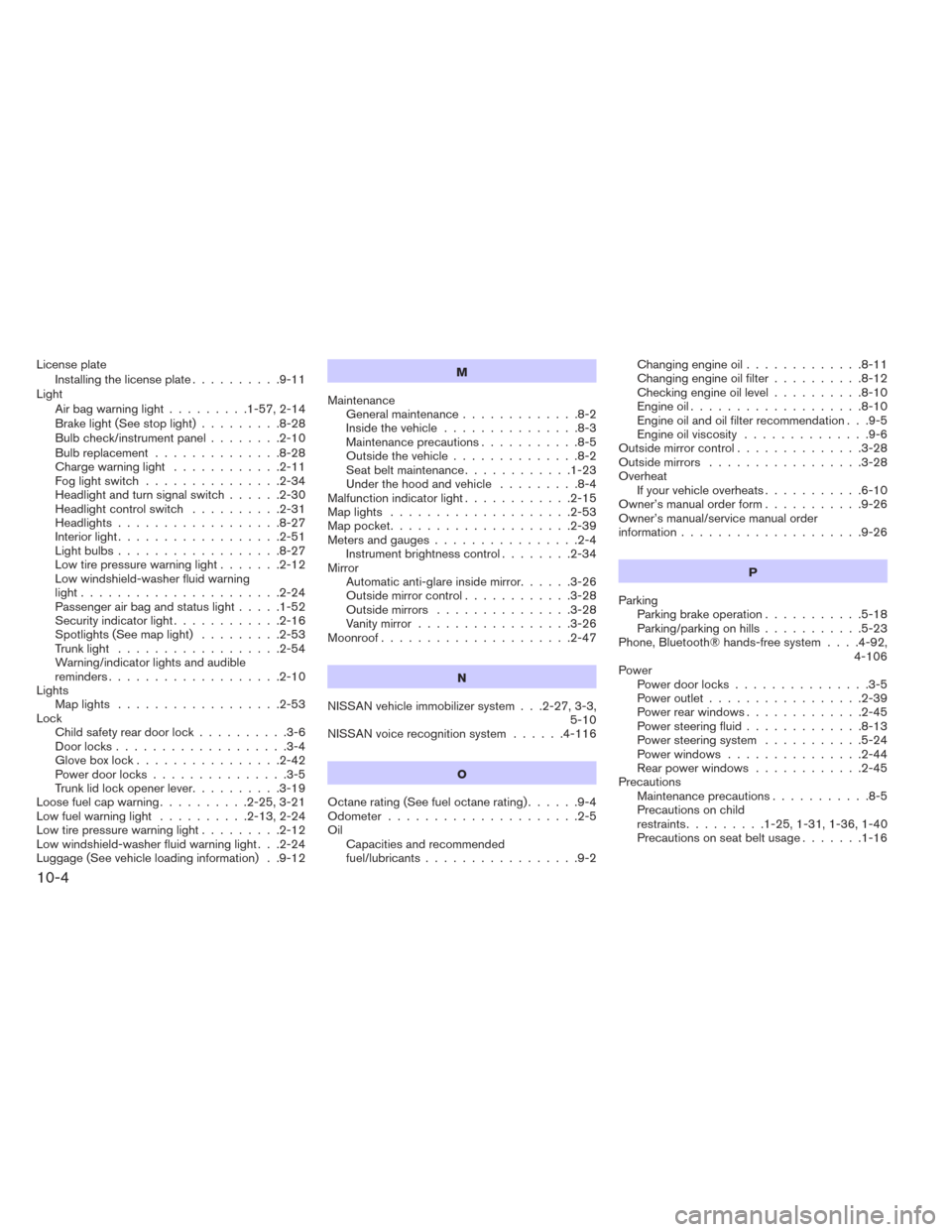
License plateInstalling the license plate ..........9-11
Light Airbagwarninglight.........1-57,2-14
Brakelight(Seestoplight).........8-28
Bulb check/instrument panel ........2-10
Bulb replacement ..............8-28
Chargewarninglight ............2-11
Foglightswitch ...............2-34
Headlight and turn signal switch ......2-30
Headlightcontrolswitch ..........2-31
Headlights..................8-27
Interiorlight..................2-51
Lightbulbs..................8-27
Low tire pressure warning light .......2-12
Low windshield-washer fluid warning
light......................2-24
Passenger air bag and status light .....1-52
Security indicator light ............2-16
Spotlights (See map light) .........2-53
Trunklight ..................2-54
Warning/indicator lights and audible
reminders ...................2-10
Lights Maplights ..................2-53
Lock Child safety rear door lock ..........3-6
Door locks ...................3-4
Gloveboxlock................2-42
Power door locks ...............3-5
Trunk lid lock opener lever ..........3-19
Loose fuel cap warning ..........2-25,3-21
Lowfuelwarninglight ..........2-13,2-24
Low tire pressure warning light .........2-12
Low windshield-washer fluid warning light . . .2-24
Luggage (See vehicle loading information) . .9-12 M
Maintenance Generalmaintenance.............8-2
Insidethevehicle...............8-3
Maintenance precautions ...........8-5
Outside the vehicle ..............8-2
Seatbeltmaintenance............1-23
Underthehoodandvehicle .........8-4
Malfunction indicator light ............2-15
Maplights ....................2-53
Map pocket ....................2-39
Meters and gauges ................2-4
Instrument brightness control ........2-34
Mirror Automatic anti-glare inside mirror ......3-26
Outside mirror control ............3-28
Outside mirrors ...............3-28
Vanity mirror .................3-26
Moonroof .....................2-47
N
NISSAN vehicle immobilizer system . . .2-27, 3-3, 5-10
NISSAN voice recognition system ......4-116
O
Octane rating (See fuel octane rating) ......9-4
Odometer .....................2-5
Oil Capacities and recommended
fuel/lubricants .................9-2 Changing engine oil
.............8-11
Changing engine oil filter ..........8-12
Checking engine oil level ..........8-10
Engine oil ...................8-10
Engine oil and oil filter recommendation . . .9-5
Engine oil viscosity ..............9-6
Outside mirror control ..............3-28
Outside mirrors .................3-28
Overheat If your vehicle overheats ...........6-10
Owner’s manual order form ...........9-26
Owner’s manual/service manual order
information ....................9-26
P
Parking Parking brake operation ...........5-18
Parking/parking on hills ...........
5-23
Phone, Bluetooth® hands-free system ....4-92,
4-106
Power Power door locks ...............3-5
Power outlet .................2-39
Power rear windows .............2-45
Power steering fluid .............8-13
Power steering system ...........5-24
Power windows ...............2-44
Rear power windows ............2-45
Precautions Maintenanceprecautions...........8-5
Precautions on child
restraints .........1-25,1-31,1-36,1-40
Precautions on seat belt usage .......1-16
10-4
Page 428 of 432
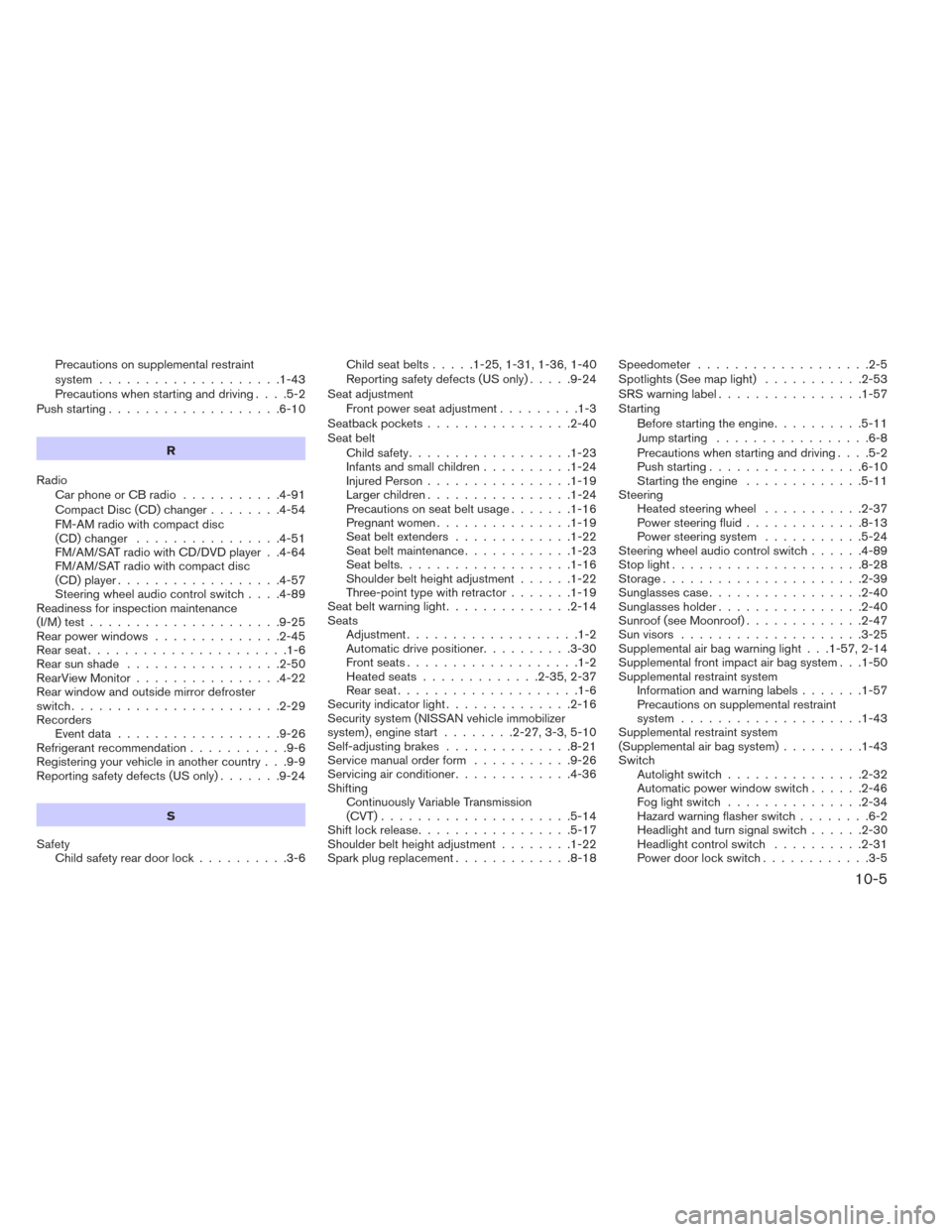
Precautions on supplemental restraint
system ....................1-43
Precautions when starting and driving....5-2
Push starting ...................6-10
R
Radio Car phone or CB radio ...........4-91
Compact Disc (CD) changer ........4-54
FM-AM radio with compact disc
(CD) changer ................4-51
FM/AM/SAT radio with CD/DVD player . .4-64
FM/AM/SAT radio with compact disc
(CD) player ..................4-57
Steering wheel audio control switch ....4-89
Readiness for inspection maintenance
(I/M) test .....................9-25
Rear power windows ..............2-45
Rearseat......................1-6
Rearsunshade .................2-50
RearViewMonitor................4-22
Rear window and outside mirror defroster
switch .......................2-29
Recorders Eventdata..................9-26
Refrigerant recommendation ...........9-6
Registering your vehicle in another country . . .9-9
Reporting safety defects (US only) .......9-24
S
Safety Child safety rear door lock ..........3-6 Childseatbelts.....1-25,1-31,1-36,1-40
Reporting safety defects (US only)
.....9-24
Seat adjustment Front power seat adjustment .........1-3
Seatback pockets ................2-40
Seat belt Child safety ..................1-23
Infants and small children ..........1-24
Injured Person ................1-19
Largerchildren................1-24
Precautions on seat belt usage .......1-16
Pregnant women ...............1-19
Seatbeltextenders .............1-22
Seatbeltmaintenance............1-23
Seatbelts...................1-16
Shoulder belt height adjustment ......1-22
Three-point type with retractor .......1-19
Seat belt warning light ..............2-14
Seats Adjustment ...................1-2
Automatic drive positioner ..........3-30
Frontseats...................1-2
Heatedseats.............2-35,2-37
Rearseat....................1-6
Security indicator light ..............2-16
Security system (NISSAN vehicle immobilizer
system) , engine start ........2-27,3-3,5-10
Self-adjusting brakes ..............8-21
Service manual order form ...........9-26
Servicing air conditioner .............4-36
Shifting Continuously Variable Transmission
(CVT) .....................5-14
Shiftlockrelease.................5-17
Shoulder belt height adjustment ........1-22
Sparkplugreplacement.............8-18 Speedometer
...................2-5
Spotlights(Seemaplight) ...........2-53
SRSwarninglabel................1-57
Starting Before starting the engine ..........5-11
Jump starting .................6-8
Precautions when starting and driving ....5-2
Push starting .................6-10
Starting the engine .............5-11
Steering Heated steering wheel ...........2-37
Power steering fluid .............8-13
Power steering system ...........5-24
Steering wheel audio control switch ......
4-89
Stoplight.....................8-28
Storage......................2-39
Sunglasses case .................2-40
Sunglasses holder ................2-40
Sunroof (see Moonroof) .............2-47
Sun visors ....................3-25
Supplemental air bag warning light . . .1-57, 2-14
Supplemental front impact air bag system . . .1-50
Supplemental restraint system Information and warning labels .......1-57
Precautions on supplemental restraint
system ....................1-43
Supplemental restraint system
(Supplemental air bag system) .........1-43
Switch Autolight switch ...............2-32
Automatic power window switch ......2-46
Fog light switch ...............2-34
Hazard warning flasher switch ........6-2
Headlightandturnsignalswitch......2-30
Headlight control switch ..........2-31
Power door lock switch ............3-5
10-5