Page 307 of 397
Tire chains may be used. For details, see “Tire
chains” in the “Maintenance and do-it-yourself”
section.
SPECIAL WINTER EQUIPMENT
It is recommended that the following items be
carried in the vehicle during winter:
• A scraper and stiff-bristled brush to remove ice
and snow from the windows and wiper blades.
• A shovel to dig the vehicle out of snow-drifts.
• Extra window washer fluid to refill the reservoir
tank.
DRIVING ON SNOW OR ICE
WARNING
• Wet ice (32°F, 0°C and freezing rain) ,
very cold snow or ice can be slick and
very hard to drive on. The vehicle will
have much less traction or “grip” under
these conditions. Try to avoid driving
on wet ice until the road is salted or
sanded.• Whatever the conditions, drive with
caution. Accelerate and slow down
with care. If accelerating too fast, the
drive wheels will lose even more trac-
tion.
• Allow more stopping distance under
these conditions. Braking should be
started sooner than on dry pavement.
• Allow greater following distances on
slippery roads.
• Watch for slippery spots (glare ice) .
These may appear on an otherwise
clear road in shaded areas. If a patch of
ice is seen ahead, brake before reach-
ing it. Try not to brake while on the ice,
and avoid any sudden steering maneu-
vers.
• Do not use cruise control on slippery
roads.
FREEING A FROZEN CHARGE
PORT LID
When the charge port is frozen, melt the ice using
a hair dryer.
Starting and driving5-27
Page 313 of 397
•
Do not use the emergency tire punc-
ture repair kit under the following con-
ditions. Contact a NISSAN certified
LEAF dealer or professional road as-
sistance.
–
when the sealant has passed its ex-
piration date (shown on the label
attached to the bottle)
–
when the cut or the puncture is ap-
proximately 0.25 in (6 mm) or longer
–
when the tire sidewall is damaged
–
when the vehicle has been driven
with extremely low tire pressure
–
when the tire has come off the in-
side or the outside of the wheel
–
when the tire wheel is damaged
–
when two or more tires are flat
Stopping the vehicle
1. Safely move the vehicle off the road and away
from traffic.
2. Turn on the hazard warning flashers.
3. Park on a level surface and apply the parking
brake.
4. Push the P (Park) position switch on the shift
lever to the P (Park) position.5. Turn off the EV (Electric Vehicle) system.
6. Raise the hood to warn other traffic and to
signal professional road assistance personnel
that you need assistance.
7. Have all passengers get out of the vehicle and
stand in a safe place, away from traffic and
clear of the vehicle.
WARNING
Make sure the parking brake is securely
applied and the vehicle is placed into the
P (Park) position.
•
Never repair tires when the vehicle is
on a slope, ice or slippery areas. This is
hazardous.
•
Never repair tires if oncoming traffic is
close to your vehicle. Wait for profes-
sional road assistance.
Getting emergency tire puncture repair
kit
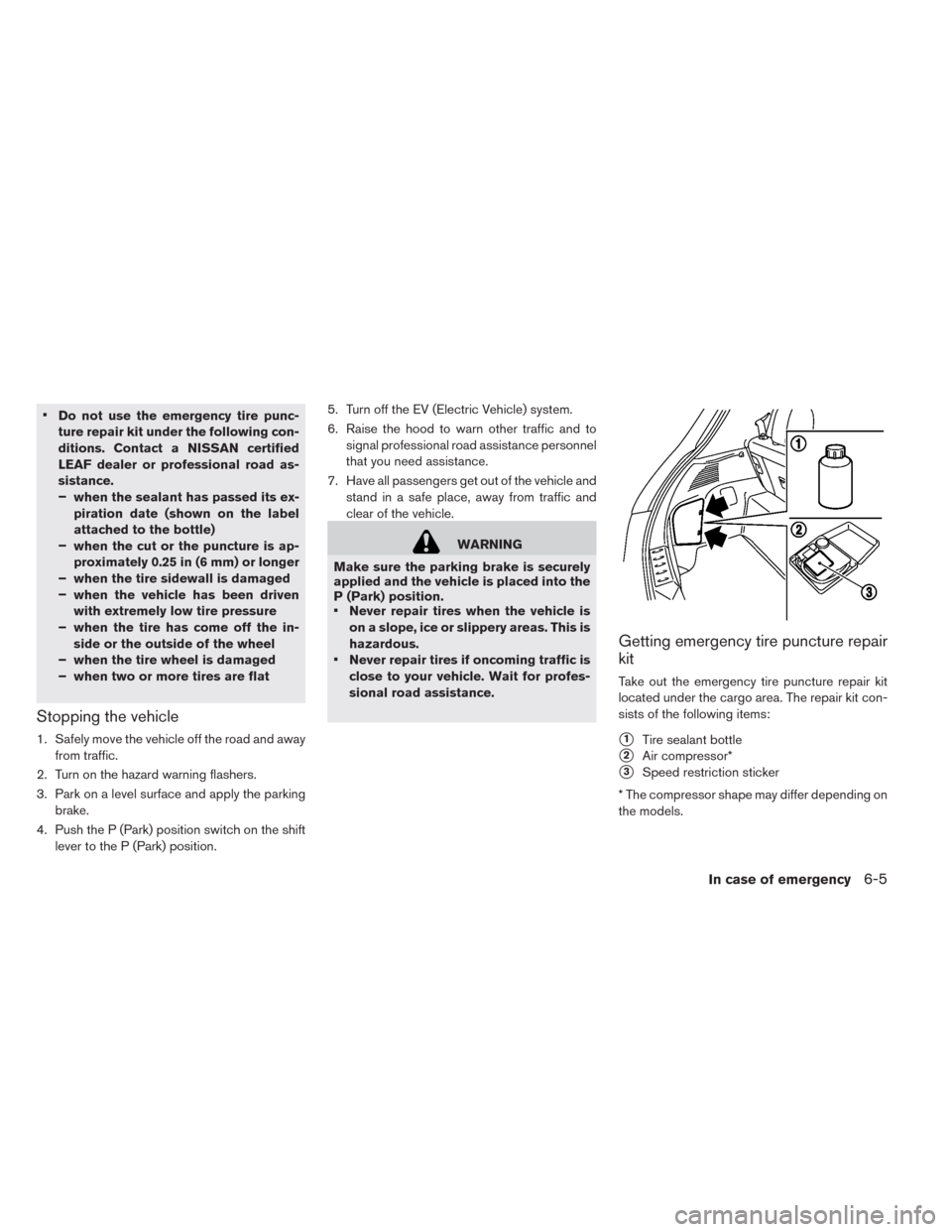
Take out the emergency tire puncture repair kit
located under the cargo area. The repair kit con-
sists of the following items:
�1Tire sealant bottle
�2Air compressor*
�3Speed restriction sticker
* The compressor shape may differ depending on
the models.
In case of emergency6-5
Page 318 of 397
• Keep the 12-volt battery out of the
reach of children.
• The booster battery must be rated at
12 volt. Use of an improperly rated
battery can damage your vehicle.
• Whenever working on or near a 12-volt
battery, always wear suitable eye pro-
tectors (for example, goggles or indus-
trial safety spectacles) and remove
rings, metal bands, or any other jew-
elry. Do not lean over the 12-volt bat-
tery when jump starting.
• Do not attempt to jump start a frozen
battery. It could explode and cause se-
rious injury.
• Your vehicle has an automatic cooling
fan. It could come on at any time. Keep
hands and other objects away from it.
WARNING
• Always follow the instructions below.
Failure to do so could result in damage
to the DC/DC converter and cause per-
sonal injury.
CAUTION
• Do not attempt to perform a jump start
on the 12-volt battery at the same time
that the Li-ion battery is being
charged. Doing so may damage the
vehicle or charging equipment and
could cause an injury.
• LEAF cannot be used as a booster ve-
hicle because it cannot supply enough
power to start a gasoline engine. How-
ever, a gasoline engine vehicle can be
used to jump start LEAF’s 12-volt bat-
tery.
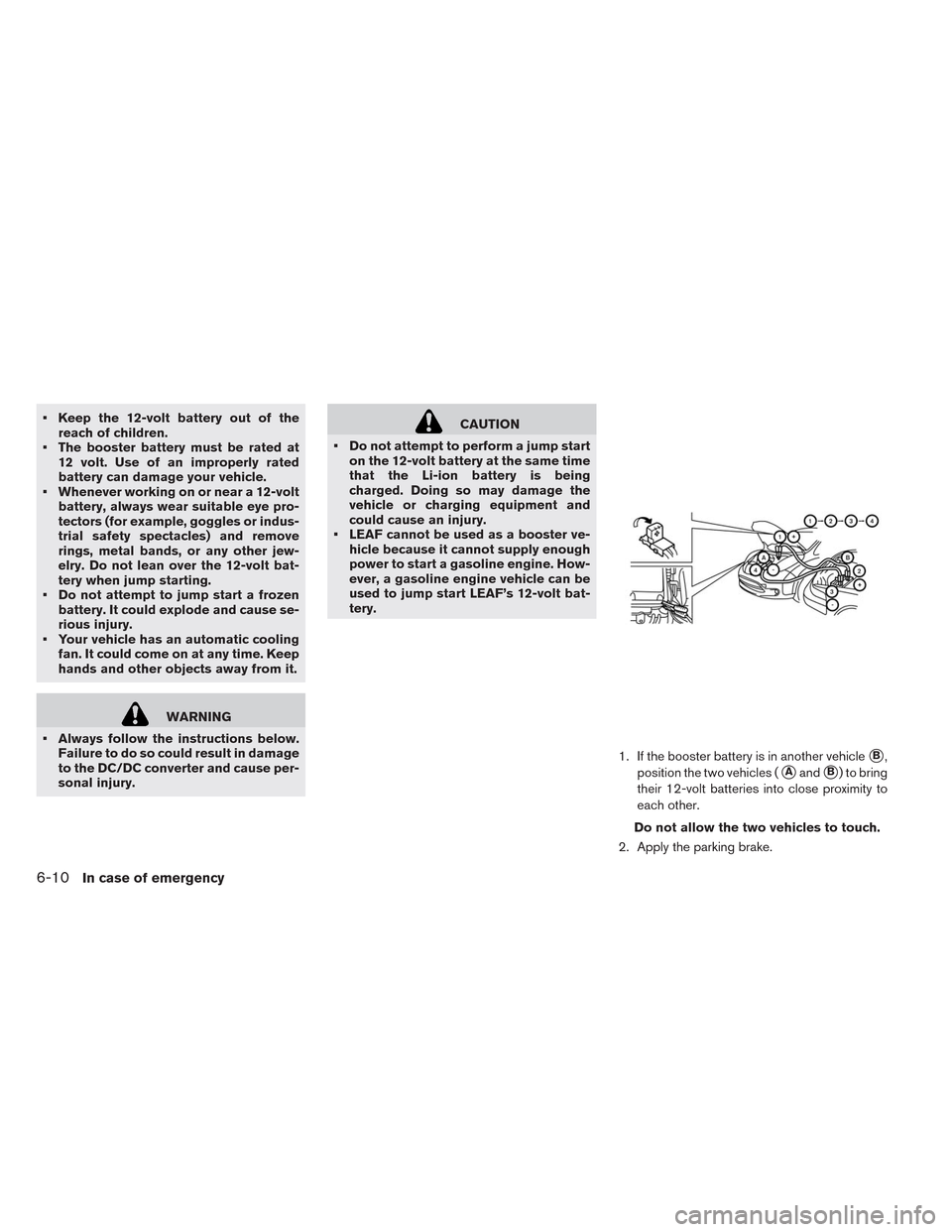
1. If the booster battery is in another vehicle
�B,
position the two vehicles (
�Aand�B) to bring
their 12-volt batteries into close proximity to
each other.
Do not allow the two vehicles to touch.
2. Apply the parking brake.
6-10In case of emergency
Page 321 of 397
When towing your vehicle, all State (Provincial in
Canada) and local regulations for towing must be
followed. Incorrect towing equipment could dam-
age your vehicle. Towing instructions are avail-
able from a NISSAN certified LEAF dealer. Local
service operators are familiar with the applicable
laws and procedures for towing. To assure
proper towing and to prevent accidental damage
to your vehicle, NISSAN recommends that you
have a service operator tow your vehicle. It is
advisable to have the service operator carefully
read the following precautions.
WARNING
• Never ride in a vehicle that is being
towed.
• Never get under your vehicle after it
has been lifted by a tow truck.
CAUTION
• When towing, make sure that the ax-
les, steering system and power train
are in working condition. If any unit is
damaged, dollies must be used.
• Always attach safety chains before
towing.For information about towing your vehicle behind
a recreational vehicle (RV) , see “Flat towing” in
the “Technical and consumer information” sec-
tion.
TOWING RECOMMENDED BY
NISSAN
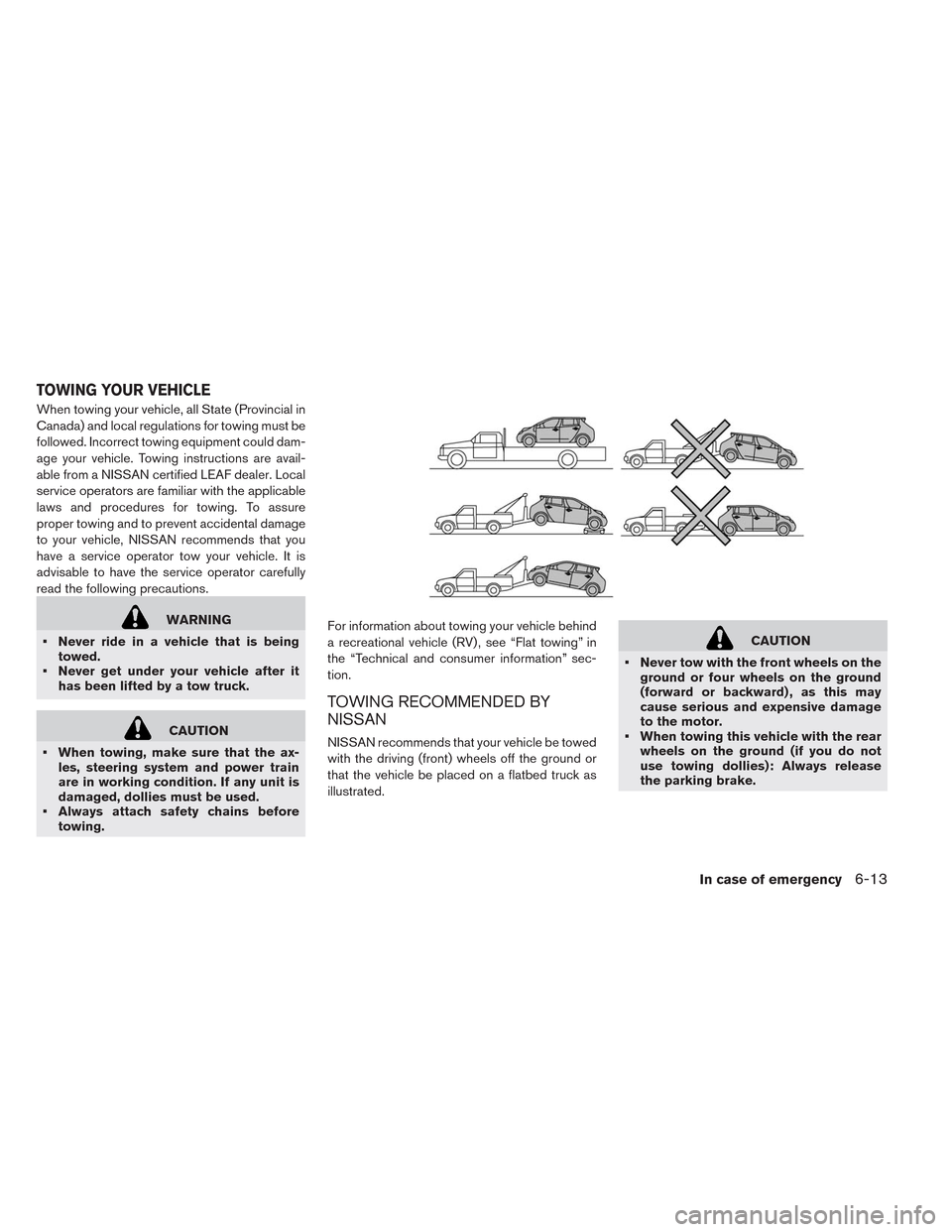
NISSAN recommends that your vehicle be towed
with the driving (front) wheels off the ground or
that the vehicle be placed on a flatbed truck as
illustrated.
CAUTION
• Never tow with the front wheels on the
ground or four wheels on the ground
(forward or backward) , as this may
cause serious and expensive damage
to the motor.
• When towing this vehicle with the rear
wheels on the ground (if you do not
use towing dollies): Always release
the parking brake.
TOWING YOUR VEHICLE
In case of emergency6-13
Page 322 of 397
NOTE:
If your vehicle cannot be moved because
the vehicle can not to be shifted to the N
(Neutral) position, please refer to the LEAF
Roadside Assistance Guide which is lo-
cated at www.NISSANUSA.com. If your ve-
hicle cannot be moved because the parking
brake cannot be released, see “Parking
brake mechanical release”.
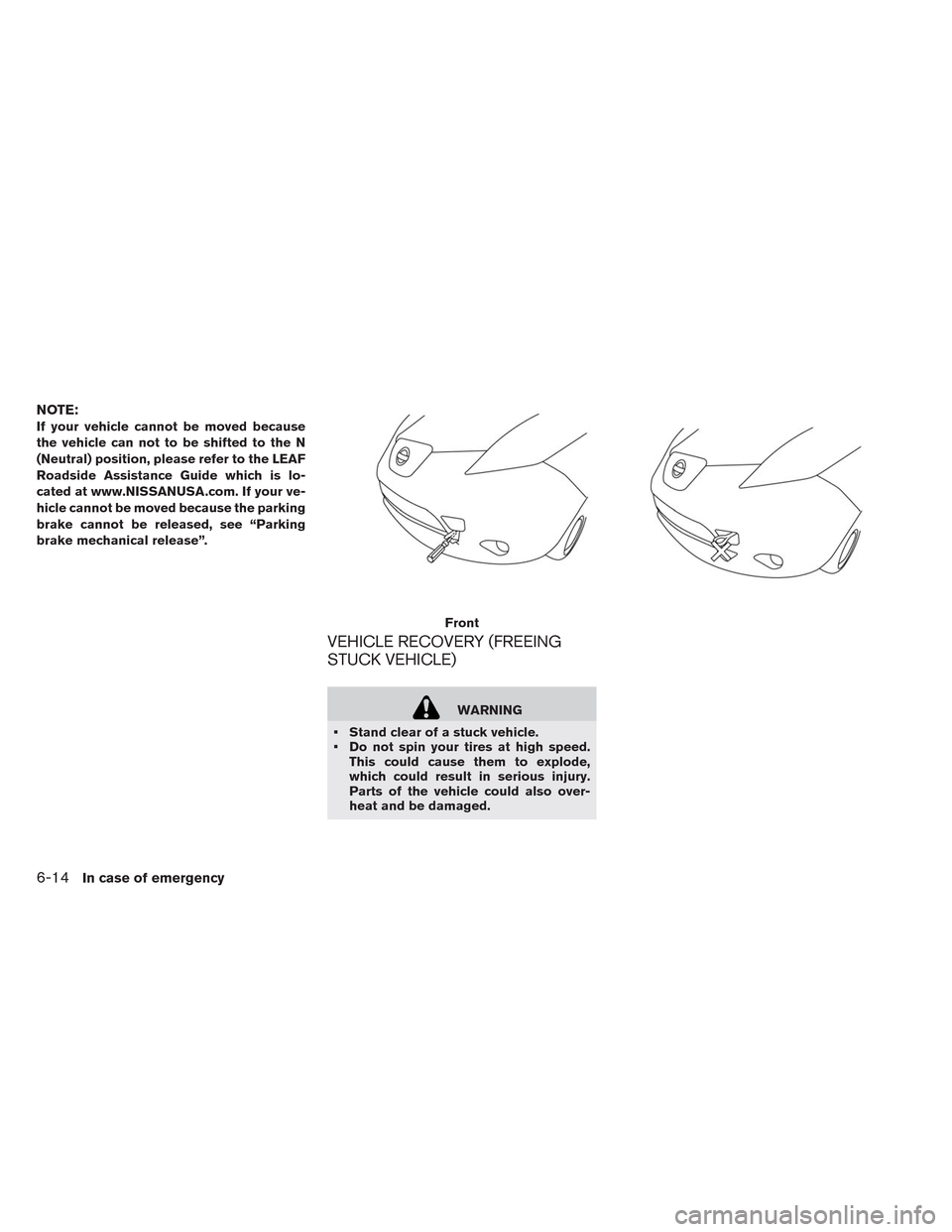
VEHICLE RECOVERY (FREEING
STUCK VEHICLE)
WARNING
• Stand clear of a stuck vehicle.
• Do not spin your tires at high speed.
This could cause them to explode,
which could result in serious injury.
Parts of the vehicle could also over-
heat and be damaged.
Front
6-14In case of emergency
Page 323 of 397
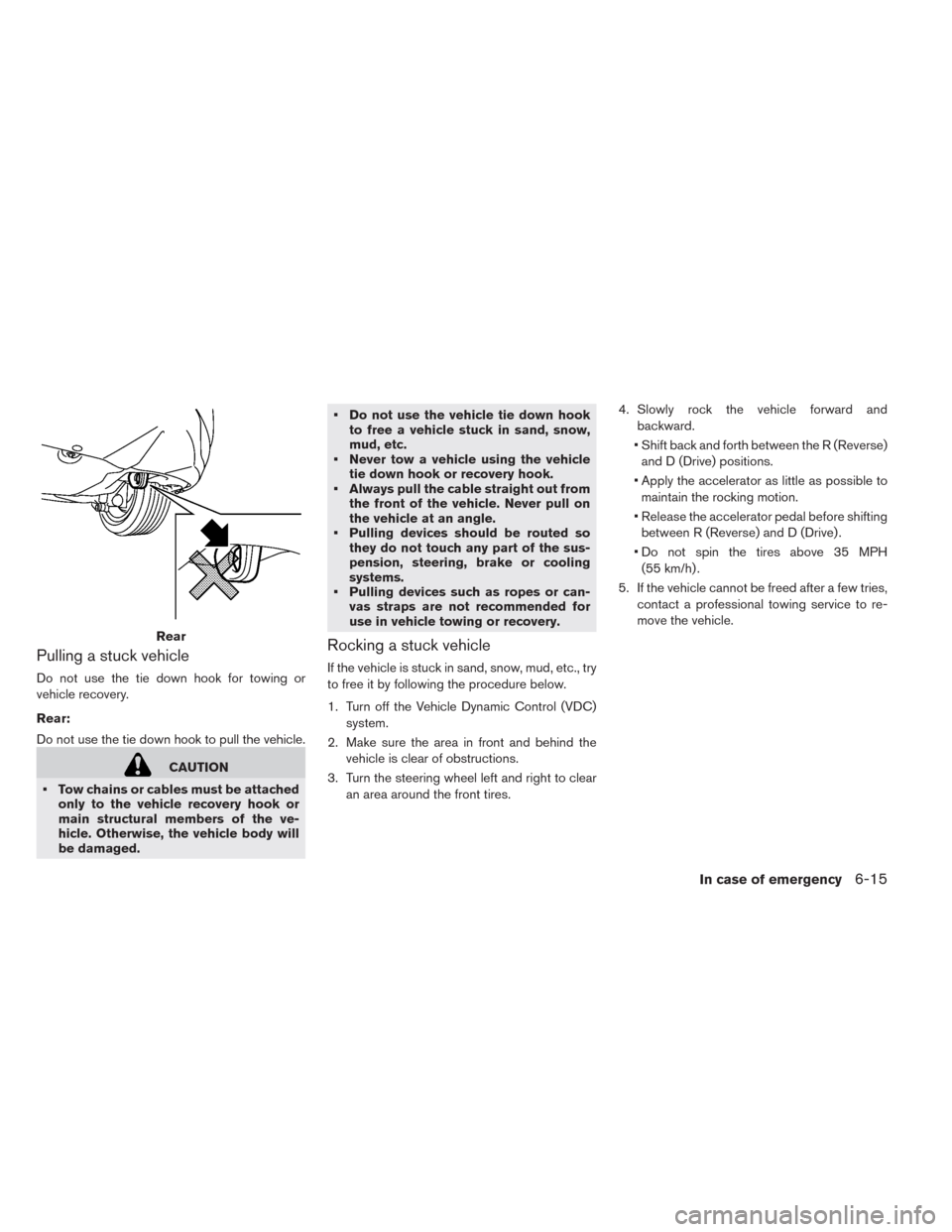
Pulling a stuck vehicle
Do not use the tie down hook for towing or
vehicle recovery.
Rear:
Do not use the tie down hook to pull the vehicle.
CAUTION
• Tow chains or cables must be attached
only to the vehicle recovery hook or
main structural members of the ve-
hicle. Otherwise, the vehicle body will
be damaged.• Do not use the vehicle tie down hook
to free a vehicle stuck in sand, snow,
mud, etc.
• Never tow a vehicle using the vehicle
tie down hook or recovery hook.
• Always pull the cable straight out from
the front of the vehicle. Never pull on
the vehicle at an angle.
• Pulling devices should be routed so
they do not touch any part of the sus-
pension, steering, brake or cooling
systems.
• Pulling devices such as ropes or can-
vas straps are not recommended for
use in vehicle towing or recovery.
Rocking a stuck vehicle
If the vehicle is stuck in sand, snow, mud, etc., try
to free it by following the procedure below.
1. Turn off the Vehicle Dynamic Control (VDC)
system.
2. Make sure the area in front and behind the
vehicle is clear of obstructions.
3. Turn the steering wheel left and right to clear
an area around the front tires.4. Slowly rock the vehicle forward and
backward.
• Shift back and forth between the R (Reverse)
and D (Drive) positions.
• Apply the accelerator as little as possible to
maintain the rocking motion.
• Release the accelerator pedal before shifting
between R (Reverse) and D (Drive) .
• Do not spin the tires above 35 MPH
(55 km/h) .
5. If the vehicle cannot be freed after a few tries,
contact a professional towing service to re-
move the vehicle.
Rear
In case of emergency6-15
Page 331 of 397
CAUTION
• NEVER remove dirt, sand or other de-
bris from the passenger compartment
by washing it out with a hose. Remove
dirt with a vacuum cleaner.
• Never allow water or other liquids to
come in contact with electronic com-
ponents inside the vehicle as this may
damage them.
Chemicals used for road surface deicing are
extremely corrosive. They accelerate corrosion
and deterioration of underbody components
such as the brake lines, brake cables, floor pan
and fenders.
In winter, the underbody must be cleaned
periodically.
For additional protection against rust and corro-
sion, which may be required in some areas, con-
sult a NISSAN certified LEAF dealer.
Appearance and care7-7
Page 333 of 397
8 Maintenance and do-it yourself
Maintenance requirement..................8-2
Scheduled maintenance.................8-2
General maintenance...................8-2
Where to go for service.................8-2
General maintenance.....................8-2
Explanation of maintenance items...........8-2
Maintenance precautions..................8-5
Motor compartment check locations............8-7
Cooling system........................8-8
Checking coolant level..................8-9
Changing coolant.....................8-9
Reduction gear fluid.....................8-10
Brake fluid..........................8-10
Window washer fluid....................8-11
12-volt battery........................8-12
Jump starting.......................8-13
Windshield wiper blades..................8-13
Cleaning.........................8-13
Replacing.........................8-13Rear window wiper blade.................8-15
Brakes............................8-15
Brake pad wear warning................8-16
Fuses.............................8-16
Motor compartment...................8-16
Passenger compartment................8-18
Nissan Intelligent Key® battery replacement......8-19
Lights.............................8-21
Headlights........................8-22
Exterior and interior lights...............8-23
Wheels and tires......................8-26
Tire pressure.......................8-26
Tire labeling.......................8-28
Types of tires.......................8-30
Tire chains.......................
.8-31
Changing wheels and tires...............8-32
Emergency tire puncture repair kit..........8-34