2014 NISSAN LEAF light
[x] Cancel search: lightPage 358 of 397
If you have a flat tire, see “Flat tire” in the
“In case of emergency” section.
TIRE PRESSURE
Tire Pressure Monitoring System
(TPMS)
This vehicle is equipped with the Tire Pressure
Monitoring System (TPMS) . It monitors tire pres-
sure of all tires. When the low tire pressure warn-
ing light is lit, and the CHECK TIRE PRESSURE
warning appears on the vehicle information dis-
play, one or more of your tires is significantly
under-inflated.
The TPMS will activate only when the vehicle is
driven at speeds above 16 MPH (25 km/h) . Also,
this system may not detect a sudden drop in tire
pressure (for example a flat tire while driving) .
For more details, see “Low tire pressure warning
light” in the “Instruments and controls” section,
“Tire Pressure Monitoring System (TPMS)” in the
“Starting and driving” section and “Tire Pressure
Monitoring System (TPMS)” in the “In case of
emergency” section.
Tire inflation pressure
Check the pressure of the tires often and always
prior to long distance trips. The recommendedtire pressure specifications are shown on the Tire
and Loading Information label under the “Cold
Tire Pressure” heading. The Tire and Loading
Information label is affixed to the driver side cen-
ter pillar. Tire pressures should be checked regu-
larly because:
• Most tires naturally lose air over time.
• Tires can lose air suddenly when driven over
potholes or other objects or if the vehicle strikes
a curb while parking.
The tire pressures should be checked when the
tires are cold. The tires are considered COLD
after the vehicle has been parked for 3 or more
hours, or driven less than 1 mile (1.6 km) at
moderate speeds.
The TPMS with Easy Fill Tire Alert also provides
visual and audible signals outside the vehicle for
inflating the tires to the recommended COLD tire
pressure. (See “TPMS with Easy Fill Tire Alert” in
the “Starting and driving” section.)
Incorrect tire pressure, including under in-
flation, may adversely affect tire life and
vehicle handling.
WARNING
• Improperly inflated tires can fail sud-
denly and cause an accident.
• The Gross Vehicle Weight rating
(GVWR) is located on the F.M.V.S.S.
certification label. The vehicle weight
capacity is indicated on the Tire and
Loading Information label. Do not load
your vehicle beyond this capacity.
Overloading your vehicle may result in
reduced tire life, unsafe operating con-
ditions due to premature tire failure, or
unfavorable handling characteristics
and could also lead to a serious acci-
dent. Loading beyond the specified ca-
pacity may also result in failure of
other vehicle components.
• Before taking a long trip, or whenever
you heavily load your vehicle, use a tire
pressure gauge to ensure that the tire
pressures are at the specified level.
• For additional information regarding
tires, refer to “Important Tire Safety
Information” (US) or “Tire Safety Infor-
mation” (Canada) in the Warranty In-
formation Booklet.
WHEELS AND TIRES
8-26Maintenance and do-it yourself
Page 365 of 397
• The original tires have built-in tread
wear indicators. When wear indicators
are visible, the tire(s) should be re-
placed.
• Tires degrade with age and use. Have
tires, over 6 years old checked by a
qualified technician, because some
tire damage may not be obvious. Re-
place the tires as necessary to prevent
tire failure and possible personal in-
jury.
• For additional information regarding
tires, refer to “Important Tire Safety
Information” (US) or “Tire Safety Infor-
mation” (Canada) in the Warranty In-
formation Booklet.
Replacing wheels and tires
When replacing a tire, use the same size, tread
design, speed rating and load carrying capacity
as originally equipped. See “Specifications” in
the “Technical and consumer information” sec-
tion for recommended types and sizes of tires
and wheels.
WARNING
• The use of tires other than those rec-
ommended or the mixed use of tires of
different brands, construction (bias,
bias-belted or radial) , or tread patterns
can adversely affect the ride, braking,
handling, ground clearance, body-to-
tire clearance, tire chain clearance,
speedometer calibration, headlight
aim and bumper height. Some of these
effects may lead to accidents and
could result in serious personal injury.
• If your vehicle was originally equipped
with 4 tires that were the same size
and you are only replacing 2 of the 4
tires, install the new tires on the rear
axle. Placing new tires on the front
axle may cause loss of vehicle control
in some driving conditions and cause
an accident and personal injury.• If the wheels are changed for any rea-
son, always replace with wheels which
have the same off-set dimension.
Wheels of a different off-set could
cause premature tire wear, degrade
vehicle handling characteristics
and/or interference with the brake
discs. Such interference can lead to
decreased braking efficiency and/or
early brake pad/shoe wear. See
“Wheels and tires” in the “Technical
and consumer information” section of
this manual for wheel off-set dimen-
sions.
• When a wheel is replaced, the TPMS
will not function and the low tire pres-
sure warning light will flash for ap-
proximately 1 minute. The light will re-
main on after 1 minute. Contact your
NISSAN certified LEAF dealer as soon
as possible for tire replacement
and/or system resetting.
• Replacing tires with those not origi-
nally specified by NISSAN could affect
the proper operation of the TPMS.
• Do not install a damaged or deformed
wheel or tire even if it has been re-
paired. Such wheels or tires could have
structural damage and could fail with-
out warning.
Maintenance and do-it yourself8-33
Page 366 of 397
• The use of retread tire is not recom-
mended.
• For additional information regarding
tires, refer to “Important Tire Safety
Information” (US) or “Tire Safety Infor-
mation” (Canada) in the Warranty In-
formation Booklet.
Wheel balance
Unbalanced wheels may affect vehicle handling
and tire life. Even with regular use, wheels can get
out of balance. Therefore, they should be bal-
anced as required.
Wheel balance service should be per-
formed with the wheels off the vehicle.
Spin balancing the wheels on the vehicle
could lead to mechanical damage.
For additional information regarding tires, refer to
“Important Tire Safety Information” (US) or “Tire
Safety Information” (Canada) in the Warranty In-
formation Booklet.
Care of wheels
See “Cleaning exterior” in the “Appearance and
care” section for details about care of the wheels.
EMERGENCY TIRE PUNCTURE
REPAIR KIT
The emergency tire puncture repair kit (Emer-
gency Tire Sealant) is supplied with the vehicle
instead of a spare tire. It can be used to tempo-
rarily repair minor tire punctures.
If possible, have the vehicle towed to a facility that
can repair or replace the flat tire. Using the emer-
gency tire puncture repair kit may cause a mal-
function of the tire pressure sensor and cause the
low tire pressure warning light to illuminate.
See “Flat tire” for more details.
8-34Maintenance and do-it yourself
Page 368 of 397
The following are approximate capacities. The actual refill capacities may be slightly different. When refilling, follow the procedure that
is described in the “Maintenance and do-it-yourself” section to determine the proper refill capacity.
Capacity (approximate) Recommended specifications
US measure Imp measure Liter
Cooling system
With reservoir 5-5/8 qt 4-5/8 qt 5.3
Pre-diluted Genuine NISSAN Long Life Antifreeze/Coolant
(blue) or equivalent
Reservoir 1/2 qt 1/2 qt 0.5
Reduction gear fluid 1-1/2 qt 1-1/4 qt 1.4 Genuine NISSAN Matic S ATF*1
Brake fluidRefill to the proper oil level according to
the instructions in the “Maintenance and
do-it-yourself” section.Genuine NISSAN Super Heavy Duty Brake Fluid*2 or
equivalent DOT 3
Multi-purpose grease — — — NLGI No. 2 (Lithium soap base)
Air conditioning system refrigerant — — — HFC-134a (R-134a)*3
Air conditioning system lubricants — — — NISSAN A/C System Oil ND-OIL11 or equivalent
*1:Using reduction gear fluid other than
Genuine NISSAN Matic S ATF will
cause deterioration in driveability and
reduction gear durability, and may
damage the reduction gear, which is
not covered by the NISSAN new ve-
hicle limited warranty.*2: Available in mainland US through a
NISSAN certified LEAF dealer.
*3: For additional information, see “Vehicle
identification” for air conditioner specifica-
tion label.
CAPACITIES AND RECOMMENDED
LUBRICANTS
9-2Technical and consumer information
Page 381 of 397
For USA
If you believe that your vehicle has a defect which
could cause a crash or could cause injury or
death, you should immediately inform the Na-
tional Highway Traffic Safety Administration
(NHTSA) in addition to notifying NISSAN.
If NHTSA receives similar complaints, it may
open an investigation, and if it finds that a safety
defect exists in a group of vehicles, it may order a
recall and remedy campaign. However, NHTSA
cannot become involved in individual problems
between you, your dealer, or NISSAN.
To contact NHTSA, you may call the Vehicle
Safety Hotline toll-free at 1-888-327-4236 (TTY:
1-800-424-9153); go to http://
www.safercar.gov; or write to: Administrator,
NHTSA, 400 Seventh Street, SW., Washington,
D.C. 20590. You can also obtain other informa-
tion about motor vehicle safety from http://
www.safercar.gov.
You may notify NISSAN by contacting our Con-
sumer Affairs Department, toll-free, at 1-877-
NOGASEV (1-877-664-2738) .For Canada
If you believe that your vehicle has a defect which
could cause a crash or could cause injury or
death, you should immediately inform Transport
Canada in addition to notifying NISSAN.
If Transport Canada receives complaints, it may
open an investigation, and if it finds that a safety
defect exists in a group of vehicles, it may request
a recall campaign. However, Transport Canada
cannot become involved in individual problems
between you, your dealer, or NISSAN.
You may contact Transport Canada’s Defect In-
vestigations and Recall Division toll free at
1-800-333-0510. You may also report safety
defects online at; https://wwwapps.tc.gc.ca/
Saf-Sec-Sur/7/PCDB-BDPP/Index.aspx.
Additional information concerning motor vehicle
safety may be obtained from Transport Canada’s
Road Safety Information Centre at
1-800-333-0371 or online at www.tc.gc.ca/
roadsafety (English speakers) or www.tc.gc.ca/
securiteroutiere (French speakers) .
To notify NISSAN of any safety concerns please
contact our Consumer Information Centre toll
free at 1-800-387-0122.In addition to Event Data Recorders (EDRs) dis-
cussed elsewhere in this Owner’s Manual, this
vehicle is equipped with electronic modules that
monitor, control and record data concerning vari-
ous vehicle systems, including the motor, batter-
ies, braking and electrical systems. Other elec-
tronic modules record information concerning
driving conditions, including idling, braking, ac-
celeration, trip and other related data, information
about your use of the car and its features such as
air conditioner or headlight usage, diagnostic
trouble codes, vehicle charging, vehicle speed,
direction and/or location.
Some of this data is stored by the vehicle for use
during vehicle servicing. Other data concerning
your vehicle’s operation and performance is wire-
lessly transmitted by cellular connection through
the vehicle onboard telematics system upon ve-
hicle start-up or at other intervals to NISSAN.
This data may be used by NISSAN for various
purposes, including: to provide you with CAR-
WINGS™ services (see LEAF Navigation System
Owner’s Manual for details); troubleshooting;
evaluation of your vehicle’s quality, functionality
and performance; analysis and research by
NISSAN designed to, among other things, opti-
mize performance of future electric vehicles in-
cluding improvements in future battery life; to
REPORTING SAFETY DEFECTS TELEMATICS OVERVIEW
Technical and consumer information9-15
Page 389 of 397
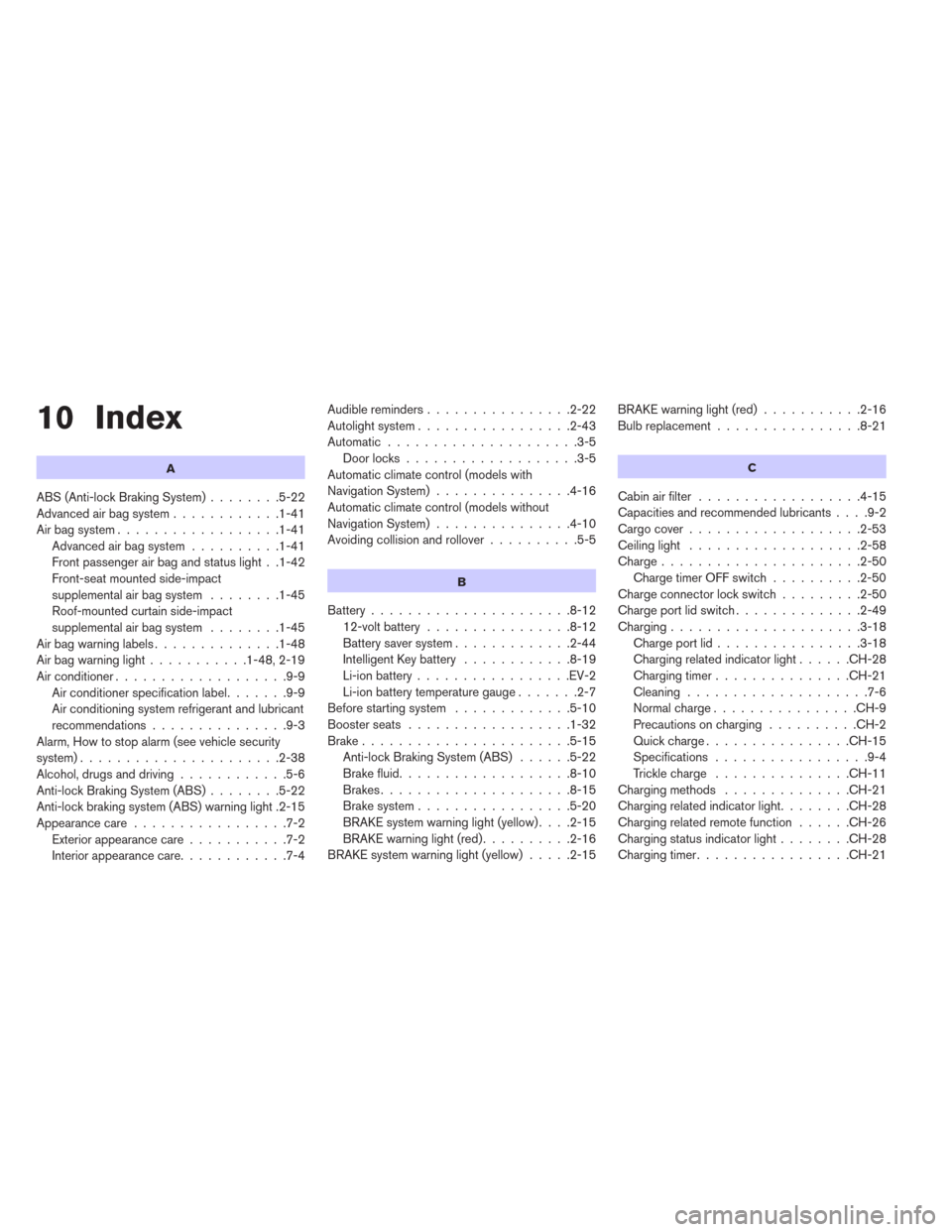
10 Index
A
ABS (Anti-lock Braking System)........5-22
Advanced air bag system............1-41
Air bag system..................1-41
Advanced air bag system..........1-41
Front passenger air bag and status light . .1-42
Front-seat mounted side-impact
supplemental air bag system........1-45
Roof-mounted curtain side-impact
supplemental air bag system........1-45
Airbagwarninglabels..............1-48
Airbagwarninglight...........1-48,2-19
Air conditioner...................9-9
Air conditioner specification label.......9-9
Air conditioning system refrigerant and lubricant
recommendations...............9-3
Alarm, How to stop alarm (see vehicle security
system)......................2-38
Alcohol, drugs and driving............5-6
Anti-lock Braking System (ABS)........5-22
Anti-lock braking system (ABS) warning light .2-15
Appearance care.................7-2
Exterior appearance care...........7-2
Interior appearance care............7-4Audible reminders................2-22
Autolight system.................2-43
Automatic.....................3-5
Door locks...................3-5
Automatic climate control (models with
Navigation System)...............4-16
Automatic climate control (models without
Navigation System)...............4-10
Avoiding collision and rollover..........5-5
B
Battery......................8-12
12-volt battery................8-12
Battery saver system.............2-44
Intelligent Key battery............8-19
Li-ion battery.................EV-2
Li-ion battery temperature gauge.......2-7
Before starting system.............5-10
Boosterseats ..................1-32
Brake.......................5-15
Anti-lock Braking System (ABS)......5-22
Brake fluid...................8-10
Brakes.....................8-15
Brake system.................5-20
BRAKE system warning light (yellow)....2-15
BRAKE warning light (red)..........2-16
BRAKE system warning light (yellow).....2-15BRAKE warning light (red)...........2-16
Bulb replacement................8-21
C
Cabin air filter..................4-15
Capacities and recommended lubricants....9-2
Cargocover...................2-53
Ceiling light...................2-58
Charge......................2-50
ChargetimerOFFswitch..........2-50
Charge connector lock switch.........2-50
Charge port lid switch..............2-49
Charging.....................3-18
Chargeportlid................3-18
Charging related indicator light......CH-28
Chargingtimer...............CH-21
Cleaning....................7-6
Normalcharge................CH-9
Precautions on charging..........CH-2
Quickcharge................CH-15
Specifications.................9-4
Trickle charge...............CH-11
Charging methods..............CH-21
Charging related indicator light........CH-28
Charging related remote function......CH-26
Charging status indicator light........CH-28
Charging timer.................CH-21
Page 390 of 397
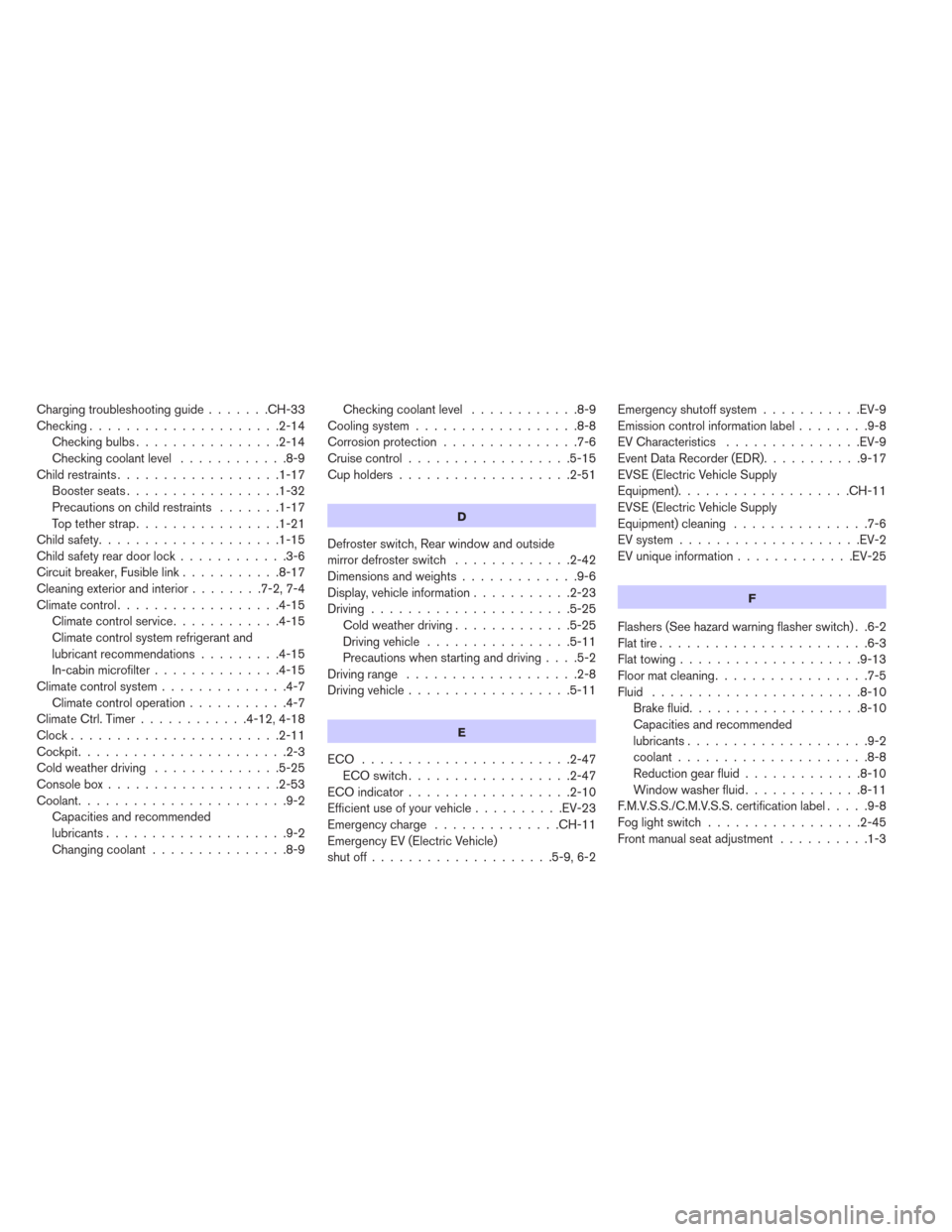
Charging troubleshooting guide.......CH-33
Checking.....................2-14
Checkingbulbs................2-14
Checkingcoolantlevel ............8-9
Child restraints..................1-17
Boosterseats.................1-32
Precautions on child restraints.......1-17
Top tether strap................1-21
Childsafety....................1-15
Child safety rear door lock............3-6
Circuit breaker, Fusible link...........8-17
Cleaning exterior and interior........7-2,7-4
Climatecontrol..................4-15
Climate control service............4-15
Climate control system refrigerant and
lubricant recommendations.........4-15
In-cabin microfilter..............4-15
Climate control system..............4-7
Climate control operation...........4-7
Climate Ctrl. Timer............4-12,4-18
Clock.......................2-11
Cockpit.......................2-3
Cold weather driving..............5-25
Consolebox...................2-53
Coolant.......................9-2
Capacities and recommended
lubricants....................9-2
Changingcoolant...............8-9Checking coolant level............8-9
Cooling system..................8-8
Corrosion protection...............7-6
Cruisecontrol..................5-15
Cupholders...................2-51
D
Defroster switch, Rear window and outside
mirror defroster switch.............2-42
Dimensionsandweights.............9-6
Display, vehicle information...........2-23
Driving......................5-25
Cold weather driving.............5-25
Driving vehicle................5-11
Precautions when starting and driving....5-2
Driving range...................2-8
Driving vehicle..................5-11
E
ECO .......................2-47
ECO switch..................2-47
ECOindicator..................2-10
Efficient use of your vehicle..........EV-23
Emergency charge..............CH-11
Emergency EV (Electric Vehicle)
shutoff....................5-9,6-2Emergency shutoff system...........EV-9
Emission control information label........9-8
EV Characteristics...............EV-9
Event Data Recorder (EDR)...........9-17
EVSE (Electric Vehicle Supply
Equipment)...................CH-11
EVSE (Electric Vehicle Supply
Equipment) cleaning...............7-6
EV system....................EV-2
EV unique information.............EV-25
F
Flashers (See hazard warning flasher switch) . .6-2
Flat tire.......................6-3
Flattowing....................9-13
Floormatcleaning.................7-5
Fluid.......................8-10
Brake fluid...................8-10
Capacities and recommended
lubricants....................9-2
coolant.....................8-8
Reductiongearfluid.............8-10
Window washer fluid.............8-11
F.M.V.S.S./C.M.V.S.S. certification label.....9-8
Foglightswitch.................2-45
Frontmanualseatadjustment ..........1-3
Page 391 of 397
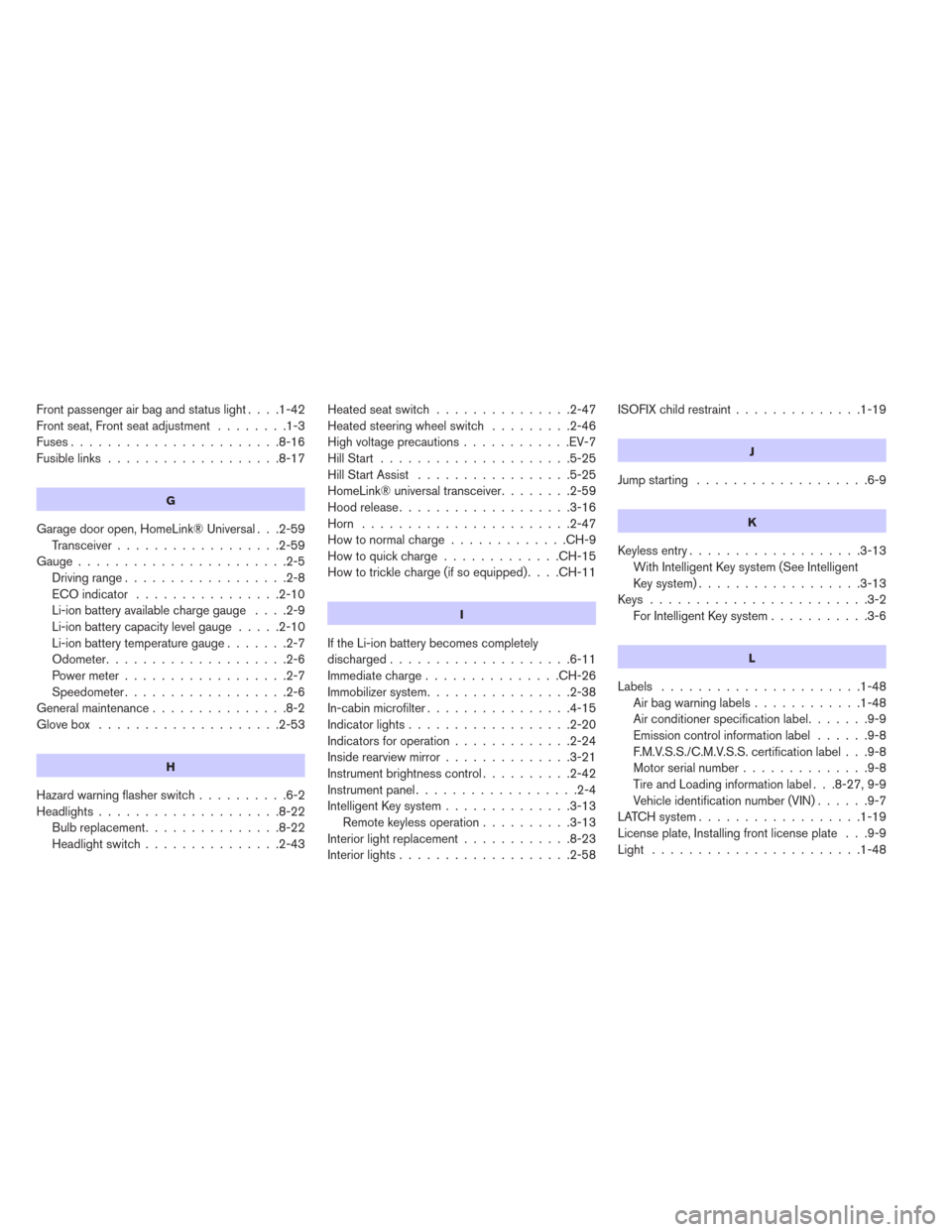
Front passenger air bag and status light....1-42
Front seat, Front seat adjustment........1-3
Fuses.......................8-16
Fusiblelinks ...................8-17
G
Garage door open, HomeLink® Universal . . .2-59
Transceiver..................2-59
Gauge.......................2-5
Driving range..................2-8
ECOindicator ................2-10
Li-ion battery available charge gauge....2-9
Li-ion battery capacity level gauge.....2-10
Li-ion battery temperature gauge.......2-7
Odometer....................2-6
Power meter..................2-7
Speedometer..................2-6
Generalmaintenance...............8-2
Glovebox ....................2-53
H
Hazard warning flasher switch..........6-2
Headlights....................8-22
Bulb replacement...............8-22
Headlightswitch...............2-43Heated seat switch...............2-47
Heated steering wheel switch.........2-46
Highvoltageprecautions............EV-7
HillStart .....................5-25
Hill Start Assist.................5-25
HomeLink® universal transceiver........2-59
Hood release...................3-16
Horn .......................2-47
How to normal charge.............CH-9
How to quick charge.............CH-15
How to trickle charge (if so equipped)....CH-11
I
If the Li-ion battery becomes completely
discharged....................6-11
Immediate charge...............CH-26
Immobilizer system................2-38
In-cabin microfilter................4-15
Indicatorlights..................2-20
Indicators for operation.............2-24
Inside rearview mirror..............3-21
Instrument brightness control..........2-42
Instrument panel..................2-4
Intelligent Key system..............3-13
Remote keyless operation..........3-13
Interior light replacement............8-23
Interior lights...................2-58ISOFIX child restraint..............1-19
J
Jump starting...................6-9
K
Keyless entry...................3-13
With Intelligent Key system (See Intelligent
Key system)..................3-13
Keys ........................3-2
For Intelligent Key system...........3-6
L
Labels ......................1-48
Airbagwarninglabels............1-48
Air conditioner specification label.......9-9
Emission control information label......9-8
F.M.V.S.S./C.M.V.S.S. certification label . . .9-8
Motor serial number..............9-8
Tire and Loading information label . . .8-27, 9-9
Vehicle identification number (VIN)......9-7
LATCH system..................1-19
License plate, Installing front license plate . . .9-9
Light .......................1-48